
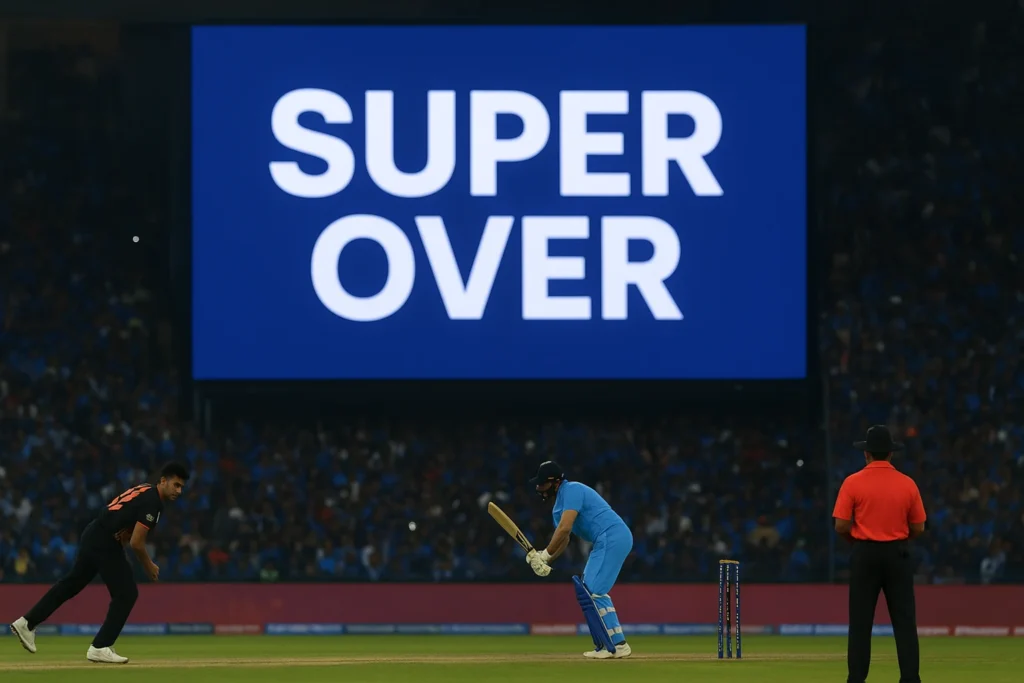
The Super Over is cricket’s ultimate tiebreaker — the moment when tension peaks, crowds roar, and every ball can decide the fate of a match. It’s used in limited-overs formats (ODIs and T20s) when both teams finish with the same score at the end of their innings.
Each team gets one additional over (6 balls) to bat and bowl, and the team scoring more runs in that over wins.
In essence, it’s a mini-match designed to produce a result, not a draw.
🏛️ History and Evolution of the Super Over
Before the Super Over existed, cricket used a bowl-out system, similar to a penalty shootout in football.
Each team’s bowlers delivered one ball at an unguarded wicket — whoever hit the stumps most times won.
However, this method was replaced due to its lack of realism and entertainment.
- 2008: The ICC officially introduced the Super Over in T20 Internationals.
- 2011: The rule extended to ODIs.
- 2019: The rule made global headlines after the World Cup final between England and New Zealand, where the match was decided by the boundary count rule — a decision that later triggered worldwide debate.
After that controversy, the ICC revised the rule:
If the Super Over ends in a tie, it will be repeated until a clear winner emerges.
📜 ICC Super Over Rules Explained
1. Structure of the Super Over
- Each team plays one over (6 legal balls).
- The team batting second in the match bats first in the Super Over.
- Both teams use the same pitch and end for the over.
2. Players and Restrictions
- Each side nominates three batsmen and one bowler.
- The innings ends if two wickets fall.
- The bowler can’t be someone who bowled the last over of the match (to prevent over-fatigue).
3. Field Placements
- The same fielding restrictions apply as in the last over of the innings.
- Fielders can’t be repositioned during the Super Over beyond standard limits.
4. Scoring Rules
- All extras (no-balls, wides, byes, leg byes) count as in regular play.
- If a no-ball is bowled, the next ball is a free hit, even in the Super Over.
- Runs scored off no-balls and wides add to the total.
5. If the Super Over Is Tied
- The match proceeds to another Super Over until a result is achieved.
- In older formats, the team with more boundaries (4s and 6s) across the game won — but that rule was abolished after 2019.
🕒 What Happens After a Super Over
Once both overs are completed:
- If one team scores more, they’re declared the winner.
- If tied, the Super Over is replayed.
- Teams may change their batsmen and bowler in each new Super Over.
🧠 Super Over in Different Formats
| Format | When Used | Overs Allowed | Tie Rule | Notable Example |
|---|---|---|---|---|
| T20 International | After tied match | 1 over | Repeat until result | India vs New Zealand, 2020 |
| ODI (World Cup & knockout) | After tie | 1 over | Repeat if tied | England vs New Zealand, 2019 |
| IPL | After tie | 1 over | Repeat until result | KXIP vs MI, 2020 Double Super Over |
| The Hundred | After tie | 5 balls per bowler | Repeat if tied | Southern Brave vs Trent Rockets |
🧩 Real Match Case Studies
🏆 Case Study 1: 2019 World Cup Final — England vs New Zealand
- Date: July 14, 2019
- Venue: Lord’s, London
- Situation: Match tied at 241 runs each.
- Super Over:
- England batted first — scored 15 runs (Stokes, Buttler).
- New Zealand matched 15 runs (Neesham, Guptill).
- Result: England declared winners due to boundary count rule — 26 boundaries vs 17.
- Aftermath: ICC faced global criticism and scrapped the boundary rule in October 2019.
🔥 Case Study 2: IPL 2020 — Mumbai Indians vs Kings XI Punjab (Double Super Over)
- Date: October 18, 2020
- Venue: Dubai International Stadium
- Event: First-ever Double Super Over in IPL history.
- Both teams scored 5 runs each in the first Super Over.
- Second Super Over: Punjab scored 11; Mumbai managed only 7.
- KXIP won — a thrilling spectacle and proof of cricket’s unpredictability.
💥 Case Study 3: India vs New Zealand (T20I Series, 2020)
- Date: January 29, 2020
- Venue: Hamilton
- India scored: 179
- New Zealand: 179
- Super Over: Rohit Sharma smashed back-to-back sixes to clinch victory.
- Significance: India’s first Super Over win in T20 Internationals.
⚖️ Controversies and Rule Changes
| Year | Issue | Change |
|---|---|---|
| 2019 | Boundary count rule controversy | Repealed by ICC |
| 2020 | Confusion in player nomination between Super Overs | Teams must re-nominate players before each over |
| 2022 | Delay in Super Over setup | ICC allowed 10-minute interval for preparation |
🧩 Tactical Insights: The Art of the Super Over
Captains must make instant, high-stakes decisions:
- Bowler selection: Usually a pacer with yorker accuracy (e.g., Bumrah, Boult).
- Batting order: Power-hitters or calm finishers (Buttler, Pollard, Stoinis).
- Field setup: Defensive yet smart — cut singles, allow risky shots.
Even a small misfield or wide can change everything in this 6-ball shootout.
🏏 Recent Updates (2025)
- ICC clarified that rain-affected matches can use Super Overs if minimum overs completed.
- Technology-assisted reviews (DRS) remain active in Super Overs.
- Leagues now mandate a Super Over training plan before tournaments for fairness.
🕰️ Historical Note: Fastest and Longest Super Overs
- Fastest completed Super Over: 4 minutes, West Indies vs New Zealand (2012).
- Longest (with interruptions): 24 minutes, IPL 2020 KXIP vs MI.
- Most runs in a Super Over: 26 by West Indies vs New Zealand (2012).
- Most wickets in a Super Over: 2 (maximum allowed).
❓ Frequently Asked Questions (FAQs)
Q1: What happens if the Super Over is also tied?
A new Super Over is played until one team wins.
Q2: How many players can bat in a Super Over?
Only three — the innings ends after two wickets.
Q3: Can a bowler who finished the last over bowl the Super Over?
No. A different bowler must bowl the Super Over.
Q4: What happens if a bowler is injured during the Super Over?
Another bowler from the playing XI must complete it; the over doesn’t restart.
Q5: What are extras allowed in Super Over?
All standard extras — wides, no-balls, byes, and leg byes.
Q6: Which team bats first in a Super Over?
The team that batted second in the main innings bats first in the Super Over.
🏁 Conclusion
The Super Over symbolizes modern cricket’s thrill — one over, six balls, endless emotions.
It has evolved from a tie-break tool to a strategic battle, where nerve, skill, and precision define victory.
With every Super Over, cricket reminds us that in this sport, it’s never over until the last ball is bowled.

Liam Thompson is a cricket regulations analyst who covers international and league-level rules in depth. He focuses on fielding laws, over-rate penalties, powerplay strategies, and updated ICC guidelines. Liam’s goal is to educate readers while keeping the excitement of the game alive.