
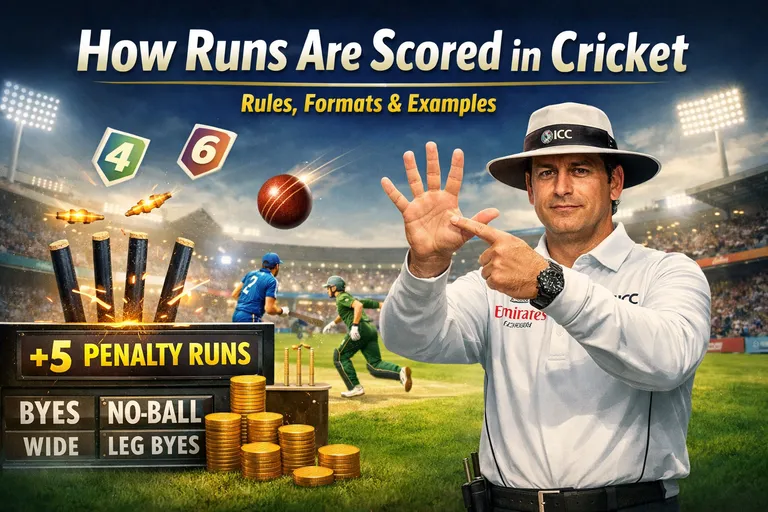
Cricket scoring looks simple at first: hit the ball, run, and add runs. But the full answer is bigger than that. In cricket, runs can come from running between the wickets, boundaries, byes, leg byes, no-balls, wides, overthrows, and penalty runs. The MCC Laws say the score is reckoned by runs, and a run is scored when batters cross and make good their ground while the ball is in play, when a boundary is scored, or when penalty runs are awarded.
This is why queries like how are runs scored in cricket, what is a run in cricket, scoring runs in cricket, and cricket run scoring rules all need one full answer, not just one line. If you understand the basic run, the extras, and the rare penalty situations, you can understand almost every scoreboard, every chase, and every strange umpire call in the game.
What is a run in cricket?
A run is the basic unit of scoring in cricket. Under Law 18, a run is scored when the two batters cross and safely make their ground from end to end while the ball is still in play. The same law also says runs can be scored through boundaries and penalty runs. So, in simple words, a cricket score is measured in runs, while the match situation is usually shown as runs, wickets, and overs.
If someone asks what are runs in cricket or how do runs work in cricket, the easiest answer is this: runs are the points a team scores to build its total and beat the other side. The team with more runs at the right point in the match wins, unless the format ends in a draw or tie.
How to score a run in cricket
The most common way to score is by running between the wickets. After the batter hits the ball, both batters run to the opposite end. If both safely make their ground once, that is 1 run. If they do it twice, it is 2 runs. If they do it three times, it is 3 runs. The law does not say batters are limited to only one or two runs by running; it simply says a run is scored each time they cross and make good their ground while the ball remains live.
That also answers another common search: in the cricket rule batsman can how much run for single ball in running. There is no special law that says “only three.” If the ball stays in play long enough, batters can run four, and in rare cases even five or more. In real cricket, five runs by running are unusual, but they are legal.
Main Ways Runs Are Scored in Cricket
The summary below is based on the MCC Laws covering scoring runs, boundaries, no-balls, wides, and byes/leg byes.
| Type of Run | How It Is Scored | Credited To Batter? | Law |
|---|---|---|---|
| Bat runs | Batter hits the ball and the batters complete runs | Yes | Law 18 |
| Four | Ball reaches boundary after touching ground | Yes | Law 19 |
| Six | Ball clears boundary without touching ground | Yes | Law 19 |
| Bye | Batter misses the ball and batters run | No | Law 23 |
| Leg bye | Ball hits batter’s body and legal conditions are met | No | Law 23 |
| No-ball extra | Bowler delivers an illegal ball | No | Law 21 |
| Wide extra | Ball is too wide to be fairly reached | No | Law 22 |
| Overthrow runs | Fielding error allows extra runs | Depends on contact and scoring situation | Laws 18 and 19 |
| Penalty runs | Umpire awards runs for a law breach | No | Multiple laws |
Boundaries: four and six
A boundary is the fastest way to score. Under Law 19, a four is scored when the ball reaches or crosses the boundary after touching the ground first. A six is scored when the ball clears the boundary without first touching the ground. These values stay the same across standard cricket formats, so there is no special T20 boundary vs ODI boundary scoring difference. A four is still four, and a six is still six.
A famous example is MS Dhoni’s winning six in the 2011 World Cup final. It is remembered not only as a great shot, but as the perfect example of how one boundary can finish a chase immediately.
Byes and leg byes
Not every run comes from the bat. If the ball passes the striker without touching bat or body, and the batters run, those runs are byes. Law 23.1 says they are credited to the batting side, not to the batter.
If the ball hits the batter’s body and the umpire is satisfied that the batter either tried to play the ball or tried to avoid being hit, then any runs are leg byes. If neither of those conditions is met, leg byes are not awarded. This is one of the most misunderstood scoring rules in cricket.
No-ball runs and wide-ball runs
A no-ball gives the batting side one extra run instantly, and that run stands even if a wicket falls. Any additional runs scored are added on top. Under MCC Law 21, a no-ball does not count as one of the over, and batters cannot be out from it except in the special cases of run out, obstructing the field, or hit the ball twice.
A wide also gives the batting side one extra run instantly, and if the ball gets away, the batters can add more. Law 22 says all runs completed from a wide, plus any boundary allowance, are scored as wides. A wide also does not count as one of the over.
Extras in Cricket Explained
This table focuses on the main extras that increase the team total without being added to the batter’s personal score.
| Extra Type | What It Means | Counts in Team Score? | Counts to Batter? | Counts in Over? |
|---|---|---|---|---|
| Bye | Ball misses bat and body, and batters run | Yes | No | Yes |
| Leg bye | Ball hits body and legal leg-bye conditions are met | Yes | No | Yes |
| No-ball | Illegal delivery by bowler | Yes | No | No |
| Wide | Ball out of normal reach of batter | Yes | No | No |
| Penalty runs | Extra runs awarded by umpire for offence | Yes | No | Not a valid ball issue |
For international white-ball cricket, current ICC ODI and T20 playing conditions add another big rule: the ball after a no-ball is a free hit. On that free hit, the striker can only be dismissed in the same limited ways that apply to a no-ball. So if a free-hit ball hits the stumps, the batter is not out, and the ball can still remain live for runs.
Overthrows and unusual scoring
Cricket gets really interesting when fielding mistakes add extra runs. Law 19.8 says that if a boundary results from an overthrow or a fielder’s wilful act, the batting side gets the boundary allowance plus the runs already completed, and also the run in progress if the batters had already crossed when the throw happened.
The most famous example is the Ben Stokes overthrow in the 2019 World Cup final. England were awarded six runs on the field, but later elite umpire Simon Taufel said the umpires had made an error of judgment and that the correct award should have been five. So this is a great case study for cricket scoring, but it should be taught as a famous controversial overthrow case, not as a perfect clean example of the law.
Penalty runs in cricket
Penalty runs are one of the rarest but most important scoring methods. The key correction here is that penalty runs are not covered by one single “Penalty Runs law.” Law 18.6 says penalty runs can come from several laws, including No ball, Wide, player returning without permission, illegal movement by the wicketkeeper, illegal fielding, helmets on the ground, unfair play, and players’ conduct.
This means searches like penalty runs in cricket, what is penalty runs in cricket, 5 run rule in cricket, and penalty run in cricket should be answered through examples, not just one sentence. Here are the most important real ones:
Pakistan were penalised five runs against West Indies in Multan in 2022 when Babar Azam fielded the ball while wearing one of the wicketkeeper’s gloves. That was illegal fielding and West Indies were awarded five penalty runs.
South Africa were awarded five penalty runs against Bangladesh in the 2022 T20 World Cup because Bangladesh wicketkeeper Nurul Hasan made unfair movement before the striker received the ball.
Sri Lanka were penalised five runs against England in 2018 after Roshen Silva was judged to have deliberately run short, which gave England five penalty runs as the fielding side.
The famous ball-tampering penalty example is Pakistan vs South Africa in Dubai in 2013, when South Africa were penalised five runs after Faf du Plessis was found guilty of ball tampering. By contrast, in the 2018 Cape Town sandpaper scandal, South Africa were not awarded five penalty runs because the umpires did not believe the ball’s condition had actually been changed.
A classic helmet example came in the 2018 Ashes at Sydney, when England received five penalty runs after the ball hit the spare helmet behind the wicketkeeper. A newer similar example came in Bangladesh A vs New Zealand A in 2025, where a badly managed spare helmet again cost the fielding side five runs.
Can 5 runs be scored by running? Can 8 runs happen in cricket?
Yes. A team can score 5 runs by running if the ball stays in play long enough. The Laws define a run by the act of crossing and making ground, not by a fixed small cap like “maximum three.” In practice, five all-run is rare, but legal.
Yes, 8 runs in cricket are also possible from one ball. For example, a team can combine completed runs with overthrows, or add extras and boundary allowances, and the total from one delivery can go above six. That is why six is the maximum from a clean hit over the boundary, but not always the maximum total outcome from one ball.
How cricket run counting works on a scoreboard
Cricket scoreboards usually show the team score as runs/wickets. So 150/4 means 150 runs scored and 4 wickets lost. The over count shows how many overs and balls have been bowled. One over contains 6 valid balls.
If you see something like “scored 20 runs off 19 balls, including 1 six and 2 fours,” it means the batter made 20 total runs from 19 deliveries. Of those 20 runs, 14 came in boundaries because 1 six plus 2 fours equals 14. The other 6 runs came from singles, twos, or threes. That is one of the easiest ways to read an individual batting score.
How many innings are there in cricket?
The Laws say a match can be one innings or two innings per side, depending on what was agreed before the match. In practice, Tests are played as two innings each, while ODIs and T20Is are one innings each side. ICC’s format guide says ODIs are 50 overs per side and T20Is are 20 overs per side.
So if a user searches how many innings in cricket or in ODI format, the easy answer is:
- Test cricket: 2 innings per team
- ODI cricket: 1 innings per team, 50 overs
- T20 cricket: 1 innings per team, 20 overs
Runs and Scoring by Format
This table gives a simple format-wise view for readers searching things like in ODI format, how many innings in cricket, and what is an over.
| Format | Innings Per Team | Overs Per Innings | Free Hit After No-Ball? | Common Scoring Style |
|---|---|---|---|---|
| Test | 2 | No fixed over limit | No | Patience, rotation, long partnerships |
| ODI | 1 | 50 | Yes | Mix of singles, doubles, boundaries |
| T20 | 1 | 20 | Yes | Fast scoring, big hitting, quick running |
In cricket, what is an over?
An over is a set of 6 valid balls bowled from one end. No-balls and wides do not count as valid balls of the over, so the bowler has to bowl extra deliveries until six valid balls are completed.
Cricket runner batsman rules
This is an important update because many readers are confused here. Under the MCC Laws, a runner can still be allowed in limited circumstances if the umpires are satisfied there is an injury during the match or another wholly acceptable reason. But in current ICC international playing conditions, runners are not permitted. So for modern international cricket, the practical answer is simple: no runner.
How long is a run in cricket?
A completed run means the batters have changed ends and made good their ground. The pitch is 22 yards (20.12 metres) long, so that is the basic distance between the wickets. In simple teaching language, people often say a run is “22 yards,” though technically the law defines the run by making ground from end to end while the ball is in play.
Quick Answers to Confusing Run Questions
This table is useful for featured snippets and fast-answer readers.
| Question | Short Answer |
|---|---|
| Can 5 runs be scored by running? | Yes, if the ball stays in play long enough |
| Is 8 runs possible on one ball? | Yes, with overthrows or extras |
| Does a no-ball count in the over? | No |
| Does a wide count in the over? | No |
| Are byes given to the batter? | No |
| Are leg byes given to the batter? | No |
| Can a free-hit ball still produce runs after hitting the stumps? | Yes, in white-ball cricket the ball can remain live for runs |
| Is a six the maximum possible total from one ball? | No, only the maximum boundary value from the bat |
Final answer
So, how are runs scored in cricket? Runs are scored by running between the wickets, hitting fours and sixes, collecting byes and leg byes, receiving no-ball and wide extras, taking advantage of overthrows, and in some rare cases receiving penalty runs. The main scoring laws are Law 18 for runs, Law 19 for boundaries, Law 21 for no-balls, Law 22 for wides, and Law 23 for byes and leg byes. Penalty runs can come from several other laws as well.
That is why cricket scoring is both simple and deep. At one level, it is just “score more runs than the other team.” At a deeper level, every run has a rule behind it, and sometimes one strange extra, overthrow, or penalty can change a whole match.
FAQs
1. What is a run in cricket?
A run is the basic unit of scoring in cricket. A team scores a run when the two batters safely change ends while the ball is in play, or when runs come through boundaries, extras, or penalty runs.
2. How are runs scored in cricket?
Runs are scored in cricket through running between the wickets, hitting fours and sixes, byes, leg byes, no-balls, wides, overthrows, and penalty runs. These scoring methods are mainly covered in Laws 18 to 23, with some penalty runs coming from other laws as well.
3. What are the main types of runs in cricket?
The main types of runs in cricket are bat runs, boundary runs, byes, leg byes, no-ball extras, wide extras, overthrow runs, and penalty runs. Some are credited to the batter, while others are counted as extras.
4. Are byes and leg byes given to the batter?
No. Byes and leg byes are added to the team total, but they are not credited to the batter. Leg byes are only allowed when the batter tried to play the ball or tried to avoid being hit.
5. What is the difference between a four and a six in cricket?
A four is scored when the ball reaches the boundary after touching the ground first. A six is scored when the ball clears the boundary without touching the ground.
6. Do wides and no-balls count as runs in cricket?
Yes. A no-ball gives the batting side one extra run, and a wide also gives one extra run. Both can also produce additional runs if the ball gets away from the fielders.
7. Do wides and no-balls count as balls in the over?
No. A wide does not count as one of the six valid balls in the over, and a no-ball also does not count as a valid ball.
8. Can 5 runs be scored by running in cricket?
Yes. The laws do not set a fixed cap like “maximum three runs by running.” If the ball stays in play long enough and the batters keep completing runs safely, five runs by running are possible, although rare.
9. Is 8 runs possible on one ball in cricket?
Yes. While a batter can score only four or six directly from a boundary shot, the total outcome from one ball can be more than six if there are overthrows, extras, or other runs added while the ball remains in play.
10. What are penalty runs in cricket?
Penalty runs are extra runs awarded by the umpire because one side broke a law. They can be given to either the batting side or the fielding side depending on the offence.
11. How many innings are there in cricket?
At the international level, Test cricket is played with two innings per side, while ODIs and T20Is are played with one innings per side.
12. What is an over in cricket?
An over is a set of six valid balls bowled from one end. Wides and no-balls do not count as valid balls, so extra deliveries must be bowled until six valid balls are completed.
13. What happens on a free hit if the ball hits the stumps?
In ICC white-ball cricket, the ball after a no-ball is a free hit. On a free hit, the striker can only be out in the same ways as on a no-ball, so being bowled is not a normal dismissal there, and the ball can still remain live for runs.
14. How long is a run in cricket?
The pitch in cricket is 22 yards long, so a completed run means the batters have changed ends across that distance and made good their ground.
