
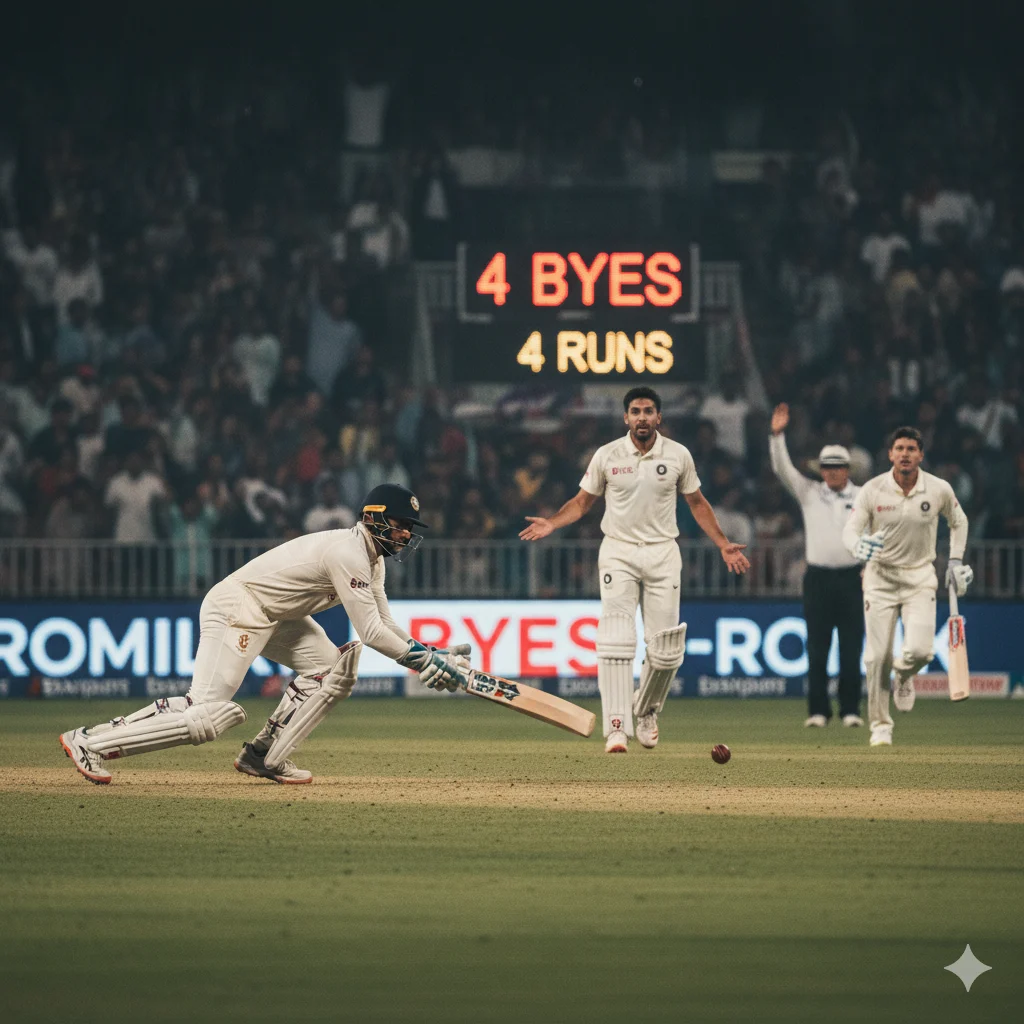
Cricket’s scoring system isn’t just about runs from the bat — it’s also about extras. Extras are runs awarded to the batting team due to mistakes or illegal deliveries by the fielding side. They often decide close matches, influence strategies, and reveal a team’s discipline level.
In this guide, you’ll learn what extras are, how each type works, penalties involved, modern rule changes (2026), and real match scenarios that shaped the laws we follow today.
What Are Extras in Cricket?
Extras are runs for the batting team, but they are not usually given to the batter as personal runs. They happen when the fielding side makes an error, the bowler delivers an illegal ball, or a special law applies. The four main extras are:
- byes
- leg byes
- no balls
- wides
There are also penalty runs in some rare cases.
Why Extras Matter So Much
Extras do three big things.
First, they increase the team total.
Second, some of them make the bowler bowl again, so the batting side gets one more chance.
Third, they show whether a team is calm and disciplined or careless under pressure. A wide in the last over, or a no ball at the wrong time, can hurt badly because the batting side gets a run and another ball.
1. Byes in Cricket
Definition
A bye happens when the bowler delivers the ball, the ball is not a wide, and it goes past the striker without touching the bat or the body. If the batters run, or the ball reaches the boundary, those runs are scored as byes.
Example:
If the wicketkeeper misses the ball and the batsmen run two, it’s recorded as 2 byes.
Scoring
- Runs go to the team total, not the batsman.
- Recorded separately in the scorebook as “B”.
Common Scenarios
- The keeper misjudges swing or bounce.
- A bowler delivers a slower ball, and it beats everyone.
Important Bye Note
A bye cannot come from a delivery that is already called a wide. But a bye can happen on a no ball. In that case, the batting side gets the one-run no-ball penalty, and then any extra running is added as byes.
Real Match Example
During the 2019 Ashes, England gained crucial byes when Australia’s wicketkeeper missed a wide outswinger. Those runs changed the match momentum.
Fielding Penalty Impact
High bye counts often show poor wicketkeeping or erratic bowling control — key metrics in professional analysis.
Also Read More About: Rules of Replacing the Ball in Cricket (T20, ODI & Test)
2. Leg Byes in Cricket
What Is a Leg Bye?
A leg bye happens when the ball hits the batter’s body instead of the bat, and the batters take runs. But there is an important condition.
The umpire allows leg byes only if the striker:
- tried to play the ball, or
- tried to avoid being hit.
Simple Example
The bowler delivers the ball.
The batter tries to defend.
The ball hits the pad and rolls away.
The batters run 1.
That is 1 leg bye.
When Leg Byes Are Not Allowed
If the umpire believes the batter did not try to play the ball and did not try to move away from it, then leg byes are not awarded. In that case, those attempted runs do not count as leg byes.
Easy Rule to Remember
If the ball hits the body and the batter made a real effort, think leg bye.
If there was no real effort, the umpire can say no leg bye.
Important Leg Bye Note
Just like byes, a leg bye can also happen on a no ball. The team still gets the one-run no-ball penalty, and the rest is scored as leg byes if the law allows it.
Case Study:
In the 2015 World Cup, a leg bye in the final over of a tense match between South Africa and New Zealand helped decide the winner — showing how one deflection can change everything.
Penalty or Misuse
If the umpire judges no attempt to play or avoid, no run is counted even if the batsmen run successfully.
Also Read More About: Cricket Ground Dimensions: Boundary Size, Pitch Length & ICC Rules
3. No Balls in Cricket
What Is a No Ball?
A no ball is an illegal delivery. As soon as no ball is called, the batting side gets 1 run. That run stands unless the call is revoked. The ball also does not count as one of the six valid balls in the over.
Common Reasons for a No Ball
A no ball can happen for different reasons, such as:
- the bowler’s front foot goes too far over the front line
- the ball bounces more than once or rolls
- the ball lands off the pitch
- the ball is thrown instead of bowled fairly
- a fielder illegally stops the delivery
- some other law about the delivery or fielding position is broken
Simple Example
The bowler oversteps the front line.
The umpire calls no ball.
The batting side gets 1 run right away.
The bowler must bowl again because it was not a valid ball.
What Happens If the Batter Hits a No Ball?
If the striker hits a no ball with the bat and runs, those runs go to the striker, and the batting side also keeps the one-run no-ball extra. If the ball is not hit by the bat, then extra runs after the no ball can be scored as byes or leg byes, depending on what happened.
Does a No Ball Count in the Over?
No. A no ball is not one of the six valid balls. That is why no balls can make an over longer and more stressful for the fielding side.
Free Hit Rule
In ICC ODI and T20 international playing conditions, the ball after a no ball is a free hit. If that free-hit ball is also not legal, such as another no ball or a wide, the next ball becomes a free hit too.
Also Read More About: Cricket Helmet Rules for Fielders and Wicketkeepers: Full Detailed Guide
Can a Batter Get Out on a No Ball?
Yes, but only in a few ways.
On a no ball, the batter is not out in the normal ways like bowled, caught, LBW, or stumped. But a batter can still be out:
- run out
- obstructing the field
- hit the ball twice
That is why a no ball is a big relief for the batter.
Common Reasons for No Balls
| Type | Description | Penalty |
|---|---|---|
| Overstepping | Bowler’s front foot crosses the popping crease | 1 run + free hit |
| Height (Beamer) | Ball passes above waist height without bouncing | Warning or ban |
| Full toss | Dangerous above waist level delivery | No ball + warning |
| Fielding Violation | More than two fielders outside circle (T20) | No ball |
| Throwing | Illegal bowling action | No ball |
Additional Rules (2025 Updates)
- Any field change during the bowler’s run-up results in a no ball.
- Repeated beamers = suspension of bowler.
- No balls now count as free hits in Tests and ODIs (experimental) — under ICC trial programs.
Case Study
In 2017 Champions Trophy, Jasprit Bumrah’s no ball dismissed Fakhar Zaman — who went on to score a match-winning century. That moment redefined discipline standards in bowling.
Also Read More About: Five Penalty Runs in Cricket (2026): Full Rule Explained with Real Match Stories
4. Wide Balls in Cricket
What Is a Wide?
A wide is a ball that is too far away for the striker to hit with a normal cricket shot. A wide is called only if the ball is not already a no ball.
Simple Example
The bowler sends the ball far outside off stump.
The batter cannot reach it with a normal stroke.
The umpire stretches both arms and calls wide.
The batting side gets 1 run, and the bowler must bowl again.
Does Batter Movement Matter?
Yes. If the batter moves and that movement causes the ball to pass wide, the umpire may not call wide. So the umpire judges the ball using the striker’s reach and position under the law, not only the original starting spot.
Does a Wide Count in the Over?
No. A wide is not one of the six valid balls. It adds 1 run and must be bowled again.
Can a Wide and a No Ball Happen Together?
The final scoring does not keep both. If a delivery is called a no ball, that call overrides the wide call.
Can a Batter Get Out on a Wide?
Yes, but only in some ways. On a wide, the batter can still be out:
- hit wicket
- obstructing the field
- run out
- stumped
That is why a wide is safe in one way, but not fully safe in every way.
⚖️ In Simple Terms:
| Batsman Movement | Ball Follows the Movement | Wide Decision |
|---|---|---|
| Moves early (before release) | Bowler adjusts line | Not Wide |
| Moves early | Bowler doesn’t adjust | Can be Wide |
| Moves late (after release) | Ball already outside reach | Wide |
| Moves across stumps (switch hit) | Ball still within reach | Not Wide |
💡 Example Scenarios
- Switch Hit Example:
If a right-handed batter switches to left-handed before the ball is released, the umpire judges the ball’s line relative to the new stance.- If the ball passes within reach of the new stance, it’s not a wide.
- If it’s outside reach even after switching, it’s a wide ball.
- Shuffle to Leg Side:
If a batsman steps toward the leg side to make room and the bowler follows them with a wider delivery — the umpire considers that fair adjustment, and no wide is called. - Late Movement After Release:
If the batsman moves after the ball is already delivered and misses it, the ball’s original line (at release) is judged — if it was outside the guideline, it’s a wide.
🧭 2026 ICC Clarification Update
In 2025, the ICC released a clarification for umpires to maintain consistency:
“If a batsman’s movement significantly changes their original stance before release, the wide line should be recalculated in proportion to the new position, ensuring fairness to both bowler and batsman.”
This clarification prevents batsmen from manipulating the wide line unfairly and helps bowlers adjust legally in fast-paced T20s.
⚙️ Case Study: Glenn Maxwell (Switch Hit, 2022 T20 World Cup)
Glenn Maxwell often switched stance mid-delivery. In one instance, the ball passed wide of his new stance, and the umpire did not call it wide, since it was within reach of his new guard.
This moment reignited debate on how far a batsman can move before it’s considered unfair.
🧾 Penalty and Fair Play Note
If a batsman deliberately moves late to deceive or distract the bowler, the umpire can invoke Law 41 (Unfair Play) and warn or penalize the batting side.
🎯 Expert Summary
- Wide is judged based on batsman’s position at the bowler’s release, not earlier stance.
- Bowler gets fair adjustment room if batsman moves early.
- Modern wide laws now balance fairness and adaptability for both sides.
- Umpires use Hawk-Eye vision line technology to assist in tight calls.
Key Rules
- The ball must be outside the batsman’s reach on either side.
- The umpire signals a wide by stretching both arms horizontally.
- Each wide adds one run to the batting team, and the delivery must be re-bowled.
Situations Leading to Wides
- Overly defensive bowling tactics.
- Pitch movement causing swing beyond the guideline.
- Bowler losing grip or control.
Strategic Impact
- Wides extend overs and add pressure.
- In T20s, one wide can shift match dynamics during tight chases.
Case Study
In the 2022 IPL, a last-over wide call stirred controversy — showing how subjective interpretation can decide high-stakes matches.
5. Penalty Runs (Bonus Section)
What Are Penalty Runs?
Penalty runs are special runs awarded when a team breaks certain laws. These are not common, but they are real and important.
Some examples include:
- the ball hits a helmet wrongly placed on the ground by the fielding side
- a fielder makes an illegal movement
- a fielder deliberately distracts, deceives, or obstructs a batter
- other unfair-play situations under the laws
Easy Example
A helmet from the fielding side is left on the ground in the wrong place.
The ball hits that helmet while it is in play.
The umpire can award 5 penalty runs to the batting side.
Important Penalty Runs Note
Penalty runs can be added in addition to other runs in many situations. They are part of why cricket laws care so much about fairness and discipline.
Apart from the four main extras, penalty runs are awarded in certain rare cases:
| Situation | Penalty Runs Awarded | Example |
|---|---|---|
| Ball hits fielder’s helmet | 5 runs | Helmet placed behind keeper |
| Obstruction of field | 5 runs | Deliberate interference |
| Repeated fielding offenses | 5 runs | Distracting batsman |
| Unfair movement | 5 runs | Fielder moves after delivery |
These penalties highlight the spirit of cricket — fairness, discipline, and sportsmanship.
Who Gets the Runs?
This part confuses many readers, so let’s make it very simple.
- Byes go to the team total, not to the batter.
- Leg byes go to the team total, not to the batter.
- No-ball penalty run is an extra run for the team.
- Wide penalty run is an extra run for the team.
- If a no ball is hit with the bat, the shot runs go to the striker, while the no-ball penalty still stays an extra.
Modern Trends and Technology in Extras (2025)
- Hawk-Eye & Smart Ball – Tracks line and height for no-ball & wide decisions in real time.
- Third Umpire Automation – Foot-fault no balls auto-detected.
- AI Data Analytics – Coaches now measure “extra run percentage” to evaluate discipline.
- Dynamic Field Restrictions – Adjusted to prevent fielding-related no balls.
Conclusion
Extras may seem small, but in modern cricket, they define victory margins. Every bye, leg bye, no ball, and wide reflects discipline, focus, and precision. Teams with fewer extras often dominate tournaments, proving that cricket isn’t just a batsman’s game — it’s a contest of control versus chaos.
Mastering extras is mastering modern cricket.
FAQs on Extras in Cricket
Do extras count in a batter’s personal score?
Usually, no. Byes, leg byes, wides, and the one-run no-ball penalty go to the team total as extras. But if the striker hits a no ball with the bat, the shot runs go to the striker, and the no-ball penalty stays as an extra.
Can there be byes on a no ball?
Yes. The batting side first gets the one-run no-ball penalty. If the ball was not hit by the bat and the batters run, the rest can be scored as byes or leg byes.
Can a wide and a no ball both stay on the scorecard for the same delivery?
No. If no ball is called, it overrides the wide call.
Does a no ball count as one of the six balls in the over?
No. A no ball does not count as a valid ball in the over.
Does a wide count as one of the six balls in the over?
No. A wide also does not count as a valid ball in the over.
Can a batter be out on a no ball?
Yes, but only in limited ways. The batter can still be run out, obstructing the field, or hit the ball twice.
Can a batter be stumped on a wide?
Yes. A batter can be stumped on a wide.
What is the easiest way to remember byes and leg byes?
Think of it like this:
- Bye = ball missed everything
- Leg bye = ball hit the body, and the batter made a real effort
Are penalty runs part of extras?
Yes. Penalty runs are also part of the extra runs system under the laws
