
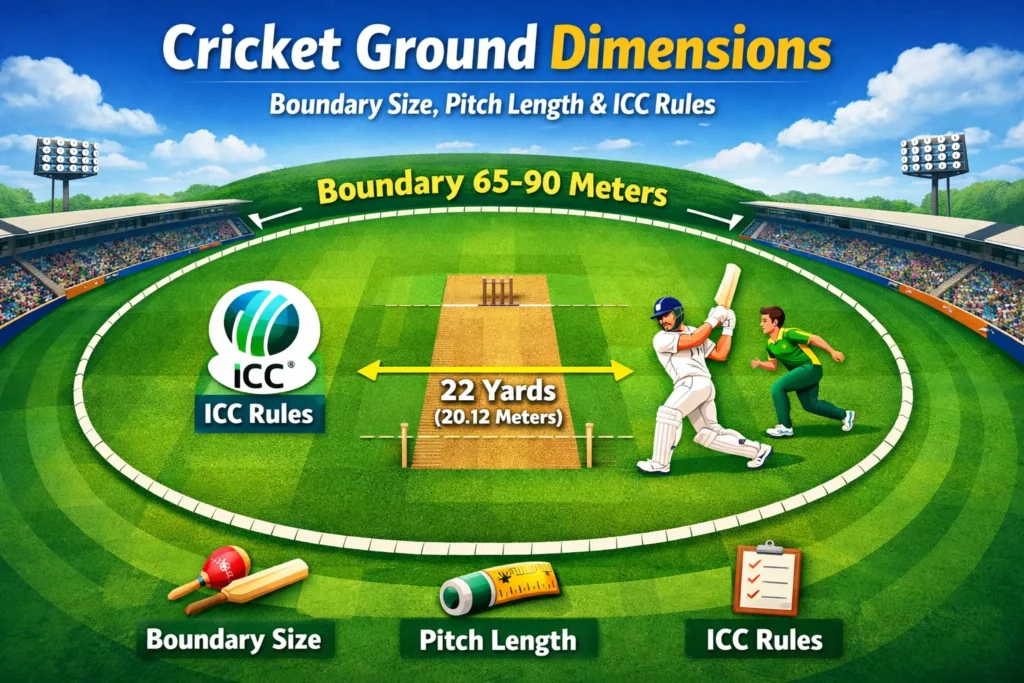
Cricket is a very popular sport played all around the world. When you watch a cricket match, you see players running, hitting the ball, and fielders chasing it. But many people do not know that a cricket ground also has special sizes and rules that must be followed.
The cricket boundary length is the distance from the center of the cricket pitch to the boundary rope around the field. In international cricket, the boundary is usually between 65 meters and 90 meters (about 213–295 feet) from the center of the pitch.
A boundary in cricket is the line or rope around the edge of the playing field. When the ball reaches or crosses this line, the batting team automatically scores four runs (if the ball bounced) or six runs (if the ball flew over without touching the ground) — according to the rules of the International Cricket Council.
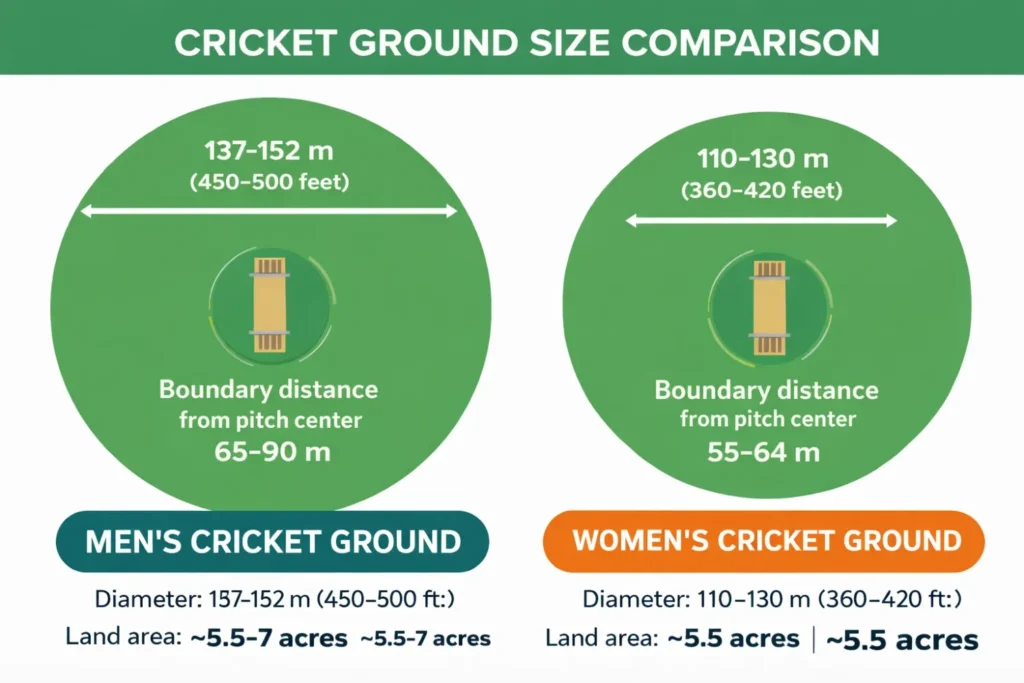
The ICC recommends that the boundary should not be smaller than about 65 meters and should usually stay within 90 meters for professional matches. This range helps keep the game fair for both batters and bowlers.
In the middle of the ground, there is a narrow strip of land called the cricket pitch. This is where the bowler bowls the ball and the batter tries to hit it. The pitch has a fixed length of 22 yards (about 20.12 meters or 66 feet) from one wicket to the other.
These sizes and measurements are guided by rules from the International Cricket Council (ICC). These rules help make the game fair so that teams can play under similar conditions in different stadiums.
In this complete guide, you will learn the cricket ground measurements — including boundary size, international cricket pitch length, ICC rules, the biggest cricket grounds in the world and India, and a full cricket ground diagram breakdown — all explained in very easy, simple language.
Also Read More About: Cricket Grounds in Sri Lanka: Stadiums, Stats, Dimensions & Records
Who Sets Cricket Ground Dimensions?
The rules are decided by the International Cricket Council (ICC).
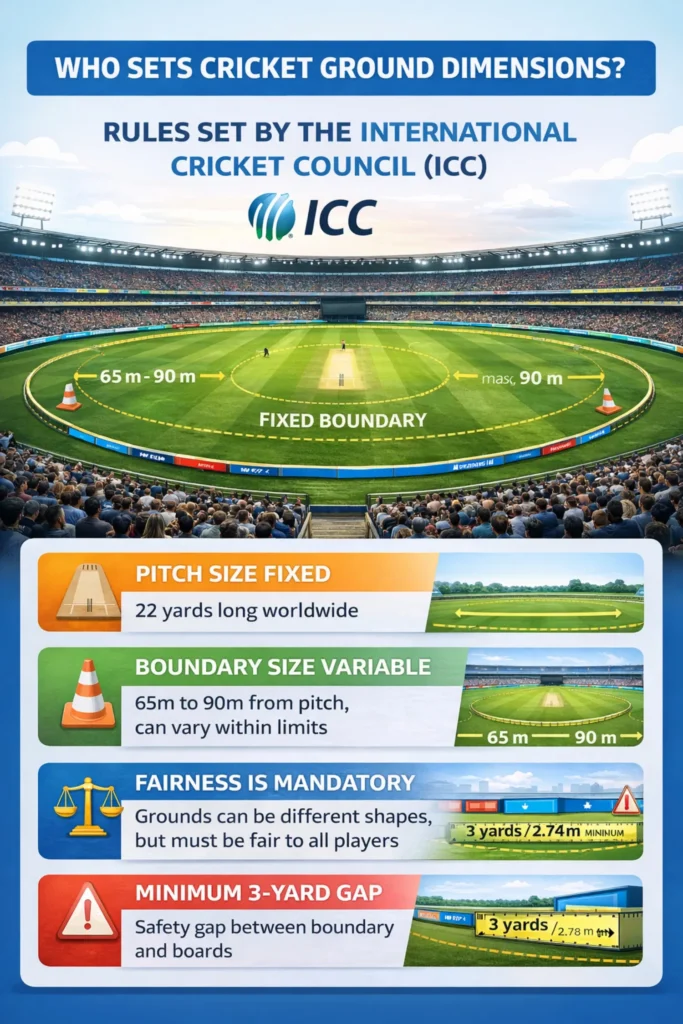
According to ICC Playing Conditions:
- Pitch size is fixed — same everywhere in the world
- Boundary size has minimum and maximum limits — but baddies hub can vary within those limits
- Grounds may vary in shape, but fairness is mandatory
- A minimum 3-yard (2.74 meter) gap must be kept between the boundary rope and any solid object like advertising boards, fencing, or camera operators. This protects fielders who may dive near the boundary.
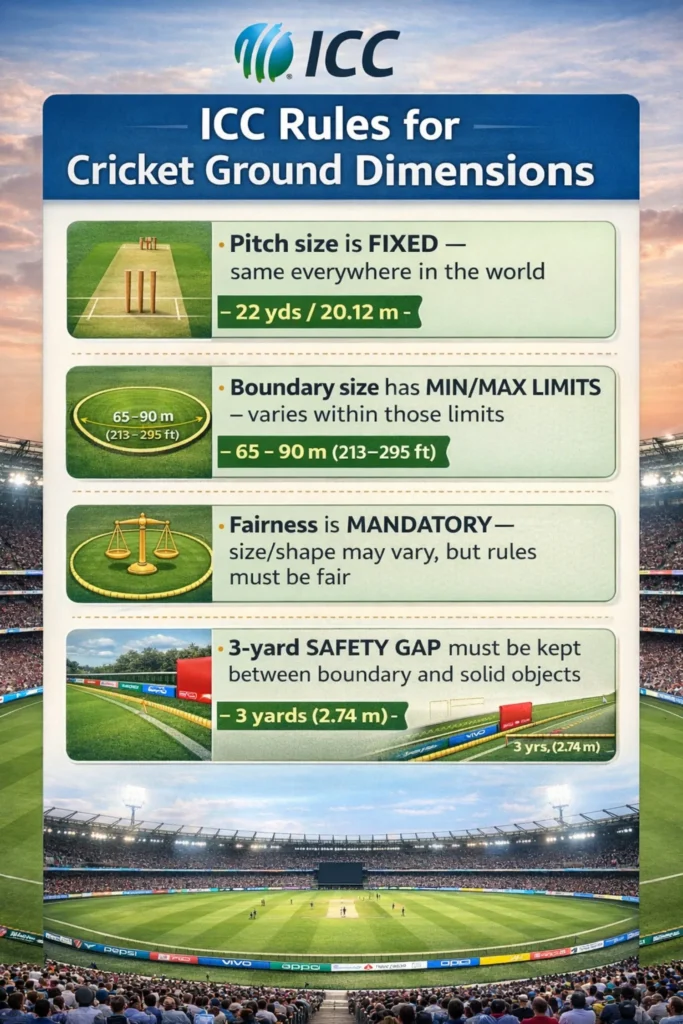
This flexibility allows cricket to be played in old historic stadiums and modern venues worldwide.
Heritage Ground Clause: The ICC has a special rule that stadiums built before October 2007 are exempt from the minimum boundary requirement if they genuinely cannot meet it due to their design. Most established international venues, however, comfortably meet the standard.
Also Read More About: Cricket Stadiums in India: International Grounds, Capacity, Records & Stats
Overall Cricket Ground Size — Important Facts
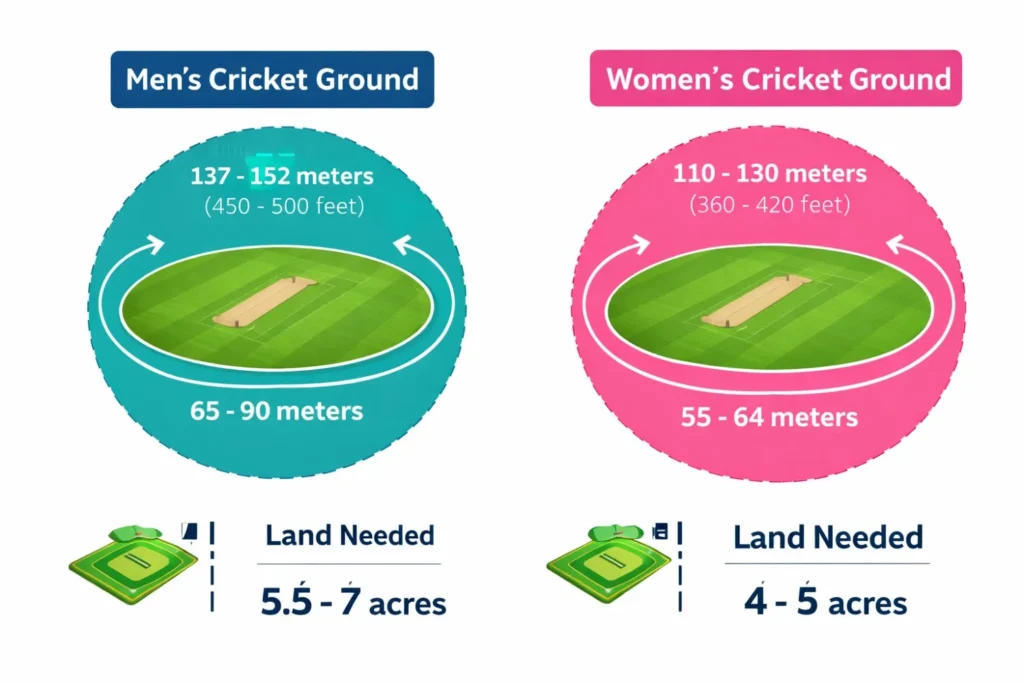
Cricket grounds are usually oval or circular — not rectangular. This is very different from sports like football or basketball which need exact rectangular fields.
Cricket Ground Size in Meters
| Measurement | Size |
|---|---|
| Men’s cricket ground diameter | 137 to 152 meters (450 to 500 feet) |
| Women’s cricket ground diameter | 110 to 130 meters (360 to 420 feet) |
| Boundary distance (men’s) | 65 to 90 meters from pitch center |
| Boundary distance (women’s) | 55 to 64 meters from pitch center |
| Total land needed for a cricket ground | 5.5 to 7 acres |
| Playing field alone | 5.5 acres (150 × 150 meters) |
Cricket Ground Size in Feet
| Measurement | Size in Feet |
|---|---|
| Men’s ground diameter | 450 to 500 feet |
| Women’s ground diameter | 360 to 420 feet |
| Minimum boundary (men’s) | 213 feet (65 meters) |
| Maximum boundary (men’s) | 295 feet (90 meters) |
| Pitch length | 66 feet (22 yards / 20.12 meters) |
What Is the Size of a Cricket Ground?
There is no single fixed size for the entire cricket ground. Different stadiums around the world are different sizes — some are bigger, some are smaller. However, the ICC sets limits so that the game stays fair. The pitch in the center is always the same size. The boundary distance must stay between 65 and 90 meters in international men’s cricket.
Also Read More About: Cricket Stadiums in Australia: International Grounds, Capacity & Records
Cricket Ground Shape — What Does It Look Like?
Shape of Cricket Ground
The shape of a cricket ground can be:
- Perfect circle (some smaller grounds)
- Elongated oval (most common for international venues)
- Rounded rectangle (some stadiums)
- Irregular oval (many historic grounds)
Almost all cricket grounds have smooth, curved boundaries — no sharp corners. This is unique. In most other sports, the playing area has sharp corners (like a football pitch or basketball court). Cricket grounds are always smooth and curved.
Because of the oval shape, the distance from the pitch center to the boundary may be different on different sides. For example, the straight boundary (behind the wickets) might be 80 meters, while the square boundary (on the side) might be only 70 meters. ICC allows this — as long as both sides stay within 65–90 meters.
Cricket Ground Measurement — Diameter vs Ground Length
What Is the Difference Between Ground Diameter and Cricket Ground Length?
Many people get confused between these two. They are not the same thing.
1. Ground Diameter The ground diameter means the total distance from one side of the boundary to the opposite side, passing through the center.
- Measures the full width of the cricket field
- Most international men’s cricket grounds: 130 to 152 meters diameter
- Because fields are oval, the diameter may differ depending on direction
- Simple idea: Boundary → Center → Boundary
2. Cricket Ground Length The cricket ground length usually refers to the distance from the center pitch to the boundary rope in one direction.
- This is basically the boundary distance
- In international matches: 65 to 90 meters according to ICC
- Simple idea: Center → Boundary
Quick Comparison Table
| Feature | Ground Diameter | Cricket Ground Length |
|---|---|---|
| Meaning | Distance across the whole ground | Distance from center to boundary |
| Measurement | Boundary to boundary | Pitch center to boundary |
| Typical Size (men’s) | 130–152 meters | 65–90 meters |
| Shape Impact | Changes with oval shape | Varies by boundary side |
Easy way to remember:
- Diameter = full ground width (boundary to boundary)
- Ground Length = half of the ground (center to boundary)
Cricket Ground Length in Meters
The cricket ground length in meters (from pitch center to boundary) is between 65 and 90 meters for international men’s cricket. The total ground diameter is typically 137 to 152 meters for men’s cricket.
Also Read More About: Cricket Stadiums in England: Historic Grounds, Capacity & Records
Cricket Ground Diagram — Full Breakdown
Below is a description of a cricket ground with measurement and all markings. Think of this as a cricket ground measurement with diagram explained in words.
                   BOUNDARY ROPE (65–90m from center)
            _______________________________________________
          /                                               \
        /          OUTFIELD (grass area)                   \
       |                                                     |
       |      30-YARD CIRCLE / INNER CIRCLE (27.43m)        |
       |           ___________________________              |
       |          /                           \             |
       |         |   INFIELD (inside circle)   |            |
       |         |                             |            |
       |         |   ========================  |            |
       |         |   |    CRICKET PITCH     |  |            |
       |         |   | 20.12m (22 yards)    |  |            |
       |         |   |  width: 3.05m (10ft) |  |            |
       |         |   ========================  |            |
       |         |                             |            |
       |          \___________________________/             |
       |                                                     |
        \          OUTFIELD (grass area)                   /
          \_______________________________________________/
                   BOUNDARY ROPE (65–90m from center)
Key Ground Markings Explained
| Marking | Description | Measurement |
|---|---|---|
| Boundary rope | Outer edge of playing field | 65–90m from pitch center |
| Inner circle (30-yard circle) | Oval fielding restriction line | 27.43m (90 feet) radius |
| Close infield circle | Two overlapping circles near pitch | 13.7m (45 feet) radius |
| Cricket pitch | Central playing strip | 20.12m long × 3.05m wide |
| Bowling crease | Line at each end of pitch | 2.64m (8 ft 8 in) long |
| Popping crease | Line 1.22m ahead of bowling crease | 4 feet from bowling crease |
| Return crease | Lines running up from bowling crease | 2.64m apart |
| Wickets | Three stumps at each end | 28 inches tall, 9 inches wide total |
Boundary Distance in Cricket — ICC Official Rules
ICC Boundary Rules (Men’s International Cricket)
According to ICC Playing Conditions (Law 19.1.3):
- Minimum boundary distance: 65 yards = 59 meters (sometimes written as 65 meters in simpler sources; the official figure in yards is 65, which equals approximately 59.43 meters)
- Maximum boundary distance: 90 yards = 82 meters (approximately 82.29 meters)
- Measured from the center of the pitch to the boundary rope
- Must apply in Test cricket, ODI cricket, and T20 International cricket
- Minimum 3-yard gap between boundary rope and any solid obstacle
ICC Boundary Rules (Women’s International Cricket)
According to ICC Playing Conditions for women’s cricket:
- Minimum boundary: 60 yards = 54.86 meters
- Maximum boundary: 70 yards = 64.01 meters
- Women’s boundaries are shorter to reflect different playing conditions
International Cricket Boundary Length — Summary
| Format | Min Boundary | Max Boundary | Notes |
|---|---|---|---|
| Men’s Test | 59.43m (65 yards) | 82.29m (90 yards) | From pitch center |
| Men’s ODI | 59.43m (65 yards) | 82.29m (90 yards) | From pitch center |
| Men’s T20I | 59.43m (65 yards) | 82.29m (90 yards) | From pitch center |
| Women’s International | 54.86m (60 yards) | 64.01m (70 yards) | From pitch center |
Men’s Cricket Boundary Size vs Women’s
A key point many fans do not know: the men’s cricket boundary size is different from the women’s boundary size. Men play with boundaries up to 90 yards (82m), while women play with a maximum of 70 yards (64m). This keeps the game balanced for different physical abilities.
Also Read More About: Cricket Stadiums in New Zealand: International Grounds, Pitch & Records
Cricket Pitch Dimensions — Fixed Worldwide
The pitch is the ONLY part of a cricket ground that has exactly the same size everywhere in the world, in every match, in every format.
Cricket Pitch Length in Meters and Feet
| Measurement | Value |
|---|---|
| Pitch length (wicket to wicket) | 22 yards / 20.12 meters / 66 feet |
| Pitch width | 10 feet / 3.05 meters |
| Bowling crease length | 8 feet 8 inches (2.64 meters) |
| Popping crease | 4 feet (1.22 meters) ahead of bowling crease |
| Return creases | 8 feet 8 inches (2.64 meters) apart |
Cricket Pitch Length in Meters
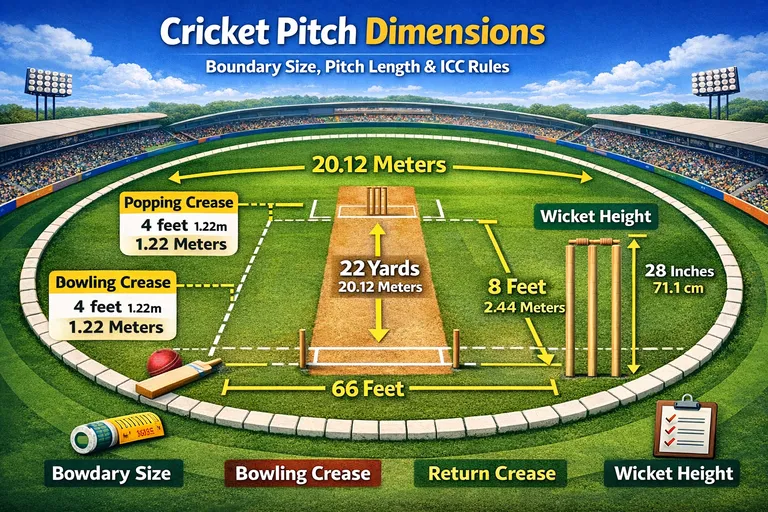
The cricket pitch length in meters is 20.12 meters. This is the distance between the two sets of stumps (wickets). This never changes — not in Test cricket, not in T20 cricket, not in club cricket, not in school cricket.
How Many Meters Is a Cricket Pitch?
A cricket pitch is 20.12 meters long (22 yards). This measurement has been used in cricket for more than 200 years and applies to every official cricket match played anywhere in the world.
International Cricket Pitch Length in Feet
The international cricket pitch length in feet is 66 feet (22 yards / 20.12 meters). This is the distance from one wicket to the other — same in India, Australia, England, the West Indies, everywhere.
Indian Cricket Pitch Length in Feet
The Indian cricket pitch length in feet is exactly the same as everywhere else: 66 feet (22 yards / 20.12 meters). India follows ICC rules, so the pitch measurement never changes regardless of which stadium in India you are playing at.
Standard Size of Cricket Pitch
| Unit | Cricket Pitch Length | Cricket Pitch Width |
|---|---|---|
| Yards | 22 yards | 3.34 yards |
| Meters | 20.12 meters | 3.05 meters |
| Feet | 66 feet | 10 feet |
Cricket Pitch Dimensions in Meters — Full Details
| Pitch Feature | Measurement in Meters |
|---|---|
| Length (wicket to wicket) | 20.12 meters |
| Width | 3.05 meters |
| Bowling crease | 2.64 meters |
| Popping crease (distance from bowling crease) | 1.22 meters |
Half Pitch Cricket Ground Measurement
Many beginners ask about a half pitch cricket ground measurement — meaning the distance from the center of the pitch to one end. Half the pitch is 11 yards = 10.06 meters = 33 feet. This is the distance from the batting crease to the center mark of the pitch.
Also Read More About: Cricket Stadiums in South Africa: International Grounds, Pitch & Records 2026
The Inner Circle (30-Yard Circle) — Full Details
What Is the 30-Yard Circle?
The 30-yard circle (also called the inner circle or cricket circle) is an oval line marked on the ground in limited-overs cricket (ODIs and T20s). It is used for fielding restrictions.
Cricket Circle Length / Cricket Ground Circle Length
| Detail | Measurement |
|---|---|
| Infield radius | 27.43 meters (90 feet) from the center of each wicket |
| Also called | 30-yard circle |
| Used in | ODI cricket, T20 cricket |
| Shape | Oval (two semicircles joined by straight lines) |
Close Infield
| Detail | Measurement |
|---|---|
| Close infield radius | 13.7 meters (45 feet) |
| Description | Two slightly overlapping circles with radius of 13.7m |
| Purpose | For close-in fielding positions |
How It Works
During powerplay overs and other restricted overs, a limited number of fielders are allowed outside this circle. This forces fielders closer to the bat, giving batters more open space to hit the ball and score runs. It is a key tactical element in white-ball cricket.
Cricket Ground Dimensions for T20 Cricket
Cricket Ground Size for T20
T20 cricket does not have different ground dimension requirements from ODI or Test cricket. The ICC applies the same boundary rules (65–90 meters for men) across all international formats. However, in practice, T20 venues often bring the boundary rope in — making the boundary shorter within the allowed limits — to create more sixes and entertainment for fans.
This is why T20 scores are generally higher than in Tests or ODIs. The ground is physically the same size, but the rope is positioned closer to the pitch center.
| Feature | T20 in Practice | Reason |
|---|---|---|
| Boundary position | Often 65–75m | Encourages high scoring |
| ICC rule | Same 65–90m limit | Applies to all formats |
| Effect | More sixes, higher scores | Entertainment value |
Cricket Stadium Dimensions — World’s Biggest Grounds by Boundary
Longest Boundary Cricket Ground in the World
The Melbourne Cricket Ground (MCG) in Melbourne, Australia holds the title of having one of the longest boundaries in the world. Its straight boundary measures 83.43 meters and its square boundary extends to 86.24 meters. These combined dimensions create one of the world’s largest playing areas.
However, the Sydney Cricket Ground (SCG) challenges the MCG for the longest specific boundary. The SCG has a 93.72-meter straight boundary — one of the longest single boundary distances in cricket. This is so large that for T20 matches, the boundary rope is brought in significantly to boost scoring.
Largest Cricket Stadium in the World by Boundary
| Rank | Stadium | Country | Straight Boundary | Square Boundary |
|---|---|---|---|---|
| 1 | Melbourne Cricket Ground (MCG) | Australia | 83.43m | 86.24m |
| 2 | Lord’s Cricket Ground | England | 88.8m (one end) | 65.2m |
| 3 | Sydney Cricket Ground (SCG) | Australia | 93.72m | varies |
| 4 | Hagley Oval | New Zealand | 83.5m | 77.45m |
| 5 | Basin Reserve | New Zealand | 81.7m | 72.48m |
| 6 | Sinhalese Sports Club (SSC) | Sri Lanka | 86.10m | 77.02m |
| 7 | Imperial Wanderers (Bullring) | South Africa | 86.75m | 64.1m |
| 8 | Kensington Oval | Barbados | 76.6m | 69.03m |
| 9 | Eden Gardens | India | 76–78m | 66–68m |
| 10 | Narendra Modi Stadium | India | 75m (all directions) | 75m |
Melbourne Cricket Ground Boundary Length
The Melbourne Cricket Ground boundary length is approximately 83–87 meters depending on the direction, with some parts of the boundary reaching close to 90–95 meters from the pitch center. This is why the MCG is famous for being difficult to hit sixes at. Many of cricket history’s greatest bowlers have loved the MCG for this reason.
The MCG boundary dimensions make it one of the most challenging grounds for batters in the world. The MCG is also the ground where the very first Test match in history was played in 1877.
Australia Cricket Ground Boundary Length
Australian grounds are generally known for their large boundaries compared to Indian grounds:
| Stadium | Location | Approximate Boundary |
|---|---|---|
| Melbourne Cricket Ground | Melbourne | 83–90m |
| Sydney Cricket Ground | Sydney | Up to 93.72m (straight) |
| Adelaide Oval | Adelaide | 75–78m |
| The Gabba | Brisbane | 73–76m |
| Perth Stadium (Optus) | Perth | 70–80m |
Lord’s Cricket Ground Boundary Length in Meters
Lord’s Cricket Ground in London — known as the “Home of Cricket” — has an interesting boundary. One side of Lord’s (the Nursery End) is longer, measuring around 88.8 meters on the straight. The other end (Pavilion End) is shorter. This uneven shape is one of Lord’s most famous characteristics. The famous 2.5-meter slope across the Lord’s pitch also makes it unique among cricket grounds in the world.
Biggest Cricket Ground in India by Boundary
Indian Cricket Ground Boundary Length — Top Grounds
Many people ask: what is the biggest cricket ground in India by boundary? The answer is often debated but here are the facts:
| Stadium | City | Average Boundary | Notes |
|---|---|---|---|
| Shaheed Veer Narayan Singh International Stadium | Raipur | ~80 meters | Often cited as largest by boundary in India |
| Ekana Cricket Stadium | Lucknow | ~75–80m | Very large ground, 160×156m dimensions |
| Eden Gardens | Kolkata | 76–78m (straight), 66–68m (square) | Historic “Mecca of Indian Cricket” |
| Narendra Modi Stadium | Ahmedabad | 75m (all sides) | Perfectly uniform boundaries |
| Rajiv Gandhi International Stadium | Hyderabad | ~70m | Large boundary for Indian standards |
| Arun Jaitley Stadium | Delhi | 68–70m | Historic central Delhi ground |
| Wankhede Stadium | Mumbai | 68–70m | Hosted 2011 World Cup final |
| M. Chinnaswamy Stadium | Bengaluru | 65–70m | Famous for short boundaries and high scores |
India’s biggest cricket ground by boundary is the Shaheed Veer Narayan Singh International Stadium in Raipur, Chhattisgarh, with an average boundary of around 80 meters — making it one of the largest-boundary cricket grounds in all of Asia.
Eden Gardens in Kolkata is another standout — with a 76–78 meter straight boundary, it is unusual for Indian cricket, where most grounds have shorter boundaries. This makes Eden Gardens one of the most challenging grounds for Indian batters.
Narendra Modi Stadium in Ahmedabad is the world’s largest cricket stadium by seating capacity (132,000 seats), but its boundaries are a uniform 75 meters in all directions — balanced rather than exceptionally large.
Biggest Cricket Ground in India by Boundary Length — Key Facts
- By seating capacity: Narendra Modi Stadium, Ahmedabad (132,000 seats)
- By boundary length: Shaheed Veer Narayan Singh Stadium, Raipur (~80m average)
- Most famous large-boundary ground: Eden Gardens, Kolkata (76–78m straight)
- Smallest boundary: Holkar Stadium, Indore (~56m in some positions — famous for big hitting and record scores)
Real Stadium Boundary Sizes — Full Global Table
| Stadium | Country | Straight Boundary | Square Boundary | Notes |
|---|---|---|---|---|
| Melbourne Cricket Ground | Australia | 83.43m | 86.24m | One of world’s biggest |
| Sydney Cricket Ground | Australia | 93.72m | varies | Longest straight boundary |
| Lord’s | England | 88.8m | 65.2m | Famous slope and uneven boundaries |
| Hagley Oval | New Zealand | 83.5m | 77.45m | Christchurch, NZ |
| Basin Reserve | New Zealand | 81.7m | 72.48m | Wellington |
| SSC Ground | Sri Lanka | 86.10m | 77.02m | Colombo |
| Imperial Wanderers | South Africa | 86.75m | 64.1m | “The Bullring” |
| Kensington Oval | Barbados | 76.6m | 69.03m | Caribbean |
| Eden Gardens | India | 76–78m | 66–68m | Kolkata |
| Narendra Modi Stadium | India | 75m | 75m | Ahmedabad |
| Sharjah Cricket Stadium | UAE | 65–70m | 65–70m | Small but famous |
| Wankhede Stadium | India | 68–70m | 68–70m | Mumbai |
| M. Chinnaswamy Stadium | India | 65–70m | 65–70m | Bengaluru, high-scoring |
Why Boundary Size Matters in Cricket
The boundary distance in cricket has a huge effect on how the game is played. It affects batters, bowlers, and fielders differently:
| Boundary Type | Impact on Batting | Impact on Bowling | Impact on Fielding |
|---|---|---|---|
| Short boundary (65–70m) | More sixes, aggressive batting | Bowlers under pressure | Less ground to cover |
| Medium boundary (70–80m) | Balanced scoring | Fair for both | Good athletic fielding needed |
| Long boundary (80–90m) | Harder to score, skill rewarded | Bowlers get more help | Fielders must be very fit |
Key Effects:
Batters love small grounds: Short boundaries mean more sixes, higher run rates, and exciting innings. This is why T20 grounds often bring the rope in.
Bowlers prefer big grounds: When batters need to hit the ball much harder to reach the boundary, bowlers have more chance to take wickets. The MCG and SCG are famous for rewarding good bowling.
Spinners get more help on big grounds: A batter against spin is less likely to risk a big shot if the boundary is far away. This makes spinners more effective on large grounds.
Small vs Large Cricket Grounds — Full Comparison
| Feature | Small Ground (65–70m) | Medium Ground (70–80m) | Large Ground (80–90m) |
|---|---|---|---|
| Sixes | Very easy | Moderate | Hard |
| Typical T20 score | 190–220+ | 165–190 | 140–165 |
| Typical ODI score | 320–360+ | 280–320 | 250–280 |
| Spinners effectiveness | Lower | Medium | Higher |
| Fielding challenge | Lower | Medium | High |
| Famous example | Holkar, Indore | Wankhede, Mumbai | MCG, Melbourne |
Cricket Ground Size for Different Levels
International (Men’s) Cricket
- Boundary: 65–90 meters from pitch center (ICC mandatory)
- Ground diameter: 137–152 meters
- Inner circle: 27.43 meters radius
- Pitch: 20.12 meters (22 yards) — fixed everywhere
International (Women’s) Cricket
- Boundary: 55–64 meters (60–70 yards)
- Smaller ground than men’s international cricket
- Same pitch length (20.12 meters)
Domestic / First-Class Cricket
- Boundary: Usually 60–80 meters
- Inner circle: Same 27.43 meters as international
- Pitch: Same 20.12 meters
Amateur / Club Cricket
- Boundary: Usually 50–70 meters depending on available space
- No strict circle requirement at lowest levels
- Pitch: Same 20.12 meters even in club cricket
Youth / School Cricket
In school and academy cricket:
- Boundaries are reduced to match younger players’ ability
- Field size is adjusted for safety and enjoyment
- Pitch may be shortened for very young players (Under-10 level)
- The standard adult pitch (22 yards) is used from Under-13 level onwards in most associations
This helps young players:
- Learn technique without being overwhelmed
- Avoid injury from trying to hit full-length deliveries too hard
- Enjoy the game while developing skills
Cricket Ground Dimensions in Different Units — Master Conversion Table
This is the most complete conversion table for cricket ground dimensions in metres, feet, and yards.
| Measurement | Meters | Feet | Yards |
|---|---|---|---|
| Pitch length | 20.12m | 66 ft | 22 yds |
| Pitch width | 3.05m | 10 ft | 3.34 yds |
| Min boundary (men’s international) | ~59.43m | ~195 ft | 65 yds |
| Max boundary (men’s international) | ~82.29m | ~270 ft | 90 yds |
| Min boundary (women’s international) | 54.86m | 180 ft | 60 yds |
| Max boundary (women’s international) | 64.01m | 210 ft | 70 yds |
| Inner circle radius | 27.43m | 90 ft | 30 yds |
| Close infield radius | 13.7m | 45 ft | 15 yds |
| Ground diameter (men’s) | 137–152m | 450–500 ft | 150–167 yds |
| Bowling crease | 2.64m | 8 ft 8 in | 2.89 yds |
| Stumps height | 0.71m | 28 in | — |
| Total stump width (3 stumps) | 0.229m | 9 in | — |
Circumference of Cricket Ground
The circumference of a cricket ground (the total distance around the boundary rope) varies because every ground has a different oval shape and size. However, here is a rough estimate:
For an average men’s international ground with a diameter of about 140 meters:
- Using oval approximation: circumference ≈ π × (major axis + minor axis) / 2
- For a ground roughly 140m wide × 130m long: approximately 425–450 meters total boundary circumference
For the MCG (one of the largest):
- Estimated boundary circumference: approximately 500–540 meters
The radius of a cricket ground from the center to the boundary is between 65 and 90 meters for international cricket.
Cricket Ground Measurements — Common Mistakes
| ❌ Wrong Belief | ✅ Correct Fact |
|---|---|
| Pitch length can change | Pitch is always exactly 22 yards (20.12m) everywhere |
| All boundaries are equal on all sides | Boundaries can be uneven — one side may be 70m, another 80m |
| Cricket grounds must be circular | Oval shape is allowed and most common |
| T20 has different pitch length | No — same 20.12 meter pitch for all formats |
| Ground diameter is same as boundary distance | They are different — diameter is boundary-to-boundary; boundary distance is center-to-boundary |
| Women’s cricket uses same boundaries as men | Women’s boundaries are shorter: 55–64m vs men’s 59–82m |
| All Indian grounds are small | Eden Gardens (76–78m) and Raipur (~80m) rival international standards |
क्रिकेट मैदान का माप (Cricket Ground Measurements in Hindi Context)
Many cricket fans in India search for क्रिकेट मैदान का माप (cricket ground measurements in Hindi). Here is a simple summary:
- क्रिकेट पिच की लंबाई: 20.12 मीटर (22 गज / 66 फीट) — यह पूरी दुनिया में एक समान है।
- क्रिकेट बाउंड्री की लंबाई: 59 से 82 मीटर (पिच के केंद्र से)
- क्रिकेट ग्राउंड का व्यास: 137 से 152 मीटर (पुरुष क्रिकेट)
- क्रिकेट मैदान का माप (कुल): अंडाकार आकार, कोई एक निश्चित आकार नहीं
- 30-यार्ड सर्कल: 27.43 मीटर त्रिज्या
(क्रिकेट ग्राउंड की लम्बाई चौड़ाई / क्रिकेट बाउंड्री की लम्बाई / क्रिकेट मैदान का माप — ये सभी ऊपर दी गई जानकारी में शामिल हैं।)
Cricket Ground Oval Dimensions — Why Cricket Is Unique
Cricket is one of very few major sports where there is no fixed shape for the playing field. Sports like football, basketball, tennis, and hockey all have exact rectangular fields.
Cricket allows oval grounds — and even irregular shapes — as long as:
- The pitch dimensions (22 yards) stay the same
- The boundary distances stay within 65–90 meters (men’s international)
- A safe gap exists between the rope and any obstacle
This is similar to Australian Rules Football and baseball, which also allow variable ground shapes. It is what makes cricket stadiums around the world all look and feel different from each other.
Cricket Oval Dimensions
| Feature | Size |
|---|---|
| Oval shape | Two semicircles joined by parallel straight lines |
| Typical men’s oval diameter | 137–152 meters |
| The oval is NOT a perfect circle | One axis may be longer than the other |
FAQs — People Also Ask
What is the standard size of a cricket ground?
There is no single standard size for the whole ground. However, ICC allows a boundary distance of 65–90 meters for international men’s cricket. The pitch in the center is always exactly 22 yards (20.12 meters) everywhere.
What is the length of a cricket ground?
The length of a cricket ground usually refers to the distance from pitch center to boundary — which is 65 to 90 meters for international men’s cricket. The total diameter (boundary to boundary) is 130–152 meters.
Is cricket pitch size same everywhere?
Yes. The pitch is always 22 yards (20.12 meters / 66 feet) long worldwide. This never changes — from village cricket to World Cup finals.
What is the biggest cricket ground in the world by boundary?
The Melbourne Cricket Ground (MCG) in Australia is generally considered the biggest by overall boundary dimensions. The Sydney Cricket Ground (SCG) has the longest single straight boundary at 93.72 meters.
What is the biggest cricket stadium in the world by boundary?
By boundary size: Melbourne Cricket Ground (MCG), Australia and Sydney Cricket Ground (SCG), Australia are the biggest. By capacity: Narendra Modi Stadium, Ahmedabad, India (132,000 seats) is the world’s biggest by seating.
What is the longest boundary cricket ground in India?
Shaheed Veer Narayan Singh International Stadium in Raipur, Chhattisgarh (~80m average boundary). Eden Gardens, Kolkata (~76–78m straight boundary) is the most famous large-boundary ground in India.
What is the Melbourne Cricket Ground boundary length?
The MCG boundary is approximately 83.43 meters (straight) and 86.24 meters (square). Some positions can approach 90–95 meters from the pitch center.
What is the MCG boundary length?
The MCG boundary measures approximately 83–87 meters depending on direction, with certain extreme points approaching 90–95 meters.
What is Lord’s Cricket Ground boundary length in meters?
Lord’s has an uneven boundary. The Nursery End straight boundary is approximately 88.8 meters. The square boundary is about 65.2 meters. The famous slope across the ground creates unusual bounce and movement.
What is the boundary distance in cricket (minimum)?
For men’s international cricket: 65 yards = approximately 59.43 meters from the center of the pitch.
How many meters is a cricket pitch?
A cricket pitch is exactly 20.12 meters long (22 yards / 66 feet).
What is the radius of a cricket ground?
The radius (center to boundary) is between 65 and 90 meters for international men’s cricket. Average international grounds have a radius of about 70–80 meters.
What is the size of a cricket ground in acres?
The playing field needs approximately 5.5 acres (150×150 meters). With stands, parking, and facilities, the total land is 6–7 acres.
What is the cricket ground size for T20?
T20 international cricket uses the same ICC boundary rules (65–90 meters) as other formats. In practice, T20 venues often position the boundary rope at the shorter end (65–75 meters) to encourage more sixes and higher scores.
What is the men’s cricket boundary size?
Men’s cricket boundary size: minimum 59.43 meters (65 yards), maximum 82.29 meters (90 yards) from pitch center.
What is ground size in cricket?
Ground size varies. The total diameter is usually 137–152 meters for men’s international grounds. The boundary distance is 65–90 meters from the pitch center.
Conclusion
Cricket ground dimensions are flexible but strictly controlled. While every ground looks different, ICC rules ensure fairness in international cricket. The pitch size is fixed at 22 yards (20.12 meters / 66 feet) everywhere in the world. The boundary size varies between 65 and 90 meters for men’s international cricket.
The Melbourne Cricket Ground holds the title of the world’s biggest by boundary dimensions. In India, Shaheed Veer Narayan Singh Stadium in Raipur and Eden Gardens in Kolkata are the biggest grounds by boundary length.
Understanding cricket ground dimensions helps:
- Players adapt their strategy to different venues
- Bowlers know how much help they will get from big boundaries
- Batters plan their shots based on boundary distances
- Fans understand why some matches produce more sixes than others
- Beginners learn the proper structure and layout of the game
Whether you are a player, coach, student, or cricket fan — knowing cricket ground measurements, cricket field dimensions, boundary distances, and pitch dimensions gives you a much deeper understanding of the greatest game in the world.
Understanding cricket ground dimensions helps players adapt, fans understand conditions, and beginners learn the game correctly.
