
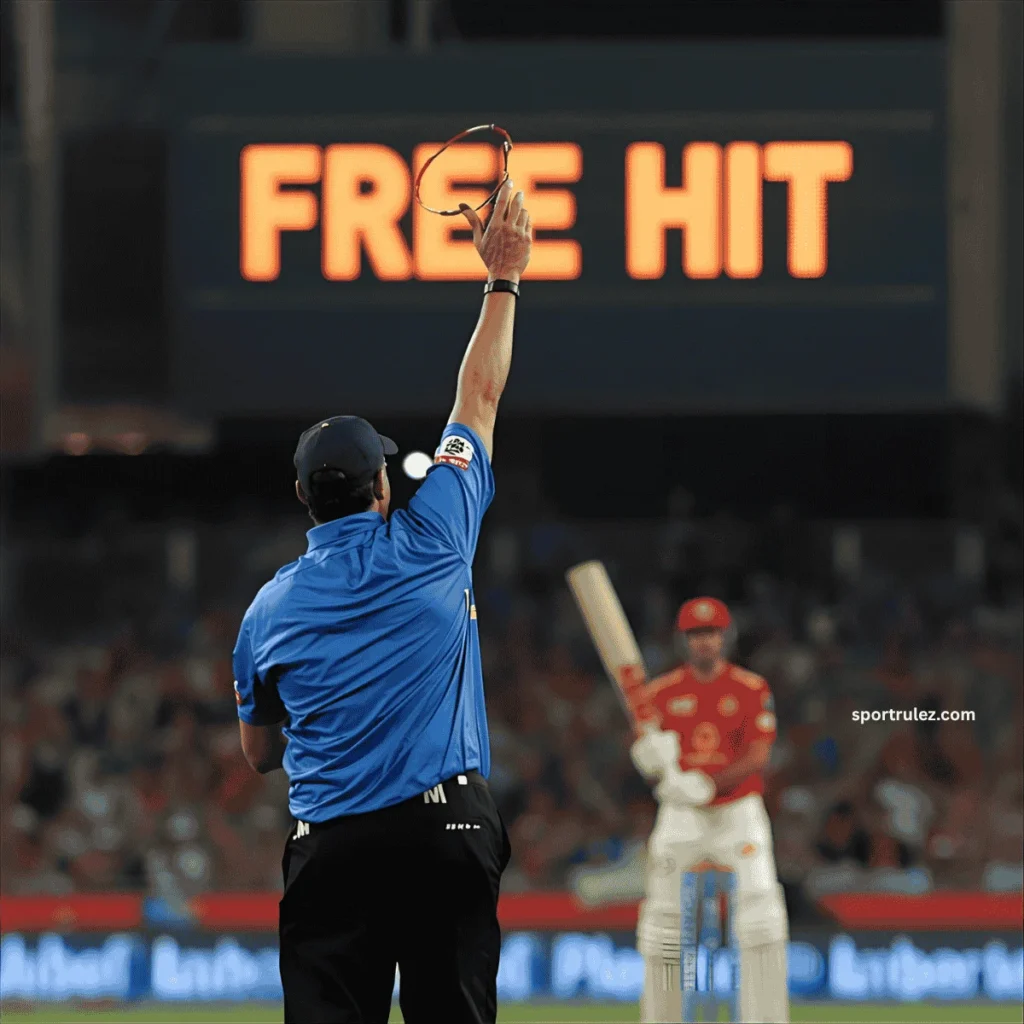
A Free Hit in cricket is a special delivery that gives the batter a unique advantage — they cannot be dismissed in most ways on that ball. It is awarded to the batting team after a bowler delivers a no-ball (except for a few specific situations like short-pitched deliveries over shoulder height).
The rule was introduced by the ICC to penalize bowlers for bowling no-balls and to reward the batting side for fair play.
Over the years, Free Hits have changed matches, created unforgettable highlights, and sparked heated debates about fairness and strategy.
📜 Origin and History of the Free Hit Rule
The Free Hit rule was first introduced in 2007 for limited-overs cricket. Initially, it applied only to front-foot no-balls.
However, in 2015, the ICC expanded the law —
“Every type of no-ball (front-foot, back-foot, high full toss, or fielding restriction breach) shall result in a Free Hit.”
This evolution made cricket more balanced and entertaining — a fair punishment for bowlers and a thrilling opportunity for batsmen.
⚖️ ICC Law 21: Free Hit Official Rule (Simplified)
According to the Marylebone Cricket Club (MCC) Law 21 and ICC playing conditions:
1. When a Free Hit Is Awarded
A Free Hit is given after any no-ball, regardless of type:
- Front-foot no-ball
- Back-foot no-ball
- High full toss (waist height or above)
- Fielding restriction breach (too many outside the circle)
2. What the Batter Can and Cannot Be Out For
During a Free Hit:
- The batter cannot be out by:
- Bowled
- Caught
- Leg Before Wicket (LBW)
- Hit wicket
However, the batter can be out by:
- Run out
- Obstructing the field
- Handling the ball (now merged with obstructing the field)
- Double hit
3. Ball Changes
- If a Free Hit delivery is again a no-ball, the next ball is also a Free Hit.
- The umpire signals the Free Hit by circling one arm above his head.
⚡ What Happens During a Free Hit Delivery
| Situation | What Happens |
|---|---|
| Bowler bowls no-ball | Umpire calls Free Hit |
| Next ball bowled | Batter can swing freely |
| Batter bowled/caught/LBW | Not out — runs count if taken |
| Bowler bowls wide/no-ball again | Free Hit continues |
| Run out occurs | Batter is out as usual |
🧠 Fielding and Position Rules During a Free Hit
- Fielders cannot change their positions unless the striker changes (i.e., batters cross).
- If they do move without permission, the delivery is again declared a no-ball.
- This rule prevents unfair tactics by the fielding team.
💡 Free Hit and DRS (Decision Review System)
- LBW appeals are invalid during a Free Hit.
- Run-out reviews are still allowed.
- If a ball hits the stumps and runs are taken, they still count as byes or leg byes.
🏏 Real Match Case Studies
1. MS Dhoni vs Sri Lanka (2012 CB Series)
- Event: No-ball by Nuwan Kulasekara
- Free Hit Result: Dhoni hit a six over long-on to finish the match.
- Impact: Cemented Dhoni’s reputation as the world’s best finisher.
2. Virat Kohli’s Double Free Hit (T20 vs Bangladesh, 2022)
- A no-ball for height followed by another for overstepping led to back-to-back Free Hits.
- Kohli scored 11 runs off those two balls.
- Showed how momentum can completely shift in a single over.
3. AB de Villiers’ Famous “360° Free Hit” (IPL 2015)
- Bowler: Lasith Malinga
- Delivery: Front-foot no-ball
- AB hit a scoop shot for six over fine leg — a viral highlight to this day.
🧩 Case Study: Controversial Free Hit Incident (India vs Pakistan, T20 World Cup 2022)
- Situation: Nawaz bowled a no-ball to Kohli (waist high).
- The ball hit the stumps and went for 3 byes.
- Pakistan appealed that the ball should be dead once it hit the stumps.
- ICC clarified: “A batter can still run if bowled on a Free Hit, as the ball remains in play.”
- This decision became one of the most discussed umpiring moments in T20 history.
🕰️ Free Hit in Different Formats
| Format | Is Free Hit Applicable? | Notes |
|---|---|---|
| Test Cricket | ❌ No | No Free Hits in Tests |
| ODI Cricket | ✅ Yes | After any no-ball |
| T20 International | ✅ Yes | After any no-ball |
| IPL / Franchise Leagues | ✅ Yes | Rule universally adopted |
| The Hundred | ✅ Yes | Still applies with 5-ball overs |
⚙️ Tactical Importance of the Free Hit
- For Batters:
- Opportunity to score maximum runs risk-free.
- Usually target straight boundaries due to minimal field risk.
- For Bowlers:
- Typically bowl yorkers or wide outside off stump.
- Avoid short or slot-length deliveries.
🔥 Statistical Highlights
- Most runs off a single Free Hit: 8 runs (2 runs + overthrow + no-ball + Free Hit).
- First ever Free Hit six in international cricket: Yuvraj Singh, 2007 T20I.
- Most Free Hits in a single innings: 5 (Bangladesh vs Sri Lanka, 2019).
🧩 Latest ICC Updates (2025)
- Umpires now have the right to review height-based no-balls before awarding Free Hits.
- If a bowler’s front foot is behind the line but back foot lands outside, it’s still a no-ball and Free Hit.
- Technology sensors (Smart Bails and Front Foot Sensors) are being tested in ICC tournaments for automatic detection.
⚖️ Interesting Facts & Rare Situations
- Free Hit on the last ball: Runs count normally; Free Hit ends the innings if it’s the final delivery.
- Hit wicket on Free Hit: Not out.
- Run out while celebrating Free Hit runs: Still out (yes, it happened once in a domestic match!).
- Free Hit on super over: Also valid if a no-ball occurs in the Super Over.
📚 Case Law Summary Table
| Incident Type | Outcome |
|---|---|
| Bowled off Free Hit | Not Out |
| Caught off Free Hit | Not Out |
| LBW on Free Hit | Not Out |
| Run Out | Out |
| Ball hits stumps & runs taken | Runs count |
| Bowler repeats no-ball | Another Free Hit |
🕰️ Historical Evolution Timeline
| Year | Change Introduced | Impact |
|---|---|---|
| 2007 | Free Hit only for front-foot no-ball | Introduced fairness |
| 2011 | Extended to all no-balls | Balanced rules |
| 2015 | Official ICC-wide expansion | Global uniformity |
| 2025 | Tech-based validation added | Accuracy improved |
❓ FAQs: Free Hit Rule in Cricket
Q1: Can a batsman be out on a Free Hit?
Only by run-out, obstructing the field, or handling the ball.
Q2: What happens if a Free Hit ball hits the stumps?
The batter isn’t out, and the ball remains live for running.
Q3: Is there a Free Hit in Test matches?
No, Free Hits apply only in limited-overs formats.
Q4: Can fielders change positions during a Free Hit?
No, unless batters have crossed ends.
Q5: What if the bowler bowls another no-ball on a Free Hit?
The next ball is again a Free Hit.
Q6: What is the umpire signal for a Free Hit?
The umpire circles his arm above his head.
🏁 Conclusion
The Free Hit rule has redefined modern cricket — transforming no-balls from minor errors into high-risk moments that can change games.
It adds excitement, strategy, and fairness, making every over unpredictable.
From Dhoni’s finishing shots to Kohli’s controversial Free Hits, the rule continues to evolve and entertain billions of fans worldwide.

Daniel Foster is a senior sports writer specializing in cricket laws and international playing conditions. With extensive experience covering ICC rules, domestic leagues, and tournament regulations, he delivers detailed yet easy-to-read explanations. His work is trusted by readers looking for accurate and up-to-date sports rules.