
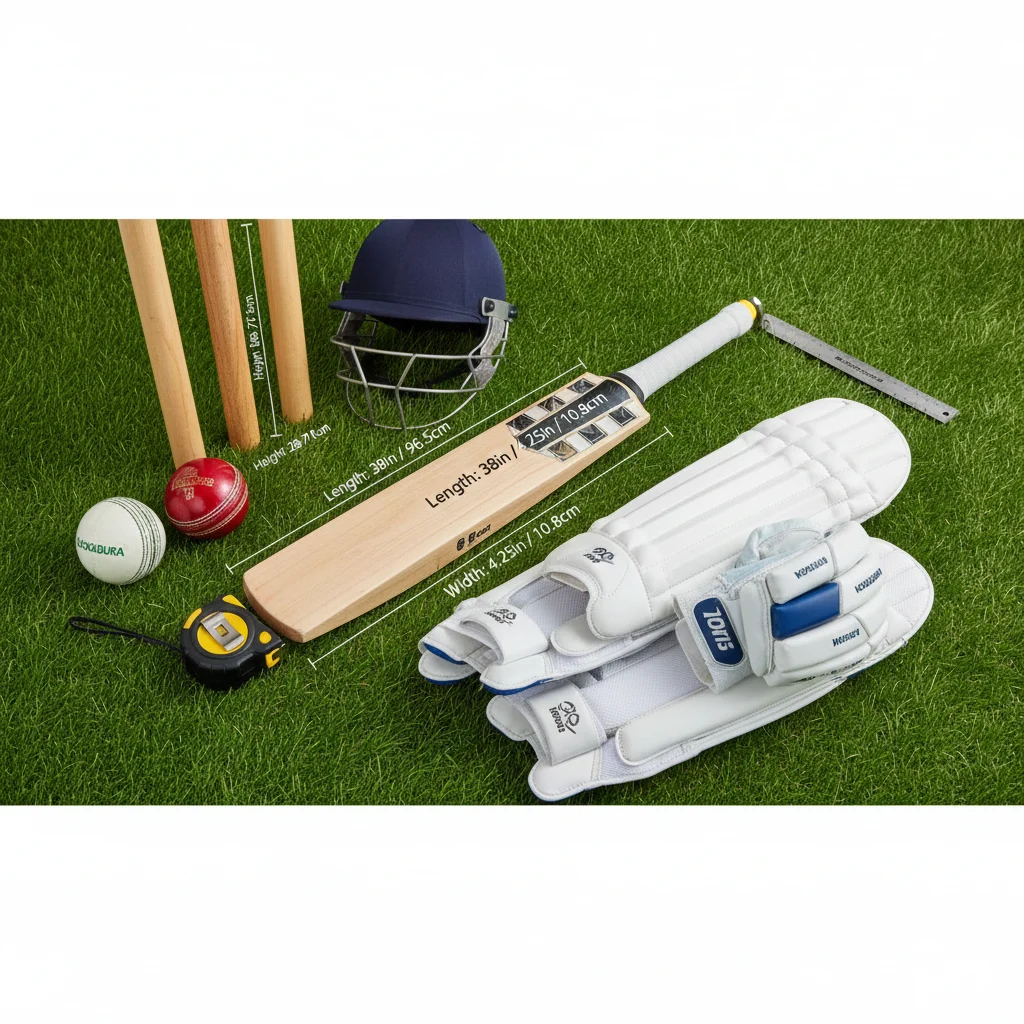
Cricket is a game steeped in tradition, but it is also one governed by a precise set of laws, especially when it comes to equipment. The rules governing bats, balls, and protective gear are meticulously defined by the Marylebone Cricket Club (MCC) and enforced by the International Cricket Council (ICC) to ensure fairness, safety, and the integrity of the contest between bat and ball. This is your ultimate guide to understanding what is and isn’t allowed on the cricket field.
The Cricket Bat: Size, Shape, and Material Rules
The cricket bat is the primary tool of the batter, and its specifications are tightly controlled to maintain a balance between offensive power and bowling fairness.
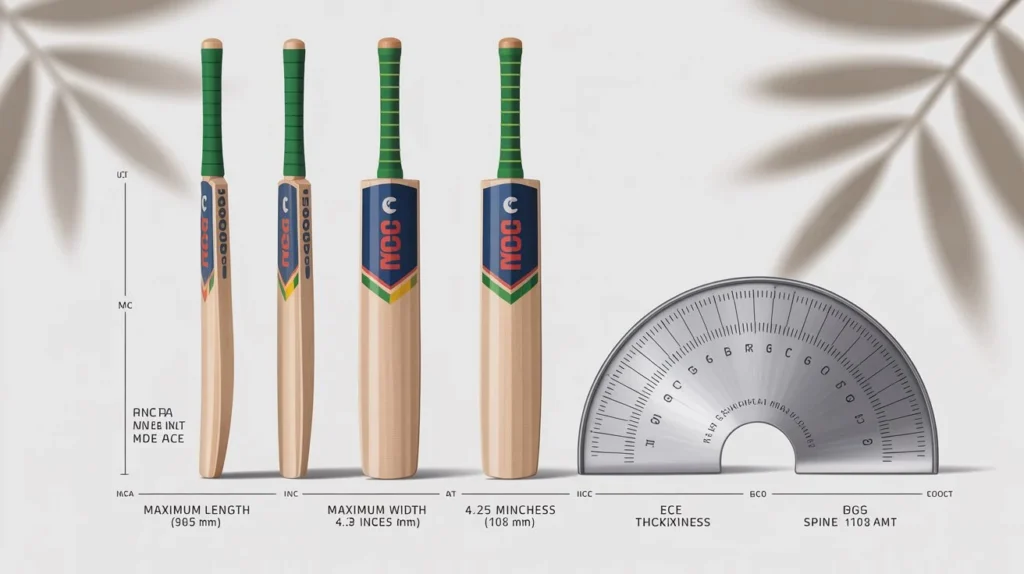
Bat Dimensions (Law 5)
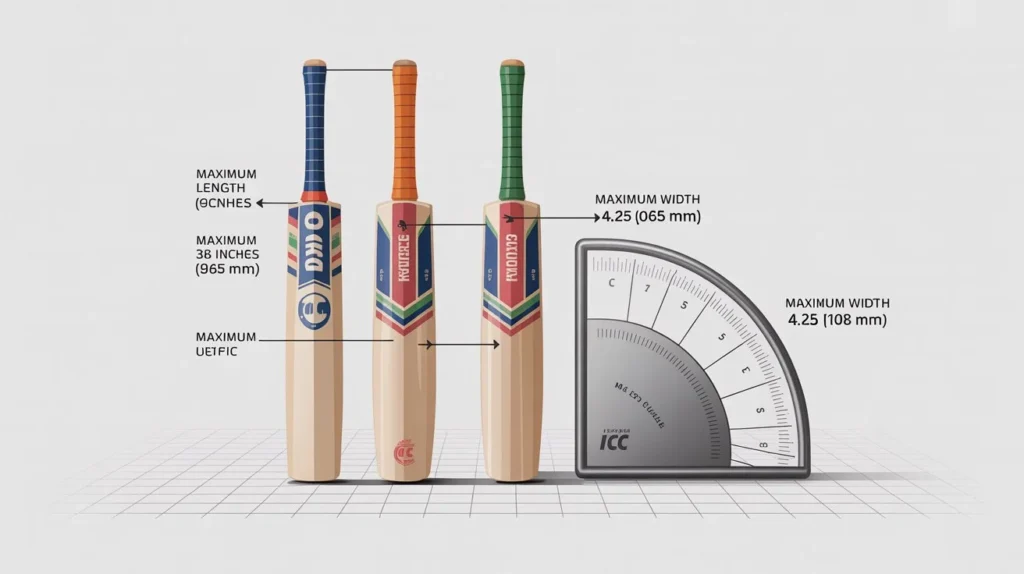
- Length: The bat must not be more than 38 inches (96.52 cm) long.
- Width: The bat must not be more than 4.25 inches (10.8 cm) wide at its widest part.
- Edges: The edges of the bat must not be more than 1.56 inches (4.0 cm) deep.
Bat Material and Construction
- The Blade: Must be made solely of wood. The most common and traditional wood is English willow (Salix alba caerulea), with Kashmir willow being a cheaper, heavier alternative. Bats made of metal or other materials are illegal.
- The Handle: Typically made from cane and rubber, and can be spliced into the blade. The handle is usually covered with a rubber grip.
- Coverings and Protection: Protective coverings on the blade (like tape) are allowed but must not exceed 0.012 inches (0.3mm) in thickness and must not materially alter the ball’s bounce. Scoops (holes in the back of the bat) are permitted but are regulated to prevent undue advantage.
The Cricket Ball: Weight, Size, and Color Regulations
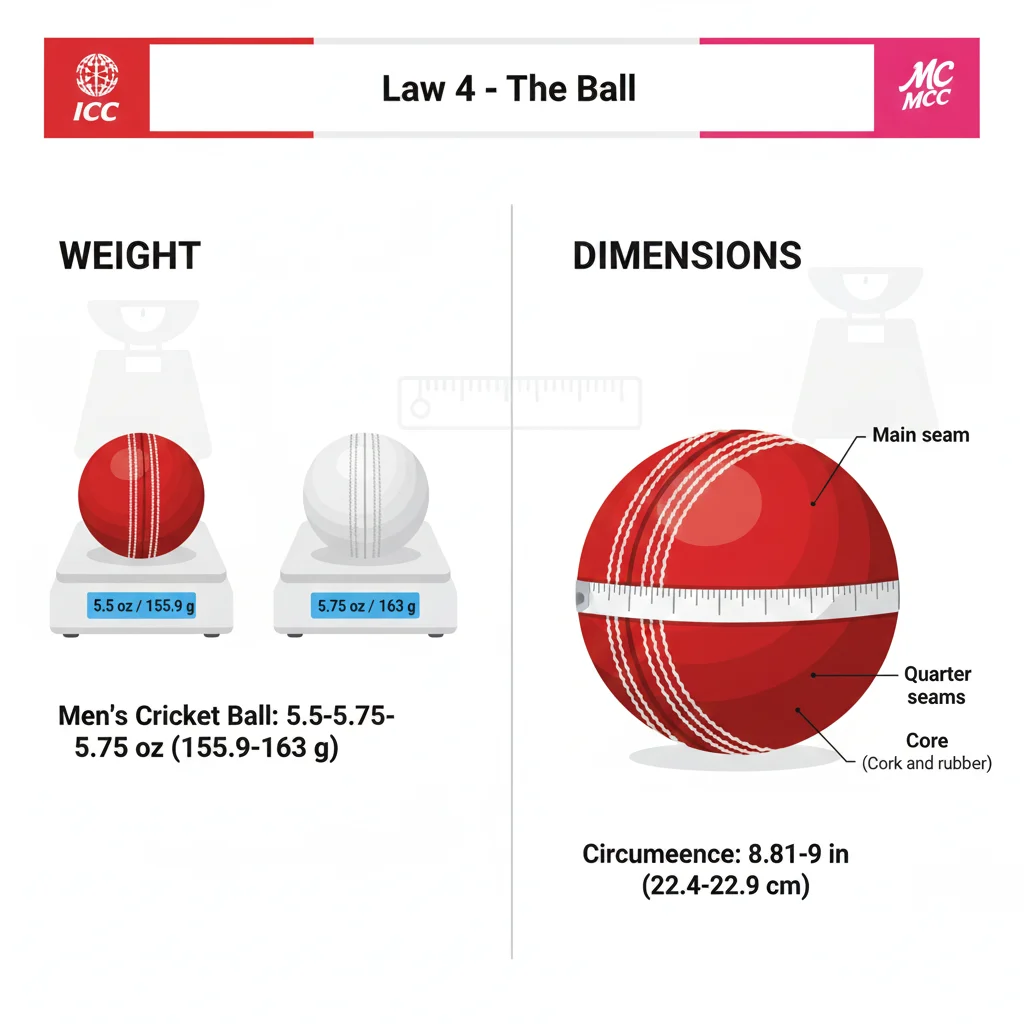
The cricket ball is engineered for durability, aerodynamics, and consistent behavior.
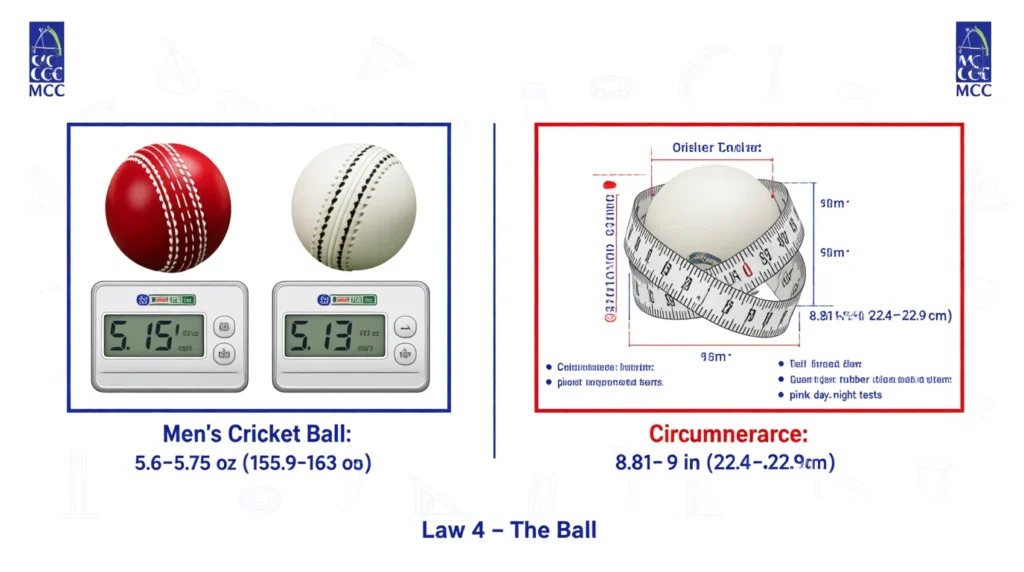
Men’s Cricket Ball (Law 4)
- Weight: Must be between 5.5 and 5.75 ounces (155.9 and 163 grams).
- Circumference: Must be between 8.81 and 9 inches (22.4 and 22.9 cm).
Women’s Cricket Ball
- Weight: Must be between 4.94 and 5.31 ounces (140 and 151 grams).
- Circumference: Must be between 8.25 and 8.88 inches (21.0 and 22.5 cm).
Junior Cricket Ball
Softer balls (e.g., “Incrediballs,” tennis balls, or rubber balls) are used at junior levels for safety, with size and weight varying by age group.
Ball Colors
- Red: The traditional color, used in Test matches and First-Class cricket.
- White: Used in limited-overs cricket (ODIs and T20s) for better visibility under floodlights. The specifications are identical to the red ball.
- Pink: Used in Day/Night Test matches, as it remains more visible than red under lights.
- Orange: Sometimes used in informal or recreational cricket for high visibility.
Protective Equipment: Safety Standards and Rules
Player safety is paramount, and the use of protective gear is both encouraged and regulated.
Mandatory Protective Gear for Batters & Wicket-Keepers
- Batting Helmet: Must be worn by batters and wicket-keepers standing up to the stumps against fast bowling. They must meet strict British Standard (BS) 7928:2013 or equivalent safety certifications. Faceguards (grilles) are mandatory.
- Batting Gloves: Heavily padded to protect the fingers and hands from impact.
- Batting Pads (Leg Guards): Protect the shins, knees, and legs from LBW impacts.
- Abdominal Guard (Box): An essential piece of protection for all batters and wicket-keepers.
- Thigh Guard, Arm Guard, Chest Guard: Optional but highly recommended for additional protection.
Fielding Equipment
- Fielders are allowed to wear a helmet (with or without a faceguard) and soft protective pads. Wearing gloves is not permitted unless specifically approved by the umpires (e.g., in very cold conditions).
Clothing and Footwear Regulations
- Clothing: Teams must wear standardized uniforms, typically consisting of a collared shirt, trousers, and a sweater or jumper for Tests, and colored jerseys and trousers for limited-overs. Logos and branding are strictly regulated by the ICC.
- Footwear: Spiked shoes (metal or plastic) are allowed to provide grip. The spikes must not be sharp enough to damage the pitch deliberately.
The Stumps, Bails, and SightScreen
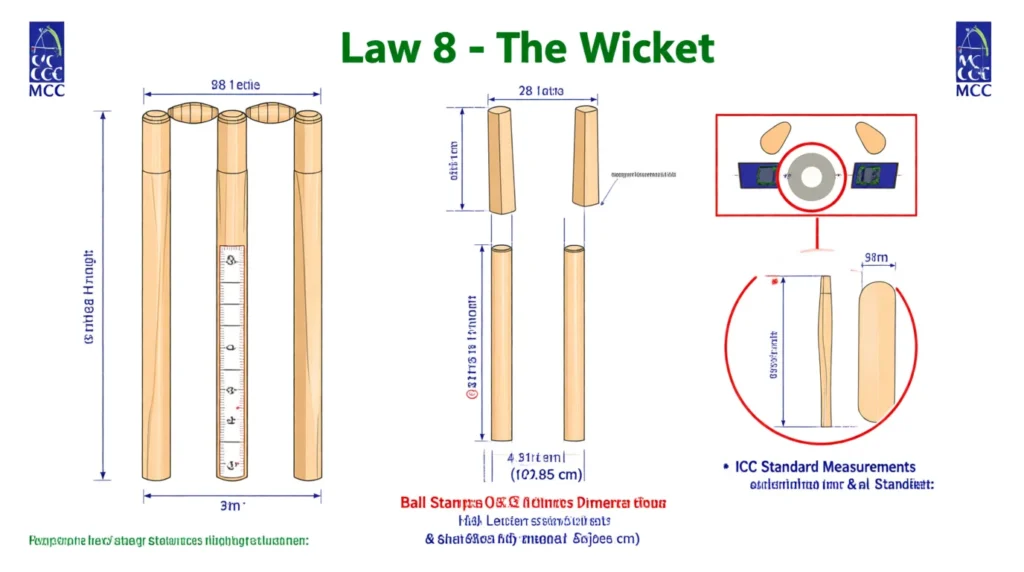
Stumps and Bails (Law 8)
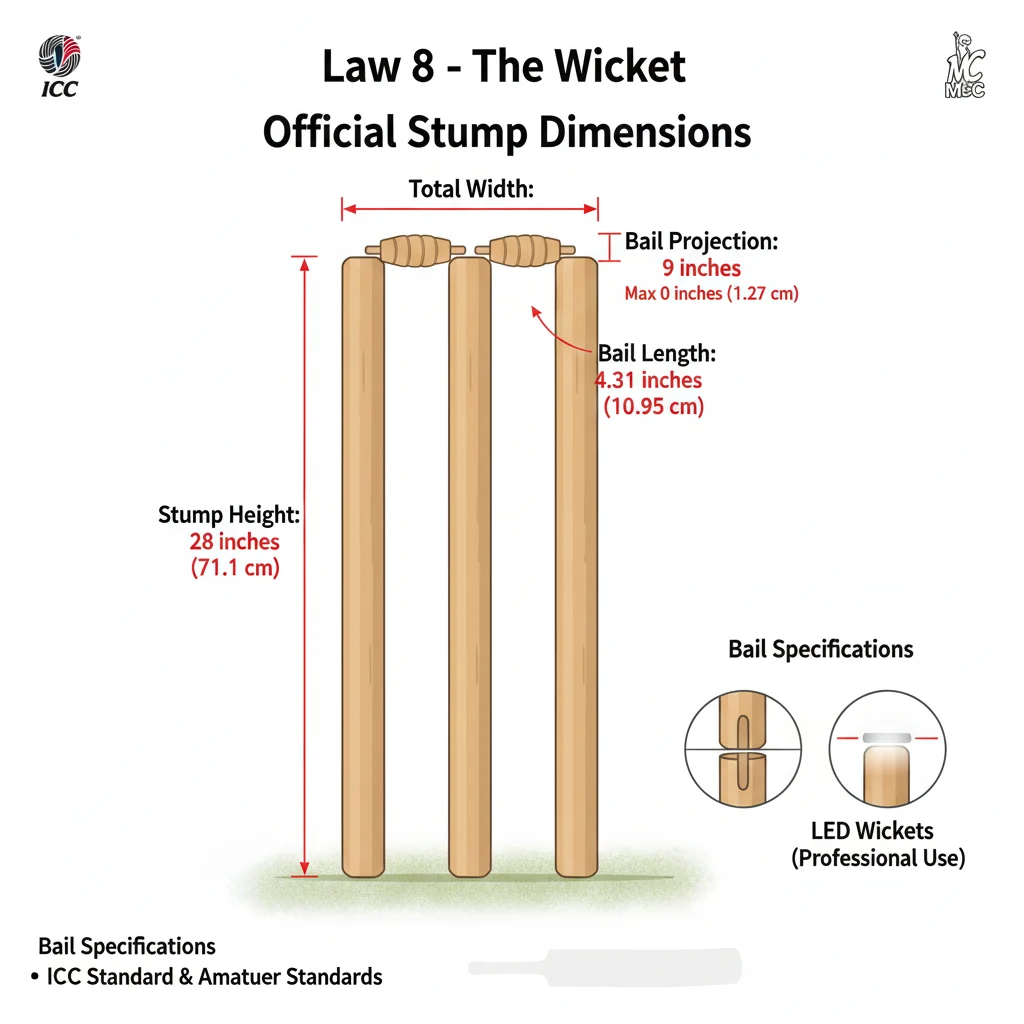
- Stumps: Three wooden stumps must be 28 inches (71.1 cm) tall.
- Bails: The two bails must not project more than 0.5 inches (1.27 cm) above the stumps.
- Width: The three stumps together must have a total width of 9 inches (22.86 cm).
- LED Stumps: In major tournaments, LED stumps and bails are used. They are designed to be the same size and weight as traditional wooden ones but contain a micro-circuit that lights up upon being dislodged.
SightScreen
A mandatory white or black screen placed at the boundary directly behind the bowler to provide a clear background for the batter to see the ball.
Illegal Equipment and Umpire’s Discretion
- Bat Tampering: Applying any substance (like silicone tape or extra grip) to the face of the bat is illegal, as it can unfairly alter the ball’s bounce or spin.
- Umpire’s Authority: The umpires have the final say on the legality of any equipment. They can inspect a player’s bat or ball at any time and disallow any item they deem to be in breach of the laws or dangerous.
Equipment Rules for Different Formats
The core equipment rules are consistent across formats, but some nuances exist:
- Test Cricket: Red ball is standard (pink for day/night). Traditional white clothing.
- Limited-Overs (ODI & T20): White ball is standard. Colored clothing is worn.
- The Hundred: Follows white-ball equipment rules but with distinct team-branded kits.
Recent Changes and Controversies
- Bat Thickness (Edge & Spine): In 2017, the MCC introduced stricter rules on the thickness of bat edges and the depth of the “spine” to prevent bats from becoming too powerful and skewing the balance between bat and ball.
- Mankading & Batter’s Equipment: A batter is considered to have left their crease when no part of their bat or person (equipment included) is grounded behind the popping crease.
- Helmet Safety: Ongoing evolution of helmet design, especially following tragic incidents, has led to mandatory use of the highest safety standards.
FAQs
Q1: Why are cricket bats made only of willow?
A: English willow is the perfect combination of lightness, strength, and fibrous structure, which allows for powerful hitting without being excessively heavy.
Q2: Can a batter use a different colored bat?
A: Yes, as long as the bat is made of wood and conforms to size regulations. However, the ICC can regulate this in international matches for commercial or visibility reasons.
Q3: What happens if the ball hits a helmet kept on the field?
A: If the ball in play hits a helmet (or any other protective equipment) placed on the ground by the fielding side, the batting side is awarded 5 penalty runs.
Q4: Are there rules for wicket-keeping gloves?
A: Yes, wicket-keeping gloves must not have webbing between the fingers except for a single piece of flexible material joining the index finger and thumb.
Q5: Can a bowler change the condition of the ball?
A: No. Polishing the ball on clothing is allowed, but rubbing the ball on the ground, scratching the surface, or applying any artificial substance (like saliva or sandpaper) is illegal and constitutes ball-tampering.
Conclusion
The equipment rules in cricket are far from arbitrary; they are the foundation upon which a fair and safe contest is built. From the precise dimensions of the bat to the certified safety of a helmet, every piece of gear is regulated to preserve the essential spirit of the game. Understanding these rules not only deepens appreciation for the sport but also highlights the continuous effort to balance tradition with innovation and safety.

Liam Thompson is a cricket regulations analyst who covers international and league-level rules in depth. He focuses on fielding laws, over-rate penalties, powerplay strategies, and updated ICC guidelines. Liam’s goal is to educate readers while keeping the excitement of the game alive.