
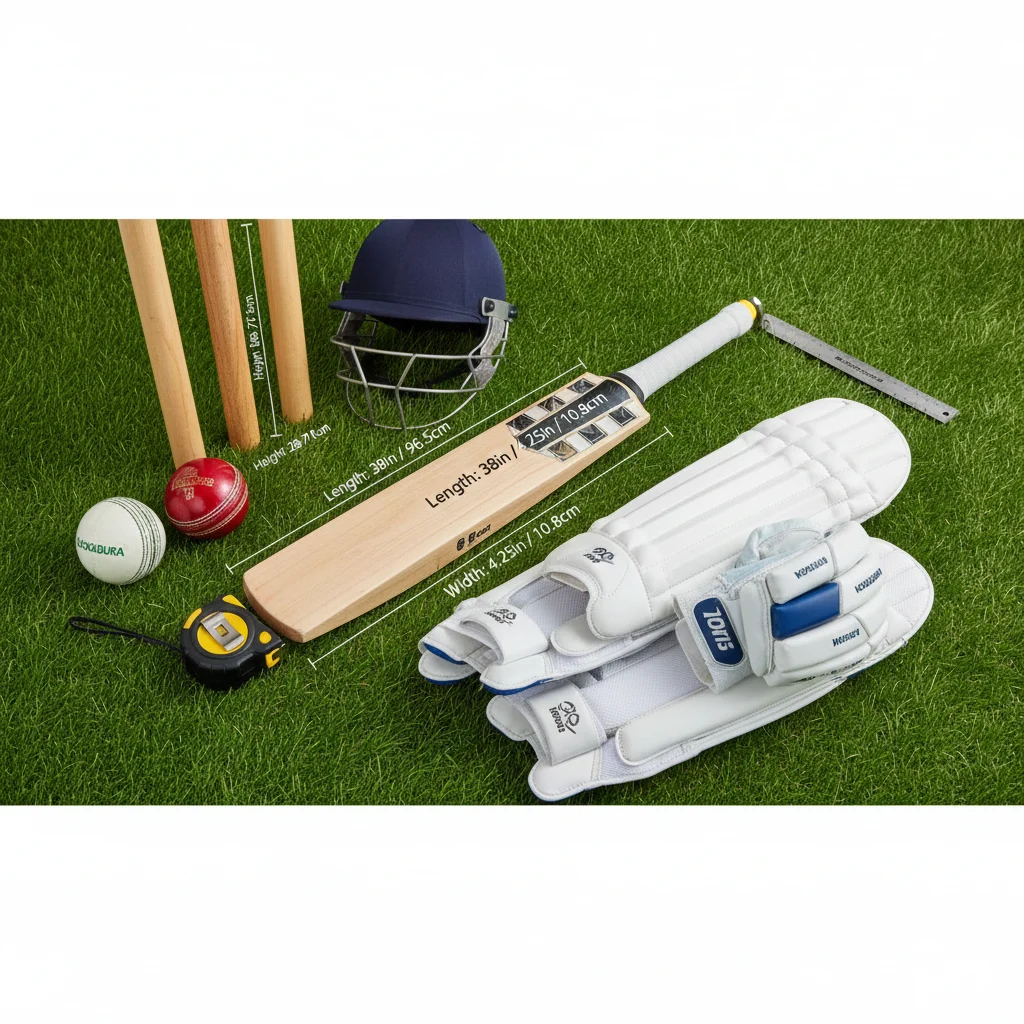
A cricket bat can look normal and still fail the gauge. A spare helmet can be placed in the wrong spot and cost the fielding side 5 penalty runs. Even wicket-keeper gloves have shape rules. That is why cricket equipment laws matter so much. They protect fairness, safety, and the balance between bat and ball.
Here is the quick answer. A legal senior cricket bat can be no longer than 38 inches (96.52 cm). Its blade can be no wider than 4.25 inches (10.8 cm), no deeper than 2.64 inches (6.7 cm), and its edges can be no deeper than 1.56 inches (4.0 cm). A standard men’s ball must weigh 155.9 to 163 g and measure 22.4 to 22.9 cm in circumference. A full wicket must be 9 inches (22.86 cm) wide, and the tops of the stumps must stand 28 inches (71.12 cm) above the ground.
MCC is the custodian of the Laws of Cricket, so the core bat, ball, stump, and wicket-keeper glove rules come from MCC. In international cricket, the ICC then adds playing conditions and clothing/equipment regulations, especially for helmets and match presentation.
The Cricket Bat: Size, Shape, and Material Rules
The cricket bat is not just “a piece of willow.” It is one of the most tightly controlled pieces of equipment in the sport. That is because bat technology can change the balance of cricket very quickly. If bats become too thick, too powerful, or too forgiving, bowlers lose ground and the contest becomes unfair. That is why the bat law focuses so strongly on dimensions and permitted materials.
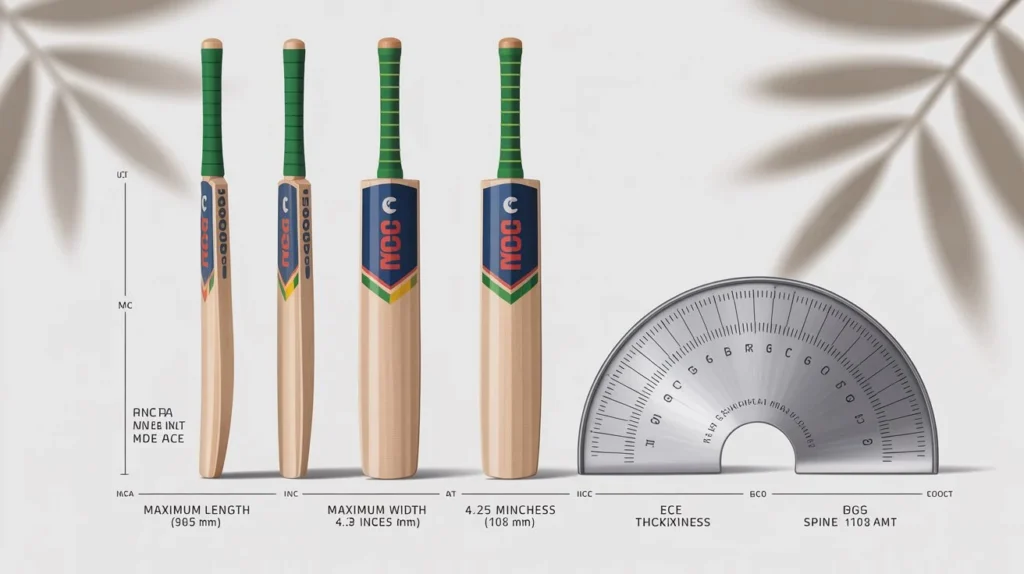
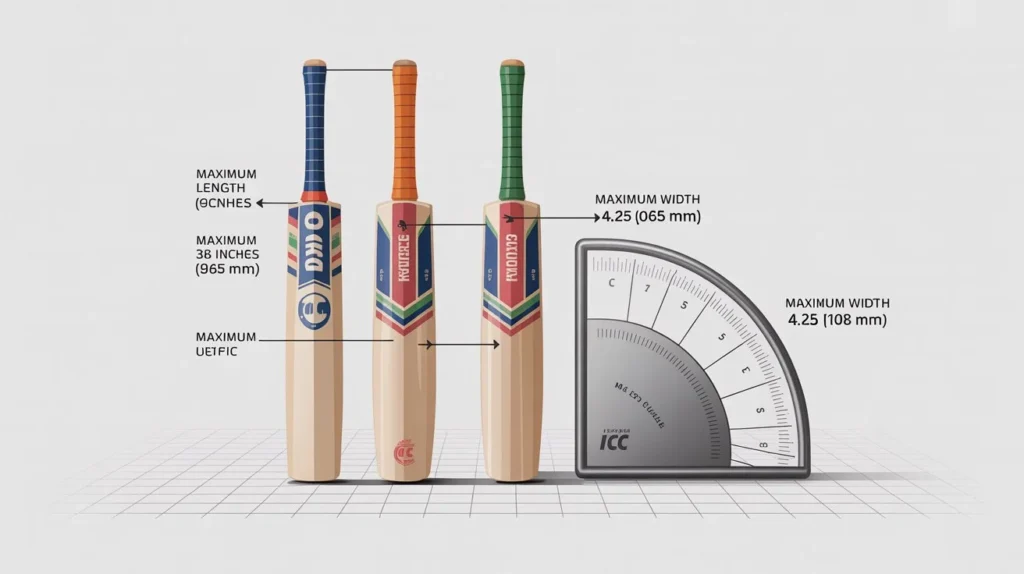
Under MCC Law 5, the key bat limits for a full-size bat are:
- Maximum overall length: 38 in / 96.52 cm
- Maximum blade width: 4.25 in / 10.8 cm
- Maximum blade depth: 2.64 in / 6.7 cm
- Maximum edge size: 1.56 in / 4.0 cm
- Handle length: for bats above size 6, the handle must not exceed 52% of the bat’s overall length
- The bat must also be able to pass through the official bat gauge.
That last point is very important. Many casual readers know the length and width rule, but they forget the gauge test. Modern bats are not checked only by a tape measure. They must also pass through an official gauge shape. In simple words, a bat can look legal from one angle and still fail if it is too swollen in the blade or edges. That makes the gauge one of the most practical anti-excess rules in cricket.
Read More About: Rules of Replacing the Ball in Cricket (T20, ODI & Test)
The blade itself must be made of wood. The handle must be made mainly of cane and/or wood. This is why metal bats, plastic match bats, or other experimental materials are not legal under normal cricket laws. At recreational level you may see all sorts of local variations, but in law-based match cricket the construction rules remain strict.
A lot of players also ask about tape, guards, and repairs. MCC allows limited protective and repair materials, but only within clear thickness limits. Material used for covering the blade must not exceed 0.04 in / 0.1 cm in thickness. Protective material on the toe of the blade must not exceed 0.12 in / 0.3 cm. Even when those materials are permitted, the bat must still pass the gauge. So the law does not ban protection, but it does stop protection from turning into hidden power.
This is the practical lesson for players: a legal bat is not simply one that “looks standard.” It must satisfy the length, width, depth, edge, and gauge rules together. If you are writing for readers who buy bats online or in local shops, this point deserves emphasis because many beginners only check bat weight and brand, not legality.
The Cricket Ball: Weight, Size, and Color Regulations
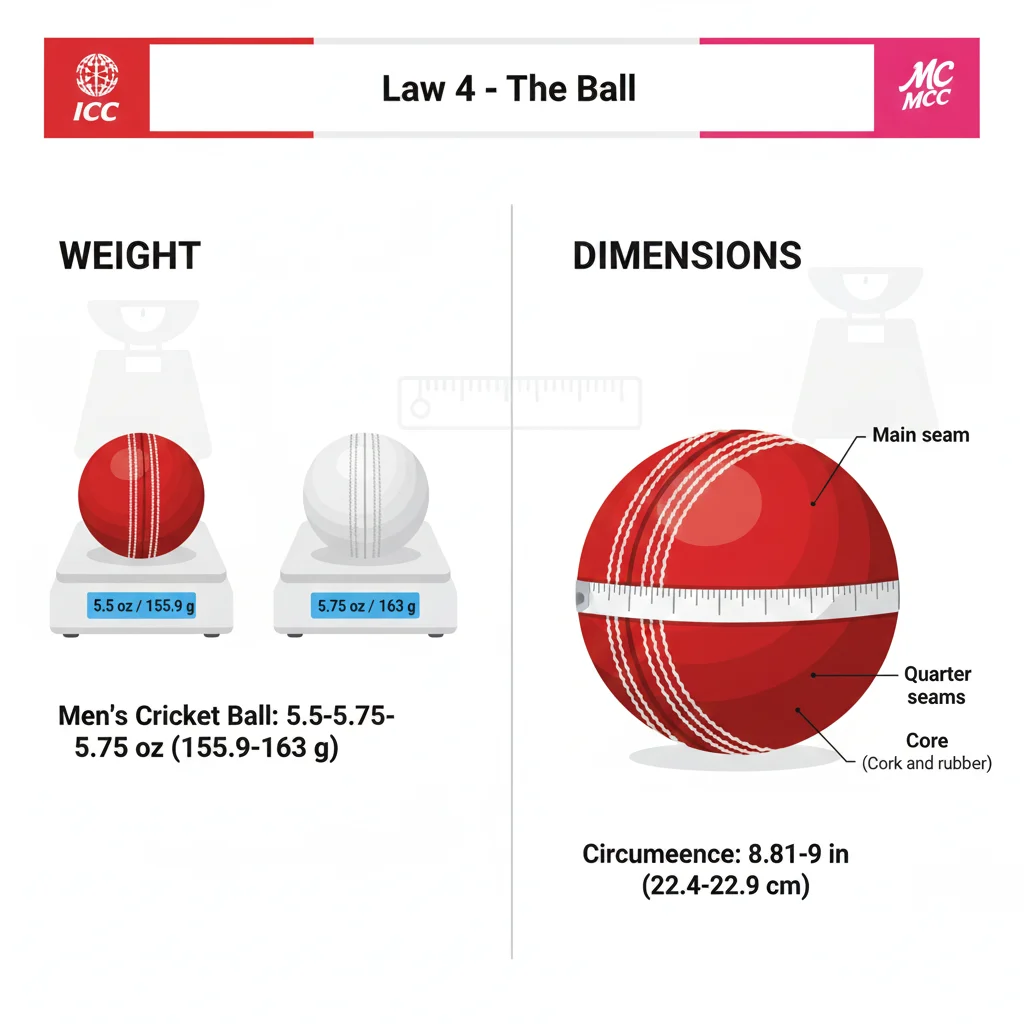
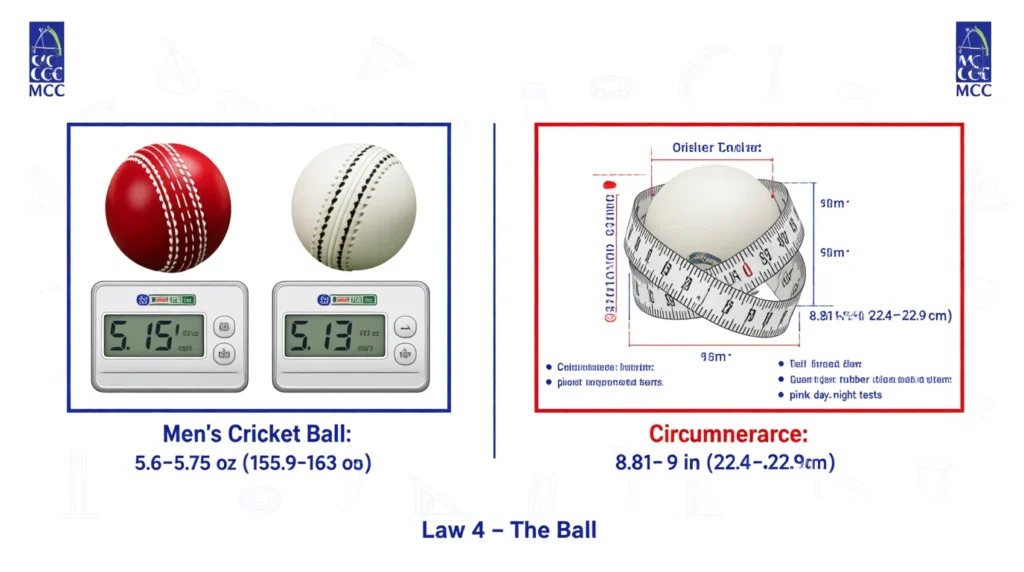
The cricket ball is also controlled very carefully because even small changes in size, seam, and weight can affect swing, bounce, carry, and durability. MCC Law 4 sets the official specifications, and it also makes clear that the umpires control the ball used in the match.
For men’s cricket, the standard ball must weigh between 155.9 g and 163 g and measure between 22.4 cm and 22.9 cm in circumference.
For women’s cricket, the ball must weigh between 140 g and 151 g and measure between 21.0 cm and 22.5 cm in circumference.
For junior cricket under 13, the ball must weigh between 133 g and 144 g and measure between 20.5 cm and 22.0 cm in circumference.
That matters because many readers wrongly assume there is only one official cricket ball size. In reality, the law already allows different official ball sizes depending on the level of cricket. So “official cricket ball weight” may need the answer for men’s cricket, women’s cricket, or junior cricket.
The law also says that the governing body responsible for the match decides which size of ball will be used. If no such decision has been made, the umpires decide. Once the balls are selected, they must be in the umpires’ possession before the toss and remain under their control during the match. That is a small detail, but it shows how seriously cricket treats equipment fairness.
Read More About: Cricket Helmet Rules for Fielders and Wicketkeepers: Full Detailed Guide
For readers, the most useful takeaway is simple: the ball is not just “a red ball” or “a white ball.” It has official weight and circumference limits, and the match officials control it from the start. That is why arguments about replacement balls, damaged balls, or incorrect ball size are not just random delays. They go to the heart of the Laws.
Ball Colors
- Red: The traditional color, used in Test matches and First-Class cricket.
- White: Used in limited-overs cricket (ODIs and T20s) for better visibility under floodlights. The specifications are identical to the red ball.
- Pink: Used in Day/Night Test matches, as it remains more visible than red under lights.
- Orange: Sometimes used in informal or recreational cricket for high visibility.
Protective equipment rules: batters, wicket-keepers, and fielders
Player safety is paramount, and the use of protective gear is both encouraged and regulated.
Protective equipment is one area where readers often mix general cricket habit with actual law. The law does not say “wear whatever helps.” It defines which visible protective items are allowed and who may wear them. MCC’s appendices make this very clear. For a batter, the permitted external protective equipment includes a protective helmet, batting pads, batting gloves, and, if visible, forearm guards. For a fielder, only a protective helmet is permitted, except for the wicket-keeper, who may also wear wicket-keeping gloves and pads.
That means ordinary fielders are not free to wear gloves just because they want extra comfort or grip. Under Law 28, no fielder other than the wicket-keeper may wear gloves or external leg guards. Protection for the hand or fingers may be worn only with the umpires’ consent. So if a reader asks, “Can fielders wear gloves in cricket?” the normal law-based answer is no, except in the limited way the law allows.
Read More About: Five Penalty Runs in Cricket (2026): Full Rule Explained with Real Match Stories
The wicket-keeper gets special treatment because the role is unique. Under Law 27, the wicket-keeper is the only fielder permitted to wear gloves and external leg guards. But even those gloves are regulated. If gloves are worn, there must be no webbing between the fingers except between the index finger and thumb, where support webbing is allowed. That webbing must be a single piece of non-stretch material with no reinforcements or tucks, and it must not protrude beyond the straight line from the top of the index finger to the top of the thumb.
This is one of the best examples of cricket’s balance between practicality and fairness. A wicket-keeper needs specialist gloves. But the gloves cannot become an unfair net or scoop. The law allows support, not a catching shortcut. That is why the shape of the webbing is regulated so tightly.
Helmet rules: what is required in top-level cricket?
Helmet rules are one of the clearest places where the ICC’s international regulations become important. ICC playing conditions state that players must wear helmets in certain situations: batters facing pace bowling, wicket-keepers standing up to the stumps, and players fielding close to the batter in front of the wicket. ICC rules also state that all such helmets must be BS7928:2013-certified.
The ICC also explains that when a helmet is worn in international cricket, it must comply with the British Standard, and that the 2019 update to the standard included specifications related to neck protectors. So for an article aimed at serious readers, it is not enough to say “players wear helmets for safety.” The better answer is that certified helmets are part of the formal equipment framework in modern cricket.
For club and local cricket, competitions may apply their own rules on top of the Laws, so players should always check local playing conditions. But the international standard is now very clear: helmet safety is regulated, not casual.
The spare helmet rule: why 5 penalty runs can happen
This is one of the most useful equipment rules for readers because it often appears in FAQs and match commentary. Under Law 28.3, a protective helmet belonging to the fielding side, when not in use, may only be placed behind the wicket-keeper and in line with both sets of stumps. If the ball in play strikes that helmet, the ball becomes dead and the batting side is awarded 5 penalty runs, with completed runs and the run in progress handled according to the law.
Read More About: Player Leaving the Field in Cricket: Full Rules for Injury, Substitutes, Return, and Penalty Time
This rule surprises many casual fans because the helmet is not being worn. But that is exactly why the law exists. Spare equipment left in the wrong area can interfere with live play. Cricket therefore treats that helmet placement as part of equipment law, not just ground tidiness. If you want your article to feel expert, this is one of the best examples to include.
Clothing and Footwear Regulations
- Clothing: Teams must wear standardized uniforms, typically consisting of a collared shirt, trousers, and a sweater or jumper for Tests, and colored jerseys and trousers for limited-overs. Logos and branding are strictly regulated by the ICC.
- Footwear: Spiked shoes (metal or plastic) are allowed to provide grip. The spikes must not be sharp enough to damage the pitch deliberately.
The Stumps, Bails, and SightScreen
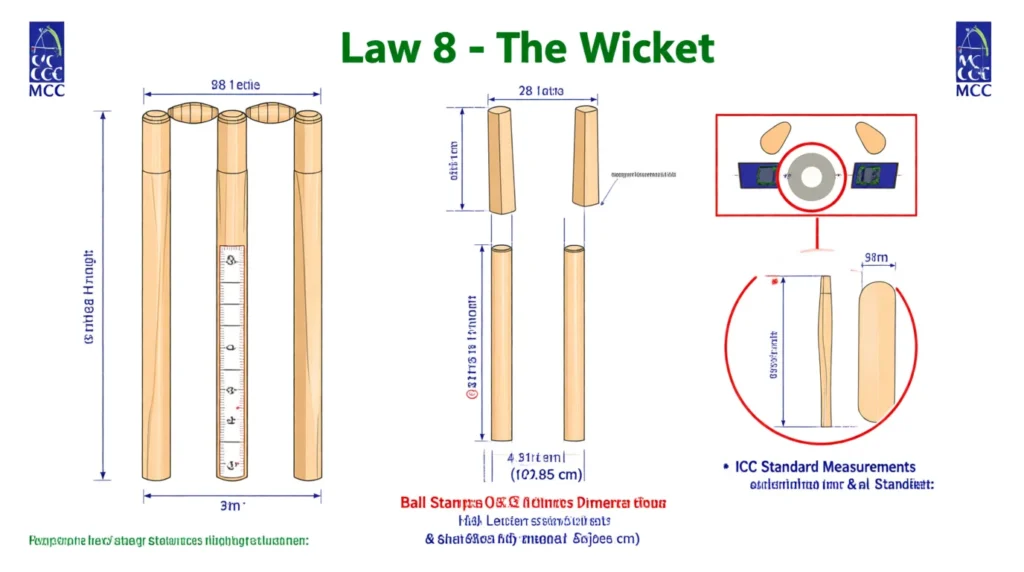
Stumps and Bails (Law 8)
- Stumps: Three wooden stumps must be 28 inches (71.1 cm) tall.
- Bails: The two bails must not project more than 0.5 inches (1.27 cm) above the stumps.
- Width: The three stumps together must have a total width of 9 inches (22.86 cm).
- LED Stumps: In major tournaments, LED stumps and bails are used. They are designed to be the same size and weight as traditional wooden ones but contain a micro-circuit that lights up upon being dislodged.
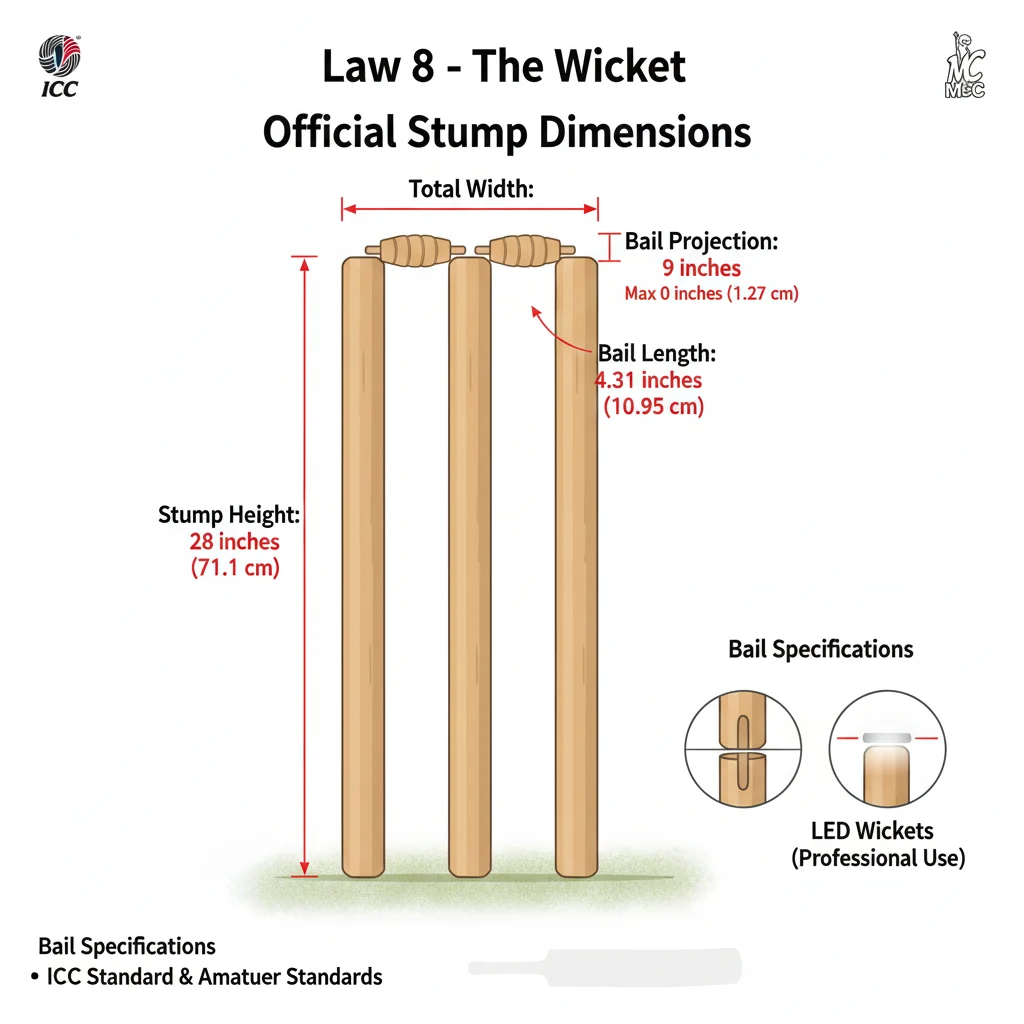
Many cricket fans talk about wickets all the time, but fewer know the official measurements. MCC Law 8 states that each wicket is 9 inches (22.86 cm) wide and consists of three wooden stumps with two wooden bails on top. The tops of the stumps must stand 28 inches (71.12 cm) above the playing surface.
The stump body above the ground must also stay within a legal diameter range. MCC states that this circular section must be no less than 1.38 in / 3.50 cm and no more than 1.5 in / 3.81 cm. That may sound like a minor detail, but it helps keep the wicket consistent across grounds. If the stumps are too thin or too thick, the behaviour of the wicket changes.
The bails have their own rules too. When in position, they must not project more than 0.5 in / 1.27 cm above the stumps, and MCC’s specifications also set the bail’s overall length at 4.31 in / 10.95 cm. These are not decorative details. They decide what counts as the wicket being broken and help keep run-out, bowled, and stumping decisions consistent.
This is why stump dimensions matter more than many readers think. In cricket, a tiny margin can separate not out from out. So the wicket itself must be standardized. That is one reason equipment laws exist: not to make the game complicated, but to stop the field from changing the result unfairly.
SightScreen
A mandatory white or black screen placed at the boundary directly behind the bowler to provide a clear background for the batter to see the ball.
Who checks if equipment is legal?
Cricket does not leave all equipment legality to players. The umpires have a direct role. MCC Law 2 says that before the toss and during the match, the umpires must satisfy themselves that the ball, the visible bat requirements, the stumps and bails, and the wicket-keeper’s gloves conform to the Laws. They must also ensure that no player is using equipment other than that permitted.
Illegal Equipment and Umpire’s Discretion
- Bat Tampering: Applying any substance (like silicone tape or extra grip) to the face of the bat is illegal, as it can unfairly alter the ball’s bounce or spin.
- Umpire’s Authority: The umpires have the final say on the legality of any equipment. They can inspect a player’s bat or ball at any time and disallow any item they deem to be in breach of the laws or dangerous.
Equipment Rules for Different Formats
The core equipment rules are consistent across formats, but some nuances exist:
- Test Cricket: Red ball is standard (pink for day/night). Traditional white clothing.
- Limited-Overs (ODI & T20): White ball is standard. Colored clothing is worn.
- The Hundred: Follows white-ball equipment rules but with distinct team-branded kits.
Recent Changes and Controversies
- Bat Thickness (Edge & Spine): In 2017, the MCC introduced stricter rules on the thickness of bat edges and the depth of the “spine” to prevent bats from becoming too powerful and skewing the balance between bat and ball.
- Helmet Safety: Ongoing evolution of helmet design, especially following tragic incidents, has led to mandatory use of the highest safety standards.
Important 2026 update readers should know
MCC has already announced a new edition of the Laws of Cricket that will come into force on 1 October 2026. Among the published headline changes are tighter tolerances for women’s and junior cricket balls, and a change allowing Type D bats, which may be laminated, in open-age cricket, not just junior cricket.
That does not mean every competition is already using those changes today. It means readers should understand the timeline. If they are checking current match law in March 2026, they should follow the law framework currently in use. If they are preparing content meant to stay fresh later in 2026 and beyond, then this upcoming edition deserves a note in the article.
FAQs
Q1: Why are cricket bats made only of willow?
A: English willow is the perfect combination of lightness, strength, and fibrous structure, which allows for powerful hitting without being excessively heavy.
Q2: Can a batter use a different colored bat?
A: Yes, as long as the bat is made of wood and conforms to size regulations. However, the ICC can regulate this in international matches for commercial or visibility reasons.
Q3: What happens if the ball hits a helmet kept on the field?
A: If the ball in play hits a helmet (or any other protective equipment) placed on the ground by the fielding side, the batting side is awarded 5 penalty runs.
Q4: Are there rules for wicket-keeping gloves?
A: Yes, wicket-keeping gloves must not have webbing between the fingers except for a single piece of flexible material joining the index finger and thumb.
Q5: Can a bowler change the condition of the ball?
A: No. Polishing the ball on clothing is allowed, but rubbing the ball on the ground, scratching the surface, or applying any artificial substance (like saliva or sandpaper) is illegal and constitutes ball-tampering.
What is the legal size of a cricket bat?
A full-size legal bat can be no longer than 38 inches, no wider than 4.25 inches, no deeper than 2.64 inches, and its edges can be no deeper than 1.56 inches. It must also pass the official bat gauge.
What is the official weight of a cricket ball?
For men’s cricket, the official ball weight is 155.9 to 163 g. Women’s and junior under-13 cricket use smaller official ranges under MCC Law 4.
Are wicket-keepers the only fielders allowed gloves?
Yes. Under MCC Law 27 and Law 28, the wicket-keeper is the only fielder permitted to wear wicket-keeping gloves. Other fielders cannot wear gloves or external leg guards, except limited hand or finger protection with umpire consent.
What happens if the ball hits a spare helmet on the field?
If the fielding side’s spare helmet is placed in the allowed location and the live ball hits it, the ball becomes dead and the batting side is awarded 5 penalty runs, subject to the law’s scoring conditions.
Are the 2026 equipment law changes already active?
Not yet. MCC has announced that the new 2026 edition comes into force on 1 October 2026.
Conclusion
The equipment rules in cricket are far from arbitrary; they are the foundation upon which a fair and safe contest is built. From the precise dimensions of the bat to the certified safety of a helmet, every piece of gear is regulated to preserve the essential spirit of the game. Understanding these rules not only deepens appreciation for the sport but also highlights the continuous effort to balance tradition with innovation and safety.
