
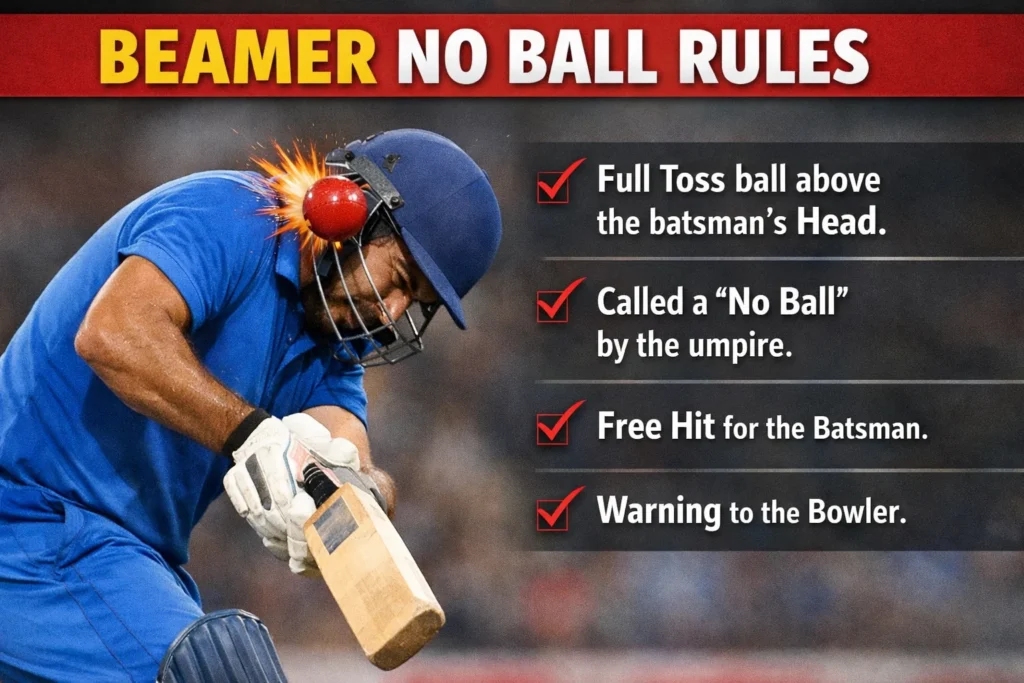
A beamer in cricket is one of the most dangerous balls a bowler can deliver. In simple words, it is a full-pitched ball that does not bounce and passes, or would have passed, above the batter’s waist height while the batter is standing upright at the popping crease. In the official law book, MCC does not mainly use the everyday word “beamer”; it describes this as dangerous and unfair non-pitching bowling. Whenever such a ball is bowled, the umpire must call No ball.
Many cricket fans think every beamer means the bowler will be banned from bowling immediately, that the ball becomes dead at once, or that runs from the bat do not count. Those ideas are not fully correct under the current laws. A beamer ball in cricket is always a No ball, but whether it is also judged dangerous depends on the umpire’s view of the risk of injury. Also, a No ball does not automatically become dead, and in white-ball international cricket the next delivery is a free hit.
This matters because the beamer rule sits at the heart of cricket safety. A fast full toss can rush at the batter before there is normal time to react, especially if the batter expects the ball to pitch. That is why the law is strict, why umpires treat repeated beamers seriously, and why famous matches still get remembered for one scary beamer.
What Is Beamer In Cricket
A beamer is a full toss above the batter’s waist height. It is always a No ball. If the umpire believes it also created a real risk of injury, the bowler gets a first and final warning for that innings, and a further dangerous beamer by the same bowler in that innings leads to removal from the attack.
If the umpire believes the beamer was deliberate, the bowler can be suspended from bowling immediately, without that warning step. In ODI and T20 international cricket, the next delivery after that No ball is a free hit.
Beamer meaning in cricket is a full-pitched ball that does not bounce and passes, or would have passed, above the batter’s waist height while the batter is judged standing upright at the popping crease, so the umpire calls it a no-ball.
Also Read More About: Wide Ball Rules in Cricket
What Exactly Is a Beamer?
The cleanest definition comes from Law 41.7.1. The law says that any delivery which passes, or would have passed, without pitching, above the striker’s waist height while standing upright at the popping crease, is unfair, and the umpire must call and signal No ball.
Beamer no ball rules in cricket say that any full-pitched delivery that passes, or would have passed, above the batter’s waist height without bouncing is called a no-ball.
The law is not mainly asking whether the ball was aimed at the head. The first legal test is simpler: no bounce, above waist, batter upright at the popping crease.
That is why a beamer is not just “a scary ball near the face.” In everyday cricket talk, people often use the word beamer for a nasty head-high full toss, but the law starts the no-ball judgment lower than that. If the ball would have passed above waist height, it is already unfair. The “head-high” image comes from the most dramatic beamers, not from the full legal definition.
A beamer is also different from a normal bad full toss. A full toss below waist height can still be legal. It may be a poor delivery, but it is not automatically a no-ball under this law. Once the full toss rises above the waist-height limit, it crosses into unfair territory and the umpire must intervene.
The Most Important Formula to Remember
If you want one simple line for your readers, use this:
No bounce + above waist height + batter judged upright at the popping crease = No ball for a beamer.
That one formula explains most of the rule.
Beamer vs Full Toss vs Bouncer
A lot of confusion disappears when you separate these three deliveries.
A full toss is any ball that reaches the batter without bouncing. Some full tosses are legal, some are not. A beamer is the illegal kind: a full toss that passes above waist height. A bouncer is different because it pitches first and then climbs. So a beamer and a bouncer can both feel threatening, but one is a non-pitching full toss and the other is a short ball that has bounced off the pitch.
This difference matters because the beamer law and the dangerous short-pitched bowling law are related, but they are not the same. The warning sequence for short-pitched dangerous balls is separate from the warning sequence for dangerous non-pitching balls. So a bowler’s trouble for bouncers does not automatically replace or merge with the trouble for beamers.
Also Read More About: Types of Bowlers in Cricket 🏏
The Official Law: What the Rulebook Really Says
The law has two layers. First, it says the ball is unfair if it is a full toss above waist height. Second, it says the ball is also dangerous if the bowler’s-end umpire believes there is a risk of injury to the striker. In making that judgment, the umpire must disregard protective equipment and consider the speed, height, direction, skill of the striker, and repeated nature of such deliveries.
This is a very important correction because many articles wrongly say that every beamer is automatically dangerous in exactly the same way. The modern law does not work like that. Every above-waist full toss is unfair and therefore a No ball. But the extra step of warning, suspension, or immediate removal depends on whether the umpire judges the delivery to be dangerous, or deliberate.
2 Beamer Rule In Cricket
Two beamer rule in cricket means that if the same bowler bowls one dangerous beamer, the umpire gives a first and final warning, and if that bowler bowls another dangerous beamer in the same innings, the bowler is removed from the attack and cannot bowl again in that innings.
Why “Standing Upright at the Popping Crease” Matters
One of the smartest details in the law is the phrase “standing upright at the popping crease.” This stops players, commentators, and fans from judging the ball only by the batter’s bent body shape at impact. If the batter ducks, crouches, bends, or charges down the pitch, the umpire still has to imagine the batter upright at the popping crease and judge the height from that legal picture.
This is exactly why some no-ball decisions become controversial. In the dramatic Australia–India women’s ODI in 2021, the officials had to judge where Nicola Carey’s waist would have been if she had been upright at the popping crease, not just where her bent body was when the ball arrived. Cricket Australia’s explanation of that finish showed how difficult that geometry can be, even on replay.
Beamer bowled in cricket does not become a legal wicket just because the ball goes on to hit the stumps. If a bowler delivers a full toss that passes, or would have passed, above the batter’s waist height without bouncing, the umpire must call it a no-ball, even if the ball then brushes past the batter’s head, shoulder, or body and crashes into the stumps.
In that case, the batter is not out bowled, because a bowled dismissal is not allowed from a no-ball. But if the full toss is below waist height, it can still be a legal delivery, and the batter can be out bowled if it hits the stumps.
A good real match example came in South Africa vs Pakistan in April 2021, when Lungi Ngidi bowled a high full toss that Shadab Khan deflected onto his own stumps. Even though the stumps were broken, the delivery was called a no-ball because it was judged too high, so the wicket did not count. That incident is a strong example of how a ball hitting the stumps does not make an above-waist beamer legal.
Is Every Beamer Dangerous?
No.
Every beamer is unfair, and therefore a No ball, but not every beamer is automatically treated as dangerous in the same way. The umpire must decide whether there was a real risk of injury. The law tells the umpire to look at speed, height, direction, the batter’s skill, and whether this kind of delivery has happened repeatedly in that innings.
This is why the old “fast beamer” and “slow beamer” table needs to be handled carefully. Those are useful cricket terms for explanation, but they are not separate official law categories with separate rulebooks. A slower over-waist full toss is still unfair and still a No ball. The difference is that the umpire may judge a slower, wider, or less threatening ball as not dangerous, while a very fast one aimed through the body line may clearly be dangerous.
Also Read More About: T20 Fielding Rules: ICC Guidelines, Field Restrictions, and Real Match Scenarios
Accidental Beamer vs Deliberate Beamer
In real cricket, many beamers are accidental. A ball can slip out because of dew, sweat, nerves, grip, or loss of control. But the law still punishes the ball as a No ball because safety comes first. Intent is not needed for the initial No-ball call. If it is above-waist and non-pitching, it is unfair.
However, intent does matter at the higher punishment level. If the umpire thinks the bowler deliberately bowled such a ball, the normal warning step is skipped. The umpire calls No ball and, once the ball is dead, tells the captain to suspend that bowler from bowling immediately for the rest of the innings. The incident is then reportable after the match.
This is why articles should not say “the rule does not consider intent” without qualification. That sentence is only partly true. For the No-ball call, intent does not save the bowler. For the disciplinary step beyond the No ball, intent can make the punishment much more severe.
What Happens the Moment a Beamer Is Bowled?
The first thing the umpire does is call and signal No ball. That gives the batting side one run immediately. But that is only the starting point, not the whole result.
This next correction is critical: the ball does not become dead on the call of No ball. Under Law 21.14, a No ball does not automatically kill the play. So if the batter still hits the ball, runs can be scored. If the ball reaches the boundary, the boundary can count. If the batter misses, byes or leg byes may still be possible under the normal scoring rules.
That means a beamer can be both a No ball and a scoring shot. A batter can edge it, pull it, slash it, or even hit it for four or six. Those runs are added on top of the no-ball extra. This is one of the most common myths in cricket writing, and it is exactly why your old draft needed correction.
Also Read More About: Five Penalty Runs in Cricket (2026): Full Rule Explained with Real Match Stories
If the Batter Hits a Beamer for Four or Six, Does It Count?
Yes. It counts.
If the beamer is struck with the bat, completed runs or boundary allowance are credited to the striker, and the one-run No-ball penalty is added as an extra. So if the batter hits the beamer for six in ODI or T20 cricket, the batting side gets seven in total: six to the batter and one No-ball extra.
If the ball is not struck by the bat, then the extra scoring can go down as byes or leg byes if the relevant conditions are met, again with the one-run No-ball penalty standing on top.
Can the Batter Be Out Off a Beamer?
A beamer is a No ball, so the dismissal rules for No balls apply.
When No ball has been called, the batter cannot be out in the normal bowler-earned ways such as bowled, caught, LBW, stumped, or hit wicket. But the batter can still be out Run out, Obstructing the field, or Hit the ball twice. This is another place where many online articles become too short and say “only run out,” which is incomplete.
So if a batter skies a beamer and a fielder catches it, that is not out, because caught is not allowed from a No ball. But if the batters run badly and one is run out, that dismissal can still stand.
Does a Beamer No-Ball Bring a Free Hit?
In ICC ODI and T20 international playing conditions, yes. The delivery following a No ball called of any kind is a free hit. That includes a beamer No ball. If the free-hit ball is itself another No ball or a Wide, the next delivery is again a free hit.
This is one of the biggest corrections from your earlier article. Saying that a beamer in ODI or T20 does not bring a free hit is wrong under current ICC white-ball playing conditions. The law is clear: all modes of No ball lead to a free hit in those formats.
The Warning System Under the Current Law
Here is the modern sequence in simple English.
If the umpire thinks the beamer was dangerous, the umpire waits until the ball is dead, repeats the No-ball signal to the scorers, and then gives the bowler a first and final warning. The umpire also informs the other umpire, the fielding captain, and the batters. That warning applies to that bowler for the whole innings.
If the same bowler then bowls another dangerous beamer in the same innings, the umpire again calls No ball and, once the ball is dead, directs the captain to suspend that bowler immediately from bowling again in that innings. If the over has to be completed, another bowler must finish it, and that replacement cannot have bowled the previous over or any part of the next over.
This warning sequence is separate from the one used for dangerous short-pitched bowling. So a bowler’s beamer warning and bouncer warning are tracked independently.
What If the Umpire Thinks the Beamer Was Deliberate?
Then the law gets much tougher.
If the umpire believes the bowler deliberately bowled the non-pitching above-waist delivery, the normal caution step is skipped. The umpire immediately calls No ball and, when the ball is dead, tells the captain to suspend that bowler from bowling again in that innings. The umpires then report the incident after the match.
This is why deliberate beamers are among cricket’s ugliest moments. They are not just bad balls. They are treated as direct threats to safety and the spirit of the game.
What If the Bowler Slips or the Ball Is Wet?
A slip or wet ball can explain why the beamer happened, but it does not erase the No-ball call. The first legal question is still whether the delivery was a full toss above waist height. If it was, the umpire must call No ball.
After that, the umpire still has to decide whether the ball was also dangerous. Match context can matter. In 2021, Cricket Australia explained that Jhulan Goswami’s first hand-to-head beamer to Nicola Carey brought a first-and-final warning, but her later over-waist full toss was judged “away from the body” and therefore not dangerous enough to require removal from the attack. That one example alone shows why fans should not assume every second above-waist full toss means automatic suspension under the current interpretation.
What About Slow Bowlers and Spinners?
The law does not create a separate official chapter saying one set of beamer rules for pace bowlers and another for spinners. The same core rule applies: above-waist non-pitching delivery equals No ball. The question of danger still depends on the umpire’s judgment of risk, which includes speed. So pace matters, but it matters inside the umpire’s danger decision, not as a separate legal definition of “beamer” itself.
This is a better and more accurate explanation than saying “slow beamers are just no-balls and fast beamers are dangerous.” A slower one can still be dangerous in context, and a quicker one is more likely to be seen that way, but the law leaves that judgment to the umpire rather than using a simple speed-label table.
Why the Rule Is So Strict
Cricket is built on risk, but it is supposed to be controlled risk. A batter expects the ball to pitch. A beamer removes that expected bounce and can attack the body line much sooner than planned. That is why the law separates ordinary bowling mistakes from dangerous non-pitching deliveries and gives umpires power to warn, suspend, and report.
The law also protects players by making the umpire ignore protective equipment when judging danger. In other words, a helmet does not make a dangerous beamer acceptable. The umpire must judge the risk to the striker, not the quality of the helmet.
History: How the Beamer Rule Changed
The current law did not always look like this. MCC announced in 2018 that it would amend Law 41.7 because the 2017 version had imposed stricter penalties on bowlers who delivered full tosses above the batter’s waist, and feedback suggested those sanctions had become too severe, especially for younger bowlers. MCC said the law would be adjusted from 1 April 2019 to allow umpires to make a more subjective decision over which deliveries were truly dangerous.
That history matters because it explains two different kinds of cricket talk that fans still use today. Some people still speak as if every over-waist full toss should bring an almost automatic next-stage punishment. That comes from the memory of stricter recent rules and tougher domestic playing conditions in some competitions. But the current MCC law puts the extra punishment on the danger judgment, not just on height alone.
Real Match Story 1: Brett Lee to Sachin Tendulkar, CB Series Final 2008
One of the most famous beamer moments came in the first final of the CB Series in Sydney in 2008. Brett Lee hit Sachin Tendulkar on the shoulder with a beamer when Tendulkar was batting on 98. Lee apologised immediately, Tendulkar shook his hand, and the moment passed without turning into a bigger on-field fight. Tendulkar later made clear that he believed it was not deliberate.
This incident is a great teaching example because it shows three important truths. First, even top fast bowlers can accidentally lose control. Second, the beamer law exists whether or not the bowler meant it. Third, players and fans often react first to the emotion of the moment, but the law still has to handle the delivery in a calm, technical way.
Real Match Story 2: Zimbabwe’s Friend Barred After Beamer at Tendulkar, World Cup 2003
A useful older example came during the 2003 World Cup, when ESPNcricinfo reported that Friend was barred from the attack by umpire Venkataraghavan after bowling a beamer at Sachin Tendulkar. That incident is often remembered as a reminder that beamers are not just embarrassing mistakes; they can cost a team its bowler inside the innings itself.
This story also helps readers understand that the discipline around beamers is not new. Long before the most recent MCC adjustment in 2019, umpires were already prepared to remove bowlers from the attack when dangerous full tosses crossed the line.
Real Match Story 3: Jack Wildermuth Removed in the BBL, 2017
A very clear removal example came in the Big Bash League in January 2017. Cricket Australia reported that Brisbane Heat paceman Jack Wildermuth bowled two deliveries above waist height to Luke Wright in the same over against Melbourne Stars, and the umpires removed him from the attack with one ball still left in his spell. Ben Cutting had to come on to bowl the last delivery.
This was the kind of incident fans love to study because it happened fast, in a pressure over, and showed exactly what an on-field suspension looks like in practice. It also reminds bowlers that one wild ball can be survived, but a repeated dangerous error in the same innings can end their spell immediately.
Real Match Story 4: Mohammed Siraj Suspended Mid-Over in IPL 2019
Another famous modern example came in the IPL in 2019. Reuters reported that Royal Challengers Bangalore paceman Mohammed Siraj was suspended midway through the 18th over for bowling a second beamer against Kolkata Knight Riders. The moment stood out because it happened in the death overs, exactly when teams most need control under pressure.
This is an excellent example for readers because it shows that the beamer rule is not some old textbook law that never appears in elite cricket. It still changes major games in modern T20 cricket, especially when bowlers miss the yorker at the end of an innings.
Real Match Story 5: Jhulan Goswami, Two High Full Tosses, But No Removal, 2021
The Australia–India women’s ODI in Mackay in 2021 is one of the best examples of the current law’s nuance. Jhulan Goswami first hit Nicola Carey’s helmet with a hand-to-head beamer and received a first-and-final warning. Later in the same over, she bowled another over-waist full toss. Many fans assumed she had to be removed. But Cricket Australia reported that umpire Claire Polosak explained the second one was away from the body and therefore was not deemed dangerous, so Goswami was allowed to continue.
This incident is gold for a rules article because it proves the modern law is not simply “two beamers and you are gone.” The real question is whether the later delivery is another dangerous such ball under the law, not merely another over-waist full toss in isolation.
Real Match Story 6: James Anderson to David Warner, Ashes 2023
Reuters reported that James Anderson floored David Warner with an unintended beamer in the fifth Ashes Test in 2023, with Warner fending off the shoulder-height ball with the bat handle. This is a good modern example of how even the most experienced bowlers can accidentally produce a beamer in top-level cricket.
It is also a reminder that not every famous beamer leads to suspension, endless controversy, or disciplinary theatre. Some are one-ball accidents. But even then, the law, the safety concern, and the visual shock of the moment remain the same.
What a Beamer Does to the Over
A No ball does not count as one of the over. So if a bowler sends down a beamer, another legal delivery still has to be bowled. That matters in T20 especially, because a beamer can mean an extra ball, a free hit in ODI/T20 cricket, and a possible loss of control at the exact worst time for the fielding team.
If the bowler is suspended after the dangerous-delivery sequence is triggered, another bowler completes the over, and that replacement bowler cannot have bowled the previous over or any part of the next over. So the punishment is not just personal to the bowler; it can disrupt the captain’s whole over plan.
Common Myths About Beamers
One myth is that every beamer becomes dead ball instantly. That is false. A No ball is not automatically dead, and runs can still come from the shot or as extras.
Another myth is that every beamer means instant suspension. That is also false. The law first asks whether the delivery was unfair, and then whether it was dangerous. Only dangerous repeated beamers by the same bowler in the innings, or a deliberate beamer, bring removal from the attack.
A third myth is that ODI and T20 beamers do not bring a free hit. Current ICC white-ball playing conditions say the next ball after all modes of No ball is a free hit.
A fourth myth is that the batter cannot score from a beamer. That is false too. If the batter hits it, the runs count, plus the one-run No-ball penalty.
Practical Advice for Bowlers
For bowlers, the first lesson is simple: do not treat a beamer like “just one bad ball.” Under pressure, one missed yorker can quickly become a safety issue, a free hit, a warning, and then a captaincy problem. Even if the ball slipped because of dew, the punishment on the scoreboard still arrives.
The second lesson is control under fatigue. Most famous beamer incidents happen in moments of pressure: death overs, fast spells, wet conditions, or frantic endings. Good bowlers do not only practice yorkers; they practice how to miss safely, how to change length, and how to reset after one mistake. That practical reading comes straight from the kind of match stories cricket keeps producing.
Practical Advice for Batters
For batters, the beamer rule gives protection, but not magic. A called No ball protects the batter from many dismissals, yet the ball may still hit the body, glove, shoulder, or helmet before the umpire’s arm becomes the story. That is why technique, awareness, and protective gear still matter so much.
Batters also need to know the scoring side of the law. If the beamer reaches them and they can control the shot, the safest choice is sometimes not outrage but a clear cricket stroke, because runs still count and a free hit may be coming next in white-ball cricket.
Why This Rule Matters More Than Many Fans Realize
The beamer rule in cricket is not just about punishing ugly bowling. It defines the line between aggression and loss of control. Cricket allows pace, intimidation, and pressure, but it does not allow bowlers to put batters in danger with uncontrolled non-pitching balls above waist height. That line is one of the game’s clearest safety boundaries.
It also affects strategy. One beamer can change the next ball, the over length, the bowler’s confidence, the captain’s plan, and the match mood. In white-ball cricket, it can also hand the batting side a free hit at exactly the moment they want to attack.
FAQ: Beamer Rules in Cricket
1) What is a beamer in cricket?
A beamer is a full-pitched delivery that does not bounce and passes, or would have passed, above the batter’s waist height while the batter is standing upright at the popping crease. It is always a No ball.
2) Is every beamer dangerous?
No. Every beamer is unfair and therefore a No ball, but the umpire separately decides whether it was also dangerous by looking at factors such as speed, height, direction, batter skill, and repetition.
3) Does a beamer make the ball dead immediately?
No. A No ball does not automatically make the ball dead. The batter can still hit the ball, and runs can still be scored.
4) If the batter hits a beamer for six, does the six count?
Yes. The six counts to the batter, and the one-run No-ball penalty is added as an extra.
5) Can a batter be out off a beamer?
Not by most common methods. On a No ball, the batter can still be out only by Run out, Obstructing the field, or Hit the ball twice.
6) Is the next ball a free hit after a beamer in ODI and T20 cricket?
Yes. In ICC white-ball international playing conditions, the next ball after any No ball is a free hit.
7) What is the punishment for a dangerous accidental beamer?
The umpire gives a first-and-final warning to that bowler for the innings. If the same bowler later bowls another dangerous beamer in that innings, the bowler is suspended from bowling again in that innings.
8) What happens if the umpire thinks the beamer was deliberate?
The warning step is skipped. The bowler can be removed from the attack immediately and reported after the match.
9) Does the law judge the ball from where the batter is bending or moving?
No. The key wording is the batter standing upright at the popping crease. That is the legal reference point for the height call.
10) Are beamers only a fast-bowler problem?
No. Any bowler can bowl one. Pace affects how dangerous the umpire thinks the ball was, but the No-ball rule still starts with the same above-waist full-toss test.
Final Conclusion
A beamer in cricket is not just a bad ball. It is a No ball by law, a possible dangerous delivery, and sometimes a disciplinary issue serious enough to remove a bowler from the attack. The current rule is more intelligent than many fans realize: it treats every above-waist full toss as unfair, but it leaves the deeper question of danger to the umpire’s judgment based on risk, not panic.
The most important corrections to remember are these: the ball is not automatically dead, runs from the bat can count, ODI and T20 beamers do lead to a free hit, and not every beamer brings instant suspension. Once readers understand those four points, they understand the heart of the modern beamer law.
And that is exactly why beamers remain one of cricket’s most dramatic moments. One ball can trigger fear, apology, controversy, scoring confusion, a free hit, a warning, or the end of a bowler’s spell. Few rules in cricket combine safety, law, pressure, and drama as sharply as the beamer rule does.
