
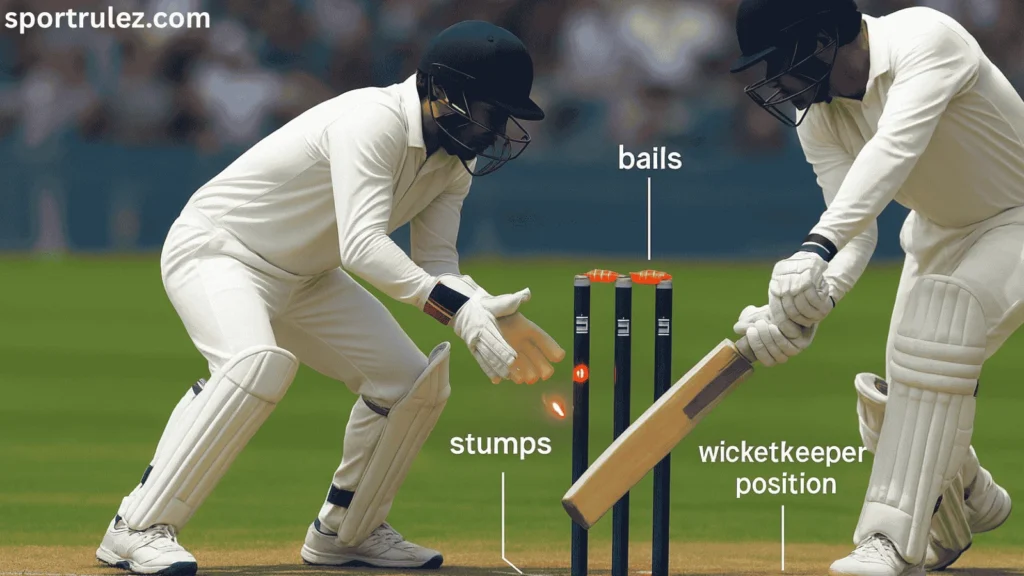
Cricket is full of thrilling moments, and one of its most electrifying sights is the wicketkeeper whipping off the bails in a flash — a stumping. It’s a blend of timing, anticipation, and skill. But what exactly is stumping? How do the rules work? And who reigns as the King of Stumping? Let’s dive deep into this fascinating aspect of cricket and answer every question you might have.
🏏 What Is Stumping in Cricket?
A stumping occurs when the wicketkeeper removes the bails from the stumps while the batsman is out of his crease and not attempting a run, following a delivery from a legitimate ball.
In simpler terms:
- If the batter steps out of the crease to play a shot and misses the ball,
- And before returning, the wicketkeeper breaks the stumps —
- Then the batter is stumped out.
This dismissal requires lightning reflexes and perfect coordination between bowler and keeper. It’s governed by Law 39 of the MCC Laws of Cricket.
⚖️ Official Stumping Rules in Cricket (Updated 2025)
Here’s how the stumping rule works according to the latest ICC updates:
| Situation | Rule Explanation |
|---|---|
| Valid Ball | Stumping can only occur on a fair delivery — no balls do not count . |
| Position of Wicketkeeper | The keeper must stay behind the stumps until the ball passes the striker. Moving ahead early results in a no-ball. |
| Batsman’s Crease | The batter must have at least part of their bat or foot grounded behind the popping crease when the bails are removed. |
| No Attempt to Run | If the batsman is attempting a run, it becomes a run out, not a stumping. |
| New Update (2025) | The ICC clarified that “partial grounding” (toe or bat tip touching the line) counts as safe. However, hovering above the line without contact is out. |
🧠 Types of Stumping in Cricket
While officially there’s only one kind of stumping, in practice, wicketkeepers execute them in creative ways:
- Classic Stumping – Traditional style where the batter charges out and misses.
- Quick Reflex Stumping – Keeper reacts to slight overbalancing of batsman.
- Spin Stumping – Usually off a spinner; timing and reading the turn are key.
- Leg-side Stumping – Batter steps across; keeper removes bails behind legs.
- Wrong-footed Stumping – Rare; the keeper stumps while slightly off balance.
🪵 Cricket Stump Dimensions and Measurements
| Specification | Measurement |
|---|---|
| Number of Stumps per End | 3 |
| Height of Stumps | 28 inches (71.1 cm) |
| Diameter of Each Stump | 1.38 inches (3.5 cm) |
| Width of the Three Stumps Combined | 9 inches (22.86 cm) |
| Bail Length | 4.31 inches (10.95 cm) |
Modern matches use LED stumps, which light up instantly when dislodged — aiding TV umpires and fans.
💡 LED Stumps: Innovation and Price
LED stumps were introduced to enhance the viewing experience and ensure accuracy in dismissals. Each LED stump set costs around $40,000–$50,000 USD (approx. ₹35–40 lakh INR) because of its embedded sensors and wireless systems.
Features:
- Lights activate in 1/1000th of a second.
- Helps determine the exact moment of bail removal.
- Now used in all major ICC tournaments.
🚫 Stumping on Free Hit: Allowed or Not?
A batter cannot be stumped on a free hit because stumping is a valid dismissal only on a legal delivery.
However, if the batter leaves the crease and the wicketkeeper breaks the stumps, it can be declared a run out — but not stumping.
🏏 Difference Between Stump Out and Run Out on a No-Ball
Although both dismissals — stumping and run out — can happen when a batsman is out of the crease, their rules differ sharply when a no-ball is bowled.
Here’s a detailed comparison:
| Aspect | Stumping | Run Out |
|---|---|---|
| Definition | When the wicketkeeper removes the bails while the batsman is out of his crease and not attempting a run, after the ball passes the stumps. | When any fielder, including the keeper, removes the bails while the batsmen are attempting a run and are short of the crease. |
| On a No-Ball | ❌ Stumping is not allowed on a no-ball. The batsman cannot be stumped if the delivery is a no-ball, even if he’s out of his crease. | ✅ Run out is allowed on a no-ball. If the batsman tries to take a run and is short of his crease when the ball is returned to the stumps, he can be run out. |
| Example Scenario | The keeper collects a no-ball cleanly and breaks the stumps while the batsman’s foot is out — not out (can’t be stumped). | The batsman hits a no-ball and tries to take a run, but the fielder’s throw hits the stumps before he returns — run out (out). |
| Who Can Effect It | Only the wicketkeeper can cause a stumping. | Any fielder, including the keeper. |
| When It Can Occur | Only when the batsman is not attempting a run. | Only when the batsmen are attempting a run. |
| Free Hit Case | Stumping is not possible on a free hit because it’s always a no-ball. | Run out is possible on a free hit if the batsman leaves the crease while running. |
⚖️ Simple Explanation
- If it’s a no-ball, the batsman cannot be stumped, no matter how far he steps out of the crease.
- But if he tries to run and gets caught short, he can be run out — even on a no-ball or free hit.
🧠 Example from Real Matches
- MS Dhoni once tried to stump a batsman off a no-ball in an IPL match — the appeal was denied instantly because stumping is not valid on no-balls.
- Run outs, however, happen quite often on no-balls — for example, when a batsman edges a no-ball and runs for a single but fails to reach the other end in time.
🏁 Summary
| Situation | Stumping Possible? | Run Out Possible? |
|---|---|---|
| Fair Delivery | ✅ Yes | ✅ Yes |
| No Ball | ❌ No | ✅ Yes |
| Free Hit | ❌ No | ✅ Yes |
| Wide Ball | ✅ Yes | ✅ Yes |
⚔️ Cricket Stumping Rules on the Line
- If the bat or foot is on the line, it is not grounded inside — hence, the batter is out.
- But if any part of the bat or foot is touching the line, it is now considered safe (post-2025 update).
- Hovering above the line = out. Touching the line = safe.
👑 Who Is the King of Stumping in Cricket?
Without question, the King of Stumping is MS Dhoni.
Known for his lightning-fast glovework, Dhoni changed the art of wicketkeeping forever.
- Fastest Stumping Time: 0.08 seconds (vs Keemo Paul, 2018).
- Total Stumpings in International Cricket: 195 across formats (as of 2025).
- Most Stumpings in ODIs: 123.
- His behind-the-stumps brilliance made “Dhoni stumping” a phrase of its own.
🕰️ History and Evolution of Stumping
Stumping dates back to the 18th century, when cricket first formalized the wicketkeeper’s role. Initially, keepers stood far back due to uneven pitches. But with the rise of spin bowling, they began standing up close — leading to the art of quick glove stumping.
Legends like Godfrey Evans, Alan Knott, and later Adam Gilchrist refined the art. But Dhoni, Kumar Sangakkara, and Jos Buttler brought technology, anticipation, and precision into the modern era.
Stumping Records in Cricket
Stumping is a unique wicketkeeping dismissal where the batsman is out of their crease and the bails are removed by the keeper. Below, I’ve compiled key records across formats (Tests, ODIs, T20Is) based on verified stats up to October 2025. These include career totals, single-match highs, innings highs, and the fastest stumping. Records focus on men’s international cricket unless noted. Data sourced from ESPNcricinfo, Guinness World Records, and other reliable outlets. Note: Some records (e.g., single-match totals) combine both innings where applicable.
Most Stumpings in Career
| Format | Player | Country | Span | Matches | Stumpings | Notes/Citation |
|---|---|---|---|---|---|---|
| Tests | Adam Gilchrist | AUS | 1999-2008 | 96 | 95 | Highest in Test history; known for aggressive keeping. |
| ODIs | MS Dhoni | IND | 2004-2019 | 350 | 123 | Guinness record for most in ODIs (as of 2019, unchanged). |
| T20Is | Mushfiqur Rahim | BAN | 2006-2024 | 130+ | 102 | Edged out Dhoni’s 98; active until recent years. |
| Overall (Intl) | MS Dhoni | IND | 2004-2019 | 538 | 195 | Combined Tests (90) + ODIs (123) + T20Is (98); no one else exceeds 150. |
Most Stumpings in a Single Match
These are totals across both innings of the match.
| Format | Stumpings | Player(s) | Match Details | Year | Citation |
|---|---|---|---|---|---|
| Tests | 7 | GRA Langley | Australia v West Indies, Brisbane | 1960 | |
| ODIs | 5 | Craig Kieswetter (innings high, match est. 5-6) | England v Pakistan, The Oval | 2010 | |
| T20Is | 5 | Mohammad Shahzad (innings high, match est. 5) | Afghanistan v Zimbabwe, Nagpur | 2016 |
Most Stumpings in a Single Innings
| Format | Stumpings | Player(s) | Match Details | Year | Citation |
|---|---|---|---|---|---|
| Tests | 5 | Kiran More | India v West Indies, Mumbai | 1987 | |
| ODIs | 5 | Kumar Sangakkara / Craig Kieswetter | Sri Lanka v Pakistan, Colombo / England v Pakistan, The Oval | 2009 / 2010 | |
| T20Is | 5 | Mohammad Shahzad / Umar Akmal | Afghanistan v Zimbabwe, Nagpur / Pakistan v Bangladesh, Dhaka | 2016 / 2014 |
Fastest Stumping Records
Measured by reaction time from ball deflection to bails removal (in seconds). MS Dhoni dominates this category due to his exceptional reflexes.
| Rank | Time | Player | Victim | Match Details | Year | Citation |
|---|---|---|---|---|---|---|
| 1 | 0.08s | MS Dhoni | Keemo Paul | India v West Indies, 1st ODI, Guwahati | 2018 | |
| 2 | 0.09s | MS Dhoni | Jos Buttler | India v England, 2nd T20I, Nagpur | 2017 | |
| 3 | 0.10s | MS Dhoni | Shane Watson | India v Australia, 1st ODI, Bangalore | 2016 | |
| 4-7 | 0.11-0.15s | MS Dhoni (multiple) | Various (e.g., Ambati Rayudu in IPL) | Various ODIs/T20Is/IPL | 2015-2019 |
Other Notable Stumping Records
- Most Stumpings in a Series:
- Tests: Percy Sherwell (South Africa) – 9 in 5 matches (Australia tour, 1910/11).
- ODIs: MS Dhoni – 8 in 7 matches (Asia Cup, 2012).
- T20Is: MS Dhoni – 6 in 5 matches (World T20, 2016).
- Youngest to 100 Stumpings (Intl): MS Dhoni (age 28 years, 2010).
- Oldest to Achieve a Stumping: Alec Stewart (England) at 40 years, 3 months (2003 ODI).
- Most Stumpings by a Part-Time Keeper: Kumar Sangakkara (199 across formats, often as batsman-keeper).
- Guinness Oddity: Most dismissals (including stumpings) in a Test match by a keeper: 11 (all catches) by Jack Russell (England v South Africa, 1995) – no pure stumping record here.
These records highlight the artistry of wicketkeeping, with MS Dhoni featuring prominently across categories for his speed and volume. For women’s cricket or domestic leagues (e.g., IPL: Dhoni 43 stumpings), let me know for expansions. Stats can evolve; check ESPNcricinfo for real-time updates.
📚 Interesting Stumping Records
| Record | Player | Details |
|---|---|---|
| Most International Stumpings | MS Dhoni | 195 stumpings |
| Fastest Stumping Recorded | MS Dhoni | 0.08 sec (2018 vs West Indies) |
| Most Stumpings in a Test Career | Bert Oldfield (AUS) | 52 stumpings |
| Most Stumpings in ODIs | MS Dhoni | 123 |
| Most Stumpings in T20Is | MS Dhoni | 34 |
| First LED Stumping | ICC World T20 2014 | Used for the first time officially |
⚙️ Common Questions About Stumping in Cricket
What is the stump rule in cricket?
It states that a batter can be out if the wicketkeeper breaks the stumps with the ball while the batter is out of his crease and not attempting a run, provided the ball is fair.
How many stumps are there in cricket?
There are three stumps at each end — off stump, middle stump, and leg stump.
What is stumps break in cricket?
It refers to either the breaking of the bails for a dismissal or the end of play in a Test day.
What does “20 overs mean” in relation to stumping?
In T20 cricket, stumpings occur more frequently due to batters’ aggression. Quick reflexes are key in this shorter format.
🧩 Fun Fact: Fastest Over-to-Stumping Combo
In 2023, Dhoni stunned viewers during IPL when he completed a stumping just 0.09 seconds after the ball passed the bat — a feat unmatched even in modern replays. Commentators later called it “Dhoni’s Blink Dismissal.”
🏁 Conclusion
Stumping isn’t just about reflex — it’s about reading the game, anticipating movement, and seizing opportunity. Whether it’s Dhoni’s lightning flick, Sangakkara’s finesse, or Buttler’s precision, stumpings define wicketkeeping excellence.
As cricket evolves with LED stumps and technology, the art of stumping continues to shine — keeping fans and players on their toes, quite literally.

Daniel Foster is a senior sports writer specializing in cricket laws and international playing conditions. With extensive experience covering ICC rules, domestic leagues, and tournament regulations, he delivers detailed yet easy-to-read explanations. His work is trusted by readers looking for accurate and up-to-date sports rules.