
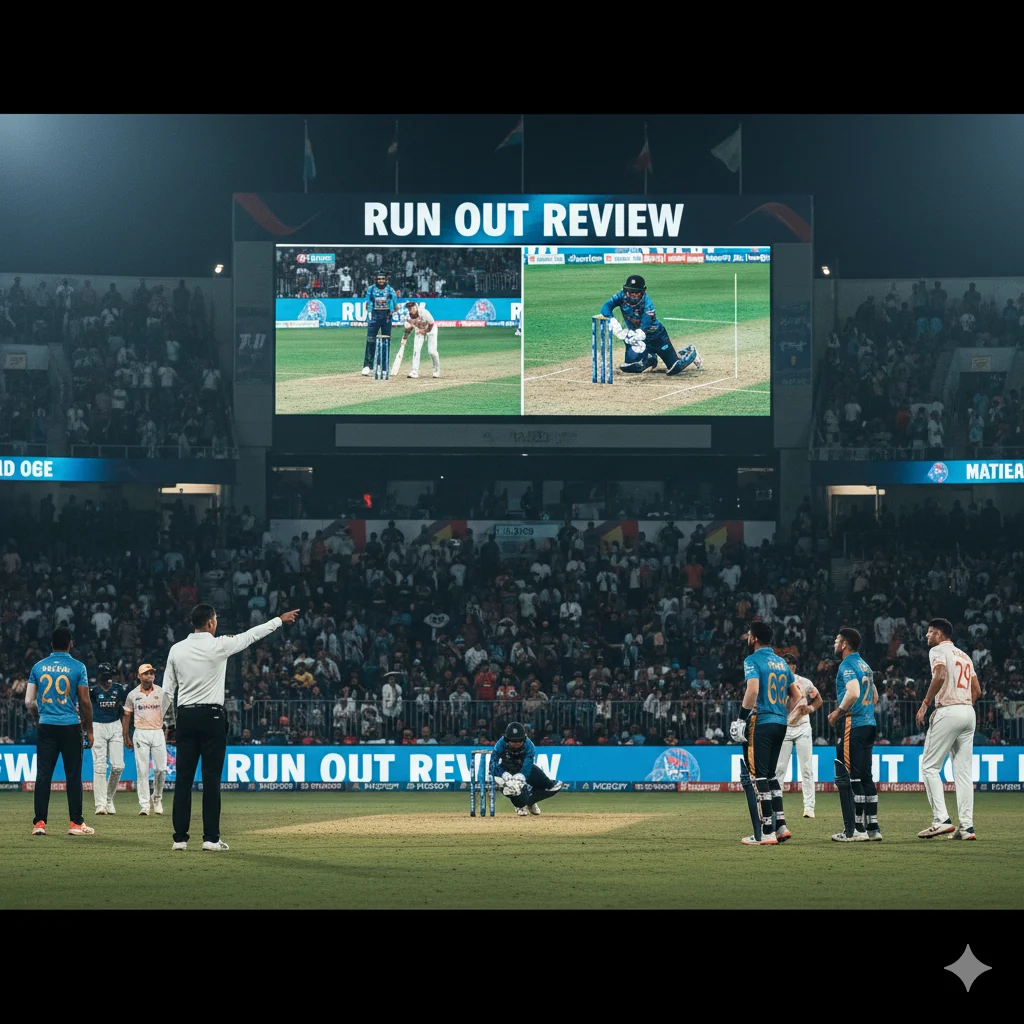
Cricket is a game of precision and timing—and few dismissals highlight that better than a run out. Whether it’s a thrilling direct hit or a moment of chaos between the wickets, a run out often turns the tide of a match.
In this guide, you’ll learn what run out means, its rules and laws, historical background, and famous real-world examples that every cricket fan should know.
⚖️ What Is a Run Out in Cricket?
A run out occurs when a batsman attempts to score a run but fails to make it back to the crease before the fielding side hits the stumps with the ball in hand.
Simply put — if the batsman isn’t safely inside the popping crease when the wicket is fairly broken by the fielders while the ball is in play, they are “run out.”
📜 Law Governing Run Outs
The Marylebone Cricket Club (MCC) Law 38 governs run outs.
Key points include:
- The batter is out if any part of their bat or body isn’t grounded behind the popping crease when the wicket is broken.
- A wicket can be broken by a direct hit or by a fielder holding the ball and dislodging the bails.
- The ball must be in play; if it’s declared dead, a run out cannot occur.
- If both batters end up at the same end, the one nearest the broken wicket is out.
🏃♂️ Common Scenarios of Run Outs
Run outs can happen in many ways, depending on the players’ timing, communication, and game awareness.
1. Direct Hit Run Out
A fielder throws the ball straight onto the stumps, dislodging the bails without any relay — an act of pinpoint accuracy and athleticism.
2. Relay Run Out
The ball is relayed from one fielder to another (often from the boundary) before hitting the stumps — common in one-day cricket.
3. Confusion Between Batters
When two batters end up at the same crease after a mix-up, one of them must go. The one farthest from the crease being attacked is run out.
4. Keeper’s Quick Reflex
A wicketkeeper can also complete a run out if they collect the ball and break the stumps while the batter is short of their ground.
5. Deflection Run Out
Sometimes, the ball deflects off a bowler or fielder unintentionally onto the stumps — if the batter is outside the crease, it still counts!
🕰️ History of Run Outs in Cricket
Run outs have existed since cricket’s earliest forms in the 18th century. The original laws emphasized fair play and quick running, but as the game evolved, fielding precision became critical.
- The first recorded run out dates back to 1744, when early scorecards described a batsman dismissed “run out before his ground.”
- Over time, run outs became more dramatic — especially with the introduction of limited-overs cricket in the 1960s and television replays in the 1990s.
- Modern technology like Hawk-Eye and Ultra-Edge ensures that run out decisions are now incredibly accurate.
In short, the art of the run out has transformed from a lucky chance to a showcase of athletic brilliance.
😲 Rare and Unusual Run Out Cases
Some run outs are so bizarre they’ve gone down in cricket folklore. Here are a few real examples:
1. Inzamam-ul-Haq vs India (2006)
Inzamam tried to avoid a throw by lifting his bat mid-run, forgetting it must touch the ground. He was run out — standing mid-pitch, bat in the air!
2. Grant Elliott vs England (2008)
Elliott collided with a bowler mid-run, fell down, and was run out — but England withdrew the appeal as an act of sportsmanship.
3. AB de Villiers (2013 Champions Trophy)
A lightning-fast direct hit from Jadeja caught him short by millimeters — showing how technology magnified precision.
4. Bizarre Deflection Run Out
In domestic cricket, a batter once got out when a throw ricocheted off the non-striker’s bat onto the stumps — technically valid under MCC Law 38!
5. Mankad Controversy
Though technically a “run out” under Law 38.3, Mankading (bowler running out non-striker before delivery) remains a heated topic — blending legality and ethics in cricket.
⚠️ Key Run Out Rules and Penalties
Here are some nuanced rules many fans don’t know:
- If the ball deflects off a helmet or umpire, a run out can still happen — as long as the ball is in play.
- If a fielder uses a cap or clothing to gather the ball, the ball becomes dead, and five penalty runs are awarded to the batting side.
- No ball or wide ball does not prevent a run out — a batsman can still be dismissed run out even on such deliveries.
- Intentional obstruction (like blocking a throw) results in dismissal “obstructing the field,” not a run out.
📊 Role of Technology in Modern Run Outs
In today’s game, technology ensures fairness and precision:
- Third umpire uses ultra-slow motion and multiple angles to check the frame in which the bails are dislodged.
- LED bails light up the instant they leave the grooves — eliminating uncertainty.
- Smart stumps now detect vibration, providing scientific accuracy in close calls.
This tech-driven precision has made the run out one of cricket’s most thrilling and transparent dismissals.
🌍 Famous Run Outs That Changed Matches
- MS Dhoni vs Bangladesh (T20 World Cup 2016): Dhoni’s sprint and direct hit sealed India’s win by one run.
- Jonty Rhodes vs Pakistan (1992 World Cup): His flying dive to run out Inzamam remains an iconic fielding moment.
- Martin Guptill vs MS Dhoni (2019 World Cup Semifinal): A direct hit ended India’s dream run — one of the most discussed moments in modern cricket.
📚 Summary
| Aspect | Details |
|---|---|
| Law | MCC Law 38 |
| Definition | Batter out if not in crease when wicket broken while ball is in play |
| Can Occur On | Any legal, wide, or no-ball delivery |
| Key Tools | Third Umpire, LED bails, Slow-Mo replay |
| Penalty for Illegal Fielding | 5 penalty runs to batting team |
| Controversial Variant | Mankading (non-striker run out before delivery) |
💬 FAQs on Run Out in Cricket
Q1: Can a batsman be run out on a no-ball?
Yes. Even if it’s a no-ball, the batsman can be run out if they’re outside the crease and the stumps are broken fairly.
Q2: What if both batsmen end up at the same end?
The batter nearest to the broken wicket is declared out.
Q3: Can a fielder remove the stumps without the ball?
No. The fielder must have the ball in hand or be holding it while breaking the stumps.
Q4: Is Mankading considered a run out?
Yes. It falls under the same law but carries moral debate regarding sportsmanship.
Q5: What’s the most unusual run out in history?
Inzamam’s dismissal for not grounding his bat while standing still remains one of the strangest ever recorded.
🏁 Conclusion
The run out is not just another way of getting dismissed — it’s a display of reflexes, intelligence, and precision. From Inzamam’s comic exits to Dhoni’s match-winning glovework, run outs remind us that cricket is a sport where every inch counts.
Whether you’re a player or a fan, understanding the rules and spirit behind a run out helps you appreciate the game’s beauty and unpredictability.

Ethan Richards is a sports rules specialist known for breaking down complex cricket laws into clear, reader-friendly guides. His articles focus on match formats, powerplays, no-balls, DRS, and game-changing rules across T20, ODI, and Test cricket. Ethan aims to make every rule easy to understand for fans and beginners.