
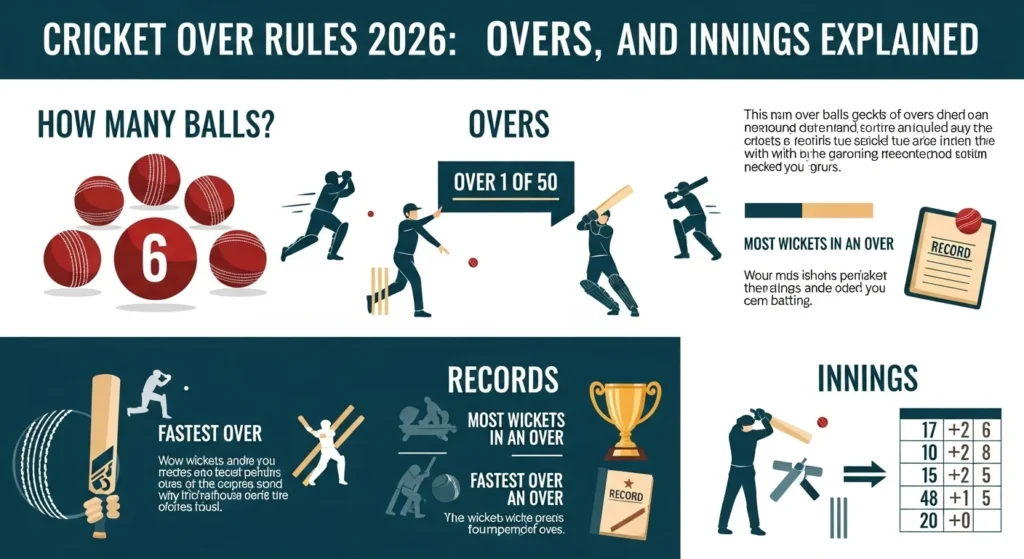
what is an over in cricket?
In cricket, an over refers to a set of six legal balls bowled by one player from one end of the pitch. Once those six deliveries are complete, it’s called an “over completion.” After every over, the fielding team switches ends, and another bowler delivers from the opposite side.
Most asked question for a non cricketer is :
How many balls are there in one over? or
1 over how many balls? or
what is over in cricket?
An over in cricket consists of 6 legal balls.
If the bowler bowls a wide ball or a no-ball, it does not count as one of the six balls, so the bowler must bowl an extra delivery.
🏏 Total Balls in Different Cricket Formats
✅ T20 Cricket
- Per team (20 overs): 20 × 6 = 120 balls
- Total match (2 innings): 240 balls
✅ One Day / ODI Cricket
- Per team (50 overs): 50 × 6 = 300 balls
- Total match: 600 balls
✅ Test Cricket (1 Day & 5 Days)
In Test cricket, a full day = 90 overs (standard rule).
- 1 day: 90 × 6 = 540 balls
- 5 days: 540 × 5 = 2,700 balls
Note: Weather, bad light, or slow over rate can reduce the actual number of balls.
✅ The Hundred
- Per team: 100 balls
- Total match: 200 balls
✅ T10 Cricket
- Per team (10 overs): 10 × 6 = 60 balls
- Total match: 120 balls
🏏 Overs to Balls Table (1–50 Overs)
| Over | Balls |
|---|---|
| 1 | 6 |
| 2 | 12 |
| 3 | 18 |
| 4 | 24 |
| 5 | 30 |
| 6 | 36 |
| 7 | 42 |
| 8 | 48 |
| 9 | 54 |
| 10 | 60 |
| 11 | 66 |
| 12 | 72 |
| 13 | 78 |
| 14 | 84 |
| 15 | 90 |
| 16 | 96 |
| 17 | 102 |
| 18 | 108 |
| 19 | 114 |
| 20 | 120 |
| 21 | 126 |
| 22 | 132 |
| 23 | 138 |
| 24 | 144 |
| 25 | 150 |
| 26 | 156 |
| 27 | 162 |
| 28 | 168 |
| 29 | 174 |
| 30 | 180 |
| 31 | 186 |
| 32 | 192 |
| 33 | 198 |
| 34 | 204 |
| 35 | 210 |
| 36 | 216 |
| 37 | 222 |
| 38 | 228 |
| 39 | 234 |
| 40 | 240 |
| 41 | 246 |
| 42 | 252 |
| 43 | 258 |
| 44 | 264 |
| 45 | 270 |
| 46 | 276 |
| 47 | 282 |
| 48 | 288 |
| 49 | 294 |
| 50 | 300 |
Simply put, an over represents a complete set of deliveries bowled by one player, and “over completion” marks the point where those deliveries are done.
⚙️ Meaning of Over Completion in Cricket
“Over completion” happens once a bowler successfully bowls six legal deliveries. After an over is completed:
- The ends are switched — the batsmen swap ends, and a new bowler takes over from the opposite side.
- The fielding captain can choose any eligible bowler who hasn’t bowled consecutive overs from the same end.
- The umpire signals the end of the over by calling “Over.”
This process keeps the match balanced, ensuring both teams face similar pitch and wind conditions throughout.
🎯 How Many Overs Can a Bowler Bowl in a Match?
The number of overs a bowler can deliver in a match depends on the format of cricket and total overs allotted per innings. This rule ensures fairness and prevents any single bowler from dominating the entire game. Generally, a bowler can bowl up to a fixed percentage (20%) of the total team overs in limited-overs formats. In Test cricket, however, there’s no limit, allowing bowlers to continue as long as their stamina and strategy permit.
| Format | Total Overs per Innings | Maximum Overs per Bowler | Percentage of Total Overs | Notes / Conditions |
|---|---|---|---|---|
| Test Match | Unlimited | No fixed limit | N/A | Depends on stamina and captain’s strategy. Bowlers can bowl consecutive overs. |
| ODI (One Day International) | 50 | 10 | 20% | Each bowler can bowl up to one-fifth of total overs. |
| T20 International | 20 | 4 | 20% | A bowler can bowl a maximum of 4 overs in an innings. |
| The Hundred | 100 balls (≈16.4 overs) | 20 balls (4 sets of 5) | 20% | A bowler can deliver up to 20 balls total, but no more than 10 consecutive balls. |
| Domestic 10-over Matches (T10) | 10 | 2 | 20% | Maximum of 2 overs per bowler to maintain fairness and balance. |
🧠 Example:
In a T20 match, each bowler can bowl 4 overs out of 20 (which is 20% of the total overs). Similarly, in ODIs, 10 overs out of 50 are allowed per bowler. This restriction ensures team balance, rotation, and fair play.
🧩 Over Completion in Different Cricket Formats
Let’s look at how overs differ across formats:
| Format | Balls per Over | Overs per Innings | Total Balls per Innings |
|---|---|---|---|
| Test Cricket | 6 | Unlimited (until 10 wickets fall or declaration) | Varies |
| One Day International (ODI) | 6 | 50 | 300 |
| Twenty20 (T20) | 6 | 20 | 120 |
| The Hundred | 5 or 10 (flexible) | 100 balls total | 100 |
🧱 Test Cricket
In Test cricket, there’s no fixed limit on overs. Each innings continues until all 10 wickets fall or the captain declares. However, every over still contains six legal balls, maintaining consistency across formats.
🔥 One Day Internationals (ODIs)
An ODI match gives each team 50 overs, translating to 300 legal deliveries per innings. If rain interrupts play, overs can be reduced using the Duckworth-Lewis-Stern (DLS) method.
⚡ Twenty20 (T20) Cricket
In T20 cricket, each team bowls 20 overs per innings, totaling 120 balls. When fans ask, “What does 20 overs mean in cricket?”, it means a team has 20 complete overs to set or chase a target. Every ball counts, making T20s fast-paced and exciting.
🏟️ The Hundred Format – A Modern Twist
England’s The Hundred format changes traditional rules slightly. Instead of six-ball overs, bowlers deliver sets of five or ten consecutive balls before switching ends. So, if you’re wondering “how many balls in an over in 100 cricket?” — the answer is five or ten, depending on the captain’s decision.
⚖️ What Happens After an Over in Cricket
Once an over ends:
- The bowler changes ends.
- The umpire calls “Over.”
- The batsmen switch ends, but the striker and non-striker positions may change only if runs are scored off the last ball.
- A new over begins from the opposite side.
This system ensures fairness in pitch usage and provides variety in bowling angles and tactics.
🤕 When a Bowler Gets Injured During an Over
Sometimes, a bowler might get injured mid-over and cannot continue. In such cases:
- Another bowler (who hasn’t bowled the previous over) must complete the remaining deliveries.
- This replacement bowler cannot bowl consecutive overs, meaning they can’t bowl the next over again.
- The umpire must approve the change, ensuring it’s a legitimate injury and not a tactical substitution.
This rule keeps play fair while protecting players’ safety and upholding the integrity of bowling rotations.
🧭 What Is an Innings in Cricket?
An innings is a period of play where one team bats and the other bowls. In T20 and ODI formats, each side gets one innings. In Test cricket, each team gets two innings, allowing more extended play and strategy.
Example:
- In T20: One innings of 20 overs per team.
- In Test: Two innings per team, no limit on overs.
Keyword Coverage: what is an innings in cricket, innings in cricket
📊 How Many Overs Are There in a Cricket Game?
The number of overs in a cricket match depends on its format:
| Format | Overs Per Side |
|---|---|
| Test | Unlimited |
| ODI | 50 |
| T20 | 20 |
| The Hundred | 100 balls (≈16.4 overs) |
This table answers popular questions like “How many overs are there in a cricket game?” and “How many overs in cricket?”
Records in Single over
Most Runs Scored in a Single Over
These records refer to the highest runs scored off the bat (and extras where applicable) in a legitimate 6-ball over across formats. Note: T10 records are from league play (e.g., ECS T10), as it’s not an ICC format.
| Format | Record (Runs) | Player(s) | Bowler | Match Details | Year | Citation |
|---|---|---|---|---|---|---|
| Test | 35 | Jasprit Bumrah (India) | Stuart Broad (England) | India v England, 5th Test, Edgbaston | 2022 | |
| ODI | 30 | AB de Villiers (South Africa) | (Multiple instances, e.g., Jason Holder) | South Africa v West Indies, various ODIs | 2015 (and others) | |
| T20I | 39 | Darius Visser (Samoa) | Nalin Nipiko (Vanuatu) | Samoa v Vanuatu, Men’s T20I | 2024 | |
| T10 | 45 | Usman Ghani (Afghanistan) | (Unnamed in ECS T10) | ECS T10 League match | 2025 |
Most Wickets Taken in a Single Over
Records for the highest wickets in a 6-ball over. In international cricket, 4 is the maximum in Tests, while limited-overs formats cap at 3 (due to fewer collapse opportunities). T10 follows similar patterns to T20.
| Format | Record (Wickets) | Bowler(s) | Victims | Match Details | Year | Notes/Citation |
|---|---|---|---|---|---|---|
| Test | 4 | Maurice Allom (England) | (4 batsmen) | England v New Zealand, Christchurch | 1930 | First instance; also achieved by Ken Cranston (1946), Fred Titmus (1965), Chris Old (1974), and others. |
| ODI | 3 | Mohammad Sami (Pakistan) | (3 batsmen) | Pakistan v New Zealand, Lahore | 2003 | Tied with several, e.g., Mohammed Siraj (India v Sri Lanka, 2023). |
| T20I | 3 | Multiple (e.g., Lasith Malinga) | (3 batsmen) | Various T20Is | Various | Common in collapses; no verified 4 in T20I history. |
| T10 | 4 | Multiple in leagues (e.g., Roelof van der Merwe) | (4 batsmen) | Various T10 leagues | Various | Achieved in fast-paced domestic T10; e.g., in ECS T10. |
Quickest Over Bowled (by Time)
These are the shortest recorded times to complete a 6-ball over (from first to last delivery, excluding extras). Data is limited for shorter formats like T20I and T10, where overs are often quicker due to pace but not always timed precisely. “Over done in time” is interpreted as the fastest (quickest) over in seconds.
| Format | Record (Seconds) | Bowler | Match Details | Year | Notes/Citation |
|---|---|---|---|---|---|
| Test | 35 | Younis Khan (Pakistan) | Pakistan v Zimbabwe (or similar Test) | ~2000 | Shortest verified over in Test history. |
| ODI | 73 | Ravindra Jadeja (India) | India v England, 2nd ODI, Cuttack | 2025 | Lightning-fast spin; his personal second-quickest internationally. |
| T20I | ~60-70 (est.) | Not officially tracked; e.g., spinners like Jadeja | Various T20Is | Various | No definitive record; quick overs common in T20 pace (e.g., 64s in Tests by Jadeja, similar in T20). |
| T10 | Not reliably tracked | N/A | N/A | N/A | T10 overs are inherently fast (~45-60s est.), but no official Guinness/ESPN record found; focus often on ball speed, not over time. |
These records are based on verified sources like ESPNcricinfo, Guinness World Records, and recent reports as of October 2025. Cricket records evolve quickly, especially in emerging formats like T10. For the latest, check official ICC or Cricinfo stats.
💬 Frequently Asked Questions
Q: How many balls are in one over?
There are six legal balls in every over across all major cricket formats.
Q: How many overs are there in a T20 match?
Each side gets 20 overs, making a total of 40 overs per match.
Q: What happens after an over in cricket?
Players switch ends, and a new bowler delivers the next over from the opposite side.
Q: How many wickets are needed to win in cricket?
The fielding team must take 10 wickets to dismiss the opposition in an innings.
Q: How many balls are in an over in The Hundred?
An over can have 5 or 10 balls, depending on tactical choice.
🏆 Conclusion
An over is the heartbeat of cricket — defining its rhythm, structure, and fairness. Whether in T20, ODI, Test, or The Hundred, the concept remains the same: a bowler must deliver a set number of legal balls to complete an over.
Understanding overs, innings, and what happens when a bowler gets injured gives fans a clearer picture of how strategy, rules, and sportsmanship intertwine in cricket’s beautiful game.

Daniel Foster is a senior sports writer specializing in cricket laws and international playing conditions. With extensive experience covering ICC rules, domestic leagues, and tournament regulations, he delivers detailed yet easy-to-read explanations. His work is trusted by readers looking for accurate and up-to-date sports rules.