
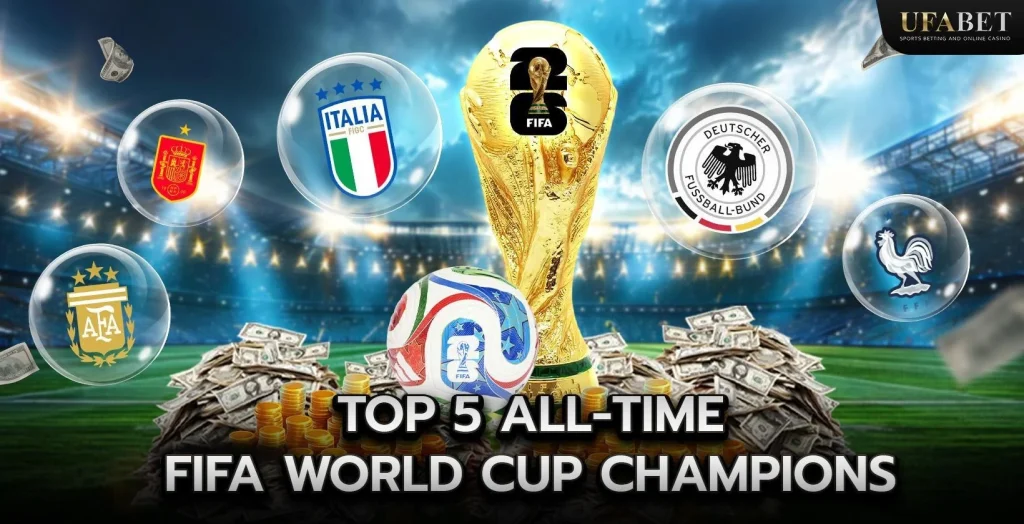
The top 5 all-time FIFA World Cup Champions are Italy (2006), Spain (2010), Germany (2014), France (2018), and Argentina (2022). The FIFA World Cup is the biggest international football tournament for national teams. The competition started in 1930 and grew into the strongest global football event across sport, media, culture, and betting. World Cup history shows how champions win through squad balance, tactical control, knockout discipline, and pressure handling. Bettors study past winners because tournament patterns reveal useful signs before future outright, match winner, handicap, and live betting decisions. Historical statistics help bettors understand which teams survive difficult matches, manage pressure, and turn big moments into titles.
1. Italy 2006
Italy 2006 is the World Cup champion that defeated France in the final after a 1 1 draw and a 5 3 penalty shootout win. Italy’s title run stood out through defensive solidity, tactical discipline, goalkeeper quality, and calm penalty execution. Fabio Cannavaro led a compact back line, while Gianluigi Buffon protected the goal with elite consistency. The final became historic because Zinedine Zidane scored early, Marco Materazzi equalized, and Zidane later received a red card in extra time. Modern bettors learn from Italy 2006 that defensive structure and tournament temperament matter as much as attacking firepower.
2. Spain 2010
Spain 2010 is the World Cup champion that defeated the Netherlands 1 0 in the final through Andrés Iniesta’s extra time goal. Spain’s title run stood out through possession control, short passing, midfield dominance, and patient chance creation. The team used a style built around Xavi, Iniesta, Sergio Busquets, and David Villa, which reduced opponent rhythm across knockout matches. Spain won several narrow matches, proving that tournament dominance does not always require high-scoring results. Modern bettors learn from Spain 2010 that midfield control, low concession rates, and tempo management create strong signals for match winner and under markets.
3. Germany 2014
Germany 2014 is the World Cup champion that defeated Argentina 1 0 in the final through Mario Götze’s extra time goal. Germany’s title run stood out through squad depth, pressing quality, tactical flexibility, and clinical finishing. The 7 1 semifinal win against Brazil became one of the most famous results in World Cup history. Germany balanced experienced leaders with younger technical players, which helped the team handle different opponents across the tournament. Modern bettors learn from Germany 2014 that depth, bench impact, and tactical variation support outright winner confidence during long tournament runs.
4. France 2018
France 2018 is the World Cup champion that defeated Croatia 4 2 in the final. France’s title run stood out through athletic transitions, defensive organization, midfield balance, and fast attacking outlets. Kylian Mbappé, Antoine Griezmann, Paul Pogba, and N’Golo Kanté gave France speed, creativity, control, and ball recovery. France adjusted well against different opponents, moving from controlled possession to direct counterattacks when the match context required it. Modern bettors learn from France 2018 that tactical adaptability and transition speed create strong betting value against teams that leave space behind.
5. Argentina 2022
Argentina 2022 is the World Cup champion that defeated France after a 3 3 draw and a 4 2 penalty shootout win. Argentina’s title run stood out through Lionel Messi’s leadership, midfield work rate, emotional resilience, and late match composure. The final became historic because Messi scored twice, Ángel Di María scored, and Kylian Mbappé completed a hat trick for France. Argentina recovered from an opening defeat against Saudi Arabia and built momentum through each knockout round. Modern bettors learn from Argentina 2022 that early setbacks do not always end title potential when leadership, tactical correction, and squad belief remain strong.
What Can Bettors Learn from World Cup Champions?
The lessons bettors learn from World Cup champions are listed below.
- Momentum building: Champions usually grow stronger as the tournament progresses. Bettors gain better outright reads by tracking match-to-match improvement instead of judging one early result.
- Squad depth: Champions need reliable starters and bench options across intense fixtures. Bettors should review substitutes, rotation quality, and injury cover before backing a contender.
- Tactical adaptability: Champions adjust shape, tempo, and attacking plan depending on the opponent. Bettors gain stronger predictions when a team wins in more than one match style.
- Big stage temperament: Champions stay calm during penalties, extra time, and difficult match states. Bettors should value teams with proven leaders in the FIFA World Cup.
What Patterns Do World Cup Champions Share?
The patterns World Cup champions share are listed below.
- Defensive solidity: Champions limit high-quality chances and protect leads under pressure. Strong defensive records help bettors judge knockout reliability.
- Midfield control: Champions usually manage tempo through passing, pressing, or ball recovery. Midfield control helps predict possession flow and match pressure.
- Knockout stage scoring efficiency: Champions convert limited chances in tight matches. Efficient finishing becomes a key signal in the history of the FIFA World Cup.
Can World Cup Winner Statistics Really Increase Betting Success?
Yes, World Cup winner statistics can increase betting success when bettors use historical data as a baseline instead of a standalone prediction tool. Past champions reveal form patterns, defensive strength, squad balance, leadership quality, and knockout performance traits. Historical data helps bettors identify undervalued contenders that match proven champion profiles before public odds fully adjust. Current form analysis matters because injuries, tactics, coaching changes, and group difficulty change each tournament. Strong betting decisions come from combining World Cup history with live team news, recent results, and responsible bankroll rules.
