
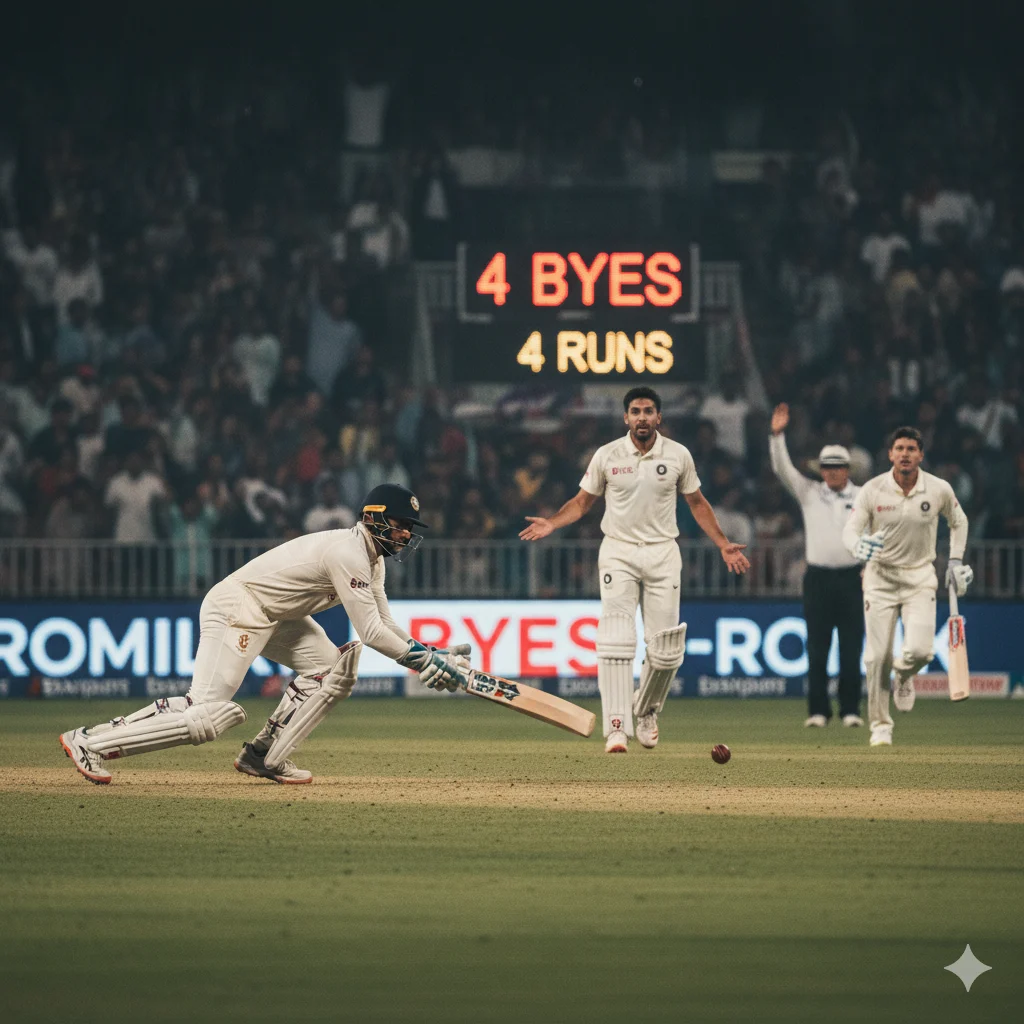
Cricket’s scoring system isn’t just about runs from the bat — it’s also about extras. Extras are runs awarded to the batting team due to mistakes or illegal deliveries by the fielding side. They often decide close matches, influence strategies, and reveal a team’s discipline level.
In this guide, you’ll learn what extras are, how each type works, penalties involved, modern rule changes (2025), and real match scenarios that shaped the laws we follow today.
What Are Extras in Cricket?
Extras are runs not credited to any batsman but added to the team’s total score. They reflect the fielding side’s errors or uncontrollable events during play.
According to the Marylebone Cricket Club (MCC) Laws of Cricket, extras are classified into four main types:
- Byes
- Leg Byes
- No Balls
- Wides
Some formats also include penalty runs for repeated offenses or rule breaches, which we’ll discuss later.
1. Byes in Cricket
Definition
A bye is awarded when the ball passes the batsman without touching bat, body, or any gear — and the batsmen complete a run.
Example:
If the wicketkeeper misses the ball and the batsmen run two, it’s recorded as 2 byes.
Scoring
- Runs go to the team total, not the batsman.
- Recorded separately in the scorebook as “B”.
Common Scenarios
- The keeper misjudges swing or bounce.
- A bowler delivers a slower ball, and it beats everyone.
Real Match Example
During the 2019 Ashes, England gained crucial byes when Australia’s wicketkeeper missed a wide outswinger. Those runs changed the match momentum.
Fielding Penalty Impact
High bye counts often show poor wicketkeeping or erratic bowling control — key metrics in professional analysis.
2. Leg Byes in Cricket
Definition
A leg bye occurs when the ball hits the batsman’s body (without touching the bat), and they attempt a legitimate run.
Important Rule
The umpire allows leg byes only if the batsman attempted a shot or tried to evade the ball.
If the batsman just stands still and the ball hits their pad, no leg bye is awarded.
Scoring
- Runs go to the team total, not the batsman.
- Recorded as “LB” in scorebooks.
Case Study:
In the 2015 World Cup, a leg bye in the final over of a tense match between South Africa and New Zealand helped decide the winner — showing how one deflection can change everything.
Penalty or Misuse
If the umpire judges no attempt to play or avoid, no run is counted even if the batsmen run successfully.
3. No Balls in Cricket
Definition
A no ball is an illegal delivery by the bowler, giving the batting team an extra run and a free delivery (free hit in limited overs).
Common Reasons for No Balls
| Type | Description | Penalty |
|---|---|---|
| Overstepping | Bowler’s front foot crosses the popping crease | 1 run + free hit |
| Height (Beamer) | Ball passes above waist height without bouncing | Warning or ban |
| Full toss | Dangerous above waist level delivery | No ball + warning |
| Fielding Violation | More than two fielders outside circle (T20) | No ball |
| Throwing | Illegal bowling action | No ball |
Additional Rules (2025 Updates)
- Any field change during the bowler’s run-up results in a no ball.
- Repeated beamers = suspension of bowler.
- No balls now count as free hits in Tests and ODIs (experimental) — under ICC trial programs.
Case Study
In 2017 Champions Trophy, Jasprit Bumrah’s no ball dismissed Fakhar Zaman — who went on to score a match-winning century. That moment redefined discipline standards in bowling.
4. Wide Balls in Cricket
Definition
A wide ball is a delivery that the batsman cannot reasonably reach when in their normal stance.
Batsman’s Movement and Wide Ball Rule (Updated 2025)
Under Law 22.1.1 (Wide Ball) of the MCC Laws of Cricket, the umpire decides whether a ball is “wide” based on the batsman’s normal guard position — that is, where the batsman is standing when the bowler begins their run-up.
However, modern cricket allows for dynamic stance changes, and the rule adapts accordingly.
🏏 Key Rule Explanation
- If the batsman moves significantly (toward the off side or leg side) before the ball is delivered,
and the bowler follows that movement reasonably,
the delivery will NOT be called a wide — even if it passes outside the original guideline. - If the batsman moves after the ball is released,
and the ball would have been wide from the original stance,
the umpire can still call it a wide.
⚖️ In Simple Terms:
| Batsman Movement | Ball Follows the Movement | Wide Decision |
|---|---|---|
| Moves early (before release) | Bowler adjusts line | Not Wide |
| Moves early | Bowler doesn’t adjust | Can be Wide |
| Moves late (after release) | Ball already outside reach | Wide |
| Moves across stumps (switch hit) | Ball still within reach | Not Wide |
💡 Example Scenarios
- Switch Hit Example:
If a right-handed batter switches to left-handed before the ball is released, the umpire judges the ball’s line relative to the new stance.- If the ball passes within reach of the new stance, it’s not a wide.
- If it’s outside reach even after switching, it’s a wide ball.
- Shuffle to Leg Side:
If a batsman steps toward the leg side to make room and the bowler follows them with a wider delivery — the umpire considers that fair adjustment, and no wide is called. - Late Movement After Release:
If the batsman moves after the ball is already delivered and misses it, the ball’s original line (at release) is judged — if it was outside the guideline, it’s a wide.
🧭 2025 ICC Clarification Update
In 2025, the ICC released a clarification for umpires to maintain consistency:
“If a batsman’s movement significantly changes their original stance before release, the wide line should be recalculated in proportion to the new position, ensuring fairness to both bowler and batsman.”
This clarification prevents batsmen from manipulating the wide line unfairly and helps bowlers adjust legally in fast-paced T20s.
⚙️ Case Study: Glenn Maxwell (Switch Hit, 2022 T20 World Cup)
Glenn Maxwell often switched stance mid-delivery. In one instance, the ball passed wide of his new stance, and the umpire did not call it wide, since it was within reach of his new guard.
This moment reignited debate on how far a batsman can move before it’s considered unfair.
🧾 Penalty and Fair Play Note
If a batsman deliberately moves late to deceive or distract the bowler, the umpire can invoke Law 41 (Unfair Play) and warn or penalize the batting side.
🎯 Expert Summary
- Wide is judged based on batsman’s position at the bowler’s release, not earlier stance.
- Bowler gets fair adjustment room if batsman moves early.
- Modern wide laws now balance fairness and adaptability for both sides.
- Umpires use Hawk-Eye vision line technology to assist in tight calls.
Key Rules
- The ball must be outside the batsman’s reach on either side.
- The umpire signals a wide by stretching both arms horizontally.
- Each wide adds one run to the batting team, and the delivery must be re-bowled.
Situations Leading to Wides
- Overly defensive bowling tactics.
- Pitch movement causing swing beyond the guideline.
- Bowler losing grip or control.
Strategic Impact
- Wides extend overs and add pressure.
- In T20s, one wide can shift match dynamics during tight chases.
Case Study
In the 2022 IPL, a last-over wide call stirred controversy — showing how subjective interpretation can decide high-stakes matches.
5. Penalty Runs (Bonus Section)
Apart from the four main extras, penalty runs are awarded in certain rare cases:
| Situation | Penalty Runs Awarded | Example |
|---|---|---|
| Ball hits fielder’s helmet | 5 runs | Helmet placed behind keeper |
| Obstruction of field | 5 runs | Deliberate interference |
| Repeated fielding offenses | 5 runs | Distracting batsman |
| Unfair movement | 5 runs | Fielder moves after delivery |
These penalties highlight the spirit of cricket — fairness, discipline, and sportsmanship.
Modern Trends and Technology in Extras (2025)
- Hawk-Eye & Smart Ball – Tracks line and height for no-ball & wide decisions in real time.
- Third Umpire Automation – Foot-fault no balls auto-detected.
- AI Data Analytics – Coaches now measure “extra run percentage” to evaluate discipline.
- Dynamic Field Restrictions – Adjusted to prevent fielding-related no balls.
Conclusion
Extras may seem small, but in modern cricket, they define victory margins. Every bye, leg bye, no ball, and wide reflects discipline, focus, and precision. Teams with fewer extras often dominate tournaments, proving that cricket isn’t just a batsman’s game — it’s a contest of control versus chaos.
Mastering extras is mastering modern cricket.
FAQs on Extras in Cricket
Q1: Do extras count in a batsman’s total?
No, extras are added to the team’s total only.
Q2: Can a wide also be a no ball?
Yes, but it’s extremely rare. The umpire must decide which law applies first — usually the no ball.
Q3: Can a wicket fall on a no ball?
Only via run-out or obstruction; otherwise, it doesn’t count.
Q4: Who gets credit for byes or leg byes?
The runs are team extras, not credited to the batsman or bowler.
Q5: Are penalty runs considered extras?
Yes, penalty runs are counted under the “extras” category.

Rahul Desai is a cricket rules researcher who closely studies official rulebooks, match conditions, and tournament regulations. His articles explain tricky scenarios like no-ball decisions, super overs, and DLS calculations in a straightforward way. Rahul’s content is ideal for fans who want rule clarity.