
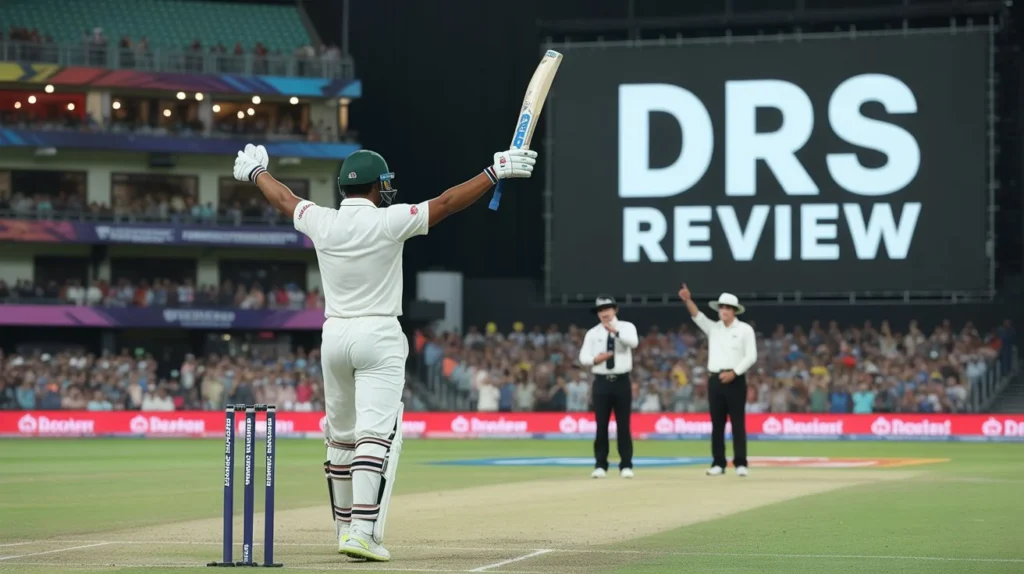
What is DRS?
The Decision Review System (DRS) is a technology-based framework used in cricket to review the on-field umpire’s decisions. It allows teams to challenge calls they believe are incorrect, with the final verdict delivered using a suite of ball-tracking and audio-visual technologies.
The Full Form
DRS stands for Decision Review System.
Why Was DRS Introduced?
DRS was born out of necessity. The catalyst was the profoundly controversial 2008 Sydney Test between India and Australia, a match marred by several umpiring errors that overshadowed the contest. This “crisis of credibility” forced the International Cricket Council (ICC) to seek a solution to minimize blatant mistakes, or “howlers,” and restore faith in the game’s fairness. The goal was not to achieve 100% perfection, but to eliminate the egregious errors that could change the course of a match or series.
Step-by-Step: How DRS Works
The DRS process is a tightly choreographed sequence:
- The On-Field Decision: The on-field umpire makes a call (e.g., “Out” LBW).
- The Challenge: The aggrieved team (batsman or fielding captain) has 15 seconds to decide whether to review. They signal a “T” with their arms.
- The Referral: The on-field umpire refers the decision to the third umpire (TV Umpire) by making a television screen signal with their hands.
- The Analysis: The TV Umpire, isolated from crowd noise and commentary, analyzes all available technology—UltraEdge first (for edges), then Hawk-Eye (for LBWs).
- The Communication: The TV Umpire relays their findings to the on-field umpire, stating the conclusive evidence for overturning or the reason for upholding the original call.
- The Final Verdict: The on-field umpire reverses their original signal or lets it stand, announcing the final decision to the players and crowd.
Types of Reviews
- Player Review: Initiated by the players. The batting side can challenge an ‘out’ decision against them, and the fielding side can challenge a ‘not out’ decision. Each team has a limited number of reviews per innings.
- Umpire Review: Initiated by the on-field umpires themselves for specific decisions, primarily line-call run-outs, stumpings, and boundaries. These are not counted against a team’s review tally.
The Technologies of Truth
DRS is not one technology but a suite of tools:
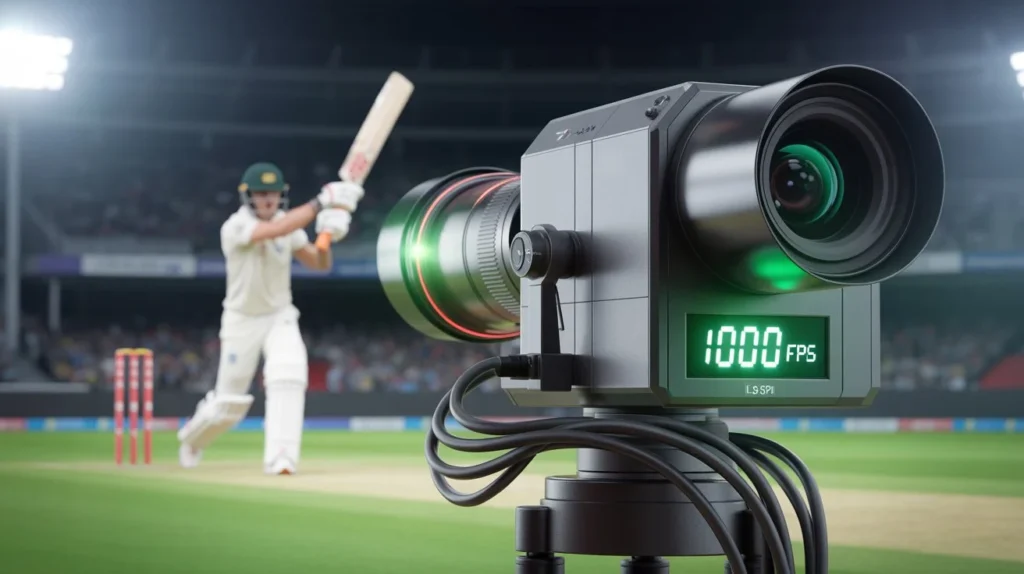
- Hawk-Eye: The most famous component. It uses six high-speed cameras to track the ball’s trajectory from release to impact, predicting its path for LBW decisions. Its core algorithm reconstructs the ball’s 3D path.
- UltraEdge (Real-Time Snicko): Synchronizes ultra-motion cameras with stump microphone audio. A clear spike in the audio waveform as the ball passes the bat indicates contact. It is the primary tool for detecting edges.
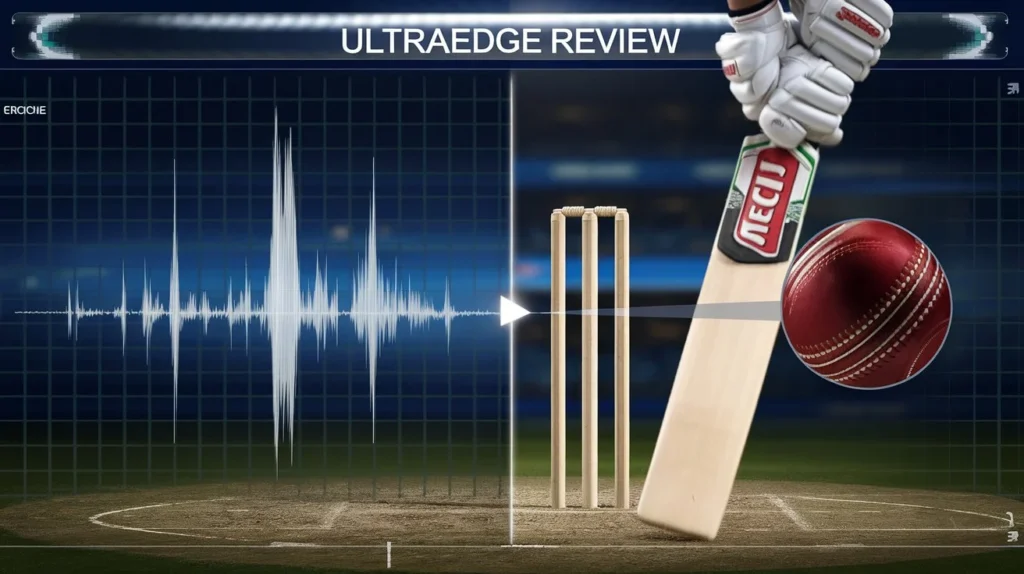
- Hot Spot: An infrared thermal imaging system that shows a bright white spot at the point of friction-based contact (ball on bat, pad, etc.). While highly effective, its use has reduced due to cost and the reliability of UltraEdge.
- High-Speed Cameras: Provide super-slow-motion footage from multiple angles to check for bumps balls, fine edges, or bat-pad catches.
DRS Rules Across Formats
- Test Matches: Each team gets 2 unsuccessful reviews per innings.
- ODIs (One Day Internationals): Each team gets 1 unsuccessful review per innings.
- T20Is (T20 Internationals): Each team gets 1 unsuccessful review per innings.
The “Umpire’s Call” Explained & Its Controversies
This is the most debated rule in DRS. For LBW reviews, Hawk-Eye projects the ball’s path. The stumps are represented by a virtual zone.
- The Rule: If less than 50% of the ball is projected to hit the stumps, the on-field umpire’s original decision is respected. This is “Umpire’s Call.”
- The Rationale: The ICC acknowledges a small “probability margin” in Hawk-Eye’s prediction. “Umpire’s Call” is a zone of uncertainty where the benefit of the doubt is given to the human umpire’s initial judgment.
- The Controversy: Critics argue it creates inconsistency. A ball clipping the stumps should be “out,” regardless of the on-field call. It leads to scenarios where two identical deliveries can have different outcomes based solely on the umpire’s initial hunch, which many feel undermines the technology’s purpose.
Case Studies: DRS in the Spotlight
- 2011 World Cup Quarter-Final, India vs. Australia: A pivotal moment where Mike Hussey was initially given not out to an LBW appeal from R. Ashwin. India reviewed, and Hawk-Eye showed the ball hitting the stumps, but it was “Umpire’s Call” on hitting and pitching, so the not-out decision stood. This early example highlighted the confusion around the rule.
- The Ben Stokes LBW (2019 Ashes, Headingley): England’s Ben Stokes was hit on the pad by a Nathan Lyon delivery. The on-field umpire said not out. Australia had no reviews left. Hawk-Eye later showed the ball would have hit the stumps, a decision that would have been overturned had Australia saved their review. This moment perfectly illustrated the strategic value of conserving reviews.
History & Evolution: A Year-by-Year Timeline
- 2008: First trialed in a Test series between India and Sri Lanka.
- 2009: Officially introduced by the ICC for international matches.
- 2011: First used in a Cricket World Cup.
- 2013: “Real-Time Snicko” (now UltraEdge) was integrated with Hawk-Eye to improve edge detection.
- 2016: The “Umpire’s Call” margin was explicitly added to the playing conditions to provide clarity.
- 2017: DRS made mandatory in all T20I and Test matches.
- 2023: The ICC abolished the “soft signal” for catches, removing a layer of subjectivity and relying solely on conclusive TV evidence.
Common Mistakes Players Make
- Emotional Reviews: Challenging a decision out of frustration rather than a genuine belief in an error.
- Wasting Reviews on Hopeful Appeals: Using a review on a 50/50 call early in the innings, leaving the team vulnerable later.
- Misreading the Batsman’s Reaction: Assuming a batsman’s grimace or shake of the head confirms an edge, which can be misleading.
- Ignoring the Bowler’s Insight: Not consulting the bowler, who often has the best feel for whether the ball was likely to hit the stumps.
Advantages & Criticisms
Advantages:
- Reduces Howlers: The primary success—blatant errors are now rare.
- Increases Fairness: Matches are decided more by skill and less by luck.
- Adds Strategic Depth: The management of reviews is a key tactical skill.
Criticisms:
- Not 100% Accurate: The technology has inherent margins of error.
- “Umpire’s Call” Confusion: The rule is often misunderstood and creates perceived injustice.
- Cost Prohibitive: Its expense limits its use to elite-level cricket, creating a disparity.
- Diminishes On-Field Umpire Authority: Some argue it undermines the umpire’s role.
The Technical Deep Dive
- Signals: The ‘T’ signal by players; the square TV signal by the on-field umpire.
- Frame Rates: Hawk-Eye cameras typically operate at 340 frames per second (fps), a critical spec for accurate tracking, especially for fast bowlers.
- Camera Angles: A minimum of six cameras are strategically placed around the ground to provide comprehensive coverage for the ball-tracking algorithm.
- Ball-Tracking Algorithms: Sophisticated software models the ball’s flight, accounting for speed, spin, swing, and bounce to predict its path after impact.
- Calibration Standards: The system is rigorously calibrated before each match using known reference points on the field to ensure spatial accuracy.
- Probability Margin: This is the statistical confidence interval built into Hawk-Eye’s projection, which is the foundation for the “Umpire’s Call” rule.
- ICC Approved Technology Vendors: The primary vendors are Hawk-Eye Innovations (for ball-tracking) and BBG Sports (for UltraEdge). All technology must pass strict ICC accreditation tests.
Review Timelines & Protocols
The strict 15-second time limit for a team to request a review is enforced using a countdown timer visible to the TV director. The entire review process from referral to final decision typically takes no more than 2-3 minutes to maintain the game’s flow.
All Controversial DRS Moments
Beyond the case studies, controversies often stem from:
- Projection Doubts: Suspicions that Hawk-Eye cannot accurately predict the bounce or turn on a worn pitch (e.g., many spinners’ LBW appeals in the subcontinent).
- Conflicting Evidence: Instances where Hot Spot shows no mark but UltraEdge registers a sound, leading to inconclusive outcomes.
- The “Pitching Outside Leg” Glitch: Rare instances where the technology incorrectly identifies the point where the ball pitched.
The Future of DRS
- AI & Machine Learning: Algorithms could become smarter, potentially reducing the “Umpire’s Call” margin by increasing predictive confidence.
- Real-Time Tracking & Automated No-Balls: A system where every delivery is automatically checked for front-foot no-balls, with the result relayed instantly to the umpire.
- Automated Umpiring (AI Umpires): The eventual future could see all LBW and edge decisions made in real-time by AI, with the on-field umpire merely managing the game. This would make DRS, as a challenge system, obsolete.
Frequently Asked Questions (FAQs)
Q1: How many reviews does a team get?
A: In Tests, 2 per innings. In ODIs and T20Is, 1 per innings.
Q2: Can the on-field umpire’s decision be changed if the review is ‘Umpire’s Call’?
A: No. If the review results in ‘Umpire’s Call’, the on-field umpire’s original decision stands, and the team does not lose their review.
Q3: What happens if a review is successful?
A: The decision is overturned, and the team retains their review.
Q4: Why is Hot Spot not used in every series?
A: Due to its high cost and the logistical challenge of installing the required infrared cameras, it is reserved for major series like the Ashes.
Q5: Who makes the final decision, the on-field or TV umpire?
A: The TV umpire makes the final decision based on the technological evidence. The on-field umpire only communicates it.
Conclusion
The Decision Review System is a testament to cricket’s complex relationship with tradition and technology. It is a flawed but essential guardian of the sport’s integrity. While debates over “Umpire’s Call” and technological margins will rage on, DRS has undeniably made cricket fairer. It has evolved from a controversial intervention into a fundamental part of the game’s fabric, a digital third umpire whose gavel, though not infallible, ensures that justice is no longer just a matter of chance.

Daniel Foster is a senior sports writer specializing in cricket laws and international playing conditions. With extensive experience covering ICC rules, domestic leagues, and tournament regulations, he delivers detailed yet easy-to-read explanations. His work is trusted by readers looking for accurate and up-to-date sports rules.