
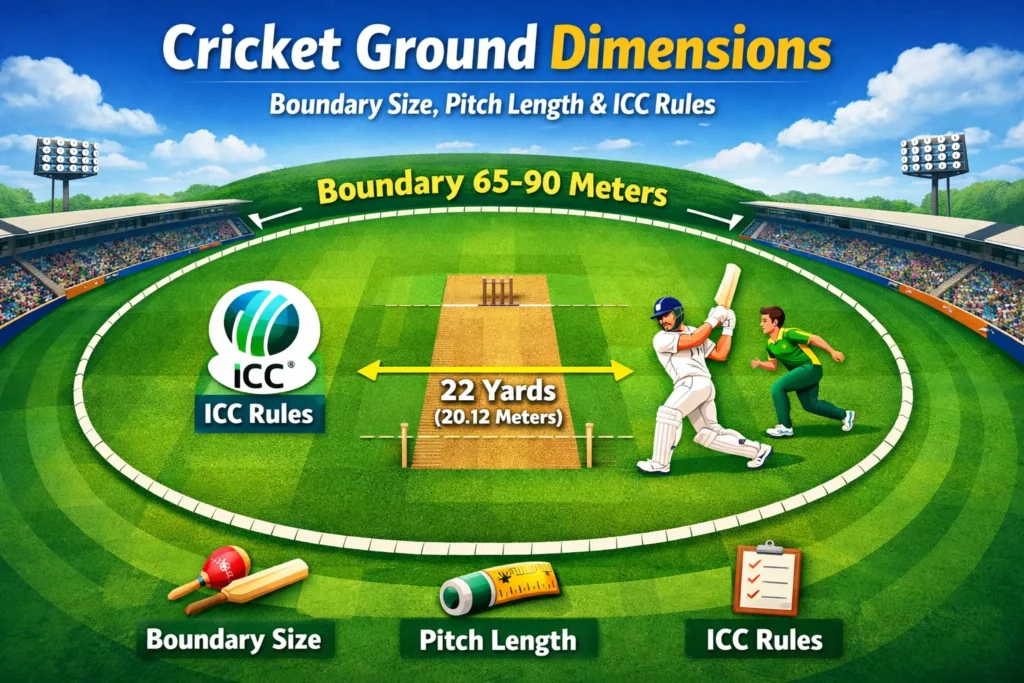
Cricket is a very popular sport played all around the world. When you watch a cricket match, you see players running, hitting the ball, and fielders chasing it. But many people do not know the cricket field dimensions that a cricket ground also has special sizes and rules that must be followed.
The cricket boundary length is the distance from the center of the cricket pitch to the boundary rope around the field. In international cricket, the boundary is usually between 65 meters and 90 meters (About 213–295 feet)
from the center of the pitch.
A boundary in cricket is the line or rope around the edge of the playing field, and when the ball reaches or crosses this line, the batting team automatically scores four runs or six runs according to the rules of the International Cricket Council.
The International Cricket Council (ICC) recommends that the boundary should not be smaller than about 65 meters and should usually stay within 90 meters for professional matches. This range helps keep the game fair for both batters and bowlers.
In the middle of the ground, there is a narrow strip of land called the cricket pitch. This is where the bowler bowls the ball and the batter tries to hit it. The pitch has a fixed length of 22 yards (about 20 meters) from one wicket to the other.
These sizes and measurements are guided by rules from the International Cricket Council (ICC). These rules help make the game fair so that teams can play under similar conditions in different stadiums.
In this guide, you will learn the simple cricket ground measurements, including boundary size,
international cricket pitch length, and ICC rules, explained in very easy language.
Who Sets Cricket Ground Dimensions?
The rules are decided by the International Cricket Council (ICC).
According to ICC Playing Conditions:
- Pitch size is fixed
- Boundary size has minimum and maximum limits
- Grounds may vary in shape, but fairness is mandatory
This flexibility allows cricket to be played in old historic stadiums and modern venues worldwide.
Overall Cricket Ground Size (Important Clarification)
Cricket grounds are usually oval or circular, not rectangular.
📏 Ground Diameter (Longest Distance)
Most international cricket grounds fall between 137 and 150 meters at their longest boundary distance, depending on the shape of the ground.
Difference Between Ground Diameter and Cricket Ground Length
Many people get confused between ground diameter and cricket ground length, but they are not the same thing. They describe different measurements of a cricket field.
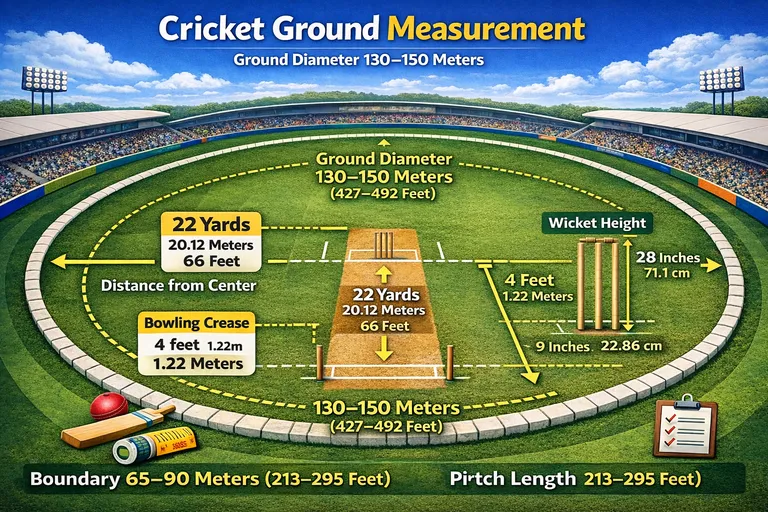
1. Ground Diameter
The ground diameter means the total distance from one side of the boundary to the opposite side of the boundary, passing through the center of the ground.
- It measures the full width of the cricket field.
- Most international cricket grounds have a diameter of about 130 to 150 meters depending on the stadium size.
- Because cricket fields are often oval, the diameter may be slightly different in different directions.
Simple idea:
Boundary → Center → Boundary2. Cricket Ground Length
The cricket ground length usually refers to the distance from the center pitch to the boundary rope in one direction.
- This is basically the boundary distance.
- In international matches, it is usually 65 to 90 meters according to guidelines from the International Cricket Council.
Simple idea:
Center → BoundaryQuick Comparison
Feature Ground Diameter Cricket Ground Length Meaning Distance across the whole ground Distance from center to boundary Measurement Boundary to boundary Pitch center to boundary Typical Size 130–150 meters 65–90 meters Shape Impact Changes with oval shape Varies by boundary side ✅ Easy way to remember:
- Diameter = full ground width
- Ground length = half of the ground (center to boundary)
✔ Grounds are not perfect circles
✔ One side may be longer than the other
✔ ICC allows this variation
Also Read More About: Cricket Stadiums in India: International Grounds, Capacity, Records & Stats
Boundary Distance (ICC Official Rule)
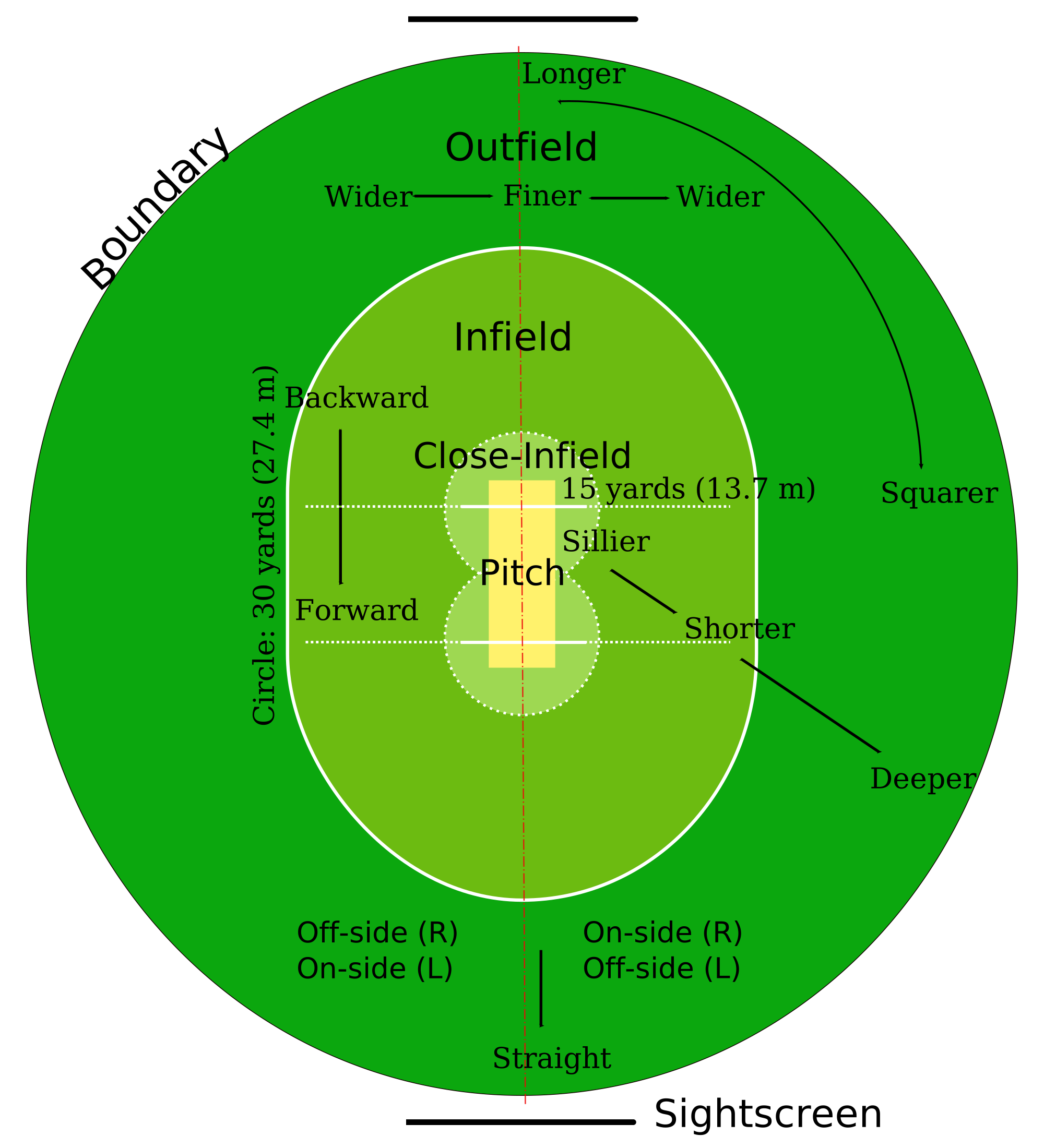
🟢 ICC Boundary Rules
According to ICC Playing Conditions:
- Minimum boundary distance: 65 meters
- Maximum boundary distance: 90 meters
📌 Measured from the center of the pitch to the boundary rope.
This rule applies to:
- Test cricket
- ODI cricket
- T20 International cricket
Longest Boundary Cricket Ground in The World
The cricket ground known for having one of the longest boundary cricket ground in world is Melbourne Cricket Ground (MCG) in **Melbourne, Australia.
The Melbourne Cricket Ground is one of the largest cricket stadium in the world by boundary. Because of its huge oval shape, the distance from the center of the pitch to some parts of the boundary can reach about 90–95 meters. This makes hitting sixes much harder compared with smaller stadiums.
Why Boundary Size Matters in Cricket
| Boundary Type | Impact |
|---|---|
| Short boundary | More sixes, high scores |
| Long boundary | More running, fewer sixes |
| Uneven boundary | Tactical field placements |
That is why:
- Batters love small grounds
- Bowlers prefer big grounds
Cricket Pitch Dimensions (Fixed Worldwide)
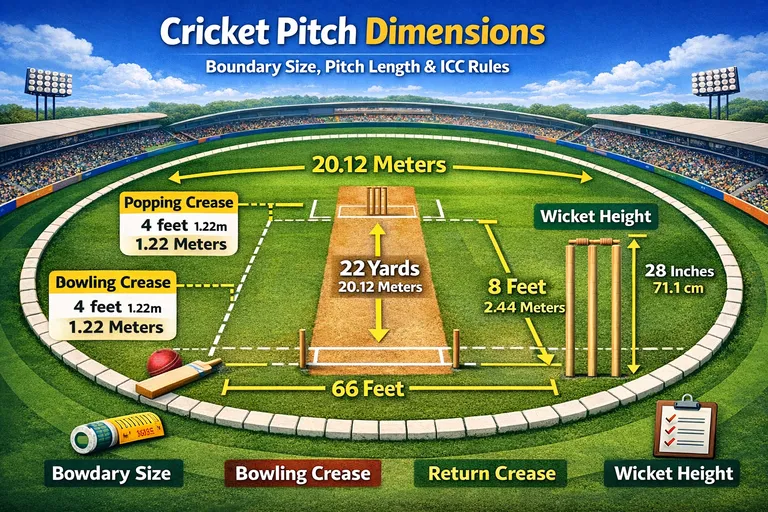

The pitch is the ONLY part of a cricket ground that has exact same size everywhere. People also search it like pitch dimensions cricket.
| Part | Measurement |
|---|---|
| Pitch length | 22 yards (20.12 m)(66feet) |
| Pitch width | 10 feet (3.05 m) |
| Bowling crease | 8 ft 8 in |
| Popping crease | 4 ft ahead of bowling crease |
| Return creases | 8 ft 8 in apart |
Cricket Pitch Length in Meters and Feet
The cricket pitch length is the distance between the two wickets in the center of the field. According to the official rules of the International Cricket Council, the length of a standard cricket pitch is:
- 22 yards
- 20.12 meters
- 66 feet
This measurement has been used in cricket for more than 200 years, and it is the same for all formats of cricket, including Test matches, One Day Internationals (ODIs), and T20 matches.
Even though cricket grounds can be different sizes, the pitch length always stays the same: 20.12 meters (66 feet) in every official cricket match.
Indian Cricket Pitch Length in Feet
The Indian cricket pitch length in feet is the same as the standard cricket pitch used all over the world. According to the rules set by the International Cricket Council, the official length of a cricket pitch is:
- 66 feet
- 22 yards
- 20.12 meters
This means the distance from one set of wickets to the other is always 66 feet, whether the match is played in India or any other country.
✔ From village cricket to World Cup finals — pitch size never changes
Inner Circle / 30-Yard Circle

📐 Measurements
- Radius: 27.43 meters (90 feet)
- Also called the 30-yard circle
🎯 Purpose
Used in ODI and T20 cricket to:
- Control fielding positions
- Encourage attacking batting
- Balance bat and ball
Real Stadium Boundary Sizes (High-Value SEO Table)
| Stadium | Country | Average Boundary |
|---|---|---|
| Melbourne Cricket Ground | Australia | 85–90 m |
| Eden Gardens | India | 70–75 m |
| Lord’s Cricket Ground | England | 65–70 m |
| Sharjah Cricket Stadium | UAE | 65–70 m |
📌 This table strongly improves featured snippet chances.
Cricket ground measurement with diagram
Why Cricket Grounds Are Different Sizes
Cricket grounds vary because of:
- Old stadium architecture
- City space limitations
- Natural land shape
- Player safety requirements
ICC allows variation only within limits, so the game stays fair everywhere.
Small vs Large Cricket Grounds
| Feature | Small Ground | Large Ground |
|---|---|---|
| Boundary | 65–70 m | 80–90 m |
| Sixes | Easy | Hard |
| Running | Less | More |
| Spinners | Less help | More help |
Cricket Ground Dimensions for Kids & School Cricket
In school and academy cricket:
- Boundaries are reduced
- Field size is adjusted for safety
- Pitch length remains 22 yards
This helps young players:
- Learn technique
- Avoid injury
- Enjoy the game
Common Mistakes About Cricket Ground Dimensions
❌ Pitch length can change
❌ All boundaries are equal
❌ Grounds must be circular
✅ Pitch is always 22 yards
✅ Boundaries can be uneven
✅ Oval shape is allowed
FAQs – People Also Ask
What is the standard size of a cricket ground?
There is no single standard size, but ICC allows 65–90 meters boundary distance.
Is cricket pitch size same everywhere?
Yes. The pitch is always 22 yards long worldwide.
Which is the biggest cricket ground?
The Melbourne Cricket Ground (MCG) is the largest.
Why do some grounds have short boundaries?
Due to space limits and stadium design.
Biggest cricket stadium in world by boundary ?
The Melbourne Cricket Ground is one of the largest cricket stadium in the world by boundary.
Conclusion
Cricket ground dimensions are flexible but strictly controlled. While every ground looks different, ICC rules ensure fairness in international cricket. The pitch size is fixed, but boundary size varies — making cricket strategic, exciting, and unique.
Understanding cricket ground dimensions helps players adapt, fans understand conditions, and beginners learn the game correctly.

Ethan Richards is a sports rules specialist known for breaking down complex cricket laws into clear, reader-friendly guides. His articles focus on match formats, powerplays, no-balls, DRS, and game-changing rules across T20, ODI, and Test cricket. Ethan aims to make every rule easy to understand for fans and beginners.