
Leaking is almost never a manufacturing fault. It is physics, and it responds to a handful of things you do differently at the sink.
Few things sour a person on refillable vaping faster than finding e-liquid through a coat pocket. The natural conclusion is that the pod is defective, and occasionally it is — but far more often the pod is behaving exactly as designed and something about how it was filled, stored or carried made leaking inevitable.
The encouraging part is that pods leak for a small number of well-understood reasons. Once you know them, the problem largely stops happening, and the fixes cost nothing and add no time to your routine.
Here is what is actually going on inside a pod, then every cause and its remedy.
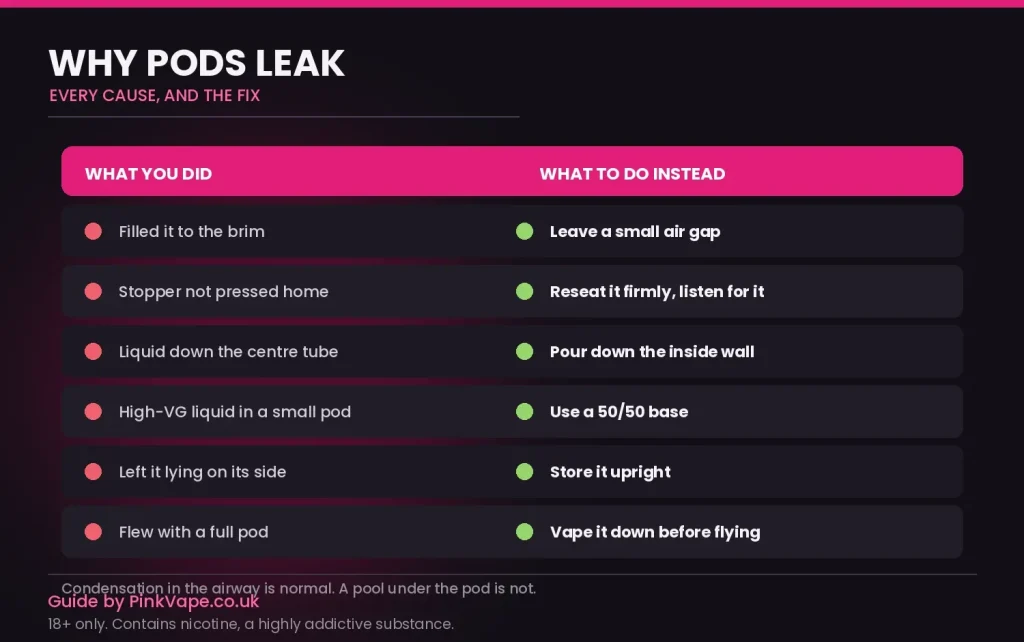
Every common cause, and what to do instead.
What Holds the Liquid In
A pod is not sealed in the way a bottle is. It cannot be, because liquid has to reach the wick and air has to reach the coil for you to draw on it. What holds everything in place is a balance of pressure.
Inside the pod, liquid presses down under gravity. Working against it, the small pocket of air trapped above the liquid holds it back. As you vape and the liquid level drops, that air pocket grows and the balance holds. It is an elegant arrangement and it works reliably until something disturbs it.
Every cause of leaking is a disturbance to that balance. Remove the air pocket, change the air pressure outside, thin the liquid, or provide an easier route out than the wick, and gravity wins.
Cause One: Overfilling
The most common cause by a distance, and the most counter-intuitive, because filling a pod to the top feels like the sensible thing to do.
A pod filled to the brim has no air pocket. With nothing pushing back, liquid presses steadily against the wick and seeps through into the airway, where it runs down and out of the base. The device has not failed; it has simply been deprived of the mechanism that was holding the liquid in.
The fix
Stop filling about three or four millimetres below the top. On most pods there is a moulded line marking exactly this, and it is there for precisely this reason rather than as a suggestion. You lose a fraction of capacity and gain a device that does not leak, which is a straightforward trade.
Cause Two: The Stopper
Most refillable pods fill through a port sealed by a small silicone bung. It is easy to press back in far enough to look closed while leaving a hairline gap, and a hairline gap is all liquid needs.
The fix
- Press it in until it sits flush with the surrounding surface, not proud of it.
- Run a fingernail round the edge to confirm there is no lip standing up.
- Check it after a day or two, since bungs can work loose with temperature changes.
- Inspect the silicone occasionally for splitting or perishing, which is a genuine wear item on a pod used for months.
A perished bung is one of the few situations where the pod genuinely is at fault, and it is worth knowing the difference before blaming yourself for a leak you did not cause.
Cause Three: Filling Down the Middle
Every pod has a central tube running from the coil up to the mouthpiece. That is the airway, and it must stay dry. Pour liquid straight down into the pod and a proportion of it goes directly down that tube.
The result is liquid sitting in the airway rather than in the reservoir, which produces gurgling, spitback into your mouth, and a slow drip out of the base.
The fix
Tilt the pod and run the liquid down the inside wall, the way you would pour a beer. It takes no longer and keeps the central tube clear. If you have already flooded the airway, blow gently through the pod onto kitchen paper before using it.
Cause Four: The Wrong Liquid
E-liquid comes in different thicknesses, and thickness determines whether the wick can control it.
A small pod coil has a fine wick with a small surface area, sized for the resistance it flows against. Thin, high-PG liquid moves through it easily — often too easily, flooding the coil and running through into the airway. Thick, high-VG liquid moves through slowly, which is fine on a large sub-ohm coil but starves a small one.
| Coil | Wants | Wrong liquid causes |
| Small pod, 0.8 ohm and up | An even 50/50 blend | High-VG: dry hits and a burnt coil |
| Sub-ohm, below 0.6 ohm | 70/30 or thicker | Thin liquid: flooding and leaking |
The rule is short: small coils want thin liquid, large coils want thick. Any well-run UK listing states the VG/PG ratio, and the product pages at PinkVape.co.uk note which coils a liquid suits, which removes the guesswork before you have bought the wrong bottle.
Cause Five: Storage
A device left lying on its side lets liquid migrate sideways into the airway, where it has an unobstructed route out through the base. This is why so many people find their device has leaked overnight without ever leaking in use.
Heat compounds it. Warmth thins e-liquid, and thinner liquid passes seals that would otherwise hold. A device on a sunny windowsill or a car dashboard is being actively encouraged to leak.
The fix
- Store it upright, mouthpiece up, whenever it is not in your hand.
- Keep it at room temperature and out of direct sunlight.
- In a bag, stand it in a side pocket rather than letting it lie flat under other things.
- If you will not use it for a few weeks, empty the pod rather than leaving liquid against the coil.
Cause Six: Pressure Changes
The air pocket holding your liquid in is at ground-level pressure. Reduce the pressure outside the pod and that trapped air expands, pushing liquid out through the wick.
Flying is the obvious case — cabin pressure drops noticeably — but altitude on a mountain road or a fast lift in a tall building produces a milder version of the same effect.
The fix
- Vape the pod down before flying rather than filling it at the gate.
- Store the device upright in a bag rather than flat in a pocket.
- Expect the first draw after landing to be wet, and clear the airway before using it properly.
- Carry bottles in a sealed bag regardless of the airport liquid rules.
None of this is dangerous, merely irritating — but arriving somewhere with liquid through your clothes is a poor start, and the prevention costs nothing.
Condensation Is Not Leaking
Worth separating, because the two get confused constantly.
Vapour that does not leave the device condenses back into droplets, and those collect in the airway, around the mouthpiece and in the pod recess. This is normal, universal and unavoidable — it happens on every device ever made, and it is not a fault.
- Condensation: a small amount of moisture in the airway and around the mouthpiece, appearing over days.
- Leaking: liquid pooling under the pod, running down the outside of the device, or visibly draining from the base.
Condensation is handled by a weekly wipe with a dry cotton bud. Leaking means working through the six causes above.
When the Pod Really Is at Fault
Occasionally it genuinely is. A split seal, a moulding flaw or a cracked shell will leak regardless of technique, and no amount of correct filling will help. The tell is consistency: if a pod leaks from the first fill despite everything above, and a different pod from the same device behaves normally, the pod is the problem. Counterfeit pods leak far more often than genuine ones, which is one practical reason to buy from an Pink vape official stockist rather than the cheapest listing available — fakes use looser tolerances and inferior silicone.
Reputable retailers will replace a genuinely faulty pod. It is worth raising rather than absorbing, particularly if more than one from a pack behaves the same way.
Frequently Asked Questions
Why does my pod leak only overnight?
Almost certainly stored on its side. Stand it upright, mouthpiece up.
Should I fill it to the top?
No. Leave three or four millimetres of air, which is what holds the liquid in.
Why does it gurgle?
Liquid in the central airway, usually from pouring down the middle. Blow gently through it onto kitchen paper.
Can I use any e-liquid?
Not safely. Small pod coils need a 50/50 base; thick high-VG liquid belongs in sub-ohm hardware.
Does leaving it in a hot car matter?
Considerably. Heat thins the liquid and degrades the battery, and both are permanent.
Is a little liquid under the pod normal?
A trace of condensation is. An actual pool is not, and points to one of the six causes.
Should I wash the pod after a leak?
Wipe the contacts and the recess with a dry cotton bud. Water on the electrical section is a worse problem than the leak.
A Filling Routine That Works
- Take the pod out of the device before filling. Filling in situ risks liquid running into the battery section.
- Hold it at an angle, port uppermost, so gravity works with you rather than against you.
- Run the liquid slowly down the inside wall, watching the level rather than the bottle.
- Stop three or four millimetres short of the top, or at the moulded fill line if there is one.
- Press the bung home until it sits flush, and check it with a fingernail.
- Wipe any liquid off the outside of the pod and off the contacts before reseating it.
- Leave it standing upright for a few minutes before the first draw — which also primes the wick.
Seven steps sounds like a lot written down; in practice it takes under a minute and becomes automatic within a week. The wiping step in particular is worth not skipping, since liquid left on the outside of a pod runs straight down into the recess and looks exactly like a leak.
The Short Version
Leave an air gap. Seat the bung flush. Pour down the wall, not the middle. Match liquid thickness to coil size. Store it upright at room temperature. Vape it down before you fly.
Six habits, none of which takes any longer than what you were doing before. Between them they account for nearly every leak that gets blamed on a faulty pod — and on the rare occasions a pod genuinely is defective, a Pink Vape or any accountable UK retailer will replace it rather than leaving you to work out whether it was your technique.
Age restriction and health notice
This article is intended for adult vapers aged 18 or over. Vaping products contain nicotine, which is a highly addictive substance. They are not suitable for non-smokers, under-18s, or anyone who is pregnant or breastfeeding. E-liquid should be stored securely out of reach of children and pets. If you are trying to stop smoking, your local NHS Stop Smoking Service offers free support.
