
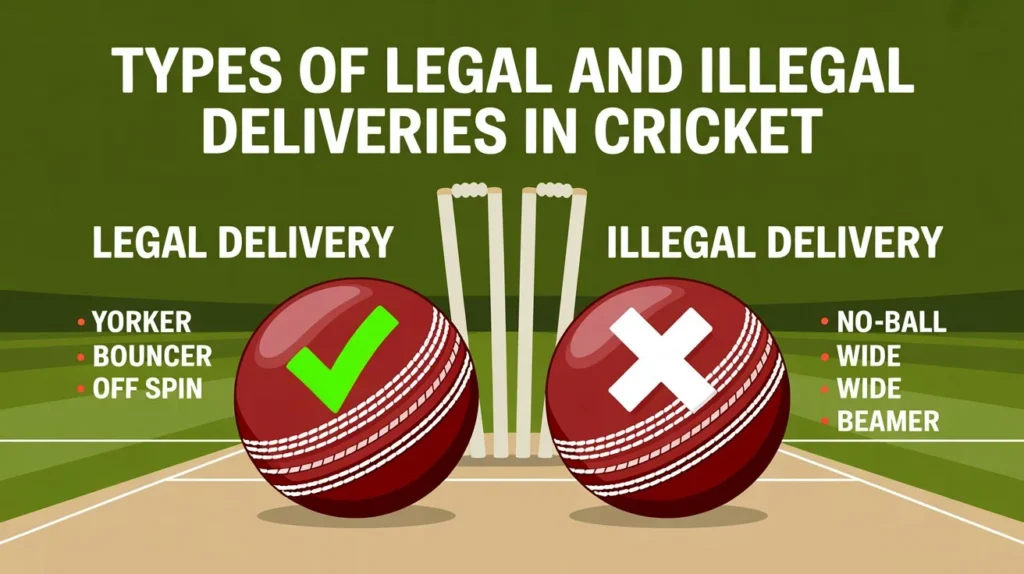
In cricket, every ball bowled by a bowler must follow certain rules to be considered a legal delivery. A legal delivery is crucial because it ensures fair competition between the batsman and the bowler, prevents unfair advantage, and maintains the spirit of the game. According to the ICC Laws of Cricket (Law 21 – No Ball), a delivery is legal only if the bowler’s action, foot placement, and ball trajectory all comply with the rules.
From front-foot placement to ball height, there are multiple aspects that decide whether a delivery is fair or not. In this article, we’ll explain the types of legal deliveries in cricket, supported by ICC laws and real match case studies.
What is a Legal Delivery in Cricket? (Law 21)
A legal delivery is a ball bowled by the bowler that is not a no-ball or a wide. For it to be legal:
- The bowler must have part of their front foot behind the popping crease.
- The ball must be delivered with a straight arm, not exceeding the 15-degree flexion rule.
- The ball must land within the pitch and not bounce more than twice.
- The ball must not be above waist height on a full toss or above head height after bouncing.
📖 Law Reference: ICC Law 21.5, 21.7, 21.10
✅ Types of Legal Deliveries in Cricket
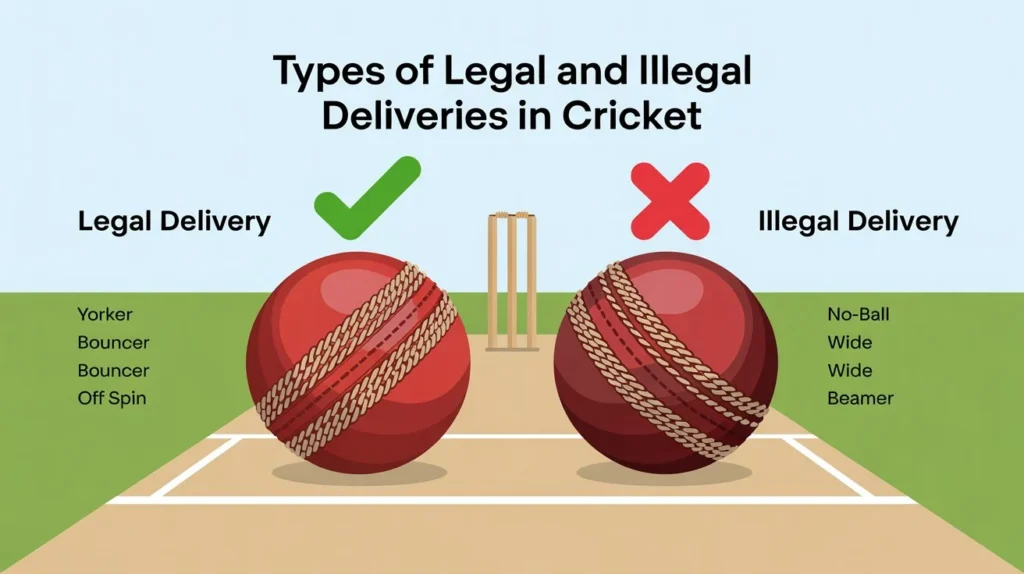
A “legal delivery” means the ball is bowled within ICC laws (bowling action + delivery rules). Legal deliveries are not just about the bowler’s action but also where the ball lands and travels. Broadly, there are 6 major types of legal deliveries:
1. Fair Bowling Action
- Arm must not extend more than 15 degrees.
- Bowler must deliver the ball with a straight arm, not throwing.
2. Valid Foot Placement
- Some part of the front foot must be behind the popping crease.
- The back foot must remain inside the return crease.
3. Fair Height Deliveries
- The ball must not pass the striker above the waist on a full toss (that would be a No Ball).
- A bouncer (ball pitching short) is legal if it passes below the head height (rules vary in Tests, ODIs, T20s).
4. Ball Pitched Inside the Playing Area
- A delivery is legal if it pitches inside the playing area before reaching the striker.
- If the ball lands outside (on the pitch edge or off the playing surface), it’s illegal.
5. Wide Ball (Legal if Not Too Wide)
- A ball is legal if it passes within the striker’s reach.
- If it’s too far outside leg or off side, it’s a wide ball (not illegal action, but still an extra run + extra delivery).
6. Types of Legal Bowling Styles
All types of bowling (pace, spin, swing, seam, off-spin, leg-spin, googly, doosra, carrom ball, yorker, bouncer, slower ball, knuckle ball, etc.) are legal as long as they follow above rules.
👉 So technically there are dozens of variations of legal deliveries.
❌ Types of Illegal Deliveries in Cricket
Illegal deliveries generally fall under No-Ball or illegal action rules. There are about 7 main types:
1. Throwing the Ball (Illegal Bowling Action)
- Arm straightening beyond 15 degrees = “chucking.”
- Example: Several bowlers reported by ICC (e.g., Muttiah Muralitharan controversy).
2. Overstepping the Crease
- If front foot lands beyond the popping crease = No-Ball.
3. Back Foot Outside Return Crease
- If the back foot crosses the side line while delivering = No-Ball.
4. High Full Toss (Waist-High No Ball)
- If a ball, without bouncing, passes above the striker’s waist height.
5. Excessive Bouncers
- In T20s: Only 1 bouncer per over allowed.
- In ODIs: 2 bouncers per over allowed.
- Beyond that = No-Ball.
6. Ball Pitching Outside Playing Area
- If ball pitches outside the pitch or bounces more than once before striker.
7. Underarm Bowling (Now Illegal)
- Unless agreed before the match, underarm bowling is not permitted.
📌 In Short
- Legal deliveries: Many (spin, pace, swing, seam, yorker, bouncer, doosra, knuckle ball, etc.) → as long as they follow action + foot + pitch + height rules.
- Illegal deliveries: Around 7 main types (throwing, overstepping, back-foot fault, waist-high, excessive bouncers, pitching outside, underarm).
🏏 Legal vs Illegal Deliveries in Cricket
| Category | Legal Deliveries | Illegal Deliveries |
|---|---|---|
| Bowling Action | Arm rotation under 15° flexion; proper bowling action (pace, spin, swing, etc.) | Throwing/Chucking (arm straightening above 15°) |
| Front Foot | Some part of the front foot behind the popping crease | Overstepping (front foot completely beyond popping crease) |
| Back Foot | Remains inside the return crease | Back foot outside return crease |
| Height (Full Toss) | Ball below the waist height | Ball above waist height without pitching = No Ball |
| Bouncers | Allowed within limit (Tests: any height below head; ODIs: max 2 per over; T20s: max 1 per over) | More than the allowed bouncers = No Ball |
| Pitching | Ball lands inside the pitch or bounces once before reaching striker | Ball lands outside pitch or bounces more than once |
| Bowling Styles | Fast, swing, seam, off-spin, leg-spin, doosra, carrom ball, yorker, knuckle ball, etc. | Underarm bowling (illegal unless agreed before match) |
| Extras (Not Illegal, But Penalty) | A ball within striker’s reach | Wide Ball (too far outside striker’s reach) |
Overarm Delivery Rules
Bowling must always be overarm in international cricket. The bowler’s elbow cannot straighten more than 15 degrees during delivery. If the action exceeds this limit, it is called an illegal bowling action.
📖 Law Reference: ICC Law 21.2
Case Study: In 2004, Sri Lankan spinner Muttiah Muralitharan was scrutinized for his doosra delivery. ICC later confirmed his action was legal under the 15-degree rule.
Foot Placement Rules for a Legal Ball
The bowler’s front foot must not cross the popping crease completely. At least part of the foot (either grounded or raised) should be behind the crease. Similarly, the back foot must remain inside the return crease.
📖 Law Reference: ICC Law 21.5
Case Study: In 2016, Indian pacer Jasprit Bumrah bowled a crucial no-ball in the T20 World Cup semifinal vs West Indies, giving a free hit that cost India dearly.
Height Rules for a Legal Delivery
- A bouncer is legal if it passes the batsman below the head height when standing upright.
- A full toss above waist height is a no-ball.
- Umpires monitor short-pitched deliveries closely in ODIs and T20s.
📖 Law Reference: ICC Law 21.10
Case Study: Pakistan’s Waqar Younis once received warnings for repeated high full tosses, which were deemed dangerous and illegal.
Pitching of the Ball
For a ball to be legal, it must land within the pitch. If it pitches outside the pitch or bounces more than twice before reaching the batsman, it is declared a no-ball.
📖 Law Reference: ICC Law 21.7
Case Study: In 2011, during a county game, a bowler accidentally dropped the ball outside the pitch. The umpire immediately called it a no-ball, showing how strictly the law is applied.
Types of Legal Deliveries in Cricket
Bowlers use various deliveries to outsmart batsmen, all of which remain legal as long as they follow ICC guidelines.
Fast Bowling Deliveries
- Yorker – A full-length ball at the batsman’s feet.
- Bouncer – A short-pitched ball rising towards the batsman’s chest/head.
- Swing Ball – Ball moving in the air (inswing, outswing).
- Seam Ball – Ball deviating off the seam after pitching.
- Slower Ball – Deception by reducing pace.
Spin Bowling Deliveries
- Off-Spin – Ball turning from off to leg side for a right-hander.
- Leg-Spin – Ball turning from leg to off side.
- Googly – A surprise delivery turning opposite to leg-spin.
- Doosra – Off-spinner’s variation turning the other way.
- Carrom Ball/Knuckleball – Unconventional variations.
All of these deliveries are legal if bowled within the rules.
Difference Between Legal and Illegal Deliveries
| Aspect | Legal Delivery | Illegal Delivery |
|---|---|---|
| Foot Placement | Behind popping crease | Overstepping (Front-foot No-Ball) |
| Bowling Action | ≤ 15° elbow flex | > 15° straightening |
| Ball Height | Below waist (full toss) / Below head (bouncer) | Above waist or head |
| Pitching | Lands within pitch | Outside pitch / multiple bounces |
| Wide Ball | Within reach of batsman | Too far off/leg side |
Impact of Legal Deliveries in Different Formats
- Tests: Umpires are lenient with wides, but no-balls still apply.
- ODIs: Powerplay overs make wides and no-balls more costly.
- T20s: Strictest format; even one no-ball with free-hit can change a match.
Case Study: In the 2019 World Cup Final, England benefited from wides and overthrows in the last over, showing how much extras impact outcomes.
FAQs
Q1. What is a legal delivery in cricket?
A delivery that follows ICC rules: proper foot placement, straight-arm action, legal height, and pitching within the pitch.
Q2. How many types of legal deliveries are there?
There are multiple types — yorkers, bouncers, swings, spin variations — all legal if bowled within ICC laws.
Q3. What makes a delivery illegal?
Overstepping, throwing (chucking), full toss above waist, bouncer above head, or ball pitching outside the pitch.
Q4. Is underarm delivery legal today?
Underarm bowling is legal only if agreed before the match, but it is banned in international cricket after the infamous 1981 incident (Australia vs New Zealand).
Q5. Can a spinner bowl a bouncer?
Yes, but it rarely happens due to their slower pace. If it goes above head height, it is illegal.
Conclusion
Legal deliveries are the foundation of cricket. From correct foot placement to respecting the 15-degree arm rule, bowlers must ensure they follow ICC laws to avoid penalties. By mastering legal deliveries like yorkers, swing, spin, and bouncers, bowlers not only stay within the laws but also add variety to their attack. Ultimately, knowing the types of legal deliveries in cricket is essential for players, umpires, and fans alike.

Daniel Foster is a senior sports writer specializing in cricket laws and international playing conditions. With extensive experience covering ICC rules, domestic leagues, and tournament regulations, he delivers detailed yet easy-to-read explanations. His work is trusted by readers looking for accurate and up-to-date sports rules.