
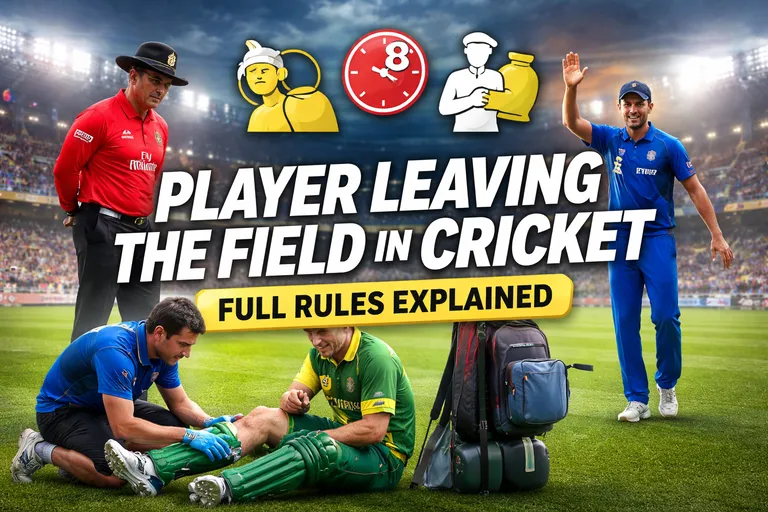
Cricket looks simple when all 11 players are on the field. But the game becomes confusing when one player goes off. Fans start asking many questions. Can another player field for him? Can he come back any time he wants? Can he bowl right away after returning? What happens if he was hurt by the ball? And what if he was not on the field from the very start?
These rules matter more than many people think. One player leaving the field can change bowling plans, batting order, and even the result of a match. Sometimes there is no problem. Sometimes there is penalty time. Sometimes a substitute fielder can help. And in special cases, like concussion, the team may even get a full replacement.
In this guide, you will learn all the important rules. We will explain what happens when a player leaves the field, stays out too long, comes back late, gets injured, misses the start of play, or cannot bowl at once. We will also look at real match stories so each rule is easy to understand.
In current ICC international cricket, if a player goes off the field for more than 8 minutes, he may get penalty time. He usually cannot bowl right away when he comes back. He may also have to wait to bat. A substitute fielder may field for him, but that substitute cannot bat or bowl. The umpire must know why the player went off, and the player needs the umpire’s okay to come back.
1) If a player is not on the field when play starts
If a player from the playing XI does not come to the field at the start, the umpire must be told why. The team may use a substitute fielder if the umpires accept the reason. In ICC cricket, only the players named as substitute fielders before the match may usually do this job, unless the Match Referee allows a later change in a special case.
Easy example
A team starts fielding. One player is still in the dressing room getting treatment. The umpire is told the reason. A named substitute fielder comes onto the field for him. That is allowed if the umpire accepts it.
Read More About: ⭐ How to Read Cricket Umpire Signals Easily (With Meaning & Examples)
2) Can the substitute bat, bowl, or keep wicket?
A normal substitute fielder can field only. He cannot bowl. He cannot act as captain. He may keep wicket only if the umpires allow it. Also, only the named player may bat, even if a substitute fielder fielded for him earlier.
Easy example
An opener is off the field at the start. A substitute fielder comes in. Later, when that team bats, the substitute cannot open the batting. Only the real player from the playing XI can bat.
3) Can a substitute take a catch or run a batter out?
Yes, an authorised substitute can do normal fielding work. ICC says a substitute’s job is fielding, and ICC also says a “fielder” includes players who are legitimately acting as substitutes. So an authorised substitute can stop runs, take a catch, or help make a run-out. That is an inference from the rule wording, and famous matches have shown it in real life.
Real case box: Gary Pratt
In the 2005 Ashes, England substitute fielder Gary Pratt ran out Ricky Ponting. That moment became one of the most famous substitute-fielder moments in cricket. It showed that a substitute can really change a match in the field.
Read More About: Rules of Replacing the Ball in Cricket (T20, ODI & Test)
4) Who gives permission when a player goes off or comes back?
The umpire must be told why the player is absent. After that, the player cannot come back in that session without the umpire’s consent. The umpire should give that consent as soon as it is practical.
Easy example
A fast bowler goes off because he feels pain. Later he feels better. He still cannot just run back in by himself. The umpire must allow him back.
Read More About: Cricket Ground Dimensions: Boundary Size, Pitch Length & ICC Rules
5) The most important rule: 8 minutes
In current ICC international cricket, 8 minutes is the big number. If a player is off the field for 8 minutes or less, there is usually no penalty time. If the player is off for more than 8 minutes, penalty time can start.
But here is the most important part: the penalty is for the full time the player was away, not just the extra time after 8 minutes. So if a player is away for 20 minutes, he may need to serve 20 minutes of penalty time. If he is away for 30 minutes, he may need to serve 30 minutes of penalty time.
What does penalty time mean?
Penalty time usually stops the player from bowling right away when he comes back. He must first spend the same amount of playing time on the field, or his team must be batting for that same amount of playing time. In ICC internationals, unserved penalty time can build up, but it is capped at 120 minutes.
Easy example 1
A player goes off for 5 minutes. He comes back. This is under 8 minutes, so there is usually no penalty time. He can normally bowl again.
Easy example 2
A bowler goes off for 20 minutes. He comes back. Now he usually cannot bowl at once. He must wait until 20 minutes of playing time have passed.
Easy example 3
A player goes off for 45 minutes. He comes back. He may have to wait 45 minutes of playing time before he can bowl. If his team starts batting before all of that penalty time is served, the rule can carry into the batting innings too.
Can he bat right away?
Not always. If the player still has unserved penalty time, he may also have to wait to bat. But there is one easy rule: if his team has already lost five wickets, then he may bat right away.
What is “playing time”?
Playing time does not mean normal clock time. It means the time when the match is really being played. Lunch, tea, innings breaks, and official drinks breaks are not counted the same way. If there is an unscheduled break, that time may count only after the player tells the umpire that he is ready to play again.
Real match example
A good real example is Rahkeem Cornwall in 2023. He was off the field because of illness. ESPNcricinfo reported that he had to serve 120 minutes of penalty time before he could bowl again. This is a good example because it shows that a player cannot always come back and bowl at once after a long break.
How many times can one player leave the field in one match?
There is no fixed number in the rule. A player can leave the field more than one time. But every time he goes off, the law checks it again. If he still has penalty time left and then goes off again, the new off-field time is added to the old unserved penalty time.
Easy example
A player goes off for 15 minutes. Later he goes off again for 10 minutes. The times can be added together if he has not finished serving the first penalty time.
One very important extra point
If a player goes off because he was hit by the ball or got some other external blow in the match, then penalty time may not apply. But if he goes off because of illness or internal injury, penalty time can still apply.
Read More About: Cricket Helmet Rules for Fielders and Wicketkeepers: Full Detailed Guide
6) What is the penalty for staying out too long?
If a player is out for more than 8 minutes, he usually cannot bowl right away when he returns. He must first spend the same amount of playing time either on the field, or while his team is batting. In current ICC Tests and ODIs, unserved penalty time is capped at 120 minutes. If time is still left, it can carry into the next innings. In Tests, it can also carry into the next day.
Easy examples
If a bowler is out for 20 minutes, he usually cannot bowl until 20 minutes of playing time have passed.
If a player is out for 150 minutes, the rule does not keep building forever. In current ICC internationals, the unserved penalty time is capped at 120 minutes.
Read More About: Five Penalty Runs in Cricket (2026): Full Rule Explained with Real Match Stories
7) Can the player bat right away after coming back?
Not always. If the player still has unserved penalty time, he may have to wait before he can bat. But there is one big relief: once his team has lost five wickets, he may bat right away even if some penalty time is still left.
Easy examples
A player is out long enough to have 30 minutes of penalty time. When his team starts batting, he may need to wait.
But if his team quickly loses five wickets, he may go in to bat right away.
Real case box: Jacques Kallis
In Adelaide in 2012, Jacques Kallis hurt his hamstring and went off the field. He could still bat, but if South Africa wanted him to bat in his usual place, he needed to spend as much time back on the field as the time he had spent off it. That is a good old real-life example of how off-field time can affect batting.
8) What does “playing time” mean?
The rule uses playing time, not simple clock time. That is why meal breaks, innings breaks, and drinks breaks do not work the same way as time with the ball in play. There is one extra point: if there is an unscheduled stoppage, that stoppage can count as penalty time served after the player tells an umpire in person that he is ready to take part again.
Easy example
A player comes back ready to play, but then rain stops the match. If the player has already told the umpire he is ready, that stoppage may count toward his penalty time.
9) What if a player goes off more than once?
The off-field time can be added together. If a player still has some penalty time left and then goes off again, the new time is added to the old time. The cap in current ICC Tests and ODIs is still 120 minutes.
Easy example
A player is out for 15 minutes. Later he goes out again for 10 minutes before serving all of the first penalty time. The rule can add the times together.
10) What if the player was hit by the ball?
This is a very important special rule. If the player suffered an external blow during the match and went off because of that, then his absence does not bring penalty time.
Easy example
A fielder stops a hard shot and the ball smashes into his hand. He leaves the field for treatment. Later he comes back. In that kind of case, penalty time does not apply because the injury came from an external blow in the match.
Real case box: Ankit Rajpoot
In IPL 2019, Ankit Rajpoot hurt his hand while fielding. ESPNcricinfo explained that he could still bowl later because the law says there is no penalty time when a player goes off after an external blow during the match.
11) What if the player is sick, has cramp, or has an internal injury?
That is different. ICC says “wholly acceptable reasons” do not include illness or internal injury. So in these cases, penalty time can still apply.
Real case: Fakhar Zaman’s injury against New Zealand
A very good modern example is Fakhar Zaman in Pakistan’s first match of the ICC Champions Trophy 2025 against New Zealand in Karachi. Fakhar got injured on the second ball of the match while chasing a cover drive from Will Young. He left the field very early, and PCB first said he was being checked for a muscular sprain. Later, ICC reported that he had an oblique injury, and Pakistan brought Imam-ul-Haq into the tournament squad as his replacement.
This case is important because it did not fall under the external-blow category. In simple words, Fakhar was not hit by the ball. He got hurt while moving and diving in the field. So this was a muscle injury while fielding, which fits the internal or non-external injury side of the rule, not the “ball hit the player” exception. That matters because the soft exception for an external blow did not apply here.
Fakhar did not stay off for only a few minutes. He was off for a little more than two hours in total. A detailed match report said he later returned to the field in two parts: first from the 13th to the 15th over, and then again from the 34th over to the end of New Zealand’s innings. Even after those returns, the time he had spent off the field still mattered under the law.
That is why Fakhar was not allowed to open Pakistan’s chase. Under the off-field rule, because he had spent so long away, he had to wait for either the remaining penalty time to pass or for five wickets to fall. Wisden’s explanation of the match said he had to wait for either 20 minutes or five wickets, so Pakistan sent Saud Shakeel to open with Babar Azam instead.
By the time Fakhar was finally allowed to bat, Pakistan were already 22 for 2 after 10 overs, so he came in at No. 4, not as an opener. The scorecards from major outlets all show that Pakistan lost Saud Shakeel first and then Mohammad Rizwan before Fakhar came in, and Fakhar’s own wicket fell later at 69 for 3 in 20.5 overs.
So, in simple words, Fakhar’s case was a fielding-injury case, not an external-blow case. He went off very early, came back later in phases, but because he had been away for a long time, the law stopped him from opening the batting. He was only able to bat later, and that is why he came in at No. 4.
Easy example
A spinner feels sick and goes off for 25 minutes. When he comes back, he may not be able to bowl right away. He may need to serve 25 minutes of playing time first.
Real case box: Rahkeem Cornwall
In 2023, Rahkeem Cornwall was off the field because of illness. Because it was illness, not an external blow, he had to serve 120 minutes of penalty time before he could bowl again.
12) Can a bowler go out to rest and then come back and bowl at once?
Not always. If the bowler is out for more than 8 minutes, the usual answer is no. He must serve his penalty time first, unless his case fits one of the exceptions, such as an external blow.
Easy example
A fast bowler goes off because he is tired and stays out for 18 minutes. When he comes back, he cannot usually bowl the very next over. He must first serve those 18 minutes in playing time.
13) What if the player comes back without permission?
This is a serious mistake. If a player comes back without the umpire’s permission and then touches the ball while it is in play, the ball becomes dead right away. The batting side gets 5 penalty runs. Any No ball or Wide still stands. Runs already completed also count, and the ball does not count in the over.
Easy example
A fielder runs back onto the field too early and stops the ball. The umpires can call dead ball and give 5 penalty runs to the batting side.
14) What if the player only goes just outside the boundary for a moment?
If a player goes briefly outside the boundary while doing fielding work, he is not treated as absent from the field. That means not every tiny step outside the rope becomes an absence case under this law.
Easy example
A fielder chases the ball, crosses the rope in the normal act of fielding, and comes back in. That alone is not the same as leaving the field under the absence rule.
15) How long can doctors treat a player on the field?
In current ICC Test and ODI playing conditions, the umpires usually allow an initial 4 minutes for the medical team to treat an injured player on the field. The umpires may tell the medical team when 90 seconds are left. If more treatment is still needed after that, the player should be taken off the field.
Easy example
A batter is hit and falls down. The doctor comes onto the field. The team gets about 4 minutes at first. If the player needs more help, he is usually taken off.
16) What if the player is not there at toss time?
In current ICC Tests, each captain names 11 players plus up to 6 substitute fielders before the toss. In current ICC ODIs, it is 11 players plus up to 4 substitute fielders before the toss. After the players are named, a player in the XI usually cannot be changed before the start without the other captain’s consent, except for special replacement rules such as concussion replacement.
The big point is simple: the rule mainly cares about the team sheet. So if a player’s name is already in the XI but he is not on the field at the start, the team may use a substitute fielder, but that named player is still the real player for batting later.
Easy example
A player is named in the XI before the toss, but he is still getting treatment when play starts. A substitute fielder may field for him. Later, the real named player may still come back and bat, subject to the penalty-time rules.
17) What if the captain is not there at toss time?
If the captain is not available, a deputy acts for him. If the captain is not available to name the players, then any person linked with the team may do that job. But after the players are named, only a nominated player can act as the captain’s deputy.
18) What if the player is fit at the toss, but gets hurt right after?
Then the team usually does not get a normal free full replacement. The player was already named in the XI before the toss. The usual answer is that the team may use a substitute fielder, but the named player still stays in the XI unless the other captain agrees to a change or a special replacement rule applies.
Easy example
A bowler is fit at toss time. In warm-up, he twists his ankle. The team usually cannot just swap him out for a fresh full player on its own. It may use a substitute fielder while the named bowler stays in the XI.
19) The special rule: concussion replacement
Concussion is different from normal absence. In current ICC cricket, a team may get a concussion replacement. The team must ask the Match Referee. The replacement should be a like-for-like player from the list named for the match, though the Match Referee can look at an outside name in exceptional cases. ICC also announced in 2025 that a player diagnosed with concussion during a match must observe a minimum seven-day stand-down before returning to play.
Real case box: Steve Smith and Marnus Labuschagne
In the 2019 Ashes, Steve Smith was hit on the neck by a Jofra Archer bouncer. He first retired hurt, then later the concussion signs became clear. Marnus Labuschagne came in as Smith’s replacement. ICC said this was the first concussion substitute in international cricket, and Labuschagne was allowed to bat and bowl because concussion replacement is a full approved replacement, not a normal substitute fielder.
20) What if a batter gets hurt and retires?
A batter may retire when the ball is dead. If the batter retires because of illness, injury, or another unavoidable cause, he is allowed to resume later. If he does not come back, he is recorded as Retired – not out. If he retires for another reason, he is recorded as Retired – out. Also, in current ICC internationals, runners are not allowed.
Easy example
A batter hurts his leg and cannot continue. He retires hurt. Later, if he is fit enough, he may come back in the innings. If he never comes back, the scorebook says Retired – not out.
Easy table: what happens in each case
The table below is a simple summary of the current ICC Test and ODI rules on players leaving the field, substitutes, batting delay, and return without permission.
| Situation | What happens |
|---|---|
| Player is out for 8 minutes or less | Usually no penalty time |
| Player is out for more than 8 minutes | Penalty time can start |
| Player comes back after 20 minutes out | He usually cannot bowl until 20 minutes of playing time have passed |
| Player still has penalty time when his team bats | He may have to wait to bat |
| Team has already lost 5 wickets | The player may bat right away |
| Player was hit by the ball and went off | No penalty time if it was an external blow |
| Player went off because of illness or internal injury | Penalty time can still apply |
| Player is named in the XI but is not on the field at the start | A substitute fielder may be allowed |
| Substitute fielder | Can field, but cannot bat or bowl |
| Substitute wants to keep wicket | Only if the umpires allow it |
| Player comes back without umpire permission and touches the ball | Dead ball + 5 penalty runs to batting side |
| Player is fine at the toss but gets hurt right after | Usually no normal full replacement; team may use a substitute fielder |
| Concussion case | A special like-for-like replacement may be allowed by the Match Referee |
Final short summary
Here is the simple rule: if a player goes off the field for more than 8 minutes, he may get penalty time. That usually stops him from bowling right away, and sometimes from batting right away too. A substitute fielder may help in the field, but he cannot bat or bowl. If the player was hit by the ball, there may be no penalty time. If the player was sick or had an internal injury, penalty time can still apply. And if the case is concussion, there is a special replacement rule.
FAQs
1. What happens if a player leaves the field in cricket?
If a player leaves the field, the umpire must know the reason. The player needs the umpire’s okay to come back.
2. How long can a player stay off the field in cricket?
A player can stay off the field, but if he is out for more than 8 minutes, penalty time may start.
3. Can a player bowl right after coming back to the field?
Not always. If the player stayed out for too long, he may have to wait before bowling again.
4. What is penalty time in cricket?
Penalty time is waiting time after a player stays off the field too long. It can stop him from bowling right away.
5. Can a substitute fielder replace a player who is off the field?
Yes, a substitute fielder may field for him if the umpire allows it.
6. Can a substitute fielder bat or bowl in cricket?
No. A normal substitute fielder can field only. He cannot bat or bowl.
7. Can a substitute fielder take a catch?
Yes, an allowed substitute fielder can take a catch and help with run-outs.
8. What happens if a player is injured and leaves the field?
It depends on the injury. If he was hit by the ball, penalty time may not apply. If he is sick or has an internal injury, penalty time can still apply.
9. What if a bowler goes off the field to rest?
If he stays out for too long, he usually cannot come back and bowl at once.
10. Can a player come back without umpire permission?
No. If he comes back without permission and touches the ball, the batting side can get 5 penalty runs.
11. What if a player is not on the field at the start of the match?
A substitute fielder may be used, but the real player from the playing XI is still the one who can bat later.
12. What if a player gets hurt after the toss?
He usually stays in the playing XI, and the team may use a substitute fielder instead of getting a normal full replacement.
13. What is the concussion replacement rule in cricket?
Concussion is a special case. A team may get a like-for-like replacement if the Match Referee approves it.
14. Can a player bat after being off the field for a long time?
Not always. He may need to wait, but if five wickets have already fallen, he may bat right away.

Sophie Carter is a skilled sports writer with a strong focus on cricket rules, match regulations, and modern playing conditions. She specializes in explaining complex laws such as powerplay restrictions, fielding rules, no-balls, wides, and DRS decisions in a clear and reader-friendly way.
Her content helps cricket fans, students, and new followers understand on-field decisions with confidence. At SportRulez, Sophie aims to make sports rules simple, accurate, and easy to follow, so readers can enjoy every match without confusion.