
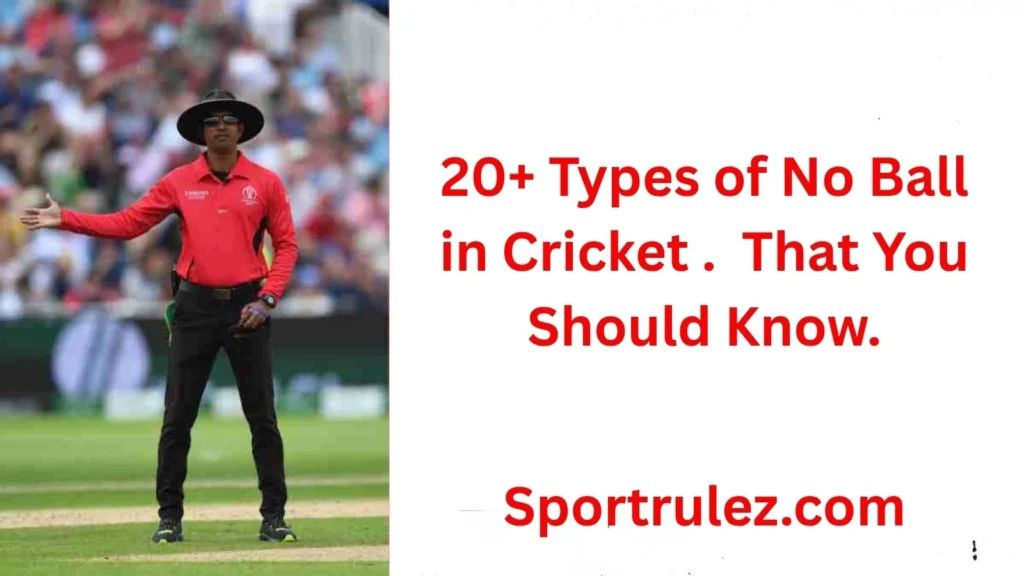
No ball meaning in cricket
A no ball means an illegal delivery by the bowler. It happens when the bowler breaks a rule, such as overstepping the crease or bowling in an unfair way. When a no ball is called, the batting team gets 1 extra run, and the ball usually does not count as one of the 6 balls in the over.
In the fast-paced world of cricket, the “no ball rules” are essential for maintaining fairness and safety on the field. A no ball is an illegal delivery bowled by the bowler, leading to penalties for the fielding side and advantages for the batting team.
Governed by the International Cricket Council (ICC), these rules are outlined in the MCC Laws of Cricket, particularly Law 21, with adaptations in playing conditions for Test matches, One Day Internationals (ODIs), and Twenty20 Internationals (T20Is).
Here are all types of no ball rules in cricket,
Front foot no ball, Back foot no ball, illegal bowling action, Change in mode without notification, Ball bouncing more than once or rolling, Ball coming to rest in front of the striker, Bowler breaking the wicket during delivery, Bowler throwing the ball before delivery stride, Wicket-keeper position violation, Fielders encroaching on the pitch, Dangerous short-pitched deliveries, Dangerous non-pitching deliveries (beamer), Deliberate front foot no ball, Fielding restrictions violation, and Unfair movement by the fielding side.
Understanding the types of no ball in cricket helps players, umpires, and fans clearly identify illegal deliveries, avoid costly penalties, and follow the game according to official ICC laws.
We’ll explore all types of no ball in cricket, definitions, consequences, format-specific variations, real-life incidents, and Canva prompts for visual explanations to help fans, players, and umpires grasp this crucial aspect of the game.
What Is a No Ball in Cricket?
According to ICC laws, a no ball occurs when the bowler delivers the ball in a manner that violates specific rules of the game. The primary reference is Law 21 of the MCC Laws of Cricket. When a no ball is called by the umpire, it results in an extra run awarded to the batting side, and the delivery does not count toward the over (meaning the bowler must bowl an additional ball). The umpire signals a no ball by extending one arm horizontally.
No ball rules ensure the bowler delivers the ball fairly, protecting the batter from unfair or dangerous play. Violations can range from foot placement errors to illegal bowling actions. Importantly, a batter cannot be dismissed in most ways off a no ball (exceptions include run out, handling the ball, or obstructing the field).
Consequences of a No Ball
The penalties for a no ball vary slightly by format:
- All Formats: The batting side gets one extra run (scored as “no ball extras”). Any runs scored off the bat or as byes/leg byes are added separately. The delivery is invalid and must be re-bowled.
- Test Matches: No additional perks like free hits.
- ODIs and T20Is: For most no balls (especially foot faults), the next delivery is a “free hit.” On a free hit, the batter cannot be dismissed except by run out, handling the ball, or obstructing the field. If the free hit is also a no ball or wide, another free hit follows.
- Repeated Violations: Bowlers may receive warnings, suspensions from bowling in the innings, or reports for illegal actions, potentially leading to bans under ICC regulations.
In limited-overs formats, no balls can also impact powerplays or super overs, amplifying their strategic importance.
All Types of No Ball Rules According to ICC Laws
The ICC categorizes no balls based on the mode of delivery, fairness, and infringements of other laws. Below, each type is detailed under its own heading, including the description, relevant ICC law, format-specific notes, a real-life incident, and a Canva prompt for creating a visual explanation.
Front Foot No Ball
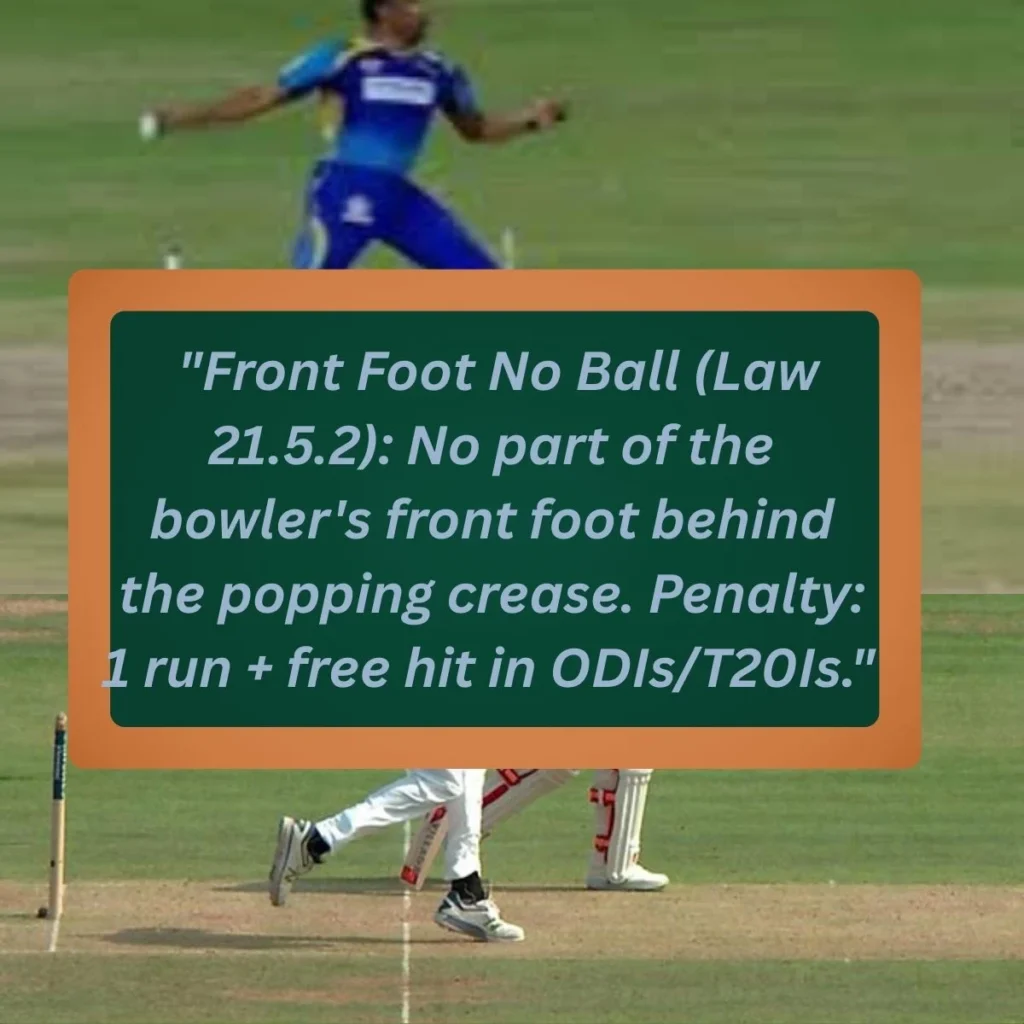
The front foot no ball is the most frequent violation, where the bowler’s front foot lands with no part (grounded or raised) behind the popping crease. This ensures the bowler doesn’t gain an unfair length advantage. It is governed by Law 21.5.2 and applies to all formats, triggering a free hit in ODIs and T20Is.
Umpires often use TV replays for confirmation, and deliberate cases can be penalized under Law 41.8 as unfair play. A real-life incident occurred during the 2005 Ashes series when Australian fast bowler Brett Lee overstepped multiple times in the final Test at The Oval, costing his team extras and momentum in a drawn match that handed England the urn.
Back Foot No Ball
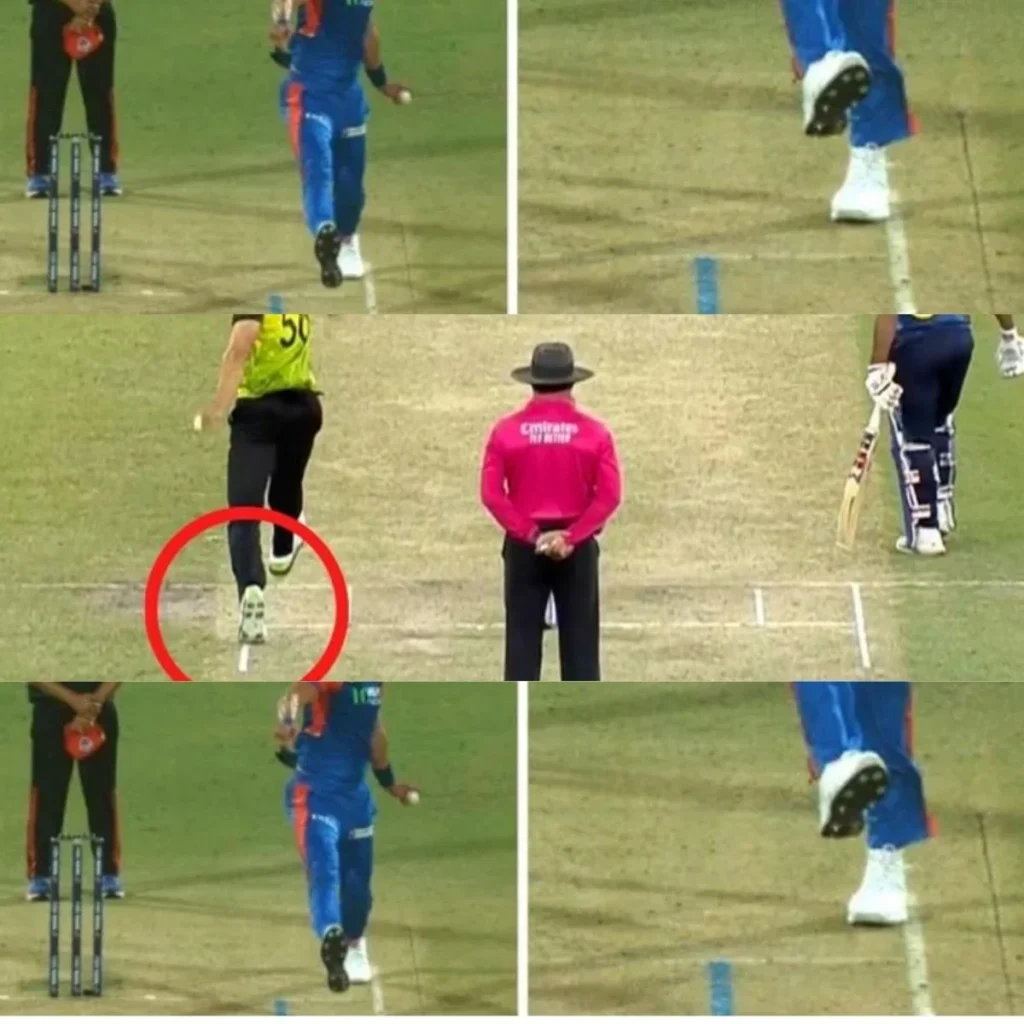
The back foot no ball happens when the bowler’s back foot lands outside or touching the return crease. Though less common, it prevents bowlers from angling deliveries illegally wide. This is outlined in Law 21.5.1 and applies to all formats. In the 2019 World Cup final, New Zealand’s Trent Boult was called for a back foot no ball against England, adding tension to an already dramatic super over finish.
Illegal Bowling Action (Throwing)
An illegal bowling action, or throwing, is called if the bowler’s elbow extends more than 15 degrees from horizontal to release, with suspected actions reported post-match. This falls under Law 21.2, applying to all formats, with the first offense resulting in a warning and repeats leading to suspension from bowling in the innings.
Underarm bowling is also banned under Law 21.1.2. Sri Lankan spinner Muttiah Muralitharan faced scrutiny in the 1990s, with his action cleared after biomechanical tests, but it highlighted debates on chucking in cricket.
Change in Mode Without Notification
A change in mode without notification occurs when a bowler switches arm (right/left) or side (over/round the wicket) without informing the umpire. This maintains transparency and is covered by Law 21.1.1, applicable to all formats, with the umpire calling no ball immediately. Indian all-rounder Ravindra Jadeja was once warned for this in a domestic match, though it’s rare internationally.
Ball Bouncing More Than Once or Rolling
If the ball bounces more than once, rolls along the ground, or pitches off the pitch before reaching the popping crease, it’s a no ball. This protects batters from erratic deliveries and is defined under Law 21.7.1 for ODIs/T20Is or Law 21.6 for Tests, applying to all formats.
In a 2018 ODI, Afghanistan’s Rashid Khan accidentally rolled a delivery against Ireland, leading to a no ball call and laughter on the field.
Ball Coming to Rest in Front of Striker
When the ball comes to rest in front of the striker without touching the bat or batter, it’s deemed a no ball, and the umpire calls dead ball. This is uncommon but ensures play resumes fairly, per Law 21.7.2 for limited overs or Law 21.8 for Tests, across all formats.
Bowler Breaking Wicket During Delivery
A bowler breaking the wicket during delivery, such as knocking the non-striker’s stumps (except in legal run-out attempts), triggers a no ball. This includes if clothing or objects fall from the bowler and is under Law 21.9, applicable to all formats. Pakistan’s Hasan Ali tripped and broke the stumps in a 2021 T20I against South Africa, resulting in a no ball.
Bowler Throwing Ball Before Delivery Stride
If the bowler throws the ball toward the striker’s end before starting the delivery stride, it’s a no ball, often seen as intimidation. This is per Law 21.4, applying to all formats; if not a no ball, it’s called dead ball, and intimidation may lead to further penalties. Shoaib Akhtar of Pakistan was notorious for this in the early 2000s, earning warnings in Tests against India.
Wicket-Keeper Position Violation
Wicket-keeper position violations happen if the keeper stands ahead of the stumps without permission. This ensures fair play for the batter and is cross-referenced in Law 27.3 and Law 21.10, across all formats. In the 2017 Champions Trophy, Australia’s Matthew Wade was penalized for encroaching against Bangladesh.
Fielders Encroaching on Pitch
Fielders encroaching on the pitch, stepping onto the protected area during delivery, leads to a no ball. Warnings escalate to penalties, under Law 28.5 and Law 21.10, for all formats. England’s James Anderson was warned for this in a 2023 Test against Australia.
Dangerous Short-Pitched Deliveries
Dangerous short-pitched deliveries exceed the allowed bouncers per over (e.g., two above shoulder height in Tests/ODIs, one in T20Is) or force evasion. This is per Law 41.6, across all formats, with a first warning followed by no balls. Neil Wagner of New Zealand used bouncers effectively but crossed the line in a 2020 Test against England, earning a no ball.
Dangerous Non-Pitching Deliveries: Full Toss (Beamer No Ball Rules in Cricket)
Dangerous non-pitching deliveries, or beamers, are full tosses above waist height (fast bowlers) or shoulder (slow), or any forcing the batter off the pitch. This is under Law 41.7, for all formats, with immediate no ball and repeats leading to suspension. Updated in 2022 to include forcing batter to leave pitch. Brett Lee bowled an infamous beamer to England’s Andrew Flintoff in 2005, apologizing mid-match.
Deliberate Front Foot No Ball
Deliberate front foot no balls involve intentional overstepping, often to prevent stumping. This is penalized under Law 41.8, across all formats, with captains warned and bowlers suspended on repeat. In IPL 2022, Rajasthan Royals’ Obed McCoy was suspended for deliberate oversteps against Gujarat Titans.
Fielding Restrictions Violation
Fielding restrictions violations occur with more fielders outside the 30-yard circle than allowed in powerplays (e.g., max 2 outside in first 10 overs of ODIs). This is per Law 28.4 and Law 21.10, for ODIs and T20Is only; no such restrictions in Tests. Mumbai Indians were called for this in IPL 2023, costing extras against Chennai Super Kings.
Unfair Movement by Fielding Side
Unfair movement by the fielding side, like moving after the bowler’s run-up or deliberate distractions, is a no ball. This is under Law 41.5 and Law 21.10, for all formats, with updates in 2022 for airborne catches and movement. South Africa’s Faf du Plessis was penalized for fake fielding in a 2017 ODI against Australia.
Note that a no ball always overrides a wide call (Law 21.13), and umpires can revoke a no ball if dead ball is called for other reasons (Law 21.12). For quick reference, here’s a summary table:
| Type of No Ball | Description | Relevant ICC Law | Format-Specific Notes |
|---|---|---|---|
| Front Foot No Ball | Bowler’s front foot lands with no part behind the popping crease. | 21.5.2 | All formats. Triggers free hit in ODIs/T20Is. |
| Back Foot No Ball | Bowler’s back foot lands outside or touching the return crease. | 21.5.1 | All formats. Less common. |
| Illegal Bowling Action (Throwing) | Elbow extends more than 15 degrees. | 21.2 | All formats. Warnings and suspensions. |
| Change in Mode Without Notification | Switches arm or side without informing umpire. | 21.1.1 | All formats. |
| Ball Bouncing More Than Once or Rolling | Bounces over once, rolls, or pitches off pitch. | 21.7.1 (ODI/T20), 21.6 (Test) | All formats. |
| Ball Coming to Rest in Front of Striker | Ball stops before striker’s crease. | 21.7.2 (ODI/T20), 21.8 (Test) | All formats. Dead ball. |
| Bowler Breaking Wicket During Delivery | Breaks non-striker’s wicket. | 21.9 | All formats. |
| Bowler Throwing Ball Before Delivery Stride | Throws toward striker before stride. | 21.4 | All formats. |
| Wicket-Keeper Position Violation | Keeper ahead of stumps without permission. | 27.3 (cross-ref 21.10) | All formats. |
| Fielders Encroaching on Pitch | Steps on protected pitch area. | 28.5 (cross-ref 21.10) | All formats. |
| Dangerous Short-Pitched Deliveries | Exceeds bouncer limit or forces evasion. | 41.6 | All formats. Warnings then no balls. |
| Dangerous Non-Pitching Deliveries (Beamer) | Full toss above waist/shoulder. | 41.7 | All formats. Immediate no ball. |
| Deliberate Front Foot No Ball | Intentional overstepping. | 41.8 | All formats. Suspensions. |
| Fielding Restrictions Violation | Too many fielders outside circle in powerplays. | 28.4 (cross-ref 21.10) | ODIs and T20Is only. |
| Unfair Movement by Fielding Side | Unfair movement or distraction. | 41.5 (cross-ref 21.10) | All formats. |
Variations in No Ball Rules Across Cricket Formats
While the core no ball rules are consistent, formats introduce nuances:
- Test Matches: Focus on endurance; no free hits.
- ODIs: Free hits for foot no balls and most others. Fielding restrictions add risks.
- T20Is: Similar to ODIs but with stricter powerplays. Free hits heighten excitement.
For women’s cricket or domestic leagues, rules align closely but may have minor tweaks—always check local governing bodies.
No Ball Out Rules in Cricket
In cricket, a batter cannot be dismissed off a no ball, with only a few specific exceptions allowed under the Laws of Cricket.
When a batter is NOT OUT on a no ball
If the delivery is called a no ball, the batter cannot be out by:
- Bowled
- LBW
- Caught
- Stumped
- Hit wicket
These dismissals are invalid because the delivery itself is illegal.
When a batter CAN be OUT on a no ball
Despite the no ball, a batter can still be dismissed in these cases:
- Run out
- Hit the ball twice (not for protecting the wicket)
- Handled the ball (now included under Obstructing the field)
- Obstructing the field
Conclusion: Why No Ball Rules Matter
No ball rules are the backbone of fair play in cricket, preventing bowlers from gaining undue advantages and ensuring batter safety. By understanding these ICC laws—from foot faults to dangerous beamers—you’ll appreciate the game’s intricacies more.
Whether you’re a casual fan or updating your sports rules website, mastering “no ball rules” enhances your cricket knowledge. Stay tuned to ICC announcements for any future amendments!
Frequently Asked Questions (FAQs) About No Ball Rules
What is no ball in cricket?
A no ball in cricket is a wrong or unfair delivery by the bowler that gives the batting team an extra run.
What happens when a no ball is called in cricket?
When a no ball is called, the batting side is awarded one extra run, and the delivery does not count toward the over, requiring the bowler to bowl an additional ball. In ODIs and T20Is, the next delivery is typically a free hit, where the batter can only be dismissed via run out, handling the ball, or obstructing the field.
Why does a front foot no ball trigger a free hit in limited-overs cricket?
A free hit in ODIs and T20Is for front foot no balls was introduced to penalize bowlers for overstepping and to add excitement by giving batters a risk-free scoring opportunity. This rule does not apply in Test matches due to their longer format and strategic focus.
How many types of no ball are there in cricket?
In cricket, there is no single fixed official number, because a no ball can be called for different reasons under the Laws of Cricket. However, for easy understanding, it is usually explained in 4 main types: foot-fault no ball, height no ball, illegal action no ball, and fielding no ball.
Can a batter be dismissed on a no ball?
A batter cannot be dismissed on a no ball except in specific cases: run out, handling the ball, or obstructing the field. This protects batters from unfair dismissals on illegal deliveries.
What is the difference between a no ball and a wide?
A no ball is an illegal delivery due to violations like foot faults or dangerous deliveries, while a wide is called when the ball is too far from the batter to play a normal shot (Law 22). A no ball always overrides a wide call if both apply (Law 21.13).
Why are beamers considered dangerous and called no balls?
Beamers, or high full tosses above waist height (fast bowlers) or shoulder (slow bowlers), are dangerous because they can surprise or injure batters. Law 41.7 mandates an immediate no ball, with repeat offenses leading to the bowler’s suspension to ensure safety.
Does a no ball count as a ball faced?
No, a no ball does not count as a ball faced by the batter because it is considered an illegal delivery under the Laws of Cricket.
What constitutes a no ball in cricket?
A delivery is called a no ball if any one of the following happens:
- Overstepping the crease: The bowler’s front foot lands beyond the popping crease while delivering the ball.
- Illegal bowling action: The bowler bends the arm beyond the permitted limit (throwing or chucking).
- High full toss (beamer): A full toss above the batter’s waist (non-fast bowler) or chest/head (fast bowler).
- Dangerous short-pitched delivery: Excessive bouncers aimed at the batter.
- Too many fielders: More than the allowed number of fielders outside the inner circle during limited-overs matches.
- Incorrect field placement: Fielders positioned in illegal areas (e.g., too many behind square on the leg side).
- Bowling the wrong type of delivery: Such as switching arms or bowling style without informing the umpire.
- Ball bouncing more than once or rolling before reaching the batter (unless it’s a permitted variation).

Sophie Carter is a skilled sports writer with a strong focus on cricket rules, match regulations, and modern playing conditions. She specializes in explaining complex laws such as powerplay restrictions, fielding rules, no-balls, wides, and DRS decisions in a clear and reader-friendly way.
Her content helps cricket fans, students, and new followers understand on-field decisions with confidence. At SportRulez, Sophie aims to make sports rules simple, accurate, and easy to follow, so readers can enjoy every match without confusion.