| Rule/Aspect | Test Cricket | One Day Internationals (ODIs) | T20 Internationals (T20s) |
|---|---|---|---|
| Bouncers per Over | Unlimited, but must not be above head height (Law 21.10) | Maximum 2 bouncers per over allowed (ICC ODI Playing Conditions) | Maximum 1 bouncer per over allowed (ICC T20 Playing Conditions) |
| Short-Pitched Deliveries | Legal as long as below head height | 2 per over legal | 1 per over legal |
| Full Toss Height | Legal if below waist height | Legal if below waist height | Legal if below waist height |
| Front Foot Rule | Legal if some part of the foot lands behind popping crease | Same rule applies | Same rule applies |
| Free Hit After No Ball | Not applicable in Tests | Yes, after every no-ball | Yes, after every no-ball |
| Bowling Variations | Any legal spin, seam, swing, cutters, yorkers, slower balls | Same as Tests | Same as Tests |
| Over Rate | No limit, 90 overs/day target | 50 overs limit | 20 overs limit |
| Powerplay Field Restrictions (Affecting Bowling Strategy) | None | First 10 overs: only 2 fielders outside 30-yard circle | First 6 overs: only 2 fielders outside 30-yard circle |
| Number of Overs Per Bowler | No restriction | Max 10 overs per bowler | Max 4 overs per bowler |
| Use of Bouncers to Attack | Common and legal | Controlled due to over restrictions | Highly limited (1 per over) |
| Umpire’s Call on Dangerous Bowling | Umpire may warn if repeated short balls are deemed dangerous (Law 41.6) | Same rule | Same rule |
👉 Summary Insight for Readers:
- Tests allow the most freedom for bowlers, especially with bouncers.
- ODIs add limits on bouncers and overs per bowler.
- T20s are the most restrictive, with just 1 bouncer per over and fewer overs per bowler.
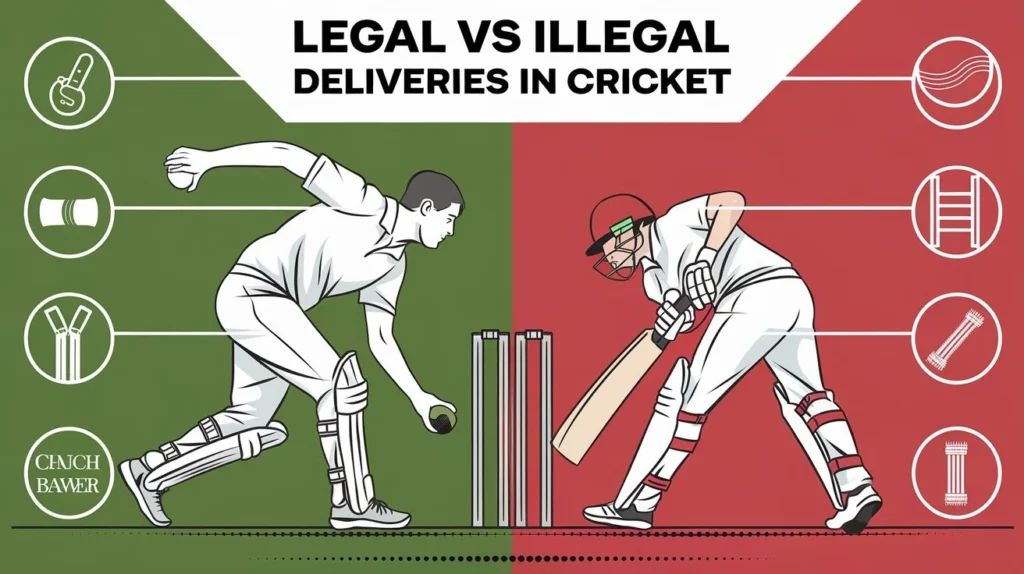
⚡This table helps readers immediately understand how legal deliveries change format to format.
🚫 Illegal Deliveries by Format (Test, ODI, T20)
| Rule/Aspect | Test Cricket | One Day Internationals (ODIs) | T20 Internationals (T20s) |
|---|---|---|---|
| Front Foot No-Ball | Illegal if front foot lands beyond popping crease (Law 21.5) | Same rule applies | Same rule applies |
| Back Foot No-Ball | Illegal if back foot touches return crease (Law 21.6) | Same rule applies | Same rule applies |
| High Full Toss (Beamer) | Illegal if above waist height on full (Law 41.7) | Same rule | Same rule |
| Dangerous Short-Pitched Bowling | Illegal if above head height (Law 21.10, 41.6) | Illegal if more than 2 per over | Illegal if more than 1 per over |
| Excessive Bouncers | Umpire may warn, then call No-Ball | 3rd bouncer in an over = No-Ball | 2nd bouncer in an over = No-Ball |
| Throwing (Illegal Bowling Action) | Any elbow extension beyond 15° is illegal (ICC Rule) | Same rule applies | Same rule applies |
| Double Bounce Rule | Illegal if the ball bounces more than once before reaching the striker (Law 21.7) | Same rule applies | Same rule applies |
| Ball Pitching Outside the Pitch | Illegal if the ball lands outside the 22-yard pitch area (Law 21.8) | Same rule applies | Same rule applies |
| Delivering Before Batsman Ready | Illegal if batsman is not ready (Law 20.4.2.1) | Same rule applies | Same rule applies |
| Underarm Bowling | Illegal unless agreed before match begins (Law 21.1) | Illegal | Illegal |
| Penalty for No-Ball | 1 run penalty, re-bowl | 1 run penalty, re-bowl, Free Hit next ball | 1 run penalty, re-bowl, Free Hit next ball |
| Penalty for Wide | 1 run penalty, re-bowl | 1 run penalty, re-bowl | 1 run penalty, re-bowl |
✅ Quick Insight for Readers
- Tests: Illegal deliveries = No-Ball or Wide, but no free hits.
- ODIs: Stricter on bouncers + free hits after no-balls.
- T20s: Toughest on bowlers (only 1 bouncer allowed, every no-ball = free hit).
📌 Case Studies on Illegal Deliveries in Cricket
1. Jasprit Bumrah’s No-Ball – Champions Trophy Final 2017
In the ICC Champions Trophy 2017 final, Jasprit Bumrah bowled a no-ball against Pakistan early in the innings. The ball dismissed Fakhar Zaman, but since it was a no-ball, the batsman survived. Zaman went on to score a match-winning century.
👉 Lesson: Even one illegal delivery can change the entire course of a big match.
2. Brett Lee’s Beamer Incident – 2005 Ashes
During the 2005 Ashes, Brett Lee accidentally bowled a head-high full toss (beamer) to Andrew Flintoff. The umpire immediately signaled a no-ball and gave a stern warning. While it wasn’t intentional, beamers are classified as dangerous deliveries under Law 41.7.
👉 Lesson: Safety is always prioritized over pace in cricket.
3. Andre Russell – Multiple Short Balls in T20
In a Caribbean Premier League (CPL) match, Andre Russell exceeded the one bouncer per over rule in T20 cricket. The umpire called the second bouncer a no-ball, awarding a free hit to the batting side.
👉 Lesson: Limited-overs formats are stricter, and bowlers must carefully manage their short-ball strategy.
4. Murali’s Bowling Action Controversy
Muttiah Muralitharan’s bowling action was heavily debated in the late 1990s and early 2000s. After biomechanical testing, the ICC introduced the 15-degree elbow extension rule for defining legal actions. Murali was eventually cleared, but the case redefined how “throwing” was judged in cricket.
👉 Lesson: ICC laws evolve with technology to ensure fairness.
5. Steve Harmison’s Wide – 2006 Ashes First Ball
In the first Test of the 2006 Ashes, Steve Harmison bowled the opening ball of the series that went straight to second slip – a shocking wide. While not dangerous, it became one of the most famous wides in cricket history.
👉 Lesson: Even legal bowlers can deliver pressure-induced wides at the highest level.
⚡ These case studies show how illegal deliveries (no-balls, wides, beamers, or action-related) can drastically impact a game’s outcome.

Isabella Brooks is a sports content writer with a strong interest in cricket rules and match regulations. She simplifies technical laws, umpiring decisions, and gameplay conditions into engaging explanations. Her writing helps casual fans follow matches with confidence and clarity.