
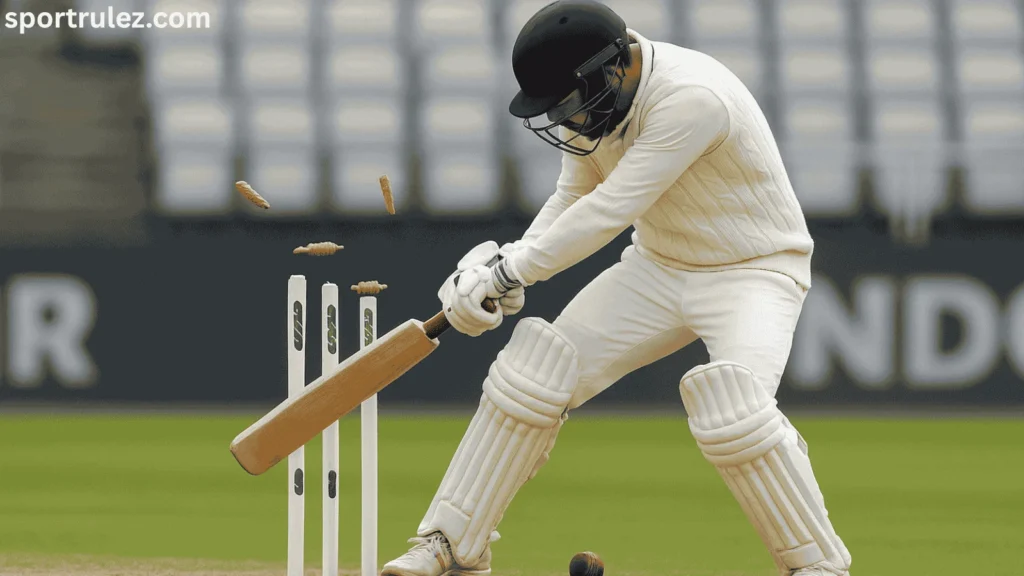
In cricket, a hit wicket is one of the most surprising and unfortunate ways a batter can get out. It happens when a batter accidentally dislodges the bails with their body, clothing, or bat after the bowler has entered their delivery stride.
While rare, these dismissals often change the course of a game, making the hit wicket rule one of the most talked-about topics among cricket fans.
This article explores the meaning, rules, and real-life examples of hit wicket, explains what happens if a batter hits a four or six before dislodging the stumps, and reveals record-breaking hit wicket moments across all formats of the game.
What Is a Hit Wicket in Cricket?
A Hit Wicket occurs when a batter accidentally dislodges the bails of their own wicket with their bat, body, or clothing after the bowler has entered the delivery stride and the ball is in play.
According to Law 35 of the MCC Cricket Rules, a batter is out Hit Wicket if:
- While attempting to hit the ball or set off for a run, they hit the stumps with their bat or body.
- The ball is in play and has not yet been called “dead.”
This means a batter’s concentration and body control are crucial — one wrong move can end their innings, even without the bowler claiming a conventional wicket.
When Is Hit Wicket Given?
A batter can be dismissed Hit Wicket in these scenarios:
- While playing a shot and the bat swings back to hit the stumps.
- While moving backward after a shot and the heel or pad touches the stumps.
- When the helmet, cap, or a piece of equipment dislodges the bails.
- When attempting a run and their clothing (like the shirt or trousers) brushes against the stumps.
Important Note:
If the batter knocks over the stumps after the ball is declared dead (for example, after a boundary or a no-ball), they are not out.
Can a Batter Be Hit Wicket on a No Ball?
No ❌ — a batter cannot be out Hit Wicket off a No Ball, unless the no-ball was for reasons other than overstepping (like dangerous bowling).
If the delivery itself is invalid, the batter cannot be dismissed through this method. However, they can still be Run Out afterward.
Famous Hit Wicket Incidents in Cricket History
| Player | Match | Year | Details |
|---|---|---|---|
| Inzamam-ul-Haq (Pakistan) | vs England, Leeds | 2006 | Tried to play a short ball, lost balance, and hit the stumps with his bat. |
| Brian Lara (West Indies) | vs Australia, 1999 | Fell backward onto his stumps while attempting a pull shot. | |
| Steve Waugh (Australia) | vs England, The Oval | 2001 | Brushed stumps with the bat’s handle after making his century. |
| Jason Roy (England) | vs South Africa, T20I | 2017 | Kicked his stumps while trying to take a quick single. |
| Martin Guptill (New Zealand) | vs Pakistan, 2020 | Hit the stumps with his foot mid-swing. |
Hit Wicket vs Bowled: What’s the Difference?
| Aspect | Hit Wicket | Bowled |
|---|---|---|
| Who causes the dismissal | Batter hits their own stumps | Bowler delivers the ball that hits stumps |
| Ball status | Still in play | Always in play |
| Credit for wicket | Awarded to the bowler | Awarded to the bowler |
| Common reason | Loss of balance, bat swing, or clothing | Ball beating the bat |
Even though both are credited to the bowler, Hit Wicket is considered a batter’s error rather than the bowler’s skill.
Hit Wicket vs Run Out on No Ball
- A Run Out can occur on a No Ball if the batter leaves the crease and the wicket is fairly broken.
- A Hit Wicket, however, cannot occur on a No Ball because it’s an invalid delivery.
- This makes the Run Out a live dismissal even when a Hit Wicket isn’t possible.
Example:
If a batter edges a no-ball, starts running, and accidentally knocks the stumps down while running — it’s not a Hit Wicket, but if the fielding side removes the bails while the batter is out of their crease, it becomes a Run Out.
History of Hit Wicket Rule
The Hit Wicket rule has existed since the 1740s — one of cricket’s earliest dismissal laws. Initially, it applied only if the batter’s bat hit the stumps. Over time, the law expanded to include the batter’s body, equipment, and even detached clothing.
The rule’s intent has always been to maintain fairness — preventing a batter from gaining an unfair advantage due to carelessness or imbalance.
Unusual and Rare Hit Wicket Moments
- Alan Knott (England, 1976): His bat broke mid-shot, and the handle alone dislodged the bails.
- AB de Villiers (2013 IPL): Helmet slipped off and hit the stumps — ruled out Hit Wicket.
- Shai Hope (West Indies, 2019): Bat slipped from his hand after a pull shot, hit the stumps — dismissed Hit Wicket.
These bizarre cases prove that Hit Wicket can happen to even the best players under high-pressure moments.
Statistical Records (All Formats)
| Format | Most Hit Wicket Dismissals | Player | Team |
|---|---|---|---|
| Test Cricket | 6 | Inzamam-ul-Haq | Pakistan |
| ODIs | 3 | Allan Border | Australia |
| T20Is | 2 | Jason Roy | England |
| Overall (All Formats) | 9 | Mix of multiple players | — |
Modern Insights: LED Stumps and Hit Wicket
With LED stumps, Hit Wickets have become easier to spot instantly. Even a gentle touch triggers a visible light signal, helping umpires make accurate, quick decisions.
Modern broadcast technology ensures that no accidental dismissal goes unnoticed.
🏏 Hit Wicket Rule in Depth — According to ICC Law 35
The Core Definition (Law 35.1)
A batter is out Hit Wicket if, after the bowler has entered the delivery stride and the ball is in play, their bat, body, or clothing breaks the wicket while:
- Playing the ball, or
- Preparing to receive the ball, or
- Setting off for the first run.
This includes any part of the batter’s person or equipment dislodging the bails while the ball is still live.
⚖️ When a Batter Is Not Out Hit Wicket
According to Law 35.2, a batter is not out Hit Wicket if the dislodging of the bails occurs:
- After the ball has been declared dead, or
- After completing a shot that resulted in a boundary (four or six), or
- If the wicket was broken by an external force, or
- The batter was avoiding injury or an unexpected deflection.
💥 The Boundary & Six Scenario Explained
🟩 Case 1: Batter hits a four and then dislodges the stumps
If a batter plays a shot, the ball crosses the boundary for four runs, and after that, the batter accidentally hits the stumps —
➡️ They are NOT out.
Why?
Because once the ball crosses the boundary line, the ball becomes dead immediately under Law 20.1.1 (Ball is Dead).
Any contact with the stumps after the ball becomes dead doesn’t count for a dismissal.
Example:
If the batter plays a cover drive, watches it roll to the fence, and in excitement or imbalance kicks the stumps —
👉 Not Out (the ball was already dead).
🟩 Case 2: Batter hits a six and dislodges the stumps
If the batter hits the ball for a six, but while following through, their bat or foot hits the stumps before the ball crosses the boundary line,
➡️ They are out Hit Wicket because the ball was still in play.
However,
If the batter’s bat touches the stumps after the ball has already landed beyond the boundary,
➡️ Not Out, since the ball became dead the instant it cleared the rope.
Example:
A batter lofts the ball toward long-on, and in the same motion, their bat handle strikes the stumps before the ball crosses the line —
👉 Out Hit Wicket (the wicket was broken while the ball was live).
If they lose balance after the six is scored,
👉 Not Out (ball already dead).
🟩 Case 3: No Ball or Free Hit Situation
- If the delivery is a no ball, the batter cannot be given out Hit Wicket, even if they break the stumps.
- On a free hit, the batter also cannot be out Hit Wicket — unless they attempt a run and are Run Out afterward.
Example:
A batter swings at a free hit, their bat hits the stumps — the ball is live, but the dismissal is not valid.
👉 Not Out (Protected under free-hit rule).
FAQs on Hit Wicket
Q1: What exactly is a Hit Wicket in cricket?
A Hit Wicket occurs when the batter breaks their own stumps with bat, foot, helmet, or clothing while the ball is live, after the bowler’s delivery stride begins.
Q2: Can a batter be out Hit Wicket after hitting a four or six?
No — once the ball crosses the boundary, it becomes dead. Any contact with the stumps after that does not count as a dismissal.
Q3: What if the batter hits the stumps before the ball crosses the boundary line?
Then they are out Hit Wicket — because the ball is still live until it touches or crosses the boundary.
Q4: Can a batter be Hit Wicket on a No Ball or Free Hit?
No. Hit Wicket is invalid on a no ball or free hit because both situations protect the batter from most dismissals.
Q5: What happens if the batter’s helmet falls and hits the stumps?
If the helmet was worn and accidentally dislodges during a live delivery, the batter is out Hit Wicket. If it happens after the ball is dead, not out.
Q6: Does the bowler get credit for a Hit Wicket?
Yes. Even though the batter causes the dismissal, the bowler still receives the wicket in the scorebook.
Q7: Can Hit Wicket happen in T20s or ODIs?
Yes. It applies to all formats — Tests, ODIs, and T20Is — under the same MCC Law 35.
Q8: Is Hit Wicket the same as Bowled?
No. In Bowled, the ball hits the stumps. In Hit Wicket, the batter does it themselves.

Daniel Foster is a senior sports writer specializing in cricket laws and international playing conditions. With extensive experience covering ICC rules, domestic leagues, and tournament regulations, he delivers detailed yet easy-to-read explanations. His work is trusted by readers looking for accurate and up-to-date sports rules.