
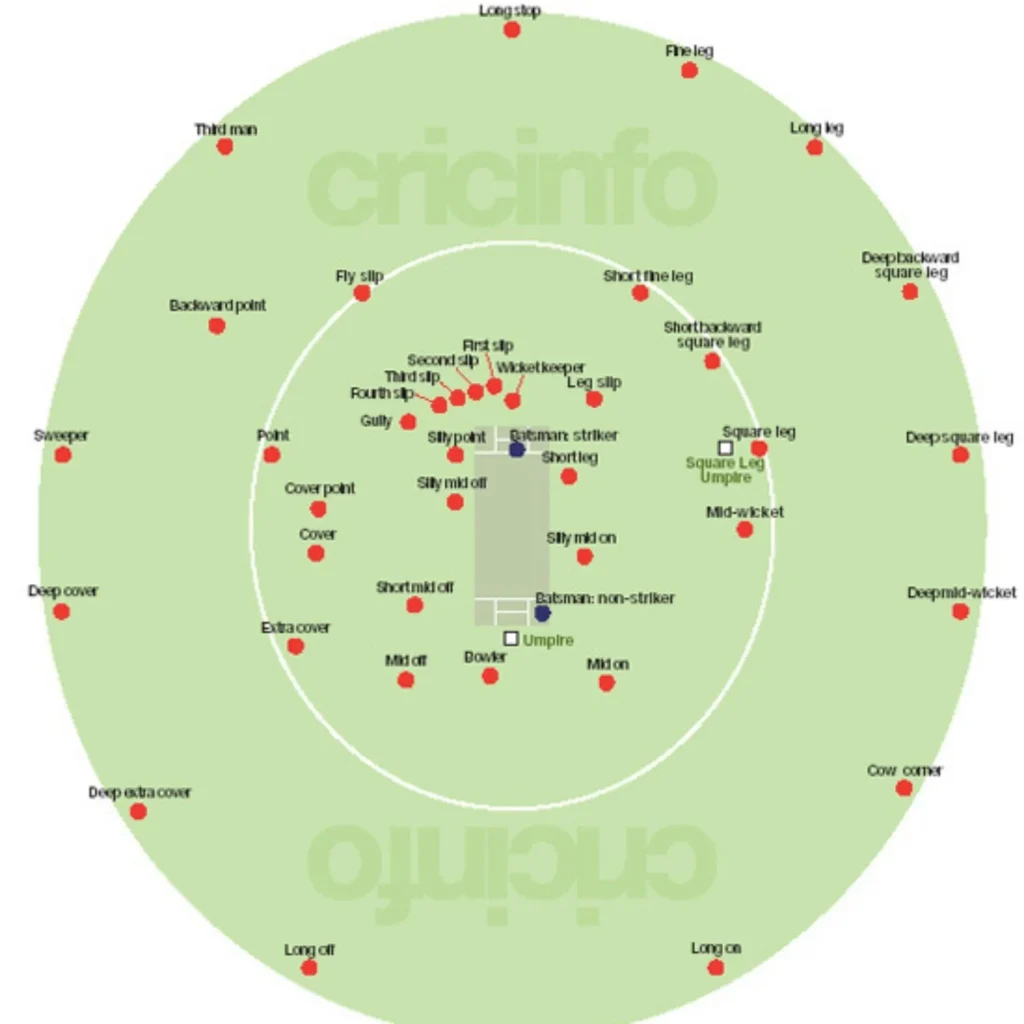
🏏The Science Behind Field Placements in Cricket
Field placement is one of the most strategic elements in cricket. It’s where the captain’s mind meets the bowler’s skill. Whether it’s Test cricket’s patience, ODI’s balance, or T20’s aggression, every format follows specific rules for where fielders can stand.
Understanding these fielding laws isn’t just for players — it’s essential for fans, analysts, and bettors who want to decode the game’s hidden patterns. This 2025 guide explains every aspect of field placement rules, penalties, and strategies across all major cricket formats.
⚖️ ICC Laws Governing Field Placements
According to the Marylebone Cricket Club (MCC), which maintains the official Laws of Cricket, fielding positions fall under:
- Law 28: The Fielder
- Law 41: Unfair Play
Together, they define how many players can field on each side of the pitch, when they can move, and what happens if they break the rules.
Key principles:
- Fielders must not distract or obstruct the batter.
- No more than two fielders are allowed behind square leg.
- Movement before the ball leaves the bowler’s hand can result in a no-ball.
🧱 Field Placement Rules in Test Cricket
Test cricket offers the most flexibility in field placements. There are no fixed Powerplays or circle restrictions, but fairness laws still apply.
Rules:
- No fielder except the wicketkeeper can stand behind the wicketkeeper.
- Only two fielders allowed behind square on the leg side.
- The wicketkeeper must remain motionless until the ball reaches the batter.
- Fielders can be placed close-in (slip, gully, short leg, silly point) or deep (midwicket, long-on, third man).
Strategy Insight:
Captains in Tests often use attacking fields early — like three slips and a gully — and switch to defensive ones later to save runs.
⚙️ Field Placement Rules in One-Day Internationals (ODIs)
ODIs introduce Powerplay restrictions, dividing the innings into three segments that control how many fielders can be outside the 30-yard circle.
| Powerplay | Overs | Fielders Outside 30-yard Circle | Description |
|---|---|---|---|
| Powerplay 1 | 1–10 | 2 fielders | Aggressive phase for batters |
| Powerplay 2 | 11–40 | 4 fielders | Balance between attack and defense |
| Powerplay 3 | 41–50 | 5 fielders | Death overs with more boundary guards |
Other Rules:
- At least two fielders must remain inside the inner circle at all times.
- Only five fielders allowed on the leg side.
Penalty:
If the captain violates field placement restrictions, the umpire signals a no-ball, and the next delivery is a free hit.
⚡ Field Placement Rules in T20 Cricket
T20 cricket compresses the same logic into high-intensity bursts.
- First 6 overs are Powerplay: only 2 fielders outside the 30-yard circle.
- After Powerplay: maximum 5 fielders outside allowed.
- No more than five fielders on the leg side at any time.
Because of the format’s pace, even a single illegal field placement can change the game.
Penalty:
- No-ball for illegal positioning.
- Free hit to the batting team.
- Repeat offenses can lead to captain warnings or suspension in tournaments governed by ICC codes.
🚫 Penalties for Illegal Field Placements
Breaking field placement rules can trigger various penalties depending on the format and situation:
1. No-Ball for Fielding Errors
- More than two fielders behind square leg.
- Too many fielders outside the circle during Powerplay.
- Wicketkeeper moving before the ball leaves the bowler’s hand.
- Fielder encroaching from outside the circle.
2. Five Penalty Runs (in Tests)
- If fielders deliberately distract the batter.
- If a substitute fielder illegally enters the field.
3. Warnings and Captain Accountability
Repeated offenses can lead to:
- Captain’s official warning.
- Report to match referee.
- In league formats (like IPL), over-rate or positioning penalties can also affect net run rate (NRR).
📚 Case Studies: Real-World Fielding Violations
1. India vs. Pakistan – Champions Trophy 2017 Final
Pakistan was warned for having three fielders behind square leg, a violation that almost resulted in a no-ball.
2. Australia vs. England – Ashes 2019
Umpires cautioned Australia’s keeper for moving too early — violating wicketkeeping position law.
3. IPL 2023 – Mumbai Indians vs. RCB
Mumbai’s bowler delivered a ball with six fielders outside the circle during Powerplay — declared no-ball, leading to a free hit that cost 6 runs.
🧠 How Captains Use Field Placements Strategically
Captains don’t just follow rules — they exploit flexibility.
In Test Matches
- Use close catchers like slip, gully, silly point early on.
- Set deep fields later to protect against boundaries.
In ODIs
- Rotate ring fielders to choke singles during middle overs.
- Use sweeper cover and long-on for defensive phases.
In T20s
- Hide weaker fielders on the off-side boundary.
- Shift field instantly based on batter’s stance and direction.
🔄 Recent ICC Updates (2023–2025)
- Helmet Distance Law: Fielders wearing helmets must keep them at least 1.5 meters behind the wicketkeeper.
- Smart Fielding Sensors: Trials ongoing for fielder position tracking to auto-detect circle violations.
- No Soft Signal: Fielding errors referred directly to the third umpire.
❓ FAQs About Field Placement Rules
Q1. How many fielders can be outside the 30-yard circle in T20 cricket?
Only 2 during the first 6 overs and up to 5 after that.
Q2. What is the penalty for wrong field placement?
Usually, a no-ball and free hit for the batting team.
Q3. Can a wicketkeeper move before delivery?
No. Early movement can result in a no-ball and official warning.
Q4. What happens if a team repeatedly violates field placement rules?
The umpire can penalize the captain, issue warnings, or even refer to the match referee.
Q5. Can fielders switch sides during delivery?
No. Fielders must remain stationary until the ball is released.
Q6. Do Test matches have Powerplays?
No. Test cricket allows flexible fielding, but limits like two behind square leg still apply.
🏁 Conclusion: Field Placements Are More Than Just Positioning
Field placements shape every ball of the game. They blend strategy, psychology, and regulation — forcing captains to balance risk and control. From the open aggression of Powerplays to the subtle traps in Test cricket, every position counts.
As technology evolves, field placement rules will only become stricter and smarter, ensuring fairness and precision in modern cricket.

Isabella Brooks is a sports content writer with a strong interest in cricket rules and match regulations. She simplifies technical laws, umpiring decisions, and gameplay conditions into engaging explanations. Her writing helps casual fans follow matches with confidence and clarity.