
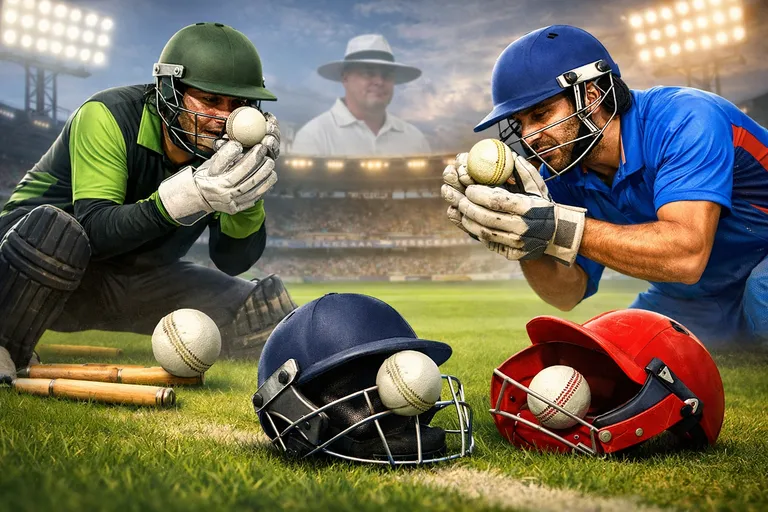
Cricket helmet rules confuse many fans because the law treats a helmet being worn and a helmet lying on the ground as two very different things. A ball can touch a helmet worn by a fielder and still lead to a fair catch, but a ball hitting a spare helmet on the ground can bring an immediate dead ball and five penalty runs to the batting side. That is why two similar-looking moments on TV can produce completely different umpire decisions.
The short version is this: if a fielder or wicketkeeper is wearing the helmet, the helmet is treated as part of lawful fielding equipment in important situations; if the helmet is not being worn and is left on the field, the law becomes much stricter. The current MCC Laws and modern ICC playing conditions both keep that basic structure.
The first big answer: if the ball touches a fielder’s helmet and then is caught, is the batter out?
Yes — if the helmet is being worn, the catch can be fair. The current MCC law on caught says a catch is fair even if the ball lodges in the external protective equipment worn by a fielder. So if a short-leg fielder is wearing a helmet, the ball strikes that helmet, pops up, and another fielder catches it before it hits the ground, the striker can be out caught.
This is one of the biggest old-vs-new changes in cricket law. Before the 2017 law change, this kind of dismissal was not allowed under the traditional MCC position. That is why some older fans still react as if such a catch should be not out. Cricket Australia’s reporting on the Mark Steketee incident explained that the dismissal would previously have been disallowed under older MCC law, but the newer playing conditions made it a fair catch, and ICC later adopted the change for international cricket from late September 2017.
Cricket Helmet Rules Summary
| Situation | What Happens | Rule Result |
|---|---|---|
| Ball hits fielder’s helmet being worn, then is caught | Helmet is part of worn protective gear | Catch can be valid, batter can be out |
| Ball hits wicketkeeper’s helmet being worn | Keeper’s equipment is involved in play | Dismissal may still be valid depending on the case |
| Ball hits spare helmet lying on the ground | Helmet on ground interferes with play | Dead ball + 5 penalty runs to batting side |
| Wicketkeeper removes helmet during over | Helmet should be kept in the proper place | Must be placed safely behind keeper in line with stumps |
| Close-in fielder wears helmet | Allowed for safety | Legal protective equipment |
| Helmet left in a random area of field | Not proper field setup | Can create problems and possible penalty outcome |
| Player wants to wear helmet | Allowed under normal conditions | No special routine permission needed |
| Umpire holding helmet | Not the normal practice | Players should manage helmet themselves |
What if the wicketkeeper is wearing the helmet?
If the wicketkeeper is wearing the helmet, the basic principle is also favorable to the fielding side. A catch can still be fair after contact with worn protective equipment, and the stumping law is even more explicit: if the ball rebounds onto the stumps from any part of the wicketkeeper’s person or equipment, it can still count as the wicket being broken by the wicketkeeper. That means a legal stumping can stand even when the ball first comes off the keeper’s equipment.
The same modern rule era also accepts helmet contact for run-out and stumping logic. ICC’s 2017 major-changes note stated that a batter can now be out caught, stumped, or run out if the ball bounces off the helmet worn by a fielder or wicketkeeper. That was one of the headline helmet-rule changes brought into top-level cricket in that period.
Also Read More About: Why Are There 11 Players in a Team? Cricket’s Lucky Number
Where can the fielding side leave a spare helmet on the ground?
This is where the law gets very specific. Under Law 28.3.1, a protective helmet belonging to the fielding side, when not in use, may not be placed on the ground except behind the wicketkeeper and in line with both sets of stumps. In plain words, the law recognizes one proper resting place for a spare fielding helmet inside the field of play: directly behind the keeper, lined up with the wickets.
So, no: a close fielder is not supposed to leave a spare helmet randomly at short leg, point, midwicket, or anywhere else. The law’s permitted place is the area behind the wicketkeeper in line with the stumps. That is the key location every player, coach, scorer, and fan should remember.
If the ball hits that spare helmet on the ground, what exactly happens?
If the ball in play strikes the spare helmet placed in that recognized position, the ball becomes dead immediately. The umpire awards five penalty runs to the batting side. Any runs already completed before impact are scored, and the run in progress also counts if the batters had already crossed when the ball hit the helmet. If the delivery was also a No ball or a Wide, that signal still stands as well.
There is a special exception in unusual situations such as leg-byes not being allowed, a runner restriction issue, or hit the ball twice. In those cases, the umpire disallows the batting-side runs and returns the batters, while still dealing with any other applicable penalties under the law. That exception is technical, but it matters for a full rules article because the famous “five penalty runs” rule is not literally automatic in every possible scoring situation.
Also Read More About: ⭐ How to Read Cricket Umpire Signals Easily (With Meaning & Examples)
Can any fielder in the fielding side wear a helmet, or only the wicketkeeper and close fielders?
Under the laws and ICC playing conditions, a normal fielder’s permitted external protective equipment is basically a protective helmet. The wicketkeeper is the exception because the keeper may also wear wicketkeeping gloves and external leg guards. So from a pure law point of view, a fielder can wear a protective helmet.
At elite ICC level, helmet use is mandatory in certain situations: when wicketkeepers stand up to the stumps, and when players are fielding close to the batter in front of the wicket. ICC playing conditions also say helmets are optional at other times, but if a player chooses to wear one, it must still be a certified helmet. That is why you often see short leg and silly point in helmets, but slip fielders are not automatically forced by the same ICC wording because the requirement is framed around close fielders in front of the wicket.
Does a player need the umpire’s permission to put on a helmet?
Not in the same way that some other protective items do. Law 28.1 specifically says that protection for the hand or fingers may be worn only with the consent of the umpires. But the law does not create a similar consent rule for wearing a fielding helmet. At the same time, Law 2.5.3 says the umpires must make sure that no player uses equipment other than what is permitted. So the practical answer is: you do not normally need to ask the umpire for permission just to wear a helmet, but umpires do supervise whether the equipment being used is lawful.
That means a close fielder or wicketkeeper does not have to stage a formal appeal to the umpire every time he wants to put the helmet on. The umpire’s role is oversight and law enforcement, not routine helmet authorization.
Also Read More About: Beamer No Ball Rules in Cricket:(Penalties and History)
Can the umpire hold the helmet?
The MCC Laws do not give umpires a normal job description of “helmet holder.” More importantly, some major domestic playing conditions say this very clearly: “Umpires are not to hold helmets.” ECB county, one-day, and The Hundred playing conditions all include that wording. So while this is competition-specific wording rather than a universal MCC sentence, it shows the direction modern cricket administration takes: the umpire should not be the person carrying helmets around.
How quickly must the helmet come on or go off? Is there a fixed time limit?
The MCC Law on fielding-side helmets controls where the spare helmet may be kept; it does not give a stopwatch number like 10 seconds or 30 seconds. So there is no famous universal law saying the helmet must reach the ground in a set number of seconds. That part is more about game management and avoiding time-wasting than about a fixed timer in Law 28.3.
Some domestic competitions go a little further and expressly allow the exchanging of equipment between members of the fielding side on the field, provided the umpires do not consider it a waste of playing time. That does not create a universal global time limit, but it does show how competitions expect helmet movement to be handled: quickly, sensibly, and without delaying the match.
Also Read More About: Rules of Replacing the Ball in Cricket (T20, ODI & Test)
Who can take the helmet back?
The written MCC/ICC law does not name one special person who alone may retrieve the spare fielding helmet. What matters in the law is the helmet’s permitted status and position, not a named collector. In some domestic conditions, on-field equipment exchange between fielders is allowed as long as it is not time-wasting, which supports the practical view that a nearby teammate can handle the change rather than turning it into a stoppage.
So for coaching and match-awareness purposes, the real lesson is simple: get it moved efficiently and lawfully, and do not let it sit around where it can affect play.
An important extra point: a wicketkeeper is only a wicketkeeper when actually acting like one
The laws also contain an overlooked detail: if by the player’s actions and positioning it is apparent to the umpires that he or she cannot perform the normal duties of a wicketkeeper, that player can lose the special recognition of being the wicketkeeper for certain laws. This matters in strange setups, such as when the “keeper” stands very wide or in an unusual place.
That is one reason the bizarre Bangladesh A incident became so widely discussed. A wicketkeeper standing like a first slip while the spare helmet remained behind the stumps looked visually wrong not only because of common sense, but because it pushed directly against how the laws normally imagine the wicketkeeper’s role.
Old rule vs new rule: what actually changed?
The biggest helmet-law shift came in the 2017 law-change cycle. ICC’s official summary said the ball could now be caught after striking a helmet worn by a fielder or wicketkeeper, and that a batter could also be out stumped or run out after the ball bounced off a worn helmet. ECB’s explainer described the same change in plain language.
Before that change, similar incidents could produce a not-out call. Cricket Australia’s coverage of Mark Steketee’s dismissal specifically noted that Matthew Wade had earlier been given not out in a Boxing Day Test against Pakistan when the ball came off close fielder Azhar Ali’s helmet — a result that was correct under the old law at the time.
The current 2026 MCC Code still keeps the same core framework: worn helmet contact can still contribute to lawful dismissals, while a spare fielding helmet on the ground is governed by the dead-ball and penalty-run rule in Law 28.3.
Famous real match stories and helmet controversies
One of the first famous modern examples was Mark Steketee in Sheffield Shield cricket in February 2017. His pull shot hit short-leg fielder Nick Larkin’s helmet and ballooned to a catcher, and he was given out under the new domestic playing condition. Cricket Australia described it as a rare dismissal and noted that it would previously have been disallowed.
That same rule later triggered debate from Usman Khawaja, who argued that while the keeper’s helmet case was understandable, he did not like the idea of close-in fielder helmet catches being out because those fielding positions are not compulsory in the same way. His reaction is one of the clearest examples of how this law change became a real cricket controversy rather than just a dry technical amendment.
Another bizarre example came in 2019 when Hilton Cartwright was dismissed after smashing the ball into Nick Larkin’s helmet at short leg, from where it rebounded high and was caught by the bowler Jason Sangha. Cricket Australia called it an extraordinary dismissal and again explained that older laws would not have allowed that wicket.
For the “helmet on the ground” side of the law, a famous Ashes example came at Sydney in 2018. Nathan Lyon beat Tom Curran and the ball hit the helmet behind the keeper, giving England five penalty runs. That is the classic TV example people remember when explaining Law 28.3.
Australia were burned by the same type of mistake again against South Africa at the SCG in January 2023. A ball from Lyon went past Alex Carey and struck the protective helmet lying behind the keeper, adding five penalty runs to South Africa’s total.
A very viral recent example came in May 2025 in the Bangladesh A v New Zealand A unofficial ODI. Wisden reported that Bangladesh A’s keeper Nurul Hasan stood effectively at first slip while his helmet remained behind the stumps, and when the ball passed through it struck that helmet, giving New Zealand A five penalty runs. That incident is almost the perfect teaching clip for this law because it shows how strange field placement plus a spare helmet can instantly punish the fielding side.
Sri Lanka also benefited from the same law in February 2025, when Nathan Lyon ball beat both batter and keeper Alex Carey in Galle and crashed into the spare protective helmet on the turf, producing five penalty runs.
Practical match situations explained simply
If a short-leg fielder is wearing a helmet and the batter’s pull shot smashes that helmet and loops to slip, the striker can be out caught. That is a worn-helmet dismissal case, and modern law allows it.
If a wicketkeeper standing up to the stumps is wearing a helmet and the ball comes off the keeper’s equipment onto the stumps, a stumping can still be valid if the rest of the stumping conditions are satisfied.
If the wicketkeeper has taken the helmet off and left it behind the stumps, and the ball beats bat and keeper and strikes that helmet, the ball is dead and the batting side gets five penalty runs, plus the other scoring consequences allowed by the law.
If a close fielder or keeper leaves a spare helmet in some random place on the field, that is not the permitted resting position under Law 28.3.1. The smart cricket answer is simple: do not do it. The law only recognizes the behind-the-keeper, in-line-with-stumps position for a spare fielding helmet.
Final verdict
So the clean rule for readers is this: helmet being worn = possible legal catch, stumping, or run-out; spare helmet on ground = danger, dead ball, and five penalty runs to the batting side if it is struck. That one sentence explains most of the confusion.
And the most important coaching lesson is even simpler: if the fielding side does not need the helmet on a player’s head, manage it properly and keep it from becoming part of the play. Modern cricket has already produced enough famous examples — from Steketee and Cartwright to the Ashes, South Africa, Sri Lanka, and Bangladesh A — to prove how costly one careless helmet can be.
FAQs
1. What happens if the ball hits a fielder’s helmet and then is caught?
If the fielder is wearing the helmet, the catch can be valid. The batter can be given out if the ball is caught before touching the ground.
2. Is a batter out if the ball hits the wicketkeeper’s helmet first?
Yes, if the wicketkeeper is wearing the helmet, the dismissal can still be valid in some cases, including catches and certain stumpings.
3. What if the ball hits a helmet lying on the ground?
If the ball hits a spare helmet lying on the ground, the ball becomes dead and the batting side usually gets five penalty runs.
4. Where can the wicketkeeper keep the helmet on the field?
A spare helmet is normally kept behind the wicketkeeper and in line with the stumps when it is not being worn.
5. Can a fielder leave a helmet anywhere on the ground?
No, a helmet should not be left anywhere randomly on the field. If it affects play, it can lead to a dead ball and penalty runs.
6. Can fielders wear helmets in cricket?
Yes, fielders can wear helmets, especially close-in fielders such as short leg and silly point, where safety is important.
7. Does a wicketkeeper have to wear a helmet?
A wicketkeeper usually wears a helmet when standing close to the stumps, especially against spinners or when safety requires it.
8. Does a player need umpire permission to wear a helmet?
Normally, no formal permission is needed just to wear a helmet, but the umpire can still make sure only proper equipment is being used.
9. Can the umpire hold a player’s helmet?
Usually, the umpire is not supposed to act as a helmet holder. Players or teammates should manage the helmet properly.
10. Can a batter be run out or stumped after the ball touches a worn helmet?
Yes, modern cricket rules allow some dismissals even if the ball first touches a helmet that is being worn by a fielder or wicketkeeper.
11. What is the difference between a worn helmet and a helmet on the ground?
A worn helmet is treated as part of the player’s equipment, but a helmet on the ground can cause a dead ball and penalty runs if struck by the ball.
12. Why are cricket helmet rules so confusing?
They are confusing because the result changes depending on whether the helmet is being worn or lying on the ground. That small difference changes the law completely.

Liam Thompson is a cricket regulations analyst who covers international and league-level rules in depth. He focuses on fielding laws, over-rate penalties, powerplay strategies, and updated ICC guidelines. Liam’s goal is to educate readers while keeping the excitement of the game alive.