
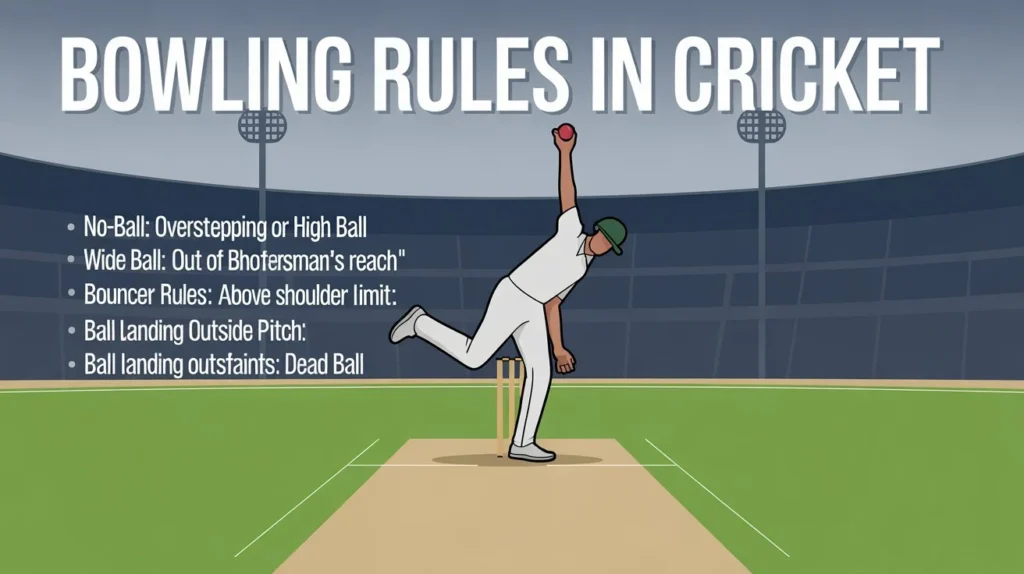
Bowling is one of the most critical aspects of cricket, shaping the balance between bat and ball. For bowlers, following proper techniques and ICC regulations is essential to avoid penalties and illegal actions. From understanding foot placement laws to the 15-degree bowling action rule, bowlers must stick to international standards to maintain fairness in the game. This guide explores cricket bowling rules, ICC regulations, illegal actions, types of bowling, and real case studies, ensuring you understand everything about the art of bowling.
Cricket Bowling Rules: The Basics
Bowling in cricket refers to the act of delivering the ball towards the batter under the Laws of Cricket as maintained by the ICC.
Key Basic Rules:
- A legal delivery must be bowled, not thrown.
- The bowler must deliver the ball with a straight arm at the elbow.
- A bowler must release the ball before the front foot crosses the popping crease.
- Only six legal deliveries make an over, unless wides or no-balls are bowled.
- The ball must be delivered overarm (underarm bowling is banned in international cricket since 1981).
ICC Law Reference: Law 21: The Bowler’s Mode of Delivery (ICC).
Cricket Bowling Rules Foot Law
Foot placement is crucial in determining whether a delivery is legal. Incorrect placement leads to no-balls.
Rules for the Front Foot:
- The front foot must land with some part behind the popping crease.
- If no part of the foot lands behind the line, it’s a front-foot no-ball.
Rules for the Back Foot:
- The back foot must remain inside the return crease.
- If it touches or goes outside, the delivery is illegal.
ICC Law Reference: Law 21.5.1: Front Foot No-ball Law.
Example: Many bowlers like Jasprit Bumrah and Mitchell Starc have faced issues with overstepping.
Illegal Bowling Action Rules (PDF-Style Explanation)
An illegal bowling action occurs when a bowler straightens the elbow more than 15 degrees during delivery.
What Makes It Illegal?
- Excessive elbow extension beyond 15 degrees.
- “Throwing” or “chucking” instead of bowling.
- Using unfair arm movements to deceive the batter.
ICC Law Reference: Law 21.2: Fair Delivery – The Arm.
Cricket Bowling Types
Bowling is divided into two main categories: Fast Bowling and Spin Bowling.
- Fast Bowling Types: Outswinger, Inswinger, Yorker, Bouncer, Reverse Swing.
- Spin Bowling Types: Off-spin, Leg-spin, Googly, Doosra, Carrom Ball.
Why Important? Each type tests the batter differently, and bowlers mix them for variation.
Illegal Bowling Action in Cricket
Illegal actions have always been controversial in cricket.
Key Cases:
- Muttiah Muralitharan (Sri Lanka): Accused of chucking, but later cleared due to a natural deformity in his arm.
- Saeed Ajmal (Pakistan): Banned in 2014 for exceeding the 15-degree rule.
- Shoaib Akhtar (Pakistan): Reported multiple times for suspect action.
These cases reshaped how ICC monitors bowling actions.
Balling or Bowling in Cricket
A common confusion is whether to say balling or bowling.
- The correct term is Bowling.
- “Balling” is incorrect in cricket terminology.
Tip for Learners: Always use “bowling” when describing delivering the ball.
ICC Bowling Action Rules
The ICC’s rules ensure fairness and standardization across cricket.
Main Rules:
- Elbow flexion not more than 15 degrees.
- Arm must be straightened naturally.
- Bowlers with suspect actions are tested using biomechanics in ICC-accredited labs.
ICC Law Reference: Appendix 6: Regulations for the Review of Bowlers Reported with Suspect Actions.
15 Degree Bowling Action Rule
The 15-degree rule is the most discussed ICC regulation.
- A bowler cannot straighten their elbow more than 15 degrees during delivery.
- This threshold is chosen because the human eye cannot detect elbow flex below 15 degrees.
Case Study – Saeed Ajmal (2014):
Ajmal was banned after biomechanics revealed an elbow extension beyond 15°. After remodeling his action, he returned but struggled to regain dominance.
Right Arm Over the Wicket
When a bowler delivers from the right arm over the wicket, it means:
- The bowler delivers from the right hand.
- They bowl from the umpire’s right side, closer to stumps.
- It creates an angle towards the batter, often targeting off-stump.
Tactical Use: Glenn McGrath mastered right arm over deliveries to right-hand batters.
Comparison Table: Bowling Rules in Cricket
| Rule/Aspect | Legal Requirement (ICC) | Penalty if Broken | Example Case |
|---|---|---|---|
| Front Foot Law | Part of foot behind crease | No-ball | Jasprit Bumrah oversteps |
| Back Foot Law | Must stay within return crease | No-ball | Rare but monitored |
| 15° Action Rule | Elbow ≤ 15 degrees | Ban/Correction | Saeed Ajmal |
| Mode of Delivery | Ball must be bowled, not thrown | Illegal action | Shoaib Akhtar reports |
| Overarm Delivery | Mandatory since 1981 | Illegal if underarm | Trevor Chappell incident |
FAQs on Bowling Rules in Cricket
Q1: What is the front-foot no-ball rule in cricket?
The bowler must have part of the front foot behind the crease. If not, it’s a no-ball.
Q2: Why is the 15-degree rule important?
It prevents bowlers from throwing and ensures fairness.
Q3: Can a bowler change from over the wicket to around the wicket?
Yes, but they must inform the umpire.
Q4: What is an illegal delivery?
Any ball delivered by overstepping, chucking, or wrong foot placement.
Q5: Is underarm bowling allowed in cricket today?
No, underarm bowling is banned in international cricket since 1981.
Conclusion
Bowling in cricket is a skill that blends art, science, and strict adherence to rules. From foot placement laws to the 15-degree action rule, ICC has enforced clear standards to ensure fairness. Famous cases like Saeed Ajmal’s ban highlight the seriousness of illegal actions. For bowlers, mastering types of bowling while following ICC rules is the only way to achieve long-term success.

Liam Thompson is a cricket regulations analyst who covers international and league-level rules in depth. He focuses on fielding laws, over-rate penalties, powerplay strategies, and updated ICC guidelines. Liam’s goal is to educate readers while keeping the excitement of the game alive.