
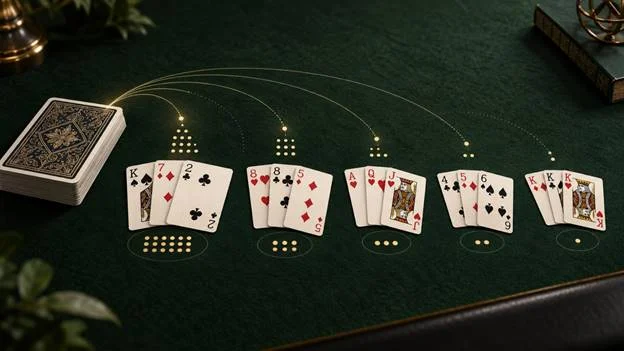
Teen Patti is a traditional three-card game built around hand comparison, limited information, and a series of simple decisions. Although learning the basic flow takes only a few minutes, understanding the strength of different teen patti hands requires closer attention. A player must recognize the six standard hand categories, know how equal-category hands are compared, and understand that certain sequence rules may change between tables.
Probability adds another useful layer of understanding. Studying teen patti probability does not reveal future cards or create a guaranteed winning method. Instead, it shows how frequently different hand categories can occur in a standard 52-card deck. This makes it easier to understand why some combinations rank above others and why rare hands should never be expected regularly.
Teen Patti Gold is a free-to-install social card-game app published by Moonfrog. It uses virtual chips and brings together Teen Patti, Poker, Rummy, Andar Bahar, private tables, tournaments, chat features, and several card-game variations. Because similarly named applications and copied icons may exist, Android users should confirm the developer and package identity rather than trusting the app name alone.
Understanding a Standard Teen Patti Round
A standard Teen Patti game uses a 52-card deck without jokers. Every player receives three face-down cards after contributing an opening amount known as the boot. Players then act one at a time according to the rules and limits of the selected table.
A player can usually remain blind, look at the cards and continue as a seen player, or pack the hand. Blind players continue without knowing their cards, while seen players make decisions after reviewing their teen patti hands. The required chip contribution may differ between blind and seen play.
Some tables may also permit a sideshow, which allows an eligible seen player to request a private hand comparison with the previous seen player. The conditions, cost, and result of a sideshow can vary. A round generally ends when all but one player have packed or when the remaining players complete a show.
Before joining any table, players should understand:
- The boot amount
- Minimum and maximum contribution limits
- Blind and seen contribution rules
- Sideshow conditions
- Show requirements
- Hand-ranking order
- Sequence and tie rules
- Whether jokers or special variations are active
These details matter because the displayed table rules control the round. A familiar game name does not guarantee that every app or mode follows identical rules.
Teen Patti Hands Ranked from Highest to Lowest
The standard ranking system contains six categories. The category is compared first. Individual card values become important only when two players hold hands from the same category.
1. Trail or Trio
A trail contains three cards of the same rank, such as A-A-A, K-K-K, or 7-7-7. It is also called a trio or three of a kind.
Trail is normally the strongest category among standard teen patti hands. When two players have trails, the rank of the matching cards determines the result. Three aces usually beat three kings, while three kings beat three queens.
Because only 52 trails can be formed from a standard deck, receiving one is extremely rare.
2. Pure Sequence
A pure sequence contains three consecutive cards from the same suit. Examples include 4-5-6 of hearts or 9-10-J of spades.
This hand combines two properties: the cards follow a continuous rank order and share one suit. That makes it stronger than an ordinary sequence containing mixed suits.
The order of special ace sequences requires attention. Some tables consider A-2-3 the highest pure sequence, while others place A-K-Q above it. Players should read the table instructions before assuming which one wins.
3. Sequence or Run
A sequence consists of three consecutive ranks that are not all from the same suit. For example, 7 of spades, 8 of diamonds, and 9 of clubs form a sequence.
A sequence is below a pure sequence because its cards do not share one suit. However, it remains stronger than a colour, pair, or high-card hand.
Once again, A-2-3 and A-K-Q may be treated differently between tables. K-A-2 is generally not accepted as a normal continuous run unless a particular variation clearly allows it.
4. Colour or Flush
A colour contains three cards from the same suit that are not consecutive. A hand containing A, 9, and 4 of clubs is one example.
When two colour hands are compared, the highest card is normally considered first. If both highest cards are equal, the second cards are compared, followed by the third cards when necessary.
For example, A-9-4 usually beats A-8-7 because the aces are equal and nine outranks eight. Suits should not automatically be used to settle a tie unless the table specifically includes a suit-ranking rule.
5. Pair
A pair contains two cards of the same rank and one unmatched side card. Q-Q-5 and 8-8-K are both examples.
When two players hold pairs, the rank of the pair is compared first. A pair of queens beats a pair of jacks regardless of the side card. If both players have the same pair rank, the unmatched card acts as the tiebreaker.
This comparison method means J-J-3 beats 10-10-A. Although the second hand contains an ace, the pair of jacks is stronger than the pair of tens.
6. High Card
A high-card hand does not contain a trail, sequence, colour, or pair. It is the lowest standard category.
To compare two high-card hands, begin with the highest card. If those cards match, compare the second-highest cards and then the lowest cards if needed.
For example, A-J-8 beats A-10-9 because both hands start with an ace, but the jack outranks the ten. High-card comparisons demonstrate why all three cards can matter even when neither player has a recognized combination.
A Simple Way to Memorize the Ranking Order
Instead of memorizing six unrelated labels, consider how each category is formed:
- Three matching ranks
- Consecutive cards in one suit
- Consecutive cards in mixed suits
- Three cards in one suit
- Two matching ranks
- No qualifying combination
This structure makes the order of teen patti hands easier to remember. Start with the rarest matching combination and gradually move toward more common arrangements.
Understanding Teen Patti Probability
A standard 52-card deck contains 22,100 distinct three-card combinations. Teen patti probability measures how many of those combinations belong to each category.
Under a common ranking model, the approximate distribution is:
| Hand Category | Combinations | Approximate Probability |
| Trail or trio | 52 | 0.24% |
| Pure sequence | 48 | 0.22% |
| Sequence | 720 | 3.26% |
| Colour | 1,096 | 4.96% |
| Pair | 3,744 | 16.94% |
| High card | 16,440 | 74.39% |
These figures explain why high-card hands appear so frequently and trails appear so rarely. A strong combination is memorable precisely because it represents only a small part of all possible deals.
The calculation can differ when a table changes which ace sequences are valid or introduces jokers, wild cards, reverse rankings, or special modes. Therefore, teen patti probability should always be interpreted within the specific rules being used.
Why Rare Hands Rank Higher
Hand rankings generally reward scarcity. A trail is extremely difficult to receive because the player needs three cards of one rank from four available suits. A pure sequence also requires a precise relationship between rank and suit.
A high-card hand has far fewer restrictions. Most random three-card combinations do not match ranks, form sequences, or share a suit, so high cards account for nearly three-quarters of standard deals.
This relationship between rarity and ranking makes the hierarchy more intuitive. However, rarity does not mean that a specific hand is “due.” Every properly randomized deal begins with a new distribution of possible cards.
Probability Does Not Predict the Next Deal
One of the most important lessons from teen patti probability is the independence of random deals. Receiving several weak hands in a row does not force the next deal to produce a pair, sequence, or trail.
A losing streak does not make a powerful hand more likely simply because one has not appeared recently. Similarly, receiving a trail in one round does not mean another trail cannot appear soon. Past outcomes do not create a schedule for future cards.
Probability describes long-term frequency across a large number of deals. It does not identify the exact cards that will arrive next. No betting progression, timing pattern, lucky seat, or repeated action can remove the chance built into the game.
Comparing Hands Within the Same Category
Recognizing the category is only the first step. Equal-category situations require a clear comparison method.
For trails, compare the repeated rank. For pairs, compare the matching rank and then the unmatched card. For colour and high-card hands, compare cards from highest to lowest.
Sequences require more caution because ace treatment is not universal. A table may place A-2-3 above A-K-Q, reverse that order, or publish another specific sequence structure. Checking this detail before the round prevents disagreements during a show.
Split pots and suit-based tiebreakers may also depend on the selected table. Players should not assume that spades always beat hearts, diamonds, or clubs unless the rules explicitly establish a suit hierarchy.
How Variations Change Hand Evaluation
Teen Patti Gold includes named variations such as Joker, Hukam, Muflis, Royal, AK47, and Potblind. These modes can change how cards behave, which combinations qualify, or how strength is evaluated.
A joker may substitute for another card, increasing the number of ways certain combinations can be completed. Hukam can introduce a trump-related rule. Muflis commonly reverses the normal objective so weaker hands may become more valuable. Potblind and other modes may modify participation or contribution conditions.
Standard teen patti probability figures should not be applied unchanged to these variations. Once wild cards, reverse rankings, or special conditions are introduced, the number and value of qualifying combinations can change substantially.
Blind and Seen Play
Playing blind preserves uncertainty because the player continues without checking the cards. Playing seen provides direct knowledge of the hand but may change the required contribution under the table rules.
Neither choice guarantees better results. A blind player might unknowingly hold a trail or an ordinary high card. A seen player knows the category but still lacks complete information about the other hands.
Understanding teen patti hands helps a seen player interpret the cards correctly, while knowledge of probability provides general context. Neither eliminates uncertainty or guarantees that continuing is the right decision.
Identifying the Correct Teen Patti Gold App
Teen Patti Gold refers to a Moonfrog social card-game application, but similar names and icons can create confusion. For Android, the useful identity details are the developer name Moonfrog and the package ID.
The application is presented as a free installation with advertisements and in-app purchases. Its gameplay uses virtual chips and is intended for social entertainment rather than real-money gambling, cash prizes, or cash withdrawals.
Before installing any Android file, users should confirm:
- The developer identity
- The exact Android package ID
- The source of the installation file
- The version and update history
- The privacy information
- The permissions requested by the app
A matching name or gold-colored icon is not sufficient proof of identity. Users should be cautious when an unrelated source promises guaranteed income, cash-out opportunities, or a winning system.
Responsible Ways to Use Probability
Probability is most useful as an educational tool. It explains why high cards are normal, why pairs appear far more often than sequences, and why trails should be treated as exceptional outcomes.
It should not be used to justify chasing lost chips or continuing beyond a personal limit. Players can create a healthier experience by setting a time boundary, deciding on a virtual-chip limit, taking regular breaks, and stopping when play is no longer enjoyable.
Teen Patti contains chance and incomplete information. Understanding the rules may reduce confusion, but it cannot guarantee a result.
Conclusion
Learning the six standard teen patti hands creates a strong foundation for understanding the game. The usual order begins with trail, followed by pure sequence, sequence, colour, pair, and high card. When two hands share a category, card ranks and table-specific tiebreakers determine the result.
Studying teen patti probability explains how uncommon the strongest combinations are and why high-card hands dominate ordinary deals. It also reinforces an essential principle: past results do not control the next deal, and no pattern can guarantee a winning outcome.
Before playing Teen Patti Gold or any variation, confirm the app identity, read the selected table rules, understand how sequences and ties are handled, and treat virtual-chip gameplay as entertainment.
