
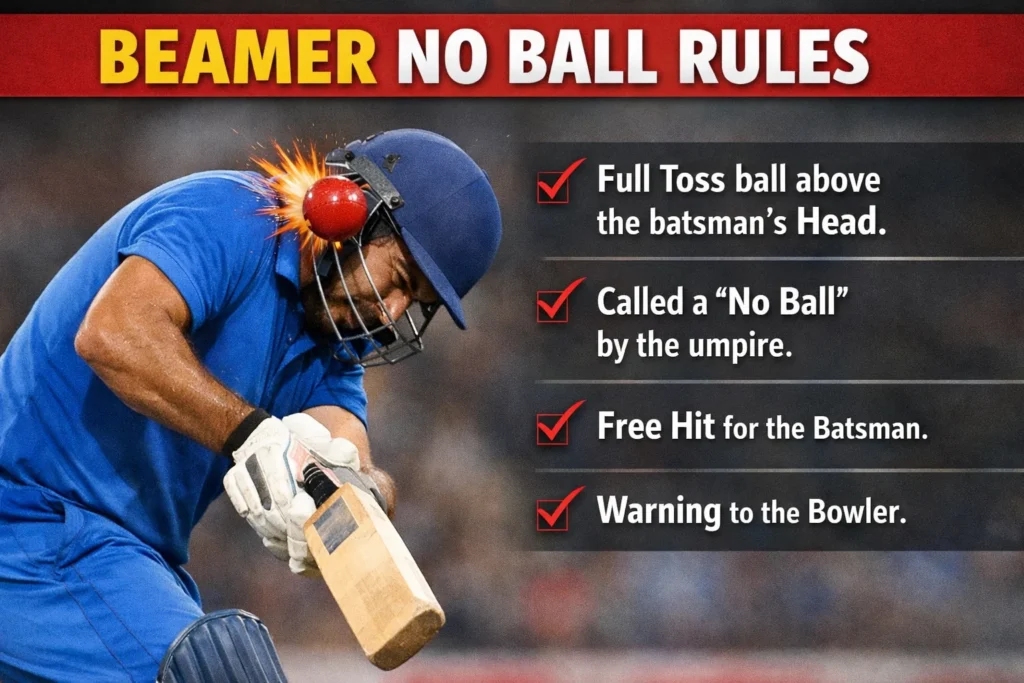
A beamer is a fast, full-pitched delivery that reaches the batsman above waist-height without bouncing on the pitch.
In cricket, a beamer is one of the most dangerous and controversial deliveries a bowler can bowl. It is a type of full-toss delivery—a ball that reaches the batsman without bouncing—but with a critical, dangerous distinction: it is aimed directly at the batsman’s head or upper body.
Think of it this way: A normal delivery bounces on the pitch and then rises. A bouncer bounces and rises above shoulder-height. A beamer never bounces at all and is aimed directly at the batsman’s upper body or head at high speed.
Key Identifier: No bounce + Above waist height = Beamer.
📜 The Official Law: What Does the Rulebook Say?
According to the ICC Laws of Cricket (Law 41.7: Dangerous and Unfair Bowling), a delivery is considered dangerous and unfair if:
“…a full-pitched delivery, which passes or would have passed above waist height of the striker standing upright at the popping crease.“
Official Rules: Why is a Beamer Illegal?
The rule (Law 41.7) says any full-pitched ball above the batsman’s waist height is illegal and dangerous.
Accidental Beamer (It was a mistake)
- First Time in an innings:
The umpire calls No Ball, gives 1 penalty run, and gives the bowler and captain a final warning.- Second Time (same bowler):
No Ball + 1 penalty run. The bowler is suspended and cannot bowl again for the rest of that innings.Deliberate Beamer (Bowled on purpose)
- If the umpire thinks the bowler meant to bowl it:
No Ball + 1 penalty run. The bowler is suspended immediately without any warning. The incident is reported for more punishment after the match.Important Notes:
- The warning is for each bowler, in each innings.
- The batsman cannot be out from a beamer (except Run Out).
- In T20/ODI, the next ball is NOT a Free Hit (unlike a normal No Ball).
The Two Types of Beamers:
The law makes a critical distinction based on speed:
| Type of Beamer | How it’s Defined | Penalty & Severity |
|---|---|---|
| 1. Fast Beamer | A fast-paced full toss above waist height. | Immediate offense. Considered dangerous bowling. |
| 2. Slow Beamer | A slow-paced (slow-medium or slower) full toss above waist height. | More lenient. Often just called a No Ball, not deemed inherently dangerous. |
Why the difference? A fast beamer at 140+ km/h gives the batsman almost no time to react to protect themselves, leading to serious injury. A slow beamer, while still illegal, is easier to evade or hit.
⚖️ Penalties and Consequences: What Happens After a Beamer?
The consequences are severe and escalate quickly to protect batsmen.
Step-by-Step On-Field Procedure:
- Immediate Call: The umpire will loudly call “No Ball!” and signal the standard one-arm-out horizontal signal.
- Dead Ball: The ball is declared dead immediately. Any runs scored off it (by the bat) don’t count. However, any extras (like byes or leg byes) do count, plus the one-run penalty for the no-ball.
- Official Warning: The umpire will issue a formal warning to the bowler and inform the bowler’s captain that the offense has been recorded.
- Second Offense: If the same bowler bowls another dangerous delivery (fast beamer) in that same innings, they are immediately suspended from bowling for the remainder of that innings.
- Report: The umpires will file an official report after the match, which can lead to further match referee hearings and potential suspension from future matches.
Penalty Summary Table:
| Offense by a Bowler | Consequence | Runs Awarded |
|---|---|---|
| First Fast Beamer | Formal Warning + No Ball called. | 1 run penalty + any extras. |
| Second Fast Beamer (in same innings) | Bowler Suspended for rest of innings. | 1 run penalty + any extras. |
| Any Slow Beamer | No Ball called. No formal warning. | 1 run penalty + any extras. |
Important Note: In limited-overs cricket (ODI & T20), a beamer no-ball is also followed by a Free Hit on the next delivery, just like a front-foot no-ball.
🎯 Why is the Beamer Rule So Strict? The Safety Reason
Cricket is a dangerous game. A hard cricket ball can cause:
- Serious facial fractures
- Concussions
- Permanent eye injuries
Batsmen wear helmets, but they are most vulnerable against a ball they don’t expect to bounce. A fast beamer aimed at the head is like being thrown a rock at 90 mph with no time to duck. The rule exists to remove intent and recklessness from the game. It enforces the principle that a bowler’s primary target must be the pitch, not the batsman’s body.
📽️ Famous Beamer Incidents in Cricket History
These moments highlight the danger and controversy surrounding beamers.
1. Most Severe & Life-Threatening Injury
Batsman: Phil Simmons (West Indies)
- Match: Tour Match, West Indies vs. Glamorgan, 1988
- Bowler: Steve Watkin (Glamorgan)
- What Happened: A brutal beamer struck Simmons on the temple, fracturing his skull.
- Injury: He suffered a blood clot on the brain and underwent emergency surgery.
- Aftermath: He was in a coma for several days. His recovery was miraculous, and he remarkably returned to play international cricket within a year. This remains one of the most serious beamer injuries in cricket history.
2. High-Profile Injuries (International Cricket)
Batsman: Craig McMillan (New Zealand)
- Match: New Zealand vs. Pakistan, 2nd ODI, 2001
- Bowler: Shoaib Akhtar (Pakistan)
- What Happened: Shoaib bowled a 150+ kph beamer that hit McMillan flush in the face, breaking his nose.
- Injury: Fractured nose, heavy bleeding, and concussion.
- Aftermath: McMillan was ruled out of the series. The incident sparked major controversy about Shoaib’s intent and the need for stricter beamer laws.
Batsman: Mahela Jayawardene (Sri Lanka)
- Match: Sri Lanka vs. Australia, CB Series Final, 2008
- Bowler: Brett Lee (Australia)
- What Happened: A fast, accidental beamer from Lee struck Jayawardene on the helmet grill.
- Injury: The impact was so severe that the helmet grill broke and cut his face.
- Aftermath: Jayawardene needed stitches and was visibly shaken. Lee apologized immediately, and it was ruled accidental.
Batsman: Sarfaraz Ahmed (Pakistan)
- Match: Pakistan vs. New Zealand, 2nd T20I, 2018
- Bowler: Lockie Ferguson (New Zealand)
- What Happened: A 145+ kph beamer hit Sarfaraz on the helmet.
- Injury: Concussion protocol was activated. He suffered whiplash and was substituted out.
- Aftermath: Sarfaraz missed the next match. Ferguson was given a warning.
3. Serious Injuries in Domestic/First-Class Cricket
Batsman: Stuart Broad (England – playing for Nottinghamshire)
- Match: County Championship, Nottinghamshire vs. Somerset, 2011
- Bowler: Alfonso Thomas (Somerset)
- What Happened: A beamer hit Broad on the nose.
- Injury: Broken nose.
- Aftermath: Broad required surgery and was out of action for several weeks. The incident reignited debates about beamer discipline.
Batsman: Will Pucovski (Australia – Domestic Match)
- Match: Sheffield Shield, Victoria vs. South Australia, 2019
- Bowler: Daniel Worrall (South Australia)
- What Happened: A sharp, head-high beamer struck Pucovski on the helmet.
- Injury: Concussion – adding to his long list of concussion-related injuries.
- Aftermath: He was ruled out of the following Test series. The bowler was warned.
List of Bowlers Known for Bowling Dangerous Beamers (Intentionally or Not)
This includes bowlers who have faced multiple incidents, warnings, or bans.
| Bowler | Team | Notable Incidents & Reputation |
|---|---|---|
| Shoaib Akhtar | Pakistan | Multiple beamer incidents. Most famous vs. McMillan (2001) and the deliberate beamer vs. Flintoff (2003) leading to suspension. Known for losing control at extreme pace. |
| Waqar Younis | Pakistan | In the 1990s, was frequently accused of bowling intentional beamers, often as “failed yorkers.” His aggressive style prompted rule changes. |
| Brett Lee | Australia | Bowling at 160+ kph, several beamers slipped out. The Jayawardene incident (2008) was the most serious. Generally considered accidental due to extreme speed. |
| Mitchell Johnson | Australia | Had a few high-profile beamers in Ashes contests, often seen as intimidation tactics. Warned multiple times. |
| Dwayne Bravo | West Indies | Suspended mid-innings for a second accidental beamer vs. India (2009). |
| Lasith Malinga | Sri Lanka | A few incidents where his signature low-arm sling action resulted in accidental head-high full tosses. |
| Lockie Ferguson | New Zealand | Recent example with the beamer to Sarfaraz Ahmed (2018). |
| Anrich Nortje | South Africa | Bowling at 150+ kph, has had a couple of beamers slip out in internationals, resulting in warnings. |
Summary Table: Batsmen Injured by Beamers
| Batsman (Team) | Bowler (Team) | Match / Year | Injury Sustained |
|---|---|---|---|
| Phil Simmons (WI) | Steve Watkin (Glamorgan) | Tour Match, 1988 | Skull fracture, brain clot, coma |
| Craig McMillan (NZ) | Shoaib Akhtar (PAK) | NZ vs PAK ODI, 2001 | Broken nose, concussion |
| Mahela Jayawardene (SL) | Brett Lee (AUS) | CB Series Final, 2008 | Facial cuts, broken helmet grill |
| Sarfaraz Ahmed (PAK) | Lockie Ferguson (NZ) | PAK vs NZ T20I, 2018 | Concussion |
| Stuart Broad (ENG) | Alfonso Thomas (Somerset) | County Championship, 2011 | Broken nose |
| Will Pucovski (AUS) | Daniel Worrall (SA) | Sheffield Shield, 2019 | Concussion |
Important Note:
Most beamers are accidental, resulting from a bowler slipping or a failed yorker. However, the physical consequences for the batsman are severe regardless of intent. The modern rules (immediate warnings, suspensions, and match referee hearings) are a direct response to these dangerous incidents to prioritize batsman safety above all else.
🤔 Common Questions About Beamer Rules (FAQ)
Q1: What if the batsman hits a beamer for a six? Does it count?
A: No. The moment a beamer is bowled, the umpire calls “No Ball” and the ball is dead. Any runs from the bat are scratched. Only the 1-run penalty and any extras (byes/leg byes) are added.
Q2: Can a beamer be bowled accidentally?
A: Yes, and it often is. A bowler can slip in their delivery stride, or a wet ball can slip out. However, the rule does not consider intent. Whether accidental or deliberate, a fast beamer is penalized the same way to encourage maximum care from bowlers.
Q3: What’s the difference between a Beamer and a Full Toss?
A: All beamers are full tosses (they don’t bounce), but not all full tosses are beamers. A full toss below waist height is a legal, albeit poor, delivery. Only the full toss above waist height is illegal and called a beamer/no-ball.
Q4: Has any famous bowler been suspended for beamers?
A: Yes. Apart from Shoaib Akhtar’s ban, players like Waqar Younis and Daryl Tuffey have faced suspensions for repeated offenses of dangerous bowling, which included beamers.
Q5: Do spinners ever bowl beamers?
A: They can, but it’s rare and usually a slow beamer from a failed attempted yorker or a full toss that goes awry. It will be called a no-ball but typically won’t incur a formal “dangerous bowling” warning unless it’s deemed fast for a spinner.
👨✈️ The Role of the Umpire
The umpire has to make a split-second judgment on two things:
- Did the ball bounce? (If yes, it’s not a beamer).
- What was its height relative to the batsman’s waist?
- What was its pace? (Fast vs. Slow beamer determination).
This is why you’ll see umpires carefully observing the point of impact and the batsman’s stance.
Conclusion: Respect and Safety First
The beamer no-ball rule is not just another technicality; it’s a fundamental safeguard in cricket. It draws a clear line between aggressive, competitive bowling and outright dangerous play.
For bowlers, it’s a reminder to maintain control. For batsmen, it provides crucial protection. And for fans, understanding this rule adds depth to viewing—you now know why a certain delivery causes such an immediate and serious reaction from players and officials alike.
The next time you see an umpire’s arm go out horizontally for a full toss, check the batsman’s reaction and the bowler’s apology (or lack thereof). You’ll be watching one of cricket’s most important safety laws in action.

Daniel Foster is a senior sports writer specializing in cricket laws and international playing conditions. With extensive experience covering ICC rules, domestic leagues, and tournament regulations, he delivers detailed yet easy-to-read explanations. His work is trusted by readers looking for accurate and up-to-date sports rules.