
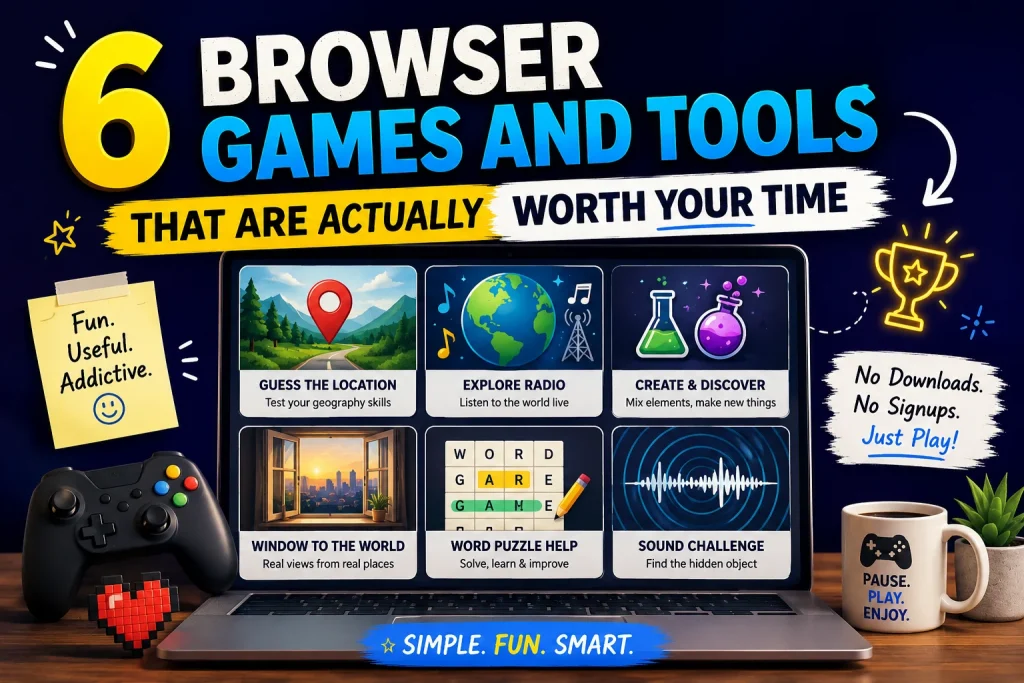
The internet is often described as either overwhelming or addictive, but that description hides an important truth: not everything online is designed to waste your time. In fact, tucked between social media platforms and productivity apps is a quiet layer of browser-based experiences that are simple, creative, and surprisingly useful.
These are the kinds of websites you open “for a minute” and somehow end up exploring far longer than expected. Some challenge your brain, some sharpen your language skills, and others are just pure, harmless curiosity wrapped in clever design.
Below are six browser-based games and tools that stand out because they manage to be both fun and meaningful without requiring downloads, payments, or complicated setups.
1. Interactive Geography Guessing Challenge
One of the most engaging browser experiences available today turns the entire world into a playable map. You are dropped into a random location using street-level imagery and must figure out where you are based purely on visual clues.
At first, it feels almost impossible. But slowly, you start noticing patterns: road signs, vegetation, architecture, language hints, and even subtle differences in infrastructure. Over time, the experience becomes less of a guessing game and more of a global observation skill builder.
What makes this type of experience so addictive is its balance between uncertainty and discovery. Every round feels like a small mystery waiting to be solved, and each correct guess brings a satisfying sense of achievement.
It’s not just entertainment—it’s accidental geography education disguised as play.
2. Global Radio Exploration Tool
Another fascinating browser-based experience allows users to explore live radio stations from around the world through an interactive globe interface.
Instead of selecting curated playlists, you simply rotate a virtual Earth and click anywhere to hear what people are broadcasting in real time. One moment you might be listening to music from a coastal city in South America, and the next you’re tuned into a late-night talk show from Europe.
The charm lies in its unpredictability. There is no algorithm trying to optimize your listening experience. Instead, you are exposed to raw, unfiltered cultural snapshots from different parts of the world.
It is one of the simplest yet most powerful ways to experience global diversity without leaving your chair.
3. Creative Element Combination Game
Some browser games thrive because they tap into human curiosity in a very direct way: what happens if I combine this with that?
Starting with only a handful of basic elements, players gradually discover new items by combining them in different ways. Fire meets water, air meets earth, and suddenly entirely new concepts emerge. Those discoveries then unlock even more combinations, creating a chain of experimentation that can last far longer than expected.
The appeal comes from its open-ended nature. There is no strict path or “correct” solution. Instead, progress is driven entirely by curiosity and experimentation.
It’s the kind of experience that rewards thinking outside the obvious.
4. Window-Based Global Perspective Platform
Not every digital experience needs to be interactive in the traditional sense. Some are powerful simply because they offer perspective.
This platform allows people from different countries to upload short video clips recorded from their windows. Visitors can then randomly view these clips, effectively stepping into someone else’s everyday environment.
One click might show a quiet suburban morning, while another reveals a busy urban intersection or a peaceful countryside view.
What makes this experience unique is its authenticity. These are not polished travel videos or curated content pieces. They are ordinary moments, captured casually, which makes them feel more real and relatable.
It’s a subtle reminder of how diverse daily life can be across the world.
5. Language Puzzle Assistant Tool
Word-based puzzle games have become extremely popular in recent years, especially daily challenges that encourage players to form as many words as possible from a limited set of letters.
However, even experienced players sometimes reach a point where no new combinations seem obvious. This is where puzzle assistance tools come into play.
A well-designed word solver allows users to explore possible combinations, learn unfamiliar vocabulary, and understand how different letter arrangements produce valid words. Rather than replacing the challenge, it often enhances learning by revealing patterns that players might otherwise miss.
Used responsibly, it becomes less of a shortcut and more of a vocabulary-building companion.
One widely used example in this category is a Spelling Bee Solver, which is often referenced by puzzle enthusiasts as a helpful way to review missed words and improve performance over time.
6. Sound-Based Hidden Object Experience
Not all browser games rely on visuals or complex mechanics. Some of the most memorable ones like find the invisible cow are built around a single clever idea executed in an unusual way.
In this type of experience, the player is tasked with finding a hidden object on the screen using only audio cues. As the cursor moves closer to the target, the sound becomes louder and more frequent, guiding the user toward the correct location.
At first, it feels almost like guessing blindly. But quickly, your brain begins to map sound intensity to spatial awareness, turning the experience into a strange blend of listening and intuition.
One particularly well-known example of this design approach is a game where you search for an invisible cow using only audio feedback. It’s simple, strange, and surprisingly engaging, proving once again that creativity often matters more than visual complexity.
Why These Browser Experiences Matter
What connects all of these tools and games is not graphics, complexity, or monetization strategies. Instead, it is simplicity combined with curiosity.
They demonstrate that the internet is still capable of offering experiences that are:
- Easy to access
- Free to use
- Instantly engaging
- Surprisingly educational
In a digital world dominated by algorithms and endless scrolling, these kinds of experiences stand out because they encourage exploration rather than consumption.
They don’t ask for your attention in aggressive ways. Instead, they earn it through interaction.
Final Thoughts
The modern internet often feels like a place built for speed, efficiency, and constant stimulation. But these browser-based experiences show a different side of the web—one that is playful, experimental, and quietly educational.
Whether you’re testing your geography skills, exploring global radio stations, experimenting with creative combinations, viewing real-life scenes from across the world, improving your vocabulary, or engaging with audio-based challenges, each of these tools offers something refreshingly different.
Sometimes, all it takes is opening a new tab to remind yourself that the internet is still full of small surprises waiting to be discovered.
