

Netball is a fast, team-based sport where 7 players per side score goals by passing a ball into a raised net without a backboard. You cannot run with the ball, every player has a specific role and area, and winning depends on teamwork, timing, and smart movement—not brute strength.
Most beginners think netball is just a “basketball-style game.”
That belief disappears the moment you truly understand how netball works. Once you do, the game becomes surprisingly intense, tactical, and addictive. This guide explains netball properly, without overloading or forcing keywords.
What exactly is netball?
Netball is a competitive court sport played worldwide in schools, clubs, and international tournaments. The objective is simple:
pass → create space → shoot → score
What makes netball different from many other sports is one strict rule:
You must stop as soon as you catch the ball.
This single rule changes everything. It removes running, dribbling, and individual domination, turning netball into a sport where thinking ahead and working as a team matters most.
International rules and competitions are governed by World Netball, which ensures the sport is played the same way across the globe.
History of Netball
Netball began in the late 19th century as a modified version of basketball, created to suit indoor play and reduce physical contact. The game was first developed in England and quickly became popular in schools, especially among women.
Over time, netball evolved into a sport with its own clear rules, court structure, and player positions. As the game spread to countries like Australia, New Zealand, and South Africa, it grew into a highly competitive international sport.
Today, netball is played worldwide under standardized rules governed by international authorities, making it one of the most organized and widely played team sports.
Is Netball a Real Sport or Just a Game?
When people ask “Is netball a sport?” or “Is netball a game?”, they usually want to know whether it’s a real, professional sport.
✅ Yes — netball is a fully recognized international sport with:
- Official rules
- Professional leagues
- International championships
- Trained umpires and officials
It is played competitively across Australia, the UK, New Zealand, England, Ireland, and many other countries.
Why netball feels different from other sports
Netball is designed to be:
- Fast but controlled
- Non-aggressive
- Highly structured
- Team-focused
You won’t see one player carrying the whole game. Instead, every pass, movement, and decision matters. This is why many players describe netball as “physical chess on a court.”
The netball court
Netball is played on a rectangular court divided into three equal sections:
- Centre third
- Two goal thirds
At each end:
- One goal post
- One shooting circle
Only certain players can enter certain areas. This rule creates constant movement and strategy, even when the ball isn’t in your hands.
Netball positions: why roles matter so much
Each team has 7 players, and every position has a clear purpose:
- Goal Shooter (GS): Scores goals
- Goal Attack (GA): Helps score and feeds passes
- Wing Attack (WA): Creates attacking chances
- Centre (C): Connects attack and defence
- Wing Defence (WD): Stops attacks early
- Goal Defence (GD): Defends the shooting circle
- Goal Keeper (GK): Protects the goal
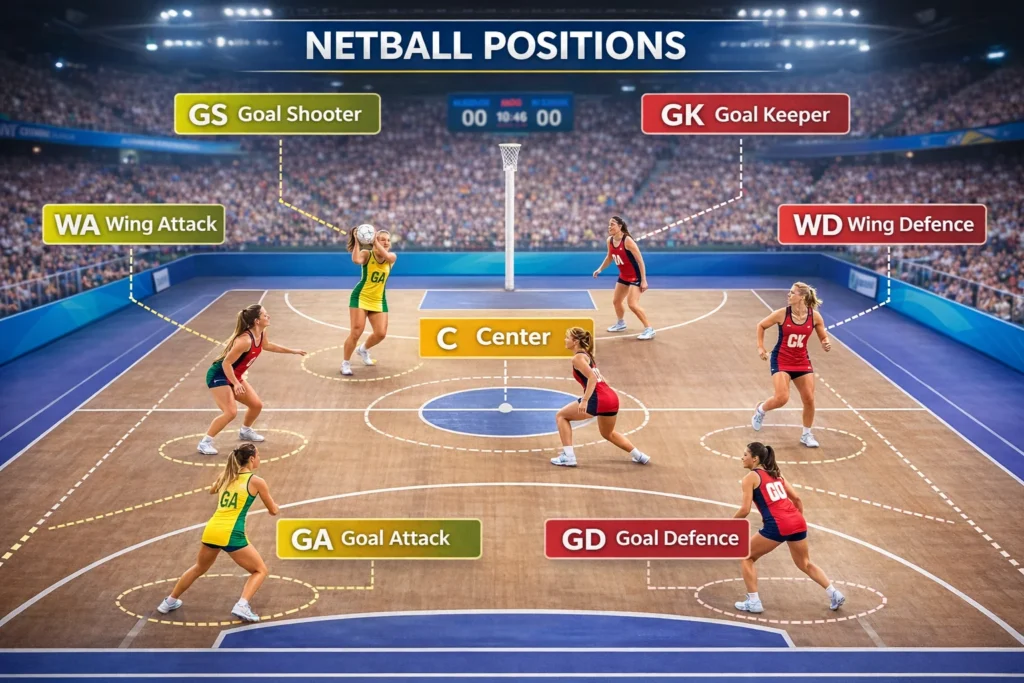
Unlike many sports, players cannot leave their assigned areas. This forces discipline, awareness, and teamwork—and that’s where netball’s real beauty lies.
How a netball match flows
A typical match looks like this:
- Game starts with a centre pass
- Teams move the ball quickly using short passes
- Defenders try to intercept without contact
- Shooters score only from inside the circle
- Play restarts from the centre after each goal
The game never slows down. Even without physical contact, netball is demanding and fast.
Why netball became so popular
Netball grew rapidly because it:
- Is easy to learn but hard to master
- Encourages teamwork over individual power
- Is suitable for schools and youth programs
- Builds fitness, coordination, and confidence
Although traditionally popular among women, netball today is played by men, women, and mixed teams in many countries.
Netball vs basketball
Netball and basketball look similar at first glance, but they feel very different to play.
Netball vs Basketball
| Netball | Basketball |
|---|---|
| 7 players in one team | 5 players in one team |
| Players cannot run with the ball | Players can run and dribble |
| No dribbling allowed | Dribbling is allowed |
| No backboard behind the net | Backboard is used |
| Each player has a fixed position & area | Players can move anywhere |
| Very less physical contact | More physical contact allowed |
| Passing is the main skill | Dribbling + shooting are main skills |
| Mostly played by women (men also play) | Played by both men and women |
| Game is more team-based | Game allows individual play |
| Court is divided into 3 sections | Court is not divided like netball |
| Shooter can score only from circle | Player can score from anywhere |
| Focus on strategy & teamwork | Focus on speed & skill |
Simple Summary
- Netball = Smart passing, fixed roles, teamwork
- Basketball = Fast movement, dribbling, freedom
👉 If you like rules and teamwork, netball is better.
👉 If you like speed and individual skill, basketball is better.
Netball focuses on:
- Passing accuracy
- Positional awareness
- Team coordination
Basketball focuses on:
- Dribbling and movement
- Individual skill
- Continuous running
If basketball is about freedom, netball is about precision.
Is netball hard for beginners?
No—and that’s one of its biggest strengths.
Beginners usually like netball because:
- Rules are clear
- Contact is limited
- Everyone has a role
- Improvement comes quickly with practice
This makes netball ideal for students, new athletes, and people returning to sport.
Why netball is more tactical than it looks
At a high level, netball becomes a mental game:
- Reading opponents
- Timing passes
- Creating space without the ball
- Defending without fouling
This depth is why professional netball is intense and exciting to watch, not just to play.
Final thoughts: is netball worth learning?
Absolutely.
Netball is not a simplified sport. It is a well-designed, global game that rewards intelligence, discipline, and teamwork. Once you understand the rules and positions, you start to see why millions of players and fans around the world love it.
FAQS
Yes, netball is a real and professional sport. It has official rules, trained umpires, professional leagues, and international championships around the world.
Each netball team has seven players on the court, and every player has a fixed position and role.
No, players cannot run with the ball in netball. When a player catches the ball, they must stop and pass it within a few seconds.
No, netball is different from basketball. Netball does not allow dribbling, does not use a backboard, and players have fixed positions on the court.
No, netball is easy for beginners to learn. The rules are simple, physical contact is limited, and teamwork helps new players improve quickly.
No, netball is played by women, men, and mixed teams. However, it is more popular among women in many countries.

I am a netball writer and match analyst who creates easy, practical guides for beginners and club players. I focuses on netball rules, court markings, and position-based strategy—explaining the “why” behind each rule with real match scenarios and clear examples. When not writing, I follow international netball events and breaks down game patterns like circle entries, intercept setups, and centre-pass plays to help readers understand netball faster.