
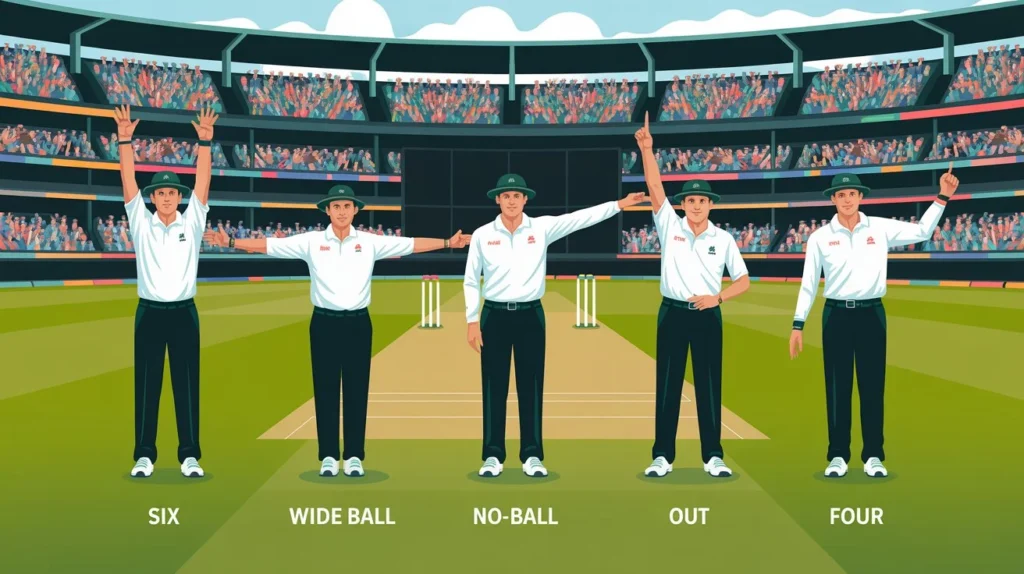
Watching cricket can be confusing if you don’t understand the umpire’s sign language. Those hand movements are not random—they are a clear code that tells players, scorers, and fans exactly what is happening on the field.
Think of umpires as traffic police for cricket. Their signals keep the game moving and inform everyone of the score, the decisions, and the rules. This guide will explain every common signal in simple language, so you’ll never be confused again!
📝 Quick Reference Table: Umpire Signals at a Glance
| Signal Name | What It Means | Umpire’s Action | Picture in Your Mind |
|---|---|---|---|
| Out | Batsman is dismissed. | Right hand raises straight up with index finger pointed to the sky. | Like pointing to heaven. |
| Four | Ball touches the boundary rope. | Right arm sweeps across the chest in a waving motion. | Like brushing something off your shoulder. |
| Six | Ball crosses boundary on the full. | Both arms raised straight up above the head. | Like a “touchdown” signal in American football. |
| No Ball | Illegal delivery by bowler. | One arm outstretched horizontally. | Like a traffic cop saying “STOP”. |
| Wide | Ball too far from batsman to hit. | Both arms outstretched horizontally. | Like making a “T” shape with your body. |
| Bye | Runs scored without ball touching bat. | One arm raised straight up. | Similar to “Out” but with an open hand. |
| Leg Bye | Runs off batsman’s body/pads. | One hand touches the raised knee. | Like tapping your own knee. |
| Dead Ball | Ball is no longer in play. | Both arms crossed at the wrist below the waist. | Like an “X” mark near your hips. |
| Short Run | Batsman didn’t complete the run. | One arm taps near the opposite shoulder. | Like patting your shoulder. |
| TV Replay | Umpire refers decision to third umpire. | Both hands make a square “TV screen” shape. | Like drawing a box in the air. |
| Five Penalty Runs | Penalty awarded to batting team. | One hand repeatedly taps the opposite shoulder. | Like the “short run” signal but repeated. |
| New Ball | New ball is taken. | One hand holds up the ball, other hand points to it. | Like showing the ball to everyone. |
| Last Hour | Last hour of play has started. | One hand points to wrist (where watch would be). | Like checking the time. |
| Revoke Signal | Umpire cancels their last signal. | Both hands sweep across each other in front of the chest. | Like wiping a slate clean. |
📥The MOST IMPORTANT Signals (You Must Know These)
These are the signals you will see in almost every over.
1. OUT (The Finger)
- Action: The umpire raises their right arm straight up with the index finger pointed to the sky.
- Meaning: The batsman is dismissed. It’s the most dramatic signal in cricket.
- Tip: Look for the bowler and fielders celebrating right after this signal!
2. FOUR
- Action: The umpire bends their elbow and waves their right hand across the chest from shoulder to shoulder.
- Meaning: The ball has touched or crossed the boundary rope after hitting the ground. 4 runs are awarded.
- Tip: This is a calm, smooth wave—not a frantic one.
3. SIX
- Action: The umpire raises both arms straight up above their head.
- Meaning: The batsman hit the ball over the boundary rope without it bouncing. 6 runs are awarded.
- Tip: This is the most exciting signal for batsmen and fans!
4. NO BALL
- Action: The umpire stretches one arm out horizontally to the side.
- Meaning: The bowler has broken a rule (usually overstepping the front line). The batting team gets 1 extra run, and the bowler must bowl that ball again.
- Important: The next ball is a “Free Hit” in limited-overs cricket, meaning the batsman can’t be out bowled, caught, etc., on that delivery.
5. WIDE
- Action: The umpire stretches both arms out horizontally, making a ‘T’ shape with their body.
- Meaning: The bowler bowled the ball too far away from the batsman for them to hit it. The batting team gets 1 extra run, and the bowler must bowl that ball again.
📤Signals for RUNS & EXTRAS
These signals tell us how runs were scored.
6. BYE
- Action: The umpire raises one arm straight up (open hand, not a finger).
- Meaning: Runs were scored without the ball touching the bat or the batsman’s body. The runs are added as “extras.”
7. LEG BYE
- Action: The umpire raises one hand and taps their knee with the other.
- Meaning: Runs were scored after the ball hit the batsman’s body or pads (not the bat). The runs are added as “extras.”
8. SHORT RUN
- Action: The umpire taps their fingers near the opposite shoulder.
- Meaning: The batsmen did not properly complete a run (they didn’t touch the ground behind the popping crease with their bat or body). That run is not counted.
⚠️Signals for STOPPING & PENALTIES
9. DEAD BALL
- Action: The umpire crosses both wrists below the waist.
- Meaning: The ball is no longer in play. No runs can be scored and no batsman can be out. This happens if something interrupts play (like a dog on the field or an injury).
10. TV REPLAY / THIRD UMPIRE
- Action: The umpire uses both hands to draw a square “TV screen” in the air.
- Meaning: The on-field umpire is unsure and is asking the third umpire (who has TV replays) to make the final decision. Used for close run-outs, catches, and boundaries.
11. FIVE PENALTY RUNS
- Action: The umpire repeatedly taps the opposite shoulder with one hand (like an exaggerated “short run” signal).
- Meaning: The fielding team has broken a serious rule (like damaging the pitch on purpose). 5 extra runs are given to the batting team.
⏰Other Useful Signals
12. NEW BALL
- Action: The umpire holds up the new ball for everyone to see.
- Meaning: In Test cricket, after 80 overs, the fielding team can choose to take a new, harder ball that swings more.
13. LAST HOUR
- Action: The umpire points to their wrist (where a watch would be).
- Meaning: In Test cricket, the final hour of play for the day has begun. A minimum number of overs must now be bowled.
14. REVOKE SIGNAL
- Action: Both hands sweep across each other in front of the chest.
- Meaning: The umpire made a mistake and is cancelling their last signal.
🧠 Pro Tips for Watching a Match
- Watch the Scorers: After every signal, look at the official scorers. They immediately update the scoreboard based on the umpire’s signal.
- Listen to the Commentary: Good commentators will say, “And the umpire signals leg byes,” which helps you learn.
- Sequence Matters: Often, you will see two signals together. For example:
- Four + Leg Bye: The ball hit the pad and then ran to the boundary. 4 leg bye runs.
- No Ball + Six: The bowler bowled a no-ball, and the batsman hit it for six! That’s 7 runs total (6 for the shot + 1 for the no-ball).
- The Soft Signal: In some close catches, the on-field umpire might give a “soft signal” (out or not out) before going to the TV replay. This is their best guess.
❓ Frequently Asked Questions
Q: Why do umpires sometimes signal after every ball and sometimes not?
A: Umpires only signal when something has changed—like runs scored, a wicket fallen, or a penalty given. If the ball is simply collected by the keeper, no signal is needed.
Q: What if the batsmen run 3, but the umpire signals a four?
A: The umpire’s signal is final. If they signal a four, only 4 runs are counted, even if the batsmen ran 3 or 5.
Q: Who do the umpires signal to?
A: Primarily to the official scorers sitting off the field. They also inform the players and the crowd.
Q: Are these signals the same all over the world?
A: Yes! These signals are universal and are set by the International Cricket Council (ICC). Whether you’re watching in India, Australia, or England, the signals mean the same thing.
Conclusion: You Are Now a Cricket Signal Expert!
Understanding umpire signals unlocks a new layer of enjoyment in cricket. You won’t have to wait for the TV graphic to update—you’ll know the score and the decision as soon as the umpire does.
Next time you watch a match, try to name the signal before the commentator does. It’s a fun game that will make you feel like a true cricket insider. Remember, every raised arm, every wave, and every point tells a part of cricket’s unfolding story.

Arjun Mehta is a dedicated cricket rules analyst with strong expertise in ODI, T20, and Test match regulations. He focuses on explaining powerplay rules, fielding restrictions, bowling limits, and modern ICC updates in simple language. Arjun’s content helps fans clearly understand match decisions and on-field situations without confusion.