
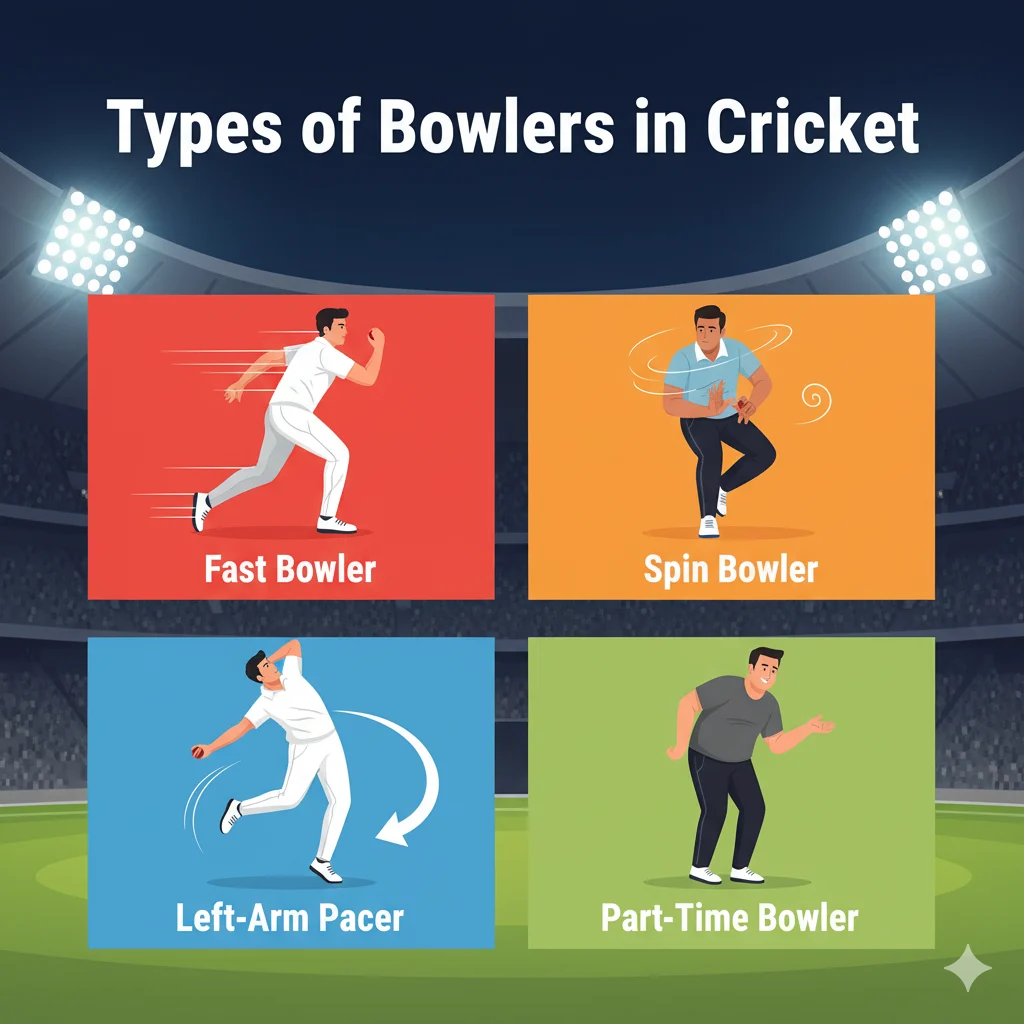
Bowling is one of the two main pillars of cricket, alongside batting. A bowler’s role isn’t just to take wickets—it’s also to build pressure, control runs, and force mistakes from the batter. Over time, cricket has developed a variety of bowling styles, each with unique techniques and strategies. The International Cricket Council (ICC) recognizes all these bowling styles under Law 21 (The Ball is Bowled) and Law 24 (No Ball) which govern delivery actions.
In this article, we’ll explore the different types of bowlers in cricket, their subcategories, famous examples, and how they’re used across Test matches, One Day Internationals (ODIs), and T20 cricket.
Fast Bowlers
Fast bowlers rely on speed, bounce, and seam movement to trouble batters.
Subtypes of Fast Bowlers
- Out-swing Bowler – Moves the ball away from the batter (e.g., Wasim Akram).
- In-swing Bowler – Swings the ball into the batter (e.g., James Anderson).
- Yorker Specialist – Targets the base of the stumps (e.g., Lasith Malinga, Jasprit Bumrah).
- Bouncer Specialist – Uses short-pitched deliveries to intimidate (e.g., Jofra Archer).
- Slower Ball Expert – Deceives batters in limited overs cricket (e.g., Dwayne Bravo).
📌 Case Study: Jasprit Bumrah’s Yorkers in the 2019 World Cup often saved India in death overs, proving how specialized deliveries can decide matches.
Medium-Pace Bowlers
Medium pacers don’t rely on raw pace but instead focus on accuracy, seam movement, and variations.
Subtypes of Medium-Pace
- Seam Bowlers – Extract bounce and movement off the pitch (e.g., Glenn McGrath).
- Cutters – Use wrist and fingers to cut the ball off the surface.
- Swing Bowlers – Rely on conventional or reverse swing (e.g., Bhuvneshwar Kumar).
📌 Case Study: Bhuvneshwar Kumar often swings the new ball early, giving India breakthroughs in powerplays.
Spin Bowlers
Spin bowling focuses on revolutions on the ball, deceiving the batter in the air and off the pitch.
Subtypes of Spin Bowling
- Off-Spin (Right-arm orthodox) – Spins into a right-hander (e.g., R. Ashwin).
- Leg-Spin (Right-arm unorthodox) – Spins away from a right-hander (e.g., Shane Warne).
- Left-arm Orthodox – Spins away from right-handers (e.g., Daniel Vettori).
- Chinaman (Left-arm unorthodox) – Spins into right-handers (e.g., Kuldeep Yadav).
- Doosra – Variation from off-spinners that turns away.
- Googly – Variation from leg-spinners that turns into right-handers.
- Carrom Ball – Flicked with fingers for unpredictable spin (e.g., Ajantha Mendis).
📌 Case Study: Muttiah Muralitharan’s doosra was nearly unplayable, making him the highest wicket-taker in cricket history.
Left-arm Bowlers
Left-arm bowlers add a natural angle advantage that troubles right-handers.
- Left-arm Fast – E.g., Mitchell Starc.
- Left-arm Spin – E.g., Ravindra Jadeja.
- Left-arm Unorthodox (Chinaman) – E.g., Kuldeep Yadav.
📌 Case Study: Mitchell Starc’s deadly yorkers against New Zealand in the 2015 World Cup final won Australia the trophy.
Right-arm Bowlers
Right-arm bowlers dominate cricket historically. They can be fast, medium, or spin bowlers.
Examples:
- Fast – Dale Steyn
- Medium – Glenn McGrath
- Spin – Shane Warne
📌 Case Study: Shane Warne’s “Ball of the Century” against Mike Gatting (1993 Ashes) remains the greatest example of right-arm leg-spin mastery.
All-rounder Bowlers
All-rounders contribute with both bat and ball.
Examples:
- Kapil Dev
- Ben Stokes
- Jacques Kallis
📌 Case Study: Ben Stokes’ spell in the 2019 World Cup final combined with his batting helped England lift their maiden title.
Part-time Bowlers
These are batters who bowl occasionally.
Examples:
- Virender Sehwag (off-spin)
- Michael Clarke (left-arm orthodox)
📌 Case Study: Michael Clarke famously took 3 wickets in the 2006 Chennai Test to win Australia the match.
📊Types of Bowlers in Cricket (With Subtypes & Famous Examples)
| Category | Subtype | Key Skill | Famous Examples |
|---|---|---|---|
| Fast Bowlers | Out-swinger | Moves ball away from batsman | Wasim Akram, Jimmy Anderson |
| In-swinger | Swings ball into batsman | Imran Khan, Trent Boult | |
| Yorker Specialist | Targets base of stumps | Lasith Malinga, Jasprit Bumrah | |
| Bouncer Specialist | Short ball, chest/head height | Jofra Archer, Shoaib Akhtar | |
| Slower Ball Expert | Changes pace to deceive batsman | Dwayne Bravo, Mustafizur Rahman | |
| Medium Pacers | Seam Bowler | Extracts movement off pitch | Glenn McGrath, Vernon Philander |
| Swing Bowler | Relies on conventional/reverse swing | Bhuvneshwar Kumar, Chaminda Vaas | |
| Cutters | Uses wrist/fingers for variation | Chris Cairns, Shardul Thakur | |
| Spin Bowlers | Off-spin (Right-arm orthodox) | Spins into right-hander | R. Ashwin, Saqlain Mushtaq |
| Leg-spin (Right-arm unorth.) | Spins away from right-hander | Shane Warne, Abdul Qadir | |
| Left-arm Orthodox | Spins away from right-hander | Daniel Vettori, Ravindra Jadeja | |
| Chinaman (Left-arm unorth.) | Spins into right-hander | Kuldeep Yadav, Brad Hogg | |
| Variations | Doosra, Googly, Carrom ball | Muralitharan, Rashid Khan | |
| Other Bowlers | All-rounders | Bat + Bowl effectively | Kapil Dev, Ben Stokes |
| Part-timers | Occasional bowlers | Michael Clarke, Virender Sehwag |
📊 Bowlers in Different Formats
| Format | Type of Bowler Most Effective | Reason | Examples |
|---|---|---|---|
| Test | Swing bowlers, long-spell spinners | Patience, endurance, exploit conditions | James Anderson, Nathan Lyon |
| ODI | Seamers, yorker specialists, accurate spinners | Balance between wicket-taking & economy | Zaheer Khan, Muralitharan |
| T20 | Variational bowlers (slower, cutters, mystery spin) | Restrict runs, force false shots | Rashid Khan, Sunil Narine |
| All Formats | All-rounder bowlers | Add depth to both batting and bowling | Jacques Kallis, Shakib Al Hasan |
Specialist Bowlers in Different Formats
Bowler effectiveness often depends on the format:
- Test Cricket – Emphasis on stamina and patience (James Anderson, Nathan Lyon).
- ODIs – Balance between economy and wickets (Zaheer Khan, Glenn McGrath).
- T20s – Focus on variations, yorkers, and slower balls (Rashid Khan, Sunil Narine).
📌 Case Study: Rashid Khan’s economical spells in T20 leagues make him the most sought-after spinner globally.
ICC Classification & Laws
- Law 21 (The Ball is Bowled) – Governs bowling delivery.
- Law 24 (No Ball) – Defines illegal deliveries.
- 15-Degree Arm Flexion Rule – Bowling action legality (introduced in 2005).
FAQs about Types of Bowlers
Q1. How many types of bowlers are there in cricket?
There are broadly two types—fast bowlers and spin bowlers. Each has several subtypes like yorker specialists, leg-spinners, doosra bowlers, etc.
Q2. Who is the fastest bowler in cricket history?
Shoaib Akhtar holds the record (161.3 km/h against England, 2003).
Q3. Who is the king of spin bowling?
Muttiah Muralitharan and Shane Warne are often called the kings of spin.
Q4. What’s the difference between pace and swing?
Pace depends on speed, while swing depends on how the ball moves in the air.
Q5. Who has the most wickets as a bowler?
Muttiah Muralitharan (800 Test wickets).
Conclusion
The types of bowlers in cricket define how the game unfolds. From lethal pace to tricky spin, bowlers bring variety and excitement. Understanding each type helps fans, players, and students of the game appreciate cricket more deeply.
Liam Thompson is a cricket regulations analyst who covers international and league-level rules in depth. He focuses on fielding laws, over-rate penalties, powerplay strategies, and updated ICC guidelines. Liam’s goal is to educate readers while keeping the excitement of the game alive.