
If you’ve ever watched netball for the first time, scoring can feel almost obvious—“ball through the ring = goal”—until a moment happens like this:
- the shooter releases the ball, the whistle goes, the ball drops in… and everyone asks, “Does that goal count?”
- a defender tips the ball after the shot, it still falls through… goal or no goal?
- someone shoots with a foot outside the shooting circle line… what now?
Netball is a fast sport, so the scoring rules are built to be clear, fair, and easy to umpire under pressure. This article explains exactly how goals are awarded in standard netball, why the rules exist, how they evolved, and how scoring changes in popular variants like FAST5 and the modern 2-point Super Shot (in some leagues).
Everything here is based on official World Netball rules (and official FAST5 rules) plus well-documented league rule trials.
Netball Scoring Basics (The One-Sentence Rule)
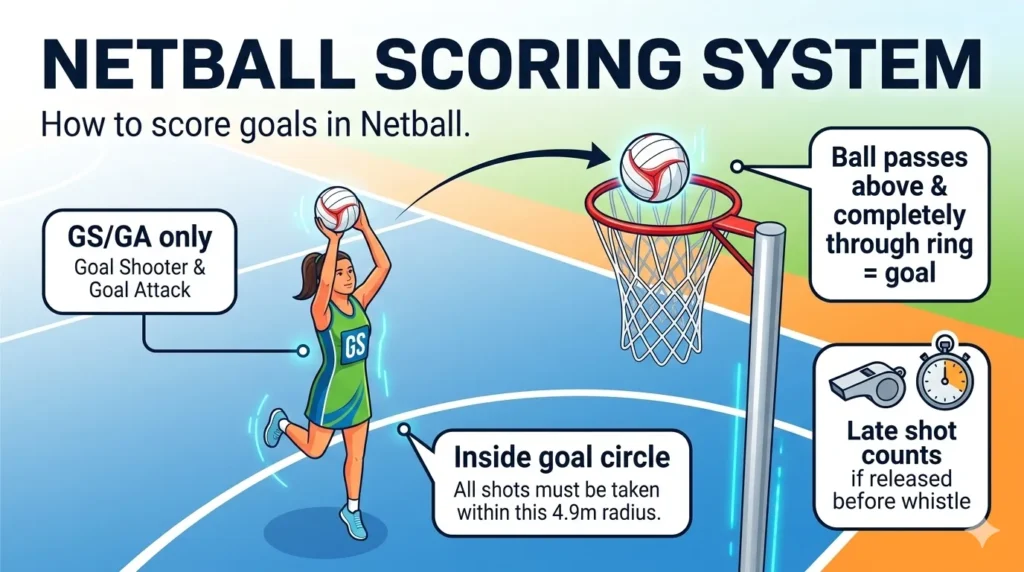
A goal is scored when the ball passes above and completely through the ring after a shot taken by Goal Shooter (GS) or Goal Attack (GA) from within the goal circle (including its boundary lines).
That’s the foundation. But netball also defines:
- who may shoot
- where they must shoot from
- when a late shot counts
- what happens if a defender interferes
- what happens if the ball falls through the ring in a “random” way
Let’s break it down clearly.
Netball Equipment: Ball, Net, Uniform & Accessories (Full Guide)
Who Can Score in Netball (GS and GA Only)
In standard netball, only two positions can score:
- Goal Shooter (GS)
- Goal Attack (GA)
Why only GS and GA can score
This rule is not just tradition—it is a design choice that creates netball’s unique teamwork style.
In basketball, anyone can score, so teams often rely on:
- individual shot creation
- dribble penetration
- fast breaks where a guard runs the whole play
Netball is built differently. Restricting scoring to GS/GA:
- forces team structure (midcourters must feed the circle)
- increases the value of circle entry passes (feeds)
- creates clear roles so netball becomes a game of movement + timing + passing lanes, not dribble isolation
This is one of the main reasons netball became its own sport historically rather than just “women’s basketball.” World Netball’s history notes early development and later standardization into a distinct sport.
Netball Rules Explained in Simple English
Where You Can Score (Inside the Goal Circle)
A shot must be taken from inside the goal circle to count. The goal circle is the semi-circle at each end of the court.
The World Netball rule is very clear: the shot must be taken “from any point within the goal circle including the lines bounding the goal circle.”
Easy explanation: “Line counts as inside”
If the shooter’s foot is on the goal circle line, that is still considered within the circle (because the rule includes the boundary lines).
Why netball uses a goal circle (not shoot-from-anywhere)
Netball’s circle rule shapes the sport:
- attacks are built through set plays
- defenders can set up around the circle edge to hunt intercepts
- shooters specialize in balance, timing, and quick release
It also keeps netball visually clean for umpires and scorers: “Was the shot taken from inside the circle? If yes, possible goal. If no, no goal.”
Netball Positions and Their Roles Explained (GS, GA, WA, C, WD, GD, GK)
What Exactly Counts as a Goal (The Ring Rule)
A goal is scored when the ball:
- passes above the ring, and
- passes completely through the ring.
Why the wording matters
Netball has no backboard, so shots can do strange things:
- drop straight down cleanly
- spin around the rim
- bounce high and fall late
The phrase “above and completely through” helps keep scoring consistent.
Umpire signal
Umpires signal a goal by raising one arm vertically.
This is important in noisy matches—players and scorers need a clear visual confirmation.
When Does a “Late” Shot Count (End of Quarter / Hold Time)
This is one of the most searched netball questions because it happens in tight matches.
Rule: If the whistle to end a period of play (or to hold time) is blown after the ball has left the shooter’s hands, and the shot is successful, the goal counts.
So the key moment is release, not when the ball lands.
Why this rule exists (fairness + realism)
Imagine the alternative: you shoot perfectly, the ball is in the air, and a timekeeper’s timing steals your goal. That would feel unfair and would encourage players to rush or stop shooting at the end.
This exact change has been explained in summaries and rule-change communications: previously the ball often had to pass through before the whistle, but the modern rule focuses on the ball leaving the hand before the whistle ends play.
Match scenario
Scenario: 14:59 on the clock, GA releases a shot. The siren/whistle goes at 15:00 while the ball is in the air. The ball drops through the ring.
✅ Goal counts because the ball left the shooter’s hands before the whistle.
This rule becomes huge in close games because it can change the score right at the break.
Deflections After a Shot (Does It Still Count?)
Yes—sometimes.
If a defender deflects a shot for goal and the ball then still passes above and completely through the ring, a goal is still scored.
Why allow it?
Because the shooter attempted a legal shot, and the ball still went through the ring after that shot. The defender’s touch doesn’t “cancel” the shot. This also prevents weird arguments like “the defender touched it so it’s not a shot anymore.”
Match scenario
Scenario: GS shoots. GD gets fingertips on the ball. The ball changes angle slightly but still drops through.
✅ Goal counts.
When the Ball Goes Through the Ring but It’s NOT a Goal
This is a classic “confusing moment.”
World Netball states:
If the ball passes completely through the ring on any other occasion, no goal is scored, and play continues.
What “any other occasion” means in real life
Examples where it does not count:
- Someone throws the ball up through the ring from below during general play (not a shot)
- The ball accidentally falls through the ring after a scramble, without a proper shot by GS/GA from inside the circle
Netball needs this rule to prevent accidental or “cheeky” goals that are not part of normal shooting action.
The “Incorrect Shot” Rule (Foot Outside the Circle)
Netball is strict about where the shooter’s body is.
When taking a shot, the player must have no physical contact with the ground outside the goal circle, including while catching or touching the ball. If they do, it is an incorrect shot, and no goal is scored.
Easy example
- If GA catches the ball inside the circle but their toe is touching the ground outside the circle line while shooting:
❌ incorrect shot → no goal
Why this exists
Because netball scoring must stay tied to the shooting circle. If shooters could lean or step outside, they could shoot from angles and distances not intended by the circle rule.
Netball Court Size, Markings & Layout Explained (Easy Full Guide)
Shooter Time Limit and Footwork (Why Scoring Is Not Just “Shoot Anytime”)
Even shooters have limits.
World Netball requires that the shooter:
- shoots within three seconds of catching the ball, and
- obeys the footwork rule.
Why the 3-second limit matters for scoring
It prevents time-wasting near goal and keeps the game flowing. It also forces defenders to stay alert—because the shot must come quickly, defenders learn to time their contests, rebounds, and intercept attempts.
Why footwork rules matter in the circle
A clean goal often starts with a clean catch and landing. If the shooter travels, steps, or loses control of the landing foot, play stops and the goal will not count if it was an infringement.
Interference With a Shot (Defenders Can’t “Cheat” the Ring)
Defenders must not:
- cause the goalpost to move to interfere with a shot, or
- deflect the ball on its downward flight to the ring (including touching it up through the net).
Sanction: Penalty pass. If the shot is successful, the goal is scored.
Why this exists
Netball has no backboard, and the ring is the only scoring target. If defenders could tap the ball through the net, push the post, or swat downward shots, scoring would become messy and unsafe.
Match scenario
- GS shoots. GK hits the ball downward as it is dropping to the ring.
✅ Penalty is awarded, and if the shot was going in, the goal can still be awarded under the interference rule.
Advantage and Scoring (When the Umpire Lets the Goal Stand)
Sometimes an infringement happens, but a goal is scored anyway.
World Netball’s advantage guidance includes a clear scoring-related case:
If the whistle is blown for an infringement, the sanction must be awarded except if a goal is scored to the advantage of the non-infringing team, the umpire awards the goal and calls “advantage.”
Why this rule exists
Netball is fast. If the attacking team still succeeds and scoring is fair, stopping play can punish the team that did nothing wrong. “Advantage” allows flow without losing fairness.
Match scenario
- Defender contacts GA as GA releases a clean shot. The umpire signals infringement, but the ball drops through.
✅ Umpire may award the goal as advantage (and still communicate the infringement).
What Happens After a Goal (Centre Pass and Momentum)
After every goal, play restarts with a centre pass, taken alternately by the centres.
Why centre pass matters for scoring strategy
In netball, you can’t rely on one player running the ball back quickly. The centre pass becomes a structured moment where:
- teams run a set play to keep possession
- defenders set traps for intercepts
- the next goal is often built from this first pass
Scoring is not just about shooting; it’s about repeatedly winning centre passes and feeding the circle cleanly.
The “Scoreboard Reality” — How Goals Are Recorded and Confirmed
In serious netball, scoring is not casual. It’s controlled by:
- umpire signal (raised arm)
- scorers confirming
- timekeeping and quarter endings
World Netball rules highlight how officials coordinate around goals and centre passes, including the importance of correct restarts.
Why it’s important
If a match ends with a one-goal difference, scoring accuracy matters as much as shooting accuracy.
History: Why Netball Scoring Was Designed This Way
Netball developed from early forms of basketball but became its own sport with strong rules around:
- movement restrictions
- position zones
- controlled contact
- circle-based shooting
World Netball notes early play and growth in the late 1800s and early 1900s, before international rules became standardized later.
Why scoring stayed “1 point per goal”
Traditional netball uses one point per goal because:
- scoring already happens frequently (many shooting opportunities)
- the sport’s tension comes from possession, turnovers, and intercepts, not big-value long-range shots
That is why standard netball does not include a normal 2-point or 3-point system.
Match Scenarios That Decide Games (How Scoring Rules Show Up Under Pressure)
Here are realistic, common match moments where scoring rules matter:
Scenario 1: Buzzer-beater release
- GA releases the ball.
- whistle ends the quarter.
- ball drops in.
✅ Goal counts because release happened before the whistle.
Scenario 2: Defender tips the shot
- GK gets a finger on the ball after GS shoots.
- it still goes through the ring.
✅ Goal counts.
Scenario 3: Shooter steps outside
- GS lands with a toe outside the circle while shooting.
❌ Incorrect shot, no goal.
Scenario 4: Ball falls through ring “randomly”
- ball goes through ring during a scramble, not after a proper shot.
❌ No goal; play continues.
Scenario 5: Defender interferes with downward flight
- defender touches ball on downward flight or up through net.
✅ Penalty; goal may still be awarded if shot was successful.
These are exactly the moments that create confusion for beginners—and why netball’s scoring rules are written so precisely.
Variations and Modern Scoring Innovations
Standard netball = 1 point per goal.
But modern formats and leagues sometimes modify scoring to increase excitement, especially for TV.
FAST5 Scoring (1, 2, or 3 points)
FAST5 is an official fast format with different scoring zones and a “super shot” style system. Official FAST5 rules describe 1, 2, and 3 goal points depending on where/how the shot is taken, plus “Power Play” doubling in certain periods.
Why FAST5 exists
FAST5 is designed to be:
- shorter
- higher scoring swings
- more dramatic late-game comebacks
So it introduces:
- multi-point shots
- power plays
- quicker structure
Two-Goal “Super Shot” in some leagues
Some leagues introduced a two-goal long-range shot to create big momentum swings.
For example, an official document on the Suncorp Super Netball Super Shot trial explains:
- it was introduced for the 2020 season
- it offers a two-goal option from a designated zone
- it is active in the final minutes of each quarter
This is not standard World Netball scoring, but it is important because many fans now see it and assume it applies everywhere.
Why leagues introduce 2-point shots
- more drama late in quarters
- tactical decisions (“risk vs reward”)
- more viewer excitement
But it can also be controversial because it changes the traditional balance of netball.
Common Beginner Confusions About Scoring (Quick Fixes)
Confusion 1: “If it goes in, it counts.”
Not always. It must be a legal shot by GS/GA from inside the circle, and the ball must pass above and completely through.
Confusion 2: “The whistle means no goal.”
Not always. If the ball has already left the shooter’s hands before the whistle, the goal can still count if successful.
Confusion 3: “The defender touched it, so it doesn’t count.”
Wrong. A deflection after the shot can still result in a goal if it goes through.
Confusion 4: “Any player can shoot if they’re in the circle.”
Wrong. Only GS and GA can score in standard netball.
Quick Comparison: Netball vs Basketball Scoring (Why They Feel Different)
Basketball
- many scoring values (1, 2, 3)
- any player can score
- backboard creates many rebound battles
Netball
- usually 1 point per goal
- only GS/GA score
- no backboard; scoring is circle-based and feed-driven
Netball’s scoring system supports the sport’s main identity: structured attack, clean feeds, and pressure around the circle edge—not long-range shooting wars.
FAQ
1) How are goals awarded in netball?
A goal is awarded when the ball passes above and completely through the ring after a shot by GS or GA from inside the goal circle.
2) Can the ball go in after the whistle and still count?
Yes—if the whistle to end play is blown after the ball has left the shooter’s hands, and the shot is successful, the goal counts.
3) What if a defender touches the ball after the shot?
If a defender deflects the shot and the ball still goes through, it is still a goal.
4) Who can score in netball?
Only the Goal Shooter (GS) and Goal Attack (GA) can score in standard netball.
5) Can you score from outside the shooting circle?
No. Standard netball goals must be shot from inside the goal circle.
6) What is an incorrect shot in netball?
If the shooter has physical contact with the ground outside the goal circle while taking the shot, it’s an incorrect shot and no goal is scored.
7) What happens if the ball falls through the ring by accident?
If the ball passes through the ring on any other occasion not meeting goal requirements, no goal is scored and play continues.
8) What is interference with a shot?
A defender cannot move the goal post to interfere or touch the ball on its downward flight to the ring (including up through the net).
9) Does standard netball have 2-point shots?
No, standard netball is typically 1 point per goal. Two-point rules appear in some leagues as special innovations (e.g., Super Shot trials).
10) How does FAST5 scoring work?
FAST5 uses multi-point scoring (1/2/3) and can include power plays that double points, depending on the rules.
Conclusion
Netball scoring looks simple at first—“ball through the ring”—but it’s actually a smart system built for speed and fairness. A goal must come from the right player (GS/GA), the right place (inside the goal circle), and the right action (a legal shot where the ball passes above and completely through the ring). Modern rule details—like goals counting if the whistle goes after release, or goals still counting after a deflection—exist to protect fairness in high-pressure moments and keep matches flowing smoothly.
Once you understand these rules, you’ll read matches differently: you’ll notice how teams build scoring through possession, safe feeds, and winning crucial moments around the circle edge—because in netball, the scoring system is tied directly to structure and teamwork.

I am a netball writer and match analyst who creates easy, practical guides for beginners and club players. I focuses on netball rules, court markings, and position-based strategy—explaining the “why” behind each rule with real match scenarios and clear examples. When not writing, I follow international netball events and breaks down game patterns like circle entries, intercept setups, and centre-pass plays to help readers understand netball faster.