
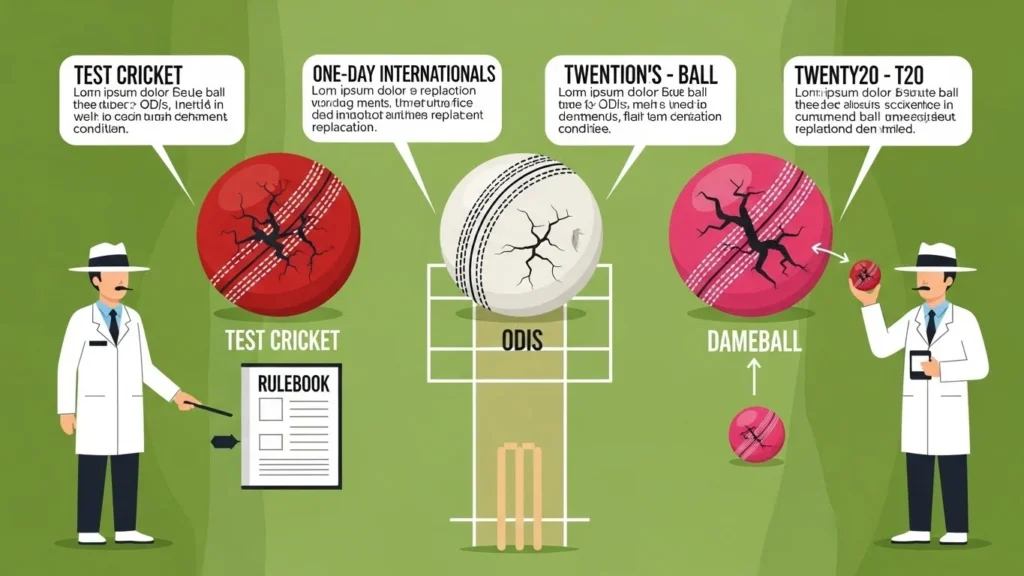
In cricket, the ball is very important. The swing, bounce, and speed all depend on the ball. Because of this, the rules for replacing the ball are very strict. A ball cannot be changed just because a team wants a new one.
This guide explains when the ball can be replaced, when it cannot, and how replacement works in T20, ODI, and Test cricket.
🏏 What Does “Replacing the Ball” Mean?
Replacing the ball means using a different cricket ball during the match because the original ball cannot be used anymore.
The new ball is not always brand new. It depends on the situation.
✅ When Can the Ball Be Replaced? (Allowed Reasons)
1. Ball Is Lost
This happens when:
- Ball goes into the crowd
- Ball cannot be found after searching
👉 Umpire replaces the ball with a similar used ball
2. Ball Is Broken or Damaged
Ball is replaced if:
- Ball is split
- Seam comes out
- Ball loses its shape
👉 A broken ball is unsafe, so it must be changed.
3. Ball Becomes Too Wet
- Heavy rain
- Wet outfield
- Waterlogged ground
👉 Umpire checks the ball
👉 If it is too wet to grip, the ball is replaced
⚠️ Light moisture is not enough
4. Ball Is Dangerous for Batters
- Ball shape becomes uneven
- Bounce becomes unpredictable
👉 Player safety comes first, so umpire replaces the ball.
❌ When the Ball CANNOT Be Replaced
These are not valid reasons:
- Ball loses shine
- Ball becomes soft
- Reverse swing stops
- Batting team complains
- Fielding team asks for advantage
👉 Normal wear and tear = NO ball change
🚫 Ball Tampering (Illegal Damage)
Ball tampering means damaging the ball on purpose.
Illegal Actions:
- Scratching with nails
- Using bottle caps or zippers
- Rubbing on rough ground
- Applying saliva with chemicals
Punishment:
- 5 penalty runs
- Ball replaced
- Player warning
- Match ban for repeat offense
🔁 What Kind of Ball Is Used as Replacement?
Replacement ball rules are simple:
- Same age as original ball
- Same level of wear
- Not brand new (unless original was new)
📌 Example:
If a 30-over old ball is damaged → replacement is also around 30 overs old
🔢 How Many Times Can the Ball Be Replaced?
- There is no fixed limit
- Ball can be replaced multiple times
- But only for real and valid reasons
👉 Umpires control everything.
🏏 Format-Wise Ball Replacement Rules
🔵 T20 Cricket Ball Replacement Rules
- White ball is used
- Ball gets wet quickly
- Replacement happens more often than Tests
Common T20 Scenarios:
- Ball lost in crowd
- Ball damaged by big hits
- Ball too wet due to dew
👉 Replacement ball must still be used, not new
🟡 ODI (One Day International) Ball Replacement Rules
- Two new balls used (one from each end)
- Each ball used for 25 overs
ODI Scenarios:
- One ball lost → replaced with similar ball
- One ball damaged → umpire replaces only that ball
- Wet conditions → ball change allowed
👉 Two-ball rule does not mean unlimited new balls
🔴 Test Match Ball Replacement Rules
- Red ball used
- One new ball every 80 overs
- Ball condition is very important
Test Match Scenarios:
- Old ball damaged → replaced with similar old ball
- Shine loss → NOT a reason
- Reverse swing stopping → NOT allowed
👉 New ball only after 80 overs, not on request
🎯 Real Match Scenarios (Easy Examples)
Scenario 1:
Ball goes into the crowd and is lost
✔ Ball replaced with similar used ball
Scenario 2:
Ball is soft and not swinging
❌ No replacement
Scenario 3:
Ball seam comes out
✔ Ball replaced immediately
Scenario 4:
Fielding team asks for new ball
❌ Umpire rejects request
Scenario 5:
Rain makes ball very wet
✔ Umpire changes ball
👨⚖️ Who Makes the Final Decision?
- Only on-field umpires
- Players can request
- Pressure or arguing = misconduct
👉 Umpire decision is final
📘 ICC Laws Behind Ball Replacement
- Law 4 – The Ball
- Law 41 – Unfair Play
These laws apply to all formats.
🧠 Why Ball Replacement Rules Are Important
- Keeps the match fair
- Stops cheating
- Protects player safety
- Maintains balance between bat and ball
❓ FAQs: Rules of Replacing the Ball in Cricket
Q1: Can a team ask for a new ball anytime?
No. A team can only request. The umpire decides if the ball can be replaced.
Q2: Is loss of shine a valid reason to replace the ball?
No. Losing shine is normal and not a reason for ball replacement.
Q3: Can the ball be replaced more than once in a match?
Yes, but only for valid reasons like damage, loss, or safety issues.
Q4: Does replacement mean a brand-new ball?
No. The replacement ball must be same age and condition as the original.
Q5: Are ball replacement rules same in T20, ODI, and Test?
Yes. The basic rules are the same, only conditions differ.
Q6: Can umpires refuse to change the ball?
Yes. If the ball is safe and usable, umpires can refuse replacement.
Q7: What happens if ball tampering is proven?
Batting team gets 5 penalty runs, and players may be fined or banned.
✅ Conclusion
Replacing the ball in cricket is not easy and not common. A ball can only be changed if it is lost, broken, wet, or unsafe. Teams cannot ask for a new ball just because they want swing or shine. The replacement ball must be similar in age and condition. These rules are the same in T20, ODI, and Test cricket and are controlled fully by the umpires.

Rahul Desai is a cricket rules researcher who closely studies official rulebooks, match conditions, and tournament regulations. His articles explain tricky scenarios like no-ball decisions, super overs, and DLS calculations in a straightforward way. Rahul’s content is ideal for fans who want rule clarity.