
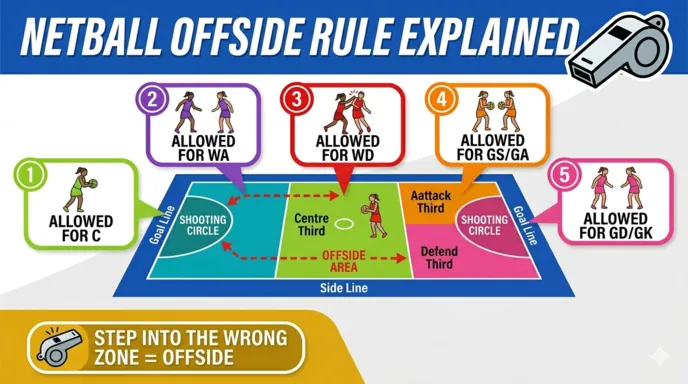
If you’ve ever played netball (or watched a school match), you know the most common whistle is not always for contact—it’s often for offside. A player gets excited, follows the ball, takes one extra step into the wrong third or into the shooting circle, and suddenly the umpire calls: “Offside!” The confusing part is that the player may not even touch the ball—yet it can still be a big mistake because it breaks netball’s biggest idea: structured positions and space control.
This article explains the offside rule in very easy English, with real match-style scenarios, why the rule exists, where the free pass is taken, and how to avoid offside mistakes. Everything is based on World Netball Rules.
What Does “Offside” Mean in Netball?
In netball, offside means:
A player is offside when they enter any area of the court that is not allowed for their position.
This applies:
- whether you have the ball or not (most of the time),
- whether you are attacking or defending,
- during normal play and also during some restarts.
Netball is different from football/soccer offside. In netball, offside is not about being ahead of defenders. It is about court areas (thirds and circles) that your position is allowed to enter.
Why Netball Has an Offside Rule (The Real Purpose)
The offside rule exists because netball is built on specialist positions and team structure.
1) It keeps the game fair
If all players could go anywhere, the strongest or fastest player could dominate the whole court. Offside restrictions stop one player from covering everything.
2) It creates clear roles and tactics
Netball uses goal shooters, feeders, and defenders with different permitted areas. This creates planned attacks and defensive patterns (set plays, switches, circle feeds).
3) It protects space and reduces chaos
Netball is a passing sport, not a dribbling sport. Court structure makes passing lanes meaningful and makes intercepts a skill, not a random accident.
World Netball explains offside in the rules and links it directly to “court areas designated for each position.”
Netball Court Areas You Must Know (Thirds + Circles)
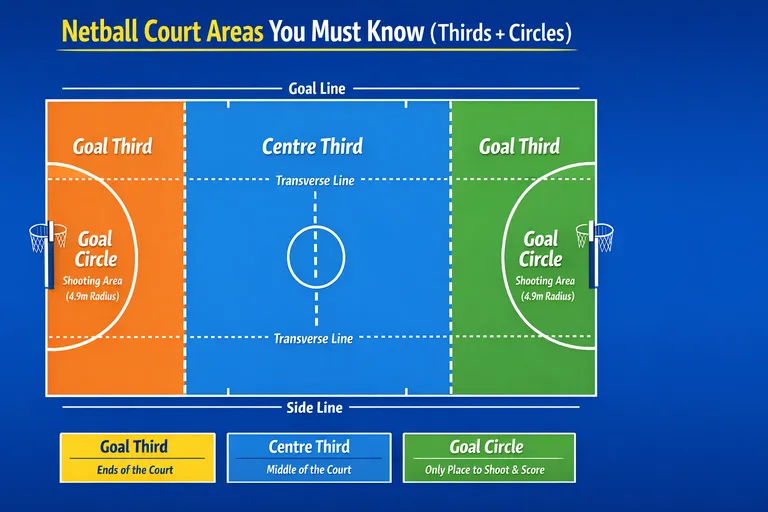
To understand offside, you must understand the court layout:
- The court is split into three equal thirds:
Goal Third – Centre Third – Goal Third. - Each end has a goal circle / shooting circle (semi-circle). Scoring happens only from inside it.
Offside happens when a player steps into a third or circle that is not part of their allowed area.
Also Read More About: Common Fouls and Penalties in Netball, Umpire signals + exact call words
Netball Positions and Their Allowed Areas (Easy Map)
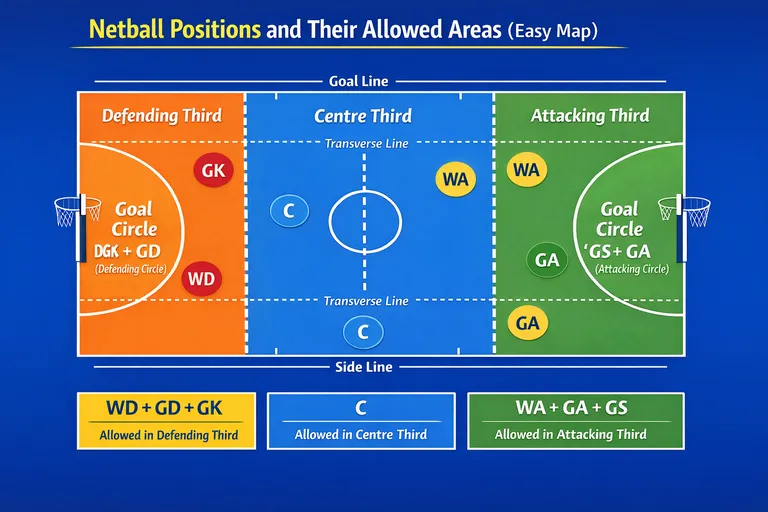
Here is the simple rule: every position has zones they can enter.
Attacking positions
- GS (Goal Shooter): Attacking third + goal circle
- GA (Goal Attack): Centre third + attacking third + goal circle
- WA (Wing Attack): Centre third + attacking third (NOT goal circle)
- C (Centre): All thirds (NOT any goal circle)
Defending positions
- WD (Wing Defense): Centre third + defending third (NOT goal circle)
- GD (Goal Defense): Centre third + defending third + goal circle
- GK (Goal Keeper): Defending third + goal circle
(These areas are standard netball position rules and are also summarized in common rules references.)
Quick memory trick:
- Only GS + GA can shoot (because they can enter the goal circle in attack).
- Only GD + GK can enter the goal circle in defense.
- WA + WD + C cannot enter any goal circle.
When Exactly Is a Player Offside?
A player is offside when they enter an area not designated for their position except in a special case: when they go offside solely to retrieve a ball to set a sanction or action (explained later).
So, normally:
- If your foot touches the wrong area, you are offside.
- It does not matter if you touched the ball or not (in most situations).
Offside Examples (Real Match Scenarios)
Scenario 1: Wing Attack steps into the shooting circle
- WA runs toward the goal circle to receive a pass.
- Even if WA does not catch the ball, WA is offside because WA cannot enter the goal circle.
Result: Umpire blows whistle → free pass to the other team.
Scenario 2: Centre enters the goal circle by accident
- The Centre (C) follows the play too close.
- C steps inside the goal circle during a scramble.
C is offside because C cannot enter any goal circle.
Scenario 3: Goal Shooter crosses into the centre third
- GS tries to help with the build-up and steps into the centre third.
- GS is only allowed in the attacking third (and goal circle), so stepping into centre third is offside.
Scenario 4: Wing Defense enters the defensive goal circle
- WD tries to stop a shot and steps into the goal circle.
- WD is not allowed in the goal circle (only GD and GK can defend there).
Also Read More About: Contact vs Obstruction in Netball (2026 rules)
What Is the Penalty for Offside?
The sanction for offside is a free pass.
What a “free pass” means (simple)
- It is given to the non-offending team
- It is taken from the correct location (explained below)
- Players must follow conditions for taking it (feet position, no delay, etc.)
Where Is the Free Pass Taken for Offside?
In most offside cases:
- the free pass is taken where the offside happened (where the player was in contact with the ground).
For centre pass and some “special restart” situations, the location can be stated more specifically (like the transverse line area), which older rule books and match interpretations explain.
Easy way to think:
- Offside happens → whistle → free pass to the other team near the spot of the infringement (with some restart exceptions).
The Special Exception: “Can You Go Offside to Retrieve the Ball?”
Yes—World Netball includes an exception:
A player is offside if they enter a non-designated area except when solely to retrieve a ball to set a sanction or action.
What this means in real play
Sometimes the ball goes out or a sanction is awarded, and the ball is rolling near a restricted area. A player may step into that area only to collect the ball so the game can restart quickly—not to participate in play.
Key idea: You can retrieve the ball, but you can’t use that offside position to gain an advantage.
A 2024 update discussion from Wales Netball also highlights the intention to speed up the game by allowing players to go offside to collect the ball.
Offside During a Centre Pass (Common Confusion)
The centre pass is where many beginners get offside.
What often goes wrong
- Players enter the centre third too early
- Players take the ball in the wrong third
- A player lands with feet across a line incorrectly
Older rule book explanations show that a centre pass must be received/touched by a player wholly in the centre third (or land first in the centre third), and infringements can lead to a free pass near the transverse line area.
Simple learning tip:
During centre pass, always check:
- Am I in my allowed third?
- Am I waiting until the whistle (if required in your competition)?
- Is my first landing foot inside the correct area?
(Exact centre pass procedures can vary by competition, but the offside principle stays the same: stay in your permitted areas.)
Offside vs “Out of Bounds” (Not the Same)
Many new players mix these up:
Offside
- You are inside the court, but in the wrong area for your position.
Out of bounds
- You or the ball goes outside the court boundary lines.
Both can cause turnovers, but they are different infringements.
Offside vs Football/Soccer Offside
- Netball offside: position-based court areas (thirds/circles)
- Soccer offside: attacker’s position relative to defenders and the ball
So if you search “offside rule,” make sure you are reading netball-specific rules, not soccer.
Why Offside Shapes Netball Strategy
Offside is not a small rule—it shapes the entire sport.
1) It creates the “passing chain” style
Because you can’t move freely everywhere, the ball moves through:
defense → centre → attack, with smart support options.
2) It increases the value of intercepts
When players must pass through specific channels, defenders can read lanes and hunt intercepts.
3) It makes circle entry a high-pressure moment
Only certain positions can enter the goal circle. That makes feeds into the circle more tactical and more defended.
Mini Case Study: Court Structure Under Pressure (2010 Commonwealth Games Final)
In the 2010 Commonwealth Games netball final, New Zealand beat Australia 66–64 after double extra time, and the final lasted 84 minutes.
Why this match is a perfect example of structured netball
Even without listing every play, the match context shows what netball becomes at the highest pressure:
- teams protect possession through the thirds
- defensive pressure increases intercept chances
- circle entries become the biggest battle because that’s where scoring is possible
This is exactly the environment where offside mistakes are costly:
- one offside call can stop momentum
- it gives the other team a free pass and a chance to reset
- it breaks a set play at the worst time
Common Offside Mistakes
Mistake 1: Ball-watching (following the ball into the wrong area)
Fix: Watch your bib role first, ball second.
Mistake 2: Stepping into the circle “just for a second”
Fix: Train your stopping distance—learn where the circle line is.
Mistake 3: Standing on lines without knowing they count
Lines matter. If you are in contact with a restricted area line, umpires may judge it as offside (depending on exactly where your foot lands and local interpretation). Best habit: stay clearly inside your permitted zone.
Mistake 4: Centre pass confusion
Fix: Reset your starting positions every centre pass. Use simple team calls like “Hold thirds” and “Check circle.”
Drills to Stop Offside
1) “Zone Freeze” drill (5 minutes)
- Mark thirds and circles clearly
- Call a position (e.g., WA)
- Player moves with the play, then you shout “Freeze!”
- Check if any foot is in an offside area
2) Circle edge passing drill
- Feeders practice passing into circle
- Non-circle players must stay outside (WA/WD/C)
- Umpire/coach watches for accidental circle steps
3) Centre pass setup drill
- Run 10 centre passes in a row
- Stop whenever someone enters the wrong third
- Correct and repeat until it becomes automatic
Quick Table: Offside Rule Summary
| Topic | Simple meaning |
|---|---|
| What is offside? | Entering an area not allowed for your position |
| Main punishment | Free pass to the other team |
| Most common offside | WA/WD/C stepping into the goal circle |
| Special exception | You may go offside only to retrieve the ball for a restart (no advantage) |
FAQs
1) What is the offside rule in netball?
Offside is when a player enters a court area not allowed for their position.
2) Is offside in netball the same as football offside?
No. Netball offside is about restricted court areas; football offside is about attackers being ahead of defenders.
3) What is the penalty for offside in netball?
The sanction is a free pass to the non-offending team.
4) Can a player be offside without touching the ball?
Yes. Offside is about where you are on court, not only ball contact.
5) Can WA go into the shooting circle?
No. WA cannot enter the goal circle; that would be offside.
6) Can the Centre go into the shooting circle?
No. The Centre cannot enter either goal circle.
7) Can WD go into the goal circle?
No. WD cannot enter the goal circle (only GD and GK can defend there).
8) Can you go offside to pick up the ball?
World Netball allows an exception: you can enter an offside area only to retrieve the ball for a sanction/action, not to play from there.
9) Where is the free pass taken for offside?
Usually near where the offside occurred; some restart situations specify locations near transverse lines.
10) What does “offside” look like in a match?
A player’s foot enters the wrong third or circle, the umpire whistles, and the other team gets a free pass.
11) Why does netball have offside areas?
To keep structure, create clear roles, and make netball a passing-and-space sport.
12) What is the easiest way to avoid offside?
Know your allowed areas, practice stopping before circle lines, and reset your position during centre passes.

I am a netball writer and match analyst who creates easy, practical guides for beginners and club players. I focuses on netball rules, court markings, and position-based strategy—explaining the “why” behind each rule with real match scenarios and clear examples. When not writing, I follow international netball events and breaks down game patterns like circle entries, intercept setups, and centre-pass plays to help readers understand netball faster.