
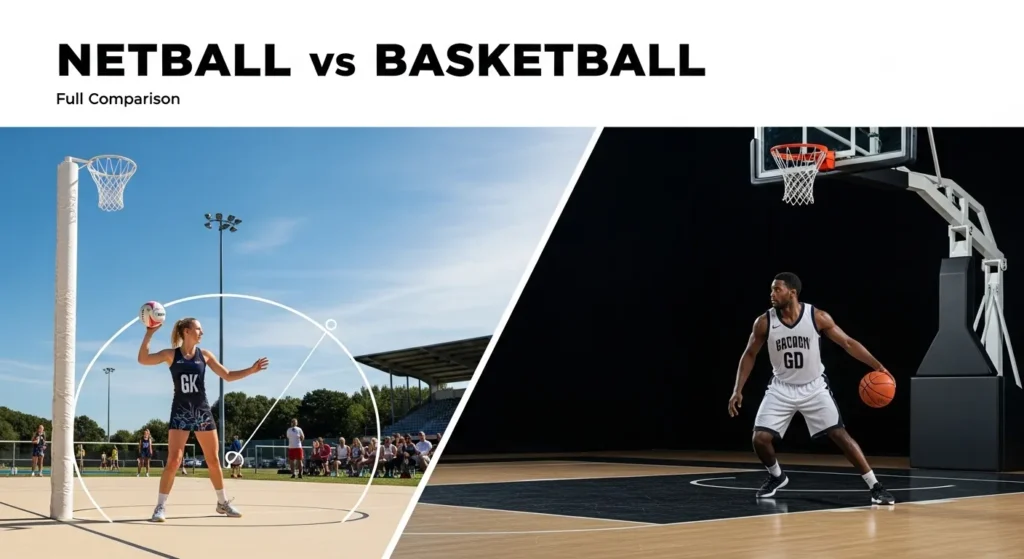
If you’ve ever watched a fast game of basketball and then seen netball, you probably felt, “Wait… this looks similar, but the rules feel totally different.” That’s exactly the user intent behind this topic: people want a clear, full comparison—rules, court, scoring, positions, movement, contact, time, and why each sport plays the way it does.
Here’s the big idea: basketball is built around dribbling, continuous movement, and more freedom, while netball is built around quick passing, set positions, and controlled movement. Both are team ball sports, but they reward different skills.
Difference Between Netball and Basketball
Netball and basketball look similar because both are team court sports with a ball, passing, shooting, and defense. But the games feel very different because netball is built around fixed positions + quick passing, while basketball is built around dribbling + free movement + fast breaks.
In netball, players move the ball mostly by passing, trying to create space in the shooting circle. In basketball, players can move the ball by passing or dribbling, attack the key/paint, and score from many areas (including the 3-point line).
Netball Rules vs Basketball Rules
Netball rules (how the game “flows”)
Netball has rules that force the game into a catch–stop–pass rhythm:
- 3-second rule (held ball): A player with the ball must pass or shoot within 3 seconds.
- Netball also has strict rules about where players can go (position areas), which creates more set plays and planned movement.
Because of these rules, netball is heavy on:
- fast, accurate passing
- quick decision-making
- reading the game for intercepts and turnovers
Basketball rules (how the game “flows”)
Basketball is more “free”:
- Players can move anywhere on court.
- Dribbling is a major tool, so fast breaks, isolation plays, and man-to-man or zone defense switching are common.
- At FIBA level, the game has 4 quarters of 10 minutes and can go to overtime if tied.
Also, basketball has many timing and lane rules (like 3 seconds in the paint, shot clock rules in competitions), which helps keep the game fast and prevents time-wasting.
Netball Court vs Basketball Court
Netball court (thirds + circles)
A netball court is divided into three equal thirds by two transverse lines: goal third – centre third – goal third.
Key netball areas:
- Centre circle (restart area)
- Goal circle / shooting circle at each end (semi-circle)
Netball court size is commonly 30.5 m long x 15.25 m wide.
Basketball court (key/paint + arcs)
A FIBA basketball court is 28 m long x 15 m wide.
Key basketball areas:
- Key/paint (free-throw lane)
- Backboard + hoop
- 3-point line (for spacing and long-range scoring)
Simple takeaway:
Netball’s court markings create a more structured passing game. Basketball’s markings support drives, screens, spacing, and shooting from distance.
Netball Positions vs Basketball Positions
Netball positions (7 players, fixed roles)
Netball has 7 positions, and each position has restricted areas where they can move. This creates strong role identity and teamwork patterns:
- GS (Goal Shooter), GA (Goal Attack) (main scorers)
- WA, C (feeders and connectors)
- WD, GD, GK (defenders)
Because of position limits, netball attacks often look like:
- short passes → switch angle → entry pass → shot
This leads to many set plays and planned movement.
Basketball positions (5 players, flexible roles)
Basketball has 5 players with common labels (guard/forward/center), but modern basketball is flexible:
- Many teams play “positionless” styles.
- Players can switch in man-to-man or zone defense.
- Any player can bring the ball up, run a fast break, or shoot.
Simple takeaway:
Netball = specialists with restricted zones.
Basketball = flexible roles and free movement.
Can You Dribble in Netball?
In basketball, dribbling is a core skill—players dribble to travel, change direction, and create shots.
In netball, you cannot travel by dribbling like basketball. Netball is designed so you must stop, pivot, and pass quickly (and usually within 3 seconds).
That is why netball rewards:
- quick release passing
- clean pivots
- smart off-ball movement to get open
Netball Scoring vs Basketball Scoring
Netball scoring
- Goals are worth 1 point
- Shots must be taken from inside the shooting circle
- Only certain roles (GS/GA) can shoot in standard netball structure
Basketball scoring
- Points can be 1, 2, or 3 depending on shot type (free throw, normal field goal, 3-pointer)
- Shots can be taken from many areas of the court (including outside arcs)
- Any player can score
Simple takeaway:
Netball scoring is more controlled and close-range.
Basketball scoring has more variety and range.
Netball Contact Rules
Netball is often described as “non-contact,” but the best way to say it is:
- Contact is much more limited than basketball.
- Defenders must respect defense distance (commonly taught as 0.9 m / 3 feet for obstruction concepts), meaning you can’t crowd a shooter or ball carrier in the same way as basketball.
This changes defense style:
- Netball defenders focus on intercepts, reading passes, and timing jumps.
- Basketball defenders can use more body pressure (within foul limits), plus screens and physical box-outs.
Netball Footwork Rule (Landing/Stepping)
This is one of the biggest “skill differences.”
Netball footwork (very strict)
Netball has a detailed footwork (landing/stepping) rule. If you catch the ball, you must:
- land correctly (often one-foot or two-foot landing)
- keep control of your landing foot and pivot rules
- release the ball quickly
Because of this, netball training spends a lot of time on:
- controlled stops
- clean pivot
- balance under pressure
Basketball footwork (different logic)
Basketball also has footwork rules (travelling), but they work differently because dribbling exists. For example, after ending a dribble, illegal foot movement can be called as travelling.
Simple takeaway:
Netball footwork decides the whole game style (stop–pivot–pass).
Basketball footwork matters too, but dribbling gives players more ways to move.
What Is Netball? A Beginner’s Guide to the Netball Sport & Game
Netball Goal Shooter vs Basketball Center
These roles can look similar (both often play near the goal), but they are not the same.
Netball Goal Shooter (GS)
- Lives mainly inside the attacking goal area
- Main job: receive passes, hold strong position, and shoot from the shooting circle
- Needs: quick turns, balance, calm finishing, good timing with feeders
Basketball Center
- Often plays near the key/paint
- Can score with post moves, rebounds, and screens
- Must fight for rebounds (offensive/defensive), protect the rim, and handle physical contact
- Works with backboard angles and box-outs
Simple takeaway:
GS is a specialist finisher inside the circle.
Center is often a rebound/paint defender who also scores inside.
Case Study (Historical Match Reference): Why Netball Feels So Different
2010 Commonwealth Games final: pressure + structure + overtime
In the 2010 Commonwealth Games netball final, New Zealand beat Australia 66–64 after double extra time—an unusually long, high-pressure netball game.
Why this match is a good example of netball’s “identity”:
- Under pressure, teams rely on safe passing and structured movement through the thirds.
- Turnovers and intercepts become the biggest momentum swings (because you can’t dribble your way out).
- Late-game situations become tactical battles: set plays, calm feeds into the shooting circle, and disciplined defending distance.
That kind of finish happens in basketball too—but basketball teams often use dribble creation, isolation, and quick shot-making. Netball is more about clean ball movement + controlled footwork + perfect timing.
Netball vs Basketball: Full comparison table
| Feature | Netball | Basketball |
|---|---|---|
| Team size | 7 players | 5 players |
| Dribbling | No (limited bounce allowed, but no running with it) | Yes (dribble to move) |
| Running with ball | Not allowed | Allowed if dribbling |
| Player zones | Yes, fixed positions + areas | No fixed zones |
| Scoring | 1 point per goal | 1, 2, 3 points (depends) |
| Where you can shoot | Only inside shooting circle | Anywhere on court (if rules allow) |
| Backboard | Usually none | Yes |
| Contact | Strict non-contact + distance | More contact allowed |
| Ball handling time | Usually must pass quickly (commonly 3 seconds) | Can hold briefly; dribble resets flow |
| Game flow | Stop–pass–reset patterns | Continuous, fast breaks common |
1) Court and lines: where the game happens
Netball court
Netball uses a rectangular court split into thirds (defensive third, center third, attacking third). The most important special area is the shooting circle near each goal. Only certain players can enter this circle and shoot.
Basketball court
Basketball courts include the key/paint, free-throw line, 3-point line, and sometimes a restricted area under the hoop. The court is designed for driving, spacing, and shooting from distance.
Why it matters:
Netball is built for structured passing through thirds, while basketball is built for free movement, spacing, and creating shots from anywhere.
History of Netball: Origin, Evolution and Timeline Explained
2) Team size and positions: who does what
Netball positions (7)
- GS (Goal Shooter) – shoots, stays mainly in attacking circle
- GA (Goal Attack) – shoots + feeds
- WA (Wing Attack) – sets up attacks, can’t enter shooting circle
- C (Center) – links defense and attack, controls center passes
- WD (Wing Defense) – blocks feeds, protects center third
- GD (Goal Defense) – defends shooters, inside defensive circle
- GK (Goal Keeper) – main last defender near the goal
Key netball rule: Players have set areas they can enter. This makes netball feel tactical and “chess-like.”
Basketball positions (5)
Common roles: point guard, shooting guard, small forward, power forward, center. But modern basketball is flexible—players can switch roles and move anywhere.
Why it matters:
Netball rewards specialists in fixed roles. Basketball rewards versatile players who can handle, shoot, defend, and switch.
3) Dribbling and moving with the ball (the biggest difference)
Basketball: dribble to travel
In basketball, you can run with the ball as long as you dribble. That’s why you see fast breaks, drives, crossovers, and isolation plays.
Netball: stop, land, and pass
In netball, you can catch the ball, stop quickly, and pass. You can pivot, but the footwork/landing rule is strict. Most netball formats also limit how long you can hold the ball (commonly 3 seconds), so the game becomes quick passing + smart positioning.
Simple way to remember:
- Basketball = “carry the ball by dribbling”
- Netball = “move the ball by passing”
4) Scoring system: how points work
Netball scoring
- Each goal = 1 point
- You must shoot from inside the shooting circle
- Only GS and GA can score
Basketball scoring
- Shots can be 2 points or 3 points
- Free throws are 1 point
- Any player can shoot and score
Why it matters:
Netball keeps scoring close-range and role-based, while basketball allows long-range strategy and more scoring variety.
5) Contact rules and defense style
Netball: controlled space, strict distance
Netball is often described as “non-contact.” In real play, there’s still contesting and body positioning, but there are strict rules about:
- No pushing/holding
- Defending distance (a defender must give space when a player has the ball)
- Clean intercepts are a major skill
Defense is about reading passes, cutting lanes, and timed contests.
Basketball: more physical, more freedom
Basketball allows more contact (within limits). You’ll see screens, box-outs, and stronger body defense. Fouls exist, but the sport expects more physical pressure.
Why it matters:
Netball defense is more about timing and angles. Basketball defense mixes footwork + strength + switching.
6) Rebounding and loose balls
Basketball: rebounding is a whole battle
Missed shots bounce off the rim/backboard, and rebounding is huge. Boxing out and jumping ability matter a lot.
Netball: fewer rebounds (different ring setup)
Netball rings often don’t use a backboard, so rebounds behave differently and are less like basketball’s “paint war.” Netball still has rebounds after misses, but the flow stays more pass-focused than crash-the-boards.
7) Time, quarters, and game rhythm
Both sports are usually played in quarters, but the rhythm feels different:
- Netball rhythm: planned movement, fast passing, quick resets, more stoppages around infringements
- Basketball rhythm: continuous play, dribble penetration, transitions, timeouts, shot clock pressure
Basketball also commonly uses a shot clock at higher levels, which forces quick shot decisions.
8) Equipment differences: ball, hoop, and backboard
- Basketball hoop: ring + backboard + net
- Netball goal: ring + net, usually no backboard
The ball sizes can also differ depending on age/level and sport standards, but the biggest visual difference is the backboard.
9) Skills each sport rewards most
Netball rewards
- lightning-fast passing accuracy
- footwork control (stop, pivot, release)
- space awareness and timing
- intercepts and reading the game
- team structure and set plays
Basketball rewards
- ball handling + dribbling creativity
- shooting range and shot-making
- driving, finishing, and drawing fouls
- rebounding and physical defense
- fast decision-making in transitions
Practical “experience-style” note (without pretending):
If you picture a school match, basketball often looks like “one player creates a shot by dribbling.” Netball often looks like “the whole team creates a shot by moving and passing.” That’s why beginners sometimes feel netball is “harder” at first—because you can’t dribble yourself out of trouble.
Similarities between netball and basketball
They’re not totally different. Both sports share:
- two teams competing for possession
- passing, catching, shooting, defending
- tactical setups (plays, formations)
- rules around fouls/infringements
- the need for teamwork, speed, and fitness
Which is better for you
Choose netball if you like structured roles, quick passing, teamwork patterns, and a sport where smart positioning matters as much as speed.
Choose basketball if you like freedom to move anywhere, dribbling skills, long-range shooting, more physical defense, and fast breaks.
Both are excellent for fitness and coordination—you just need the style that fits your personality.
FAQs
Can you dribble in netball?
Not like basketball. In netball you may bounce the ball, but you cannot run while bouncing or keep dribbling to travel. Netball is mainly catch–stop–pass.
Why does netball have fixed positions?
Fixed zones make netball more tactical and balanced. It prevents one player from dominating everywhere and forces teamwork across the court.
Is netball safer than basketball?
Netball is usually less physical because of stricter contact and distance rules, but any sport can have injuries. Good technique and warm-ups matter in both.
Is netball just “basketball for girls”?
No. Netball is its own sport with its own rules, history, and global competitions. It’s played by many genders in different countries.
Conclusion
Netball and basketball look related, but they play very differently. Basketball is built around dribbling, full-court freedom, and scoring from anywhere. Netball is built around fast passing, fixed roles, strict footwork, and shooting only from the circle. Once you understand those core rules, the rest of the differences make perfect sense.

I am a netball writer and match analyst who creates easy, practical guides for beginners and club players. I focuses on netball rules, court markings, and position-based strategy—explaining the “why” behind each rule with real match scenarios and clear examples. When not writing, I follow international netball events and breaks down game patterns like circle entries, intercept setups, and centre-pass plays to help readers understand netball faster.