
If you’ve ever watched netball for the first time, it can feel confusing in a very specific way: the game looks like basketball, but the moment a player catches the ball, everything changes.
Netball is played between two teams of 7 players, and each player has a fixed position with certain court areas where they are allowed to move. The main aim is to pass the ball down the court and score goals by shooting the ball through the ring. A standard game lasts 60 minutes, divided into 4 quarters of 15 minutes each.
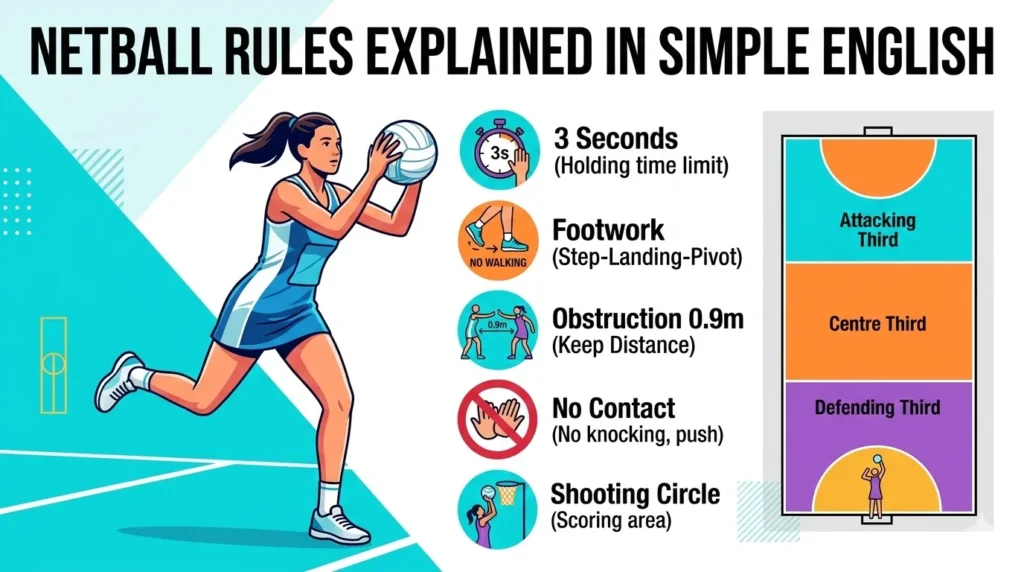
Some of the most important netball rules are very simple. A player with the ball must pass or shoot within 3 seconds, and players are not allowed to run with the ball. They must also follow the footwork rule, which means they cannot move the landing foot illegally after catching the ball.
Another key rule is obstruction. A defender must stay at least 0.9 metres (3 feet) away from the player with the ball. Netball also has a contact rule, which means players cannot push, hold, trip, or make unfair body contact with an opponent.
Only the Goal Shooter (GS) and Goal Attack (GA) can score, and they can only shoot from inside the goal circle. If the ball goes outside the court, it is given to the other team as a throw-in.
How long is a netball game?
A netball game is 60 minutes long, played in 4 quarters of 15 minutes each, with breaks between the quarters and a half-time interval.
Another confusion is normal, because netball is not “basketball without dribbling.” Netball is its own sport with a rule system built around quick passing, fixed positions, controlled footwork, and fair space for defending. Many rules exist for one big purpose: to keep the game fast, skill-based, and safe, while creating clear roles and teamwork patterns.
In this guide, I’ll explain netball rules in easy English, with real match-style scenarios (so you can picture the rules), plus a short history of why these rules exist and what problem each one solves. The information is based primarily on World Netball’s official rule book, plus official rule update documents and major netball organizations.
Entities
World Netball, England Netball, Netball Australia, Commonwealth Games, centre circle, transverse line, goal third, centre third, shooting circle, goal post, ring, net, umpire.
(Primary sources: World Netball rules + official guidance.)
What Is Netball? (Simple Definition)
Netball is a team sport played by two teams of 7 players. The goal is to score by shooting the ball through a ring at each end of the court. The key difference from basketball is how you move the ball:
- In basketball, players often move by dribbling.
- In netball, players mostly move by passing—because once you catch the ball, you must stop and follow strict footwork and timing rules.
Netball’s rules create a unique style:
- Fast passing
- Structured positions (restricted areas)
- Quick shooting from inside the shooting circle
- Defending with space (distance rules)
A Short History of Netball Rules (Why Netball Became Different)
Netball’s story begins with basketball’s early years. Basketball was invented in 1891 by James Naismith. Soon after, versions of the game were adapted for women in ways that reflected the social rules of that time—often limiting contact, movement, and “rough play.” Those early changes influenced what eventually became netball.
How netball became its own sport
In England, at Madame Österberg’s Physical Training College, basketball-style games were adapted over several years. The court became structured, goals became rings with nets, and the sport gained its own identity called “net ball.” Early official rules appeared around the start of the 1900s, and the game spread widely through Commonwealth countries.
Why history matters for understanding modern rules
Some of netball’s most famous rules—like:
- restricted positions,
- limited contact,
- strict footwork,
- and fast ball release,
…all support a game that is:
- team-based, not individual dribble-based
- fast but controlled
- skill-first (passing + timing + movement)
How Netball Is Different from Basketball (Full Comparison)
Netball Court Basics (So the Rules Make Sense)
Before rules, you need the court layout, because many rules depend on where a player is allowed to stand.
A standard netball court is divided into three thirds:
- Goal third
- Centre third
- Goal third
At each end, there is a shooting circle (goal circle). Goals can only be scored from inside this circle.
There’s also a centre circle used for the centre pass.
The Golden Rule of Netball (The One Rule That Changes Everything)
If you only remember one netball rule, remember this:
You must pass or shoot within 3 seconds
A player holding the ball must pass or shoot for goal within 3 seconds. The standard sanction is a free pass to the other team.
Why this rule exists (the “why” behind it)
Without the 3-second rule, a team could slow the game down by holding the ball. The rule forces:
- fast decisions
- quick passing
- constant movement off the ball
- a high-skill game where teamwork matters
Match scenario
Your team wins possession with an intercept. The Wing Attack catches the ball and stops. A defender blocks one pass option. If the Wing Attack panics and holds the ball too long—whistle—held ball. That becomes a turnover and your fast chance disappears.
Can You Dribble in Netball? (Simple Answer + Real Explanation)
Netball is not a dribbling sport like basketball. The game is designed around catching, stopping, pivoting, and passing.
Some beginner-level netball discussions mention “bouncing,” but the key point is this:
- You cannot move up the court the way basketball players dribble.
- The rules and style push you toward passing, not dribbling runs.
Why netball avoids dribble-based movement (history + design)
Netball developed into a sport that highlights:
- team structure
- passing lanes
- timing and space
- controlled contact
If long dribbling runs were allowed like basketball, netball would lose its identity and would become closer to basketball again—especially because the court and position restrictions are built around passing phases.
Netball Court Size, Markings & Layout Explained (Easy Full Guide)
Netball Positions and Their Rules (Who Can Go Where)
Netball has 7 positions:
GS, GA, WA, C, WD, GD, GK
The important part is that each position has restricted areas on the court. This is why netball feels structured and “set-play” heavy.
Why positions are restricted
Restrictions force:
- teamwork and role clarity
- passing through thirds
- balanced attack and defense
- fewer “one player dominates everywhere” moments
Easy position guide (what each one mainly does)
Goal Shooter (GS)
- Main scorer
- Works inside the attacking goal third and shooting circle
- Focus: catching feeds, shooting under pressure
Goal Attack (GA)
- Supports scoring + sets up shots
- Moves between attacking third and centre third (depending on rules format) and can shoot
- Focus: feeds + moving the circle defenders
Wing Attack (WA)
- Specialist feeder
- Helps bring the ball into the attacking third and set up circle entries
- Cannot shoot
Centre (C)
- Link player
- Controls the centre pass, moves the ball between thirds
- Usually has the widest movement range
Wing Defense (WD)
- Blocks feeds and pressures the attack
- Focus: intercepts, forcing turnovers
Goal Defense (GD)
- Defends shooters
- Works around the defensive circle to stop feeds and shots
Goal Keeper (GK)
- Last line of defense
- Battles the GS and protects the goal area
(Exact movement areas depend on the standard netball court rules.)
Netball Equipment: Ball, Net, Uniform & Accessories (Full Guide)
How Scoring Works in Netball (Simple Rules)
Netball scoring rule
A goal is scored when the ball is thrown through the ring from inside the shooting circle.
Key scoring facts
- Each goal = 1 point
- Only allowed shooting players (in standard rules, GS and GA) may shoot
- Shots from outside the circle do not count
Why netball scoring is circle-only (design reason)
Circle-only scoring forces:
- teamwork to create an entry
- skill under close pressure
- clear roles for shooters and feeders
- fewer random long-range scoring attempts (unlike basketball 3-pointers)
Match scenario
It’s the last 10 seconds. Your GA catches the ball just outside the circle. In basketball, a player might shoot anyway. In netball, that shot would not count—so your team must feed into the circle or move the ball to a shooter inside.
The Centre Pass Rule (How Play Starts and Restarts)
The centre pass starts each quarter and restarts after every goal. The centre pass is taken from the centre circle area and is one of the most important “structure rules” in the game.
What the centre pass rule tries to achieve
- A fair restart
- A predictable structure so teams can set up
- A clear contest for possession without chaos
Match scenario
After a goal, the teams reset. The Centre gets ready. The umpire blows the whistle, and now the Centre must obey the footwork rule as they step or pivot for the pass.
The Footwork Rule (Landing, Stepping, and Pivoting) — Explained Simply
Footwork is one of the most common reasons beginners get whistled.
Simple footwork rule
When you catch the ball, you must land correctly and keep control of your landing foot. You can pivot, but you cannot:
- hop on the landing foot,
- drag it illegally,
- or re-step in a way that breaks the landing rule.
Why netball has strict footwork (the “why”)
Footwork rules:
- stop players from running with the ball
- protect fairness (so speed alone doesn’t dominate)
- reduce collisions (players stop instead of charging through space)
- keep the passing rhythm fast and clean
Easy way to picture footwork
Think: catch → stop → pivot → pass/shoot.
Match scenario (classic footwork mistake)
A WA sprints, catches the ball at full speed, and takes an extra step after landing. The umpire calls footwork and awards a free pass.
Special clarification (falling with the ball)
Rule clarifications and FAQs discuss situations like a player falling while holding the ball and then regaining footing; the key idea is that footwork is judged strictly and consistently, including what happens to the grounded foot.
Contact Rules in Netball (What Is Allowed and What Isn’t)
Netball is often described as “non-contact,” but a more accurate beginner-friendly phrase is:
Netball has very strict limits on contact.
What counts as illegal contact (simple)
Illegal contact includes actions like:
- pushing
- holding
- leaning into an opponent
- bumping to move someone out of space
Why netball limits contact (design + safety)
Strict contact rules help:
- keep the sport skill-based
- reduce injury risk
- keep movement patterns cleaner
- make defending about timing and positioning, not force
Match scenario
A GD jumps for an intercept but hits the shooter’s arm. Even if the defender touched the ball, the contact can still be penalized because netball protects clean contesting space.
The Obstruction Rule (Defense Distance: 0.9m / 3 feet) — In Plain English
One of netball’s most famous rules is obstruction, often taught as the “3 feet / 0.9m rule.”
Simple obstruction rule
A defending player cannot stand too close to the player with the ball in a way that prevents them from passing or shooting.
Many coaching resources explain this as: the defender must be at least 0.9m (3 feet) away when defending the ball carrier.
Why obstruction exists
Obstruction rules ensure that:
- a player with the ball has a fair chance to pass
- defenders must use timing and reading, not crowding
- the game stays flowing and skill-based
Match scenario (easy picture)
A GA catches the ball and lifts it to pass. A defender steps too close and waves hands right in the shooter’s face from a short distance. Whistle—obstruction—and the attacker gets a penalty.
Free Pass vs Penalty Pass (And Why It Matters)
These two sanctions are a huge part of netball flow.
Free pass (simple)
A free pass is awarded for many infringements (like held ball/3 seconds, footwork, etc.). The opposing team takes the pass from the spot of the infringement.
Penalty pass (simple)
A penalty pass is often given for contact, obstruction, and similar infringements. The infringing player must stand out of play until the pass is taken (rules vary by level and interpretation, but the core idea is: the attacker gets an advantage and space).
Why netball uses these sanctions
This system keeps the game moving while punishing rule breaks:
- Free pass = “you broke a basic movement/possession rule”
- Penalty pass = “you unfairly affected an opponent (contact/obstruction)”
Replay, Over a Third, and Other “Control of Play” Rules (Beginner-Friendly)
Netball rule books include several control rules that prevent players from gaining an unfair advantage.
Over a third (simple idea)
Netball is structured by thirds, and players have movement restrictions. Some rules prevent illegal movement of the ball or players into areas where they should not be.
Replayed ball (simple idea)
Rule updates and manuals often clarify what a player can do while gaining or re-gaining possession, to keep control consistent and avoid confusion.
(Exact details can be technical; if you want, I can add a separate “Over a Third + Replayed Ball” mini-chapter with diagrams and examples from the rules book.)
Out of Bounds (Out of Court) Rule — Explained with Examples
Simple out of bounds rule
The ball is out when it touches the ground or an object outside the court, or when the player touching it is outside the court. Many official rule manuals state that the line counts as part of the court.
Why out-of-bounds rules matter so much in netball
Because netball is passing-based, many passes are thrown near the side line. The out-of-bounds rule:
- rewards accurate passing
- punishes panic throws
- creates pressure traps near boundaries
Match scenario
Your WD forces the WA toward the side line. The WA receives a pass but lands with a foot outside the boundary. Whistle—out of court—turnover. That’s classic netball defending: use space and boundaries as an extra defender.
How a Typical Netball Attack Works (Switch → Feed → Pivot → Shoot)
If you want to “read” netball quickly, learn this common pattern:
1) Switch
A switch means moving the ball from one side to the other. It is used to:
- change passing angles
- pull defenders out of position
- open the circle entry lane
2) Feed (circle entry)
A feed is the pass into the shooting circle or into a shooter’s best space. This is one of the highest-pressure skills in netball.
3) Pivot
Because footwork is strict, players often:
- catch
- land cleanly
- pivot to protect the ball and select the best option
4) Shoot
Only shots from inside the circle count. So the whole attack is designed to create a high-quality shot in the circle.
Defense in Netball (Man-to-Man Style, But With Space Rules)
Netball defense often looks like man-to-man because each attacker has a clear opponent near them. But netball defending is unique because of:
- obstruction distance
- strict contact rules
- the value of intercepts
Two core defending goals
- Force a bad pass → intercept
- Force a rule break (held ball, footwork) → turnover
Match scenario
A GD doesn’t need to steal the ball every time. If they keep legal distance, block the main passing lane, and make the GA hesitate—3 seconds passes—whistle—turnover.
Rebounds in Netball (What Happens After a Miss?)
Netball has rebounds, but the rebounding “battle” is not the same as basketball’s paint fight.
Why rebounds feel different
Basketball uses a backboard, which changes angles and creates constant rebound contests in the key/paint. Official basketball equipment includes a backboard as standard.
Netball typically has a ring and net without a backboard, so:
- shots don’t rebound off a board the same way
- circle defenders focus more on positioning and timing for rebounds and intercept opportunities
Game Time, Quarters, and Overtime (Simple Explanation)
Many netball formats are played in quarters. If the score is tied in some competitions, there can be extra time.
A famous example is the 2010 Commonwealth Games netball final: New Zealand beat Australia 66–64 after double extra time, and the match is noted as the longest ever official game (84 minutes).
Why that match is a perfect rule example
Because netball is built around:
- controlled possession
- pressure circle entries
- intercepts and turnovers
- structured movement through thirds
…the final became a test of structure and calm decision-making.
Mini Case Study (Match Scenario): The 2010 Commonwealth Games Final Under Pressure
Fact recap: New Zealand defeated Australia 66–64 in double extra time in the 2010 Commonwealth Games final.
What the rules created in that match (simple lessons)
1) Safe ball movement through thirds becomes everything
Under extreme pressure, teams avoid risky passes because one mistake becomes a turnover. The thirds structure supports this “phased” movement.
2) One intercept can swing the game
Because netball is pass-heavy, one intercept can instantly turn defense into attack. In high-stakes finals, intercepts often decide momentum.
3) Circle entry is the biggest pressure point
Since scoring is circle-only, entry passes become the most valuable pass in netball. The more pressure, the more teams rely on disciplined movement and timing.
RNZ coverage of the 2010 final highlights late-game pressure moments and how quickly one out-of-court error can change everything.
Common Beginner Questions (Rules Explained Quickly)
What happens if you hold the ball too long?
Whistle—held ball—free pass to the other team.
What happens if you step or hop after catching?
Whistle—footwork—free pass to the other team.
What happens if a defender is too close?
Whistle—obstruction—penalty (often a penalty pass) to the attacker.
What happens if the ball goes out?
Throw-in / restart to the other team. Out-of-court rules include line/boundary definitions.
FAQs
1) What is the most important rule in netball?
The 3-second rule: you must pass or shoot within 3 seconds.
2) Can you run with the ball in netball?
No. After catching, you must stop and follow footwork rules.
3) Can you dribble in netball like basketball?
No. Netball is designed around passing rather than dribbling up the court.
4) What is obstruction in netball?
Obstruction is when a defender is too close and prevents fair play; many guides explain it using 0.9m / 3 feet distance.
5) What is contact in netball?
Contact is illegal physical interference (pushing, holding, bumping).
6) What is the shooting circle in netball?
The semi-circle area where shots must be taken to score.
7) Who can score in netball?
In standard netball, mainly Goal Shooter (GS) and Goal Attack (GA) can shoot from inside the circle.
8) What happens after a goal in netball?
Play restarts with a centre pass.
9) What is a free pass in netball?
A free pass is awarded for many infringements like held ball and footwork.
10) What is a turnover in netball?
A turnover is when possession changes due to an error, intercept, or rule infringement.
11) Why are netball rules so strict?
They keep the game fast, fair, skill-based, and safer by controlling contact and movement.
12) What was the longest official netball match?
The 2010 Commonwealth Games final is noted as the longest official game (84 minutes), with New Zealand beating Australia 66–64 after double extra time.
“Why You Can Rely on This Guide”
This article is built from:
- World Netball official rules (primary source)
- official 2024 rule update explanations (clarifications)
- major netball organization guidance (beginner-friendly explanations)
- a verified real match example (2010 Commonwealth final)
Conclusion
Netball rules are built to create a sport that is fast, structured, and team-driven. The 3-second rule keeps the ball moving. Footwork rules stop running with the ball and protect fairness. Obstruction and contact rules protect space and reduce heavy collisions. Position restrictions create clear roles and strong teamwork. And circle-only scoring turns every attack into a smart puzzle: move through thirds, find a clean entry, and finish under pressure.
Once you understand these basics—3 seconds, footwork, obstruction distance, circle scoring, centre pass, and turnovers—netball becomes easy to follow and very exciting to watch, because every pass and every intercept can change the match in seconds.

I am a netball writer and match analyst who creates easy, practical guides for beginners and club players. I focuses on netball rules, court markings, and position-based strategy—explaining the “why” behind each rule with real match scenarios and clear examples. When not writing, I follow international netball events and breaks down game patterns like circle entries, intercept setups, and centre-pass plays to help readers understand netball faster.