
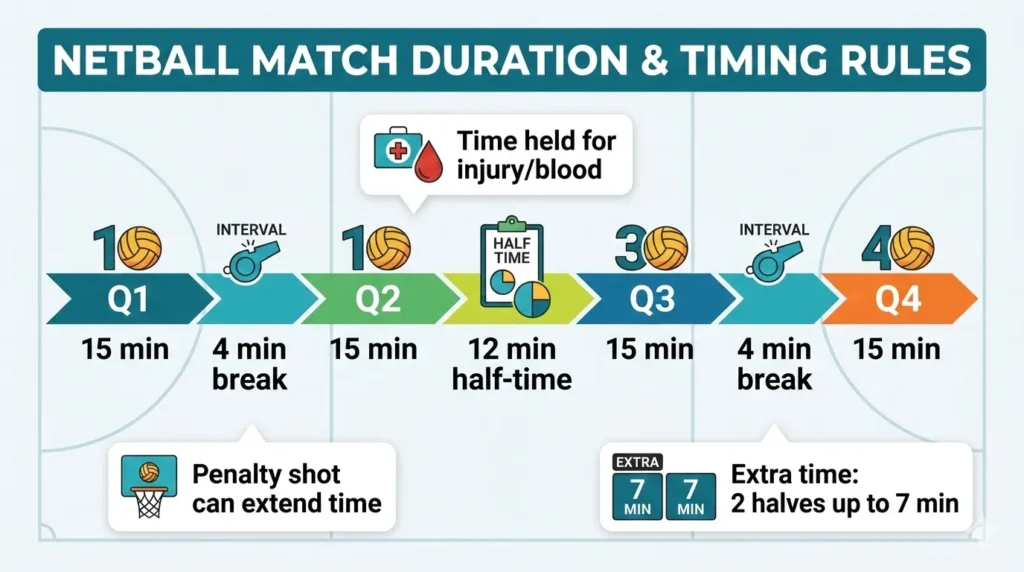
If you’ve ever watched a tight netball game, you know the “clock moments” feel different from many other sports. One late penalty shot, one injury stoppage, or one extra time period can flip the result. That’s why people search “Netball match duration, quarters & timing rules”—they want the exact timings and the real meaning behind them: Why 4 quarters? Why those breaks? When does time stop? What happens if a penalty is awarded at the buzzer?
This guide explains everything in simple English, using the official World Netball Rules (2024 edition) as the main reference.
Netball match duration (standard game length)
Official length: 60 minutes of playing time
Under standard World Netball rules, a match is:
- 4 quarters
- 15 minutes each
- Total = 60 minutes playing time
Official breaks (intervals)
World Netball also sets standard breaks:
- 4 minutes between Quarter 1 and Quarter 2
- 12 minutes half-time between Quarter 2 and Quarter 3
- (Half-time may be 8 minutes if the event organiser and both teams agree)
- 4 minutes between Quarter 3 and Quarter 4
Teams change ends each quarter
Teams swap ends after every quarter.
Why this matters in real matches:
Changing ends affects wind/light in outdoor venues, crowd noise, and even bench communication. That’s one reason netball timing isn’t only about minutes—it’s also about managing momentum across quarters.
Why netball is played in quarters (not one long half)
Netball’s quarter structure is practical and strategic:
1) Player welfare and intensity
Netball is explosive: quick passing, sharp pivots, repeated sprints, constant contesting for space. Quarters + intervals help players recover and reduce fatigue-related errors.
2) Coaching and tactical resets
Between quarters, coaches can quickly adjust:
- defensive match-ups
- circle-entry patterns (feeds into the shooting circle)
- centre-pass set plays
- how to protect possession and reduce turnovers
That’s why you often see teams “win a quarter” even if they don’t win the match.
3) Fairness when conditions change
Switching ends each quarter also improves fairness (especially outdoors) because both teams play under similar conditions across the match.
Quarter-by-quarter timing (what usually happens)
Here’s the common rhythm of a netball match:
Quarter 1: Feeling out the game
Teams usually focus on:
- safe passing lanes
- early intercept pressure
- testing the shooter/defender match-ups
Quarter 2: Tactical pressure rises
You often see:
- faster circle entries
- more intercept attempts
- teams trying to “win the half” before the long break
Quarter 3: The “championship quarter”
After half-time, coaches may change:
- defensive system (tight man marking vs more zone-style help positioning)
- centre-pass structures
- shooting strategies (when to reset vs shoot quickly)
Quarter 4: Clock management and composure
This is where timing rules become most visible:
- slow down safely when leading (without delaying illegally)
- protect possession
- take smart centre passes
- avoid panic passes that cause turnovers
The most important timing rule: quarters must not exceed playing time (with one big exception)
World Netball states a period must not exceed the specified playing time except when a penalty is awarded in the attacking goal circle right before time ends.
The “penalty at the buzzer” rule (super important)
If a team is awarded a penalty pass/shot in its attacking goal circle before the timekeeper signals the end:
- The umpire ends the period with the whistle, but
- Time is extended only to allow the penalty to be taken, including any further infringements at that penalty
Match scenario (easy example):
- 2 seconds left in Q4
- Defender contacts the shooter in the circle
- Umpire awards a penalty shot
- Even if the clock hits 0, the shooter still gets the shot (and any follow-up infringements at that same penalty situation are handled)
Why this rule exists:
It prevents a team from “fouling on purpose” in the last second to steal the clock and avoid a scoring chance.
Latest Netball Rules 2026 Explained in Simple English
Do umpires ever extend an interval?
Yes. An interval may be extended for an emergency.
World Netball also allows umpires to hold time or extend intervals for serious issues (injury to a player or official, court/goalpost/ball issues, weather, technical equipment problems, or other extreme circumstances).
When does time stop in netball?
In netball, the umpire can “hold time,” and the timekeeper pauses the clock.
Time is held for injury/illness and blood
World Netball says umpires must hold time:
- for injury/illness after a verifiable request (or when an injury is obvious/serious)
- when they notice active bleeding/open wound/blood-stained clothing
What happens during a stoppage?
During a stoppage for injury/illness/blood:
- players not being substituted generally remain on court
- teams can make substitutions and/or team changes within the time allowed by the umpires
Who controls the stoppage length?
Umpires and the event organiser decide how long the stoppage lasts in serious cases and ensure play restarts as soon as possible.
Why netball uses this system:
Netball wants the game to be continuous and fair, but player safety must come first—especially with blood rules and concussion protocols.
Netball Positions and Their Roles Explained (GS, GA, WA, C, WD, GD, GK)
Timing rules around substitutions and team changes
Netball timing is closely linked to when you are allowed to change players.
Standard idea
- Most substitutions happen during intervals and stoppages
- In some competitions (like elite leagues), rolling substitutions may exist under competition regulations (not always identical to the base rules)
World Netball’s stoppage procedure notes that substitutions/team changes can occur during an injury/blood stoppage if completed within the allowed time.
Match scenario:
Late in Quarter 4, your shooter rolls an ankle. Time is held. You can:
- substitute a fresh shooter
- adjust defensive match-ups
- reset your centre-pass plan
…but only within the stoppage time window.
Extra time and overtime rules in netball
Not every match uses extra time. It depends on the event organiser (for example, finals often require a winner). World Netball explains that before a match begins, the organiser may advise that extra time will be played if scores are tied at full-time, and they will specify the half length.
Standard extra time structure (World Netball)
If extra time is used:
- 4-minute interval after full-time
- Extra time has two halves of equal length
- Each half must not exceed 7 minutes
- 1-minute half-time interval within extra time
- Teams change ends at extra-time half-time
Who takes the first centre pass in extra time?
The first centre pass in each extra-time half is taken by the team entitled to the next centre pass.
If still tied after extra time: the “two-goal” rule
If the score is still tied after extra time:
- play continues until one team leads by two goals (a visual signal is placed at the official bench to indicate this).
Why the two-goal rule exists:
It avoids endless “golden goal” randomness and ensures the winner proves clear control (score twice ahead) under pressure.
Mini case study: 2010 Commonwealth Games final (timing pressure in real life)
In the 2010 Commonwealth Games netball final, New Zealand beat Australia 66–64 after double extra time.
What this match teaches about timing
- Quarters build pressure: Each break becomes a tactical reset.
- Extra time tests depth: Fitness, bench impact, and calm decision-making matter.
- Centre passes become priceless: In tight endings, one centre pass error can decide the match. World Netball’s technical manual even highlights that centre pass errors commonly happen after stoppages or at the start of quarters—exactly the moments when the clock and restarts feel chaotic.
- Penalty decisions feel bigger: When the game goes long, the value of one penalty shot or one turnover rises sharply.
Even if you don’t watch the replay, the scoreline + double extra time tells you: timing rules aren’t “boring admin”—they shape how champions win.
Timing + restarts: why “centre pass timing” is a big deal
A goal is followed by a centre pass, and centre passes alternate based on entitlement rules. Under pressure, mistakes happen.
World Netball’s Technical Officials Manual warns that a centre pass error can affect the outcome and says these errors often occur:
- after a stoppage immediately following a goal
- at the start of a quarter
Match scenario:
Goal is scored → player gets injured right away → stoppage → teams substitute → play restarts…
This is where teams forget who has the next centre pass. Good technical officials help prevent that.
Scoring System in Netball 2026: How Goals Are Awarded
Why netball timing rules are designed this way (the “why” behind the rules)
1) Keep the game fair
- penalty-at-buzzer extension prevents “foul to kill the clock” behavior
- changing ends each quarter balances conditions
2) Protect player safety
- time held for injury/blood makes safety non-negotiable
- concussion observers and primary care procedures support safer decisions
3) Keep the sport fast and skill-based
Netball’s identity is speed of thought:
- quick passing
- sharp pivot
- structured movement through thirds
Timing rules support that identity by avoiding long dead time and forcing clean restarts.
Netball timing variations (what may change in different formats)
Not every netball match you watch will be 60 minutes. Some formats are designed for TV, festivals, schools, or social leagues.
Fast5 netball (short, TV-friendly format)
Fast5 (a popular variant) uses shorter quarters:
- 4 quarters of 6 minutes
- 1-minute intervals between Q1–Q2 and Q3–Q4
- 3-minute half-time
Fast5 exists to make matches faster and more entertainment-focused (power plays, super shots in some versions, quicker coaching influence).
Domestic/league guidance can repeat the core rules
For example, England Netball domestic guidance repeats the 15-minute quarters and standard intervals from World Netball.
Important note for readers:
Always check the competition regulations (tournament handbook) because organisers can adjust match lengths for scheduling while still following the main rules framework.
“Timing rules” checklist for players, coaches, and viewers
Use this quick checklist to avoid confusion:
- Standard match = 4 × 15-minute quarters
- Breaks = 4 minutes, 12 minutes half-time (or 8 by agreement), 4 minutes
- Teams change ends every quarter
- Umpires hold time for injury/illness and blood
- Penalty in attacking goal circle before time ends → time extends for that penalty
- Extra time (if required) = two halves up to 7 minutes + two-goal rule if still tied
- Centre pass errors often happen after stoppages or at quarter starts—be alert
Common match scenarios (timing + real decision-making)
Scenario 1: Penalty shot as the quarter ends
- Contact in the circle with 1 second left
- Umpire awards penalty shot
- Time is extended until the penalty sequence is completed
Tip: Shooters should slow breathing and use a consistent routine—pressure is highest here.
Scenario 2: Injury after a goal
- Goal scored
- Player goes down immediately
- Umpire holds time
- On restart, centre pass entitlement can get confused (officials often check it)
Scenario 3: Extra time in a final
- Full-time draw
- Short break
- Two short halves
- If still tied, two-goal rule
This is where teams often win by: - protecting possession
- reducing risky cross-court feeds
- pushing intercept pressure without fouling
Short history: how netball became a structured, timed sport
Netball developed from early forms of basketball and was shaped into its own sport in England in the late 1800s/early 1900s, then spread widely through Commonwealth countries. World Netball’s history notes early versions had different team sizes and rules before standardisation.
International standardisation in the modern era helped make global match timing consistent, which is one reason today’s quarter system and extra-time structure are so widely recognised in top competitions.
SEO FAQs
1) How long is a standard netball match?
A standard netball match is 60 minutes, played as 4 × 15-minute quarters.
2) How long is half-time in netball?
Half-time is 12 minutes, but it may be 8 minutes if agreed by the organiser and both teams.
3) How long are quarter breaks in netball?
There are 4-minute intervals between Q1–Q2 and Q3–Q4.
4) Do teams change ends each quarter?
Yes. Teams change ends at the end of every quarter.
5) Does time stop for injuries in netball?
Yes. Umpires hold time for injury/illness (and for blood).
6) What happens if a penalty is awarded as time runs out?
If a penalty is awarded in the attacking goal circle before the time signal, the period is extended so the penalty can be taken.
7) Is extra time always played if the match is tied?
Not always. The organiser decides whether extra time will be used (common in finals).
8) How long is extra time in netball?
Extra time is two halves, each not exceeding 7 minutes, with a 1-minute half-time interval.
9) What if the score is still tied after extra time?
Play continues until one team leads by two goals.
10) What is Fast5 match duration?
Fast5 matches are typically 4 × 6-minute quarters with short intervals and half-time.
11) Who manages the clock in netball?
Timekeepers manage the clock, working with umpires who signal when to hold/start time.
12) Why do centre pass errors happen after stoppages?
Officials note centre pass errors often occur after stoppages following a goal or at quarter starts, so they recommend clear checks.
Conclusion
Netball timing rules are not just “how long the game lasts.” They are a system designed to protect fairness, player safety, and the sport’s fast, skill-based identity. Standard matches run 60 minutes (4 × 15) with set intervals, time can be held for injury/blood, a last-second circle penalty can extend play, and finals may go into structured extra time (and even a two-goal finish).
If you understand these timing rules, you’ll understand why netball endings feel so intense: every restart, every stoppage, and every penalty can decide the match.

I am a netball writer and match analyst who creates easy, practical guides for beginners and club players. I focuses on netball rules, court markings, and position-based strategy—explaining the “why” behind each rule with real match scenarios and clear examples. When not writing, I follow international netball events and breaks down game patterns like circle entries, intercept setups, and centre-pass plays to help readers understand netball faster.