
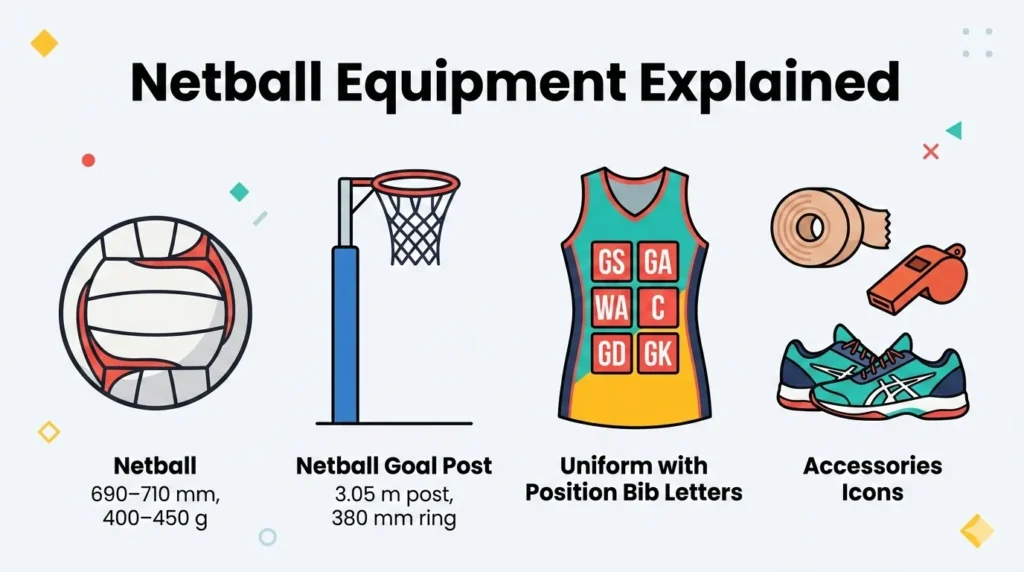
The first time most beginners step onto a netball court, the equipment is what surprises them—not the rules. The ball feels a little different in the hands. The ring has no backboard, so shots don’t “bank” the same way. And the uniform rules are stricter than many sports (no jewellery, short nails, hair tied back).
That’s not random. Netball equipment rules exist to protect player safety, support fair contest, and keep the game fast and clean.
This article explains everything about netball equipment—ball, goalpost & net, uniform, bibs, shoes, protective gear, accessories, plus why each item exists, how it changed over time, and real match situations where equipment rules matter.
In this Guide we will explain all these Terms step by step
Netball Equipment: Ball, Net, Uniform & Accessories
netball ball size and weight, netball ring and net specifications, netball goalpost height, netball uniform rules, netball bib letters, netball shoes, netball accessories, netball jewellery rules, netball fingernails rule
passing, catching, grip, dribbling (one-bounce), pivot, shooting circle, possession, intercept, rebound, turnover, out of bounds, footwork, defence distance, set play, umpires, quarters, overtime, tape, padding, medical devices, player monitoring devices
World Netball, Rules of Netball 2024, goalpost, ring, net, ball circumference, ball inflation, playing position initials (GS/GA/WA/C/WD/GD/GK), match officials/umpires
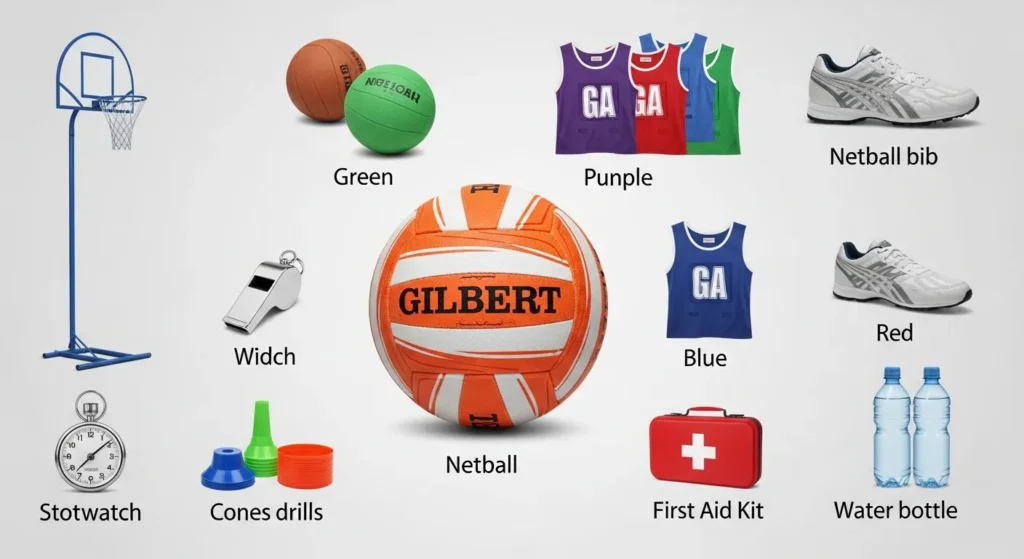
1) Netball Ball (Match Ball Specs + Why It’s Built That Way)
The netball is the single most important piece of equipment. It affects passing accuracy, catching confidence, and shooting control.
Official match ball specifications (World Netball)
According to the Rules of Netball 2024, match balls must:
- be spherical and made of leather, rubber, or suitable synthetic material
- measure 690–710 mm in circumference
- weigh 400–450 g
- be inflated to the pressure specified by the manufacturer
Why netball uses these ball specs
These numbers are not “just tradition.” They support how netball is played:
- Fast passing game: The ball must travel quickly and predictably for clean passing lanes and fewer random bounces.
- One-bounce rule: Netball allows a controlled “bounce once then catch” action, so the ball must behave consistently on different surfaces.
- Safer catching: A ball that’s too heavy increases injury risk and makes catching harder at speed.
Material and grip (practical guide)
Even within official specs, balls differ by surface texture:
- Leather feel: classic grip, often used at higher levels
- Synthetic: durable, all-weather friendly, easier to maintain
Match scenario:
If the ball is wet (outdoor courts, humidity, rain), grip changes. Teams often adjust by:
- using safer, shorter passes
- reducing risky overhead feeds
- focusing on body positioning to protect possession
History of Netball: Origin, Evolution and Timeline Explained
Ball rotation during the match
The Rules of Netball 2024 allow match balls to be rotated throughout the match depending on event rules.
That’s common in competitions so play stays consistent if one ball becomes too slick, damaged, or under-inflated.
Match scenario:
- A ball loses pressure slightly → passes float and timing breaks → more turnovers.
Rotating balls or replacing the ball keeps the match fair.
Official supplier
World Netball’s Rules book notes an official and exclusive ball supplier (Gilbert Netball) in the publication. This doesn’t mean other balls can’t exist in non-WN settings, but it shows that top-level netball is tied to consistent equipment standards.
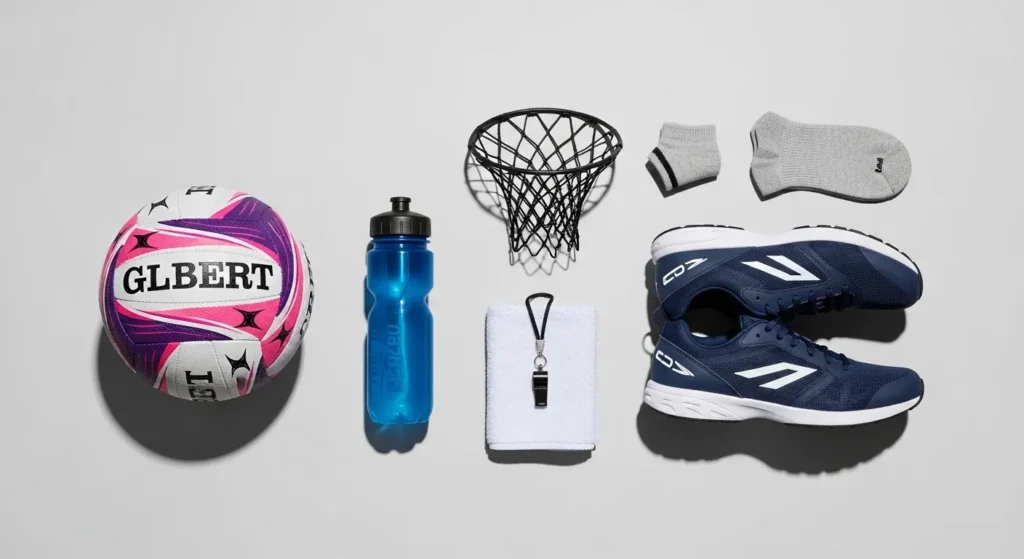
2) Netball Goalpost, Ring, and Net (Exact Specs + Why No Backboard)
Netball goals look simple: post + ring + net. But the exact dimensions matter because scoring happens only in the shooting circle, and a goal is only counted when the ball passes fully through the ring.
Goalpost position
A goalpost is placed at the mid-point of each goal line.
Goalpost height and pole thickness
World Netball’s technical specifications show the goalpost height as 3.05 m (10 ft), and pole diameter typically 65–100 mm.
Why 3.05 m?
This height creates a shooting challenge that rewards:
- controlled release
- timing under pressure
- clean technique (no backboard “bail-out”)
It also keeps netball’s scoring style different from basketball.
Ring dimensions
The ring’s internal diameter is 380 mm (15 in).
World Netball also shows a horizontal bar/connection of 150 mm projecting from the post to attach the ring.
Net length
The net must be clearly visible and open at top and bottom:
- minimum length 380 mm (15 in)
- maximum length 457 mm (18 in)
Why net length matters
A proper net helps:
- confirm a clean goal (ball passes through)
- reduce confusion for umpires and scorers in fast matches
How Netball Is Different from Basketball (Full Comparison)
Why netball has no backboard (history + gameplay)
Early “net ball” grew from basketball variations, but in England it evolved into a different sport—rings with nets, structured zones, and less physical contact.
A backboard would change the sport by:
- increasing “bank shot” scoring
- changing rebounds into a constant battle (more like basketball’s paint game)
- rewarding different shot angles
Netball kept the ring-only scoring style to match its identity: clean feeds + controlled shots rather than heavy rebound wars.
3) Netball Uniform (What You Must Wear + What You Cannot Wear)
Uniform rules are part of netball’s safety and fairness system. The Rules of Netball 2024 list clear requirements.
What players must wear (World Netball)
During a match, players must wear:
- a registered playing uniform (distinct from the opposing team)
- suitable sports footwear that is not spiked
- playing position initials (150 mm high) that are clearly visible and worn above the waist, front and back
The position initials are:
GS, GA, WA, C, WD, GD, GK
Why position initials exist
Netball has fixed roles and movement areas. Visible initials help:
- umpires apply rules quickly (offside areas, correct positioning)
- scorers track play
- players identify match-ups, especially during fast transitions
Match scenario:
Late substitution or confusion at center pass: position initials help umpires catch wrong setups faster.
4) Jewellery, Nails, Hair (Safety Rules That Are Strict for a Reason)
Netball is fast and close. Hands, wrists, and faces are often near the ball. That’s why personal safety rules are strict.
Jewellery and dangerous items
Players may not wear anything that could endanger themselves or others. A key rule summary (also shown in WN uniform guidance) includes:
- No jewellery/adornment (a wedding ring may be allowed only if taped)
- Medical alert bracelet may be worn if covered with tape
- Fingernails must be short and smooth
- Hair must be suitably tied back
Why these rules exist (simple)
- Rings, earrings, bracelets can cause cuts, scratches, or get caught.
- Long nails increase injury risk during contested catches or rebounds.
- Loose hair blocks vision and can cause unsafe contact.
Match scenario:
A defender attempts an intercept; hands collide → jewellery can cause facial injury. Netball prevents that by banning it upfront.
Netball Court Size, Markings & Layout Explained (Easy Full Guide)
5) Position Bibs / Letters (Uniform Accessory That Runs the Whole Game)
Even if your league uses bibs (instead of printed uniforms), the goal is the same: clear position identity.
Why bibs matter
Bibs help:
- avoid confusion when teams wear similar colors
- keep position visible for umpires
- support quick decisions during set plays, especially around the shooting circle
Practical tip:
Choose bibs with:
- bold, high-contrast letters (GS/GA/…)
- strong straps that don’t twist
- breathable fabric for outdoor heat
6) Footwear (Netball Shoes + Why Spikes Are Not Allowed)
World Netball requires suitable sports footwear and bans spiked shoes.
Why netball footwear matters more than people think
Netball is stop-start:
- sprint → sudden stop → pivot → jump → land
That is intense on ankles and knees.
What “good netball shoes” should support
- strong lateral support (side-to-side movement)
- grip for sudden stops
- cushioning for repeated jumps/landings
- stable heel counter to reduce ankle rolling
Match scenario:
A Wing Defence (WD) changes direction to cut a passing lane—bad shoes = slip = late contest = easy feed into circle.
7) Protective Gear and Accessories (What’s Allowed + What Needs Covering)
Netball allows some accessories, but only if they don’t create danger.
Allowed (with conditions)
Medical devices
Medical devices may be worn if they are securely covered with tape and/or padding.
Player monitoring devices
Player monitoring devices (like GPS/heart-rate tech) may be worn if secured within the playing uniform.
Tape and padding
Tape/padding is commonly used for:
- finger support
- ankle support
- protecting dermal piercings (when removal is not possible)
World Netball’s uniform guidance discusses dermal piercings and religious bracelets needing suitable covering for safety.
Not allowed
Communication devices
No communication devices may be worn.
This protects fair play and keeps coaching within rules.
8) Head Coverings, Long Sleeves, Leggings (Inclusion + Safety)
World Netball uniform guidance explains that head coverings (like hijabs) are acceptable for religious reasons—provided they are safe:
- soft material
- no metal pins
- secured (no loose/flapping edges)
It also permits long sleeves/tights/leggings/trousers for religious reasons if:
- they match uniform color closely
- they aren’t excessively loose
Why these rules were implemented
Netball has roots as a women-focused sport that has evolved toward inclusivity. The modern approach aims to:
- remove barriers to participation
- still protect safety (no pins, no loose material)
9) Umpires’ Equipment Responsibilities (What They Check Before Play)
In netball, umpires don’t just blow the whistle. They also help ensure the match starts safely and fairly.
World Netball uniform guidance notes that it’s part of match officials’ responsibility to check players meet uniform requirements (like no jewellery).
The Rules also specify players’ required uniform items (initials, footwear, etc.).
Match scenario:
A player forgets to tape a ring or has long nails. If not corrected before start, it can lead to stoppages or penalties later. Good pre-check avoids conflict and keeps the match smooth.
10) Equipment and Real Match Situations (Examples You Can Add for EEAT)
Here are common match moments where equipment rules show their value:
Scenario A: Slippery ball and more turnovers
- Outdoor humidity or rain → ball becomes slick → catching errors increase.
- Teams adjust to shorter passes, safer angles, and more controlled feeds.
This connects directly to why balls can be rotated during matches.
Scenario B: Confusing positions on a quick restart
- After a goal, netball restarts quickly.
- Clear position initials/bibs reduce confusion and help umpires manage correct setups.
Scenario C: Injury prevention (nails, jewellery, hair)
- Contested catches + rebounds (ball rebounds from goalpost is allowed)
- Hands collide, faces close to arms → jewellery and long nails become a real injury risk
- That’s why rules are strict and checked pre-game.
Scenario D: Safe inclusion (headscarves/leggings)
- Rules allow religious clothing but require it to be secured and safe (no pins, no loose edges).
11) A Short History: How Netball Equipment Evolved (Why It Looks Like This Today)
Netball traces back to early basketball development. Over time, it became its own sport with different court structure, movement rules, and equipment choices.
Key evolution points that shaped equipment:
- Moving from baskets to rings with nets helped confirm goals clearly and suit outdoor play.
- Keeping no backboard preserved a clean scoring style and reduced “bank shot” dependence.
- Strong uniform safety rules grew from netball’s emphasis on player safety and controlled contact.
12) Quick Buying Guide (Ball, Net, Uniform, Accessories)
If you’re buying equipment for school, club, or home practice, use this simple checklist.
Netball ball (practice vs match)
- Match-grade: within 690–710 mm circumference and 400–450 g weight
- Practice: choose the same size for skill consistency
- Always check manufacturer inflation pressure
Post + ring + net
- Height around 3.05 m
- Ring internal diameter 380 mm
- Net length 380–457 mm
Uniform
- Clear team colors
- Position initials 150 mm high, front and back, above waist
- Non-spiked shoes
Accessories
- Tape (ankle/finger) and safe padding
- No jewellery; nails short; hair tied back
- Secure any medical items properly
FAQs
What size is an official netball?
Official match balls measure 690–710 mm in circumference and weigh 400–450 g.
Does netball have a backboard?
Usually no. Netball uses a ring and net without a backboard, which changes shooting style and rebounds.
Are players allowed to wear jewellery in netball?
No, jewellery is generally not allowed because it can be dangerous. Some items (like a wedding ring) may be permitted only if properly covered/taped, and medical alert items may be allowed if taped.
Why do netball players wear position letters?
Because netball has fixed positions and court areas. Letters help umpires and players identify roles quickly.
What shoes should you wear for netball?
Wear non-spiked sports shoes with strong lateral support for quick stops, pivots, and jumps. World Netball bans spiked footwear.
Conclusion
Netball equipment is not just “gear”—it’s part of the sport’s identity. The official ball size and weight support fast, accurate passing. The goalpost, ring, and net specs create fair and clear scoring without a backboard. And uniform rules (position initials, safe footwear, no dangerous items) exist to protect player safety and keep the game clean, fast, and fair.
When you explain netball equipment to readers, always connect it to real play: possession, intercepts, circle feeds, and safe contest. That’s what makes the article feel expert and truly useful.

I am a netball writer and match analyst who creates easy, practical guides for beginners and club players. I focuses on netball rules, court markings, and position-based strategy—explaining the “why” behind each rule with real match scenarios and clear examples. When not writing, I follow international netball events and breaks down game patterns like circle entries, intercept setups, and centre-pass plays to help readers understand netball faster.