
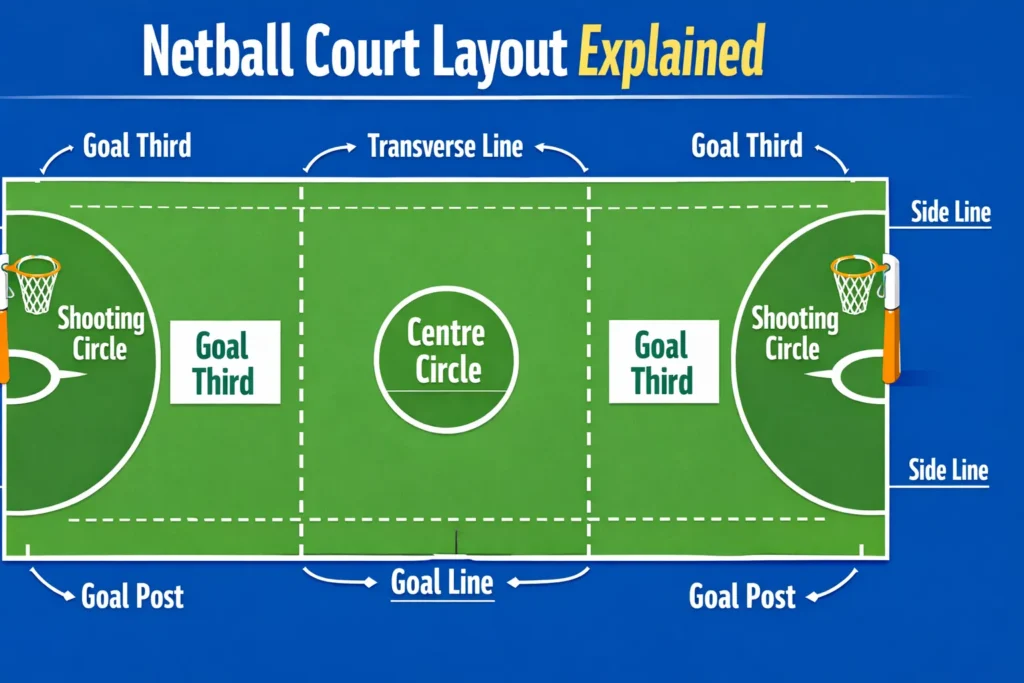
A netball court may look simple, but its lines and zones control the whole game. The court is designed for fast passing, quick pivots, and clear attacking/defending areas—especially the shooting circle. In this guide, you’ll learn the exact netball court size, every major marking, and how the layout connects to real gameplay (possession, intercepts, turnovers, out of bounds, set plays, and more).
Sources used: World Netball (official) rules and facilities guidance.
Netball Court Size (Official Measurements)
A standard netball court is:
- Length: 30.5 m (100 ft)
- Width: 15.25 m (50 ft)
The long lines are called side lines, and the short lines are called goal lines.
Court thirds (the 3-zone layout)
Two lines (called transverse lines) divide the court into three equal thirds:
- Goal third (one end)
- Centre third (middle)
- Goal third (other end)
This “thirds” design is a big reason netball is a passing-first sport (you build attacks through space rather than dribbling).
Netball Court Markings (Every Line You Must Know)
1) Side lines and goal lines (the court boundary)
- If the ball touches the line or goes outside it, it is out of bounds.
- Possession changes using a throw-in (rules depend on the exact situation).
These boundary lines define the playable area and make width management important for set plays and safe passing lanes.
2) Transverse lines (divide the court into thirds)
These two lines create the three-thirds structure.
Why it matters:
- It helps control player movement by position (who can enter which third).
- It shapes team tactics: quick passing chains, switching sides, and creating intercept chances.
3) Centre circle (the restart control point)
There is a centre circle in the middle of the court:
- 0.9 m (3 ft) in diameter
It’s used for the centre pass and helps structure restarts cleanly.
4) Goal circles / shooting circles (where goals can be scored)
At each end is a semi-circle called the goal circle (also known as the shooting circle):
- Radius: 4.9 m (16 ft)
- The centre point is the midpoint of the outside of the goal line.
This marking is the heart of scoring and is why netball feels different from basketball’s “shoot from anywhere” style.
5) Line width (important detail many articles miss)
For official courts, the lines are typically:
- 50 mm (2 in) wide
- Lines are part of the court (so touching a line counts as “on court” for many decisions).
Netball Court Layout (Simple Walkthrough)
Picture the court from one goal to the other:
- Goal line at the end + goal post in the middle of it
- A large shooting circle (semi-circle) drawn around the post
- A goal third (space between goal line and the nearest transverse line)
- Transverse line
- Centre third with the centre circle in the middle
- Transverse line
- The other goal third
- The other shooting circle and goal line
All this is designed so teams must advance the ball by passing and smart movement, not by continuous dribbling like basketball.
Goal Post, Ring, and Net (Equipment Specs)
On each goal line, there is a goal post:
- Post height: 3.05 m
- Ring diameter: 380 mm
- Net attached to the ring
These equipment specs are widely stated in official-style facility guides and sport references.
Key comparison entity (basketball): Basketball uses a backboard; netball typically does not, which changes rebound angles and shot style.
How Netball Is Different from Basketball (Full Comparison)
Netball Court Markings Table (Quick Study)
| Marking | What it is | Measurement | Why it matters in play |
|---|---|---|---|
| Side lines | Long boundaries | 30.5 m sides | Out of bounds + width for passing |
| Goal lines | Short boundaries | 15.25 m ends | Goalpost location + out of bounds |
| Transverse lines | 2 lines across court | 3 equal thirds | Controls zones + set plays |
| Centre circle | Middle circle | 0.9 m diameter | Centre pass control |
| Goal/shooting circle | Semi-circle at each end | 4.9 m radius | Only scoring area |
| Line width | Thickness of lines | 50 mm | Lines count as part of court |
Passing Sport (Instead of Dribbling Up the Floor)
Netball is designed to move the ball mainly by passing, not by one player dribbling up the court like basketball.
Why passing becomes the “main engine”
- 3-second rule (Held ball)
In netball, the player with the ball must pass or shoot within 3 seconds. That rule alone forces quick passing because you don’t have time to hold the ball and “build a dribble attack.” - No dribble travel style
Even if a player bounces the ball, netball is not built for “dribble and run.” The whole attack is built around:
catch → stop → pivot → pass (and quickly).
What this changes in real play (important NLP keywords)
- You see more short passes, give-and-go movement, and quick feeds.
- Teams protect possession by choosing safe passing lanes.
- A bad pass becomes a quick turnover because defenders are waiting for intercepts.
More Set Play Structure (Thirds + Shooting Circle)
Netball court markings create structure—it’s not “free roaming” like basketball.
The court is built for planned movement
- The court is split into three thirds (goal third, centre third, goal third).
- Scoring only happens inside the goal circle / shooting circle (a semi-circle).
Why this produces “set plays”
Because you must move the ball through thirds and finally into the shooting circle, teams naturally use:
- patterned passing (planned sequences)
- switches (moving the ball from one side to the other)
- timed cuts to lose defenders
- rehearsed circle entries (how the ball is fed into the shooting circle)
This is why netball often looks like a series of organized phases, rather than basketball’s frequent “drive and kick” or “fast break dribble” style.
History of Netball: Origin, Evolution and Timeline Explained
More Value on Intercepts (Breaking Passing Lanes)
In netball, defenders can’t rely on heavy contact. Instead, they win the ball mainly by:
- reading the play
- cutting passing lanes
- timing jumps and hands
Why intercepts are so valuable in netball
Since the ball must move by passing, every pass is a chance for the defense:
- If the pass is slow, high, or predictable, it becomes an intercept.
- One intercept often becomes instant attack because teams are already positioned by thirds.
“Defense distance” and clean defense
Netball also has strict rules about how a defender can challenge the ball carrier without interfering illegally—especially the 0.9 m (3 ft) concept used in obstruction/interference context.
So defenders become experts at:
- staying legal (distance + no interference)
- still applying pressure by anticipation
- forcing risky passes → turnovers
Clear Attack/Defense Transitions (Winning Possession = Quick Entry Attempts)
Netball transitions are often very clear:
- you win possession (intercept, rebound, opponent error)
- you immediately try to move the ball through the thirds
- you push for a quick entry into the shooting circle
Why transitions feel “fast” even without dribbling
Netball can look slower because there’s less dribble-running, but transitions are fast because:
- the ball travels faster through the air than a dribble
- players spread into their zones quickly
- teams use a quick centre pass structure and passing patterns
The biggest “moment” in transitions: circle entry
The pass into the shooting circle is often the most pressured pass in netball, because:
- it’s the final gate before a shot
- defenders set traps around the circle edge
- one mistake near the circle becomes a high-value turnover
What Is Netball? A Beginner’s Guide to the Netball Sport & Game
Less “Paint Battle” Than Basketball (Clean Feeds vs Rebound Wars)
Basketball’s key area is called the key/paint because teams constantly fight there for:
- rebounds
- post position
- close-range shots
- physical screens and box-outs
Netball is different:
- there’s no basketball-style backboard system that creates the same rebound angles and constant “paint battles”
- netball focuses more on clean feeds into the shooting circle and quick shots from controlled positions
So instead of nonstop paint wrestling, netball’s key contest becomes:
- who wins the space inside/around the shooting circle
- who times their lead and feed better
- who forces errors and intercepts at the circle edge
(For contrast: basketball equipment and backboard structure is defined in FIBA equipment/rules documents.)
Why Netball Strategy Often Looks Like: Switch → Feed → Pivot → Shoot
This is the classic netball attacking chain:
1) Switch
The ball is moved from one side to the other (a switch) to:
- change the angle
- move defenders
- open a new passing lane
2) Feed
A feed is the smart entry pass toward the shooting circle—usually timed with a cutter’s movement.
3) Pivot
Because of netball’s stopping and landing control, the ball carrier often uses a clean pivot to:
- protect the ball
- face a new passing option
- line up a safe feed
(World Netball rules emphasize controlled play with clear limits and movement rules.)
4) Shoot
The shot can only be taken inside the shooting circle, so the whole attack is built to create a clean look there.
Basketball contrast: fast break dribble drive
In basketball, a common pattern is:
steal → dribble sprint → fast break layup / kick-out three
Because dribbling and free movement allow one player to carry the attack. Netball doesn’t work like that.
Mini Case Study: Court Layout Under Pressure (2010 Commonwealth Games Final)
What happened (verified)
In the 2010 Commonwealth Games netball final, New Zealand beat Australia 66–64 after double extra time. The match lasted 84 minutes (extremely long for an official netball match).
Why this match proves court markings matter
1) Teams rely on safe ball movement through thirds
Because the court is divided into thirds and player movement is structured, teams must keep the ball safe while progressing. Under pressure, this becomes even more obvious.
2) One intercept or forced turnover in the centre third can decide everything
The centre third is like the “control room” of netball:
- it connects defense to attack
- it’s where many risky passes happen under pressure
- an intercept here instantly turns into attack momentum
That’s why top teams value defenders who can read and jump passing lanes legally.
3) Entry passes into the shooting circle become the highest-pressure moment
Because scoring is only possible in the shooting circle, that final feed is the “make-or-break” action.
- If the feed succeeds → high chance of a shot
- If it fails → painful turnover right near scoring range
What the scoreline + extra time tells you (even without replay)
A tight 66–64 double-extra-time final shows:
- both teams defended circle entries well
- possession mattered a lot
- structure and discipline beat “random play”
This is netball’s identity: space, control, and timing—forced by the court layout.
Common Mistakes on Court Markings (Easy Fix Guide)
Mistake 1: Out of bounds confusion (line is part of the court)
What people do wrong:
Players think “touching the line is safe.”
Correct understanding:
In netball, if the ball or a player in possession is judged outside the boundary, it’s out of bounds and becomes a turnover/throw-in situation. Always treat the boundary like a wall: stay clearly inside.
Easy fix:
Train your feet: “One step inside the side line” when receiving passes near the edge.
Mistake 2: Circle entry timing (feeding too early or too late)
What people do wrong:
They throw the ball into the shooting circle when the shooter is not ready, or when defenders are set.
Why it fails:
Circle entry is the highest-pressure pass. Defenders are waiting for a predictable feed to intercept it.
Easy fix (simple coaching tip):
- Look for the shooter’s front cut or clear lead
- Feed to space, not to the defender
- Use a quick switch first if one side is blocked
(Scoring rules + circle structure are defined in World Netball rules.)
Mistake 3: Centre pass misunderstanding (where players can stand)
What people do wrong:
Players crowd the centre circle or stand in illegal places at the restart.
Why it matters:
The centre pass has strict positioning rules (who can enter the centre third and where the ball starts). Poor setup can cause immediate turnovers or lost timing.
Easy fix:
Before every centre pass, quickly check:
- Are you in your allowed third?
- Is the ball being started from the correct place?
- Are you giving safe passing angles?
(World Netball rules cover centre pass procedures and positioning.)
Mistake 4: Confusing the goal circle with the goal third
What people do wrong:
Some beginners think entering the goal third means they can shoot.
Correct understanding:
You can only score from inside the goal circle (shooting circle), not anywhere in the goal third.
Easy fix:
Remember: Third = area to build attack. Circle = area to score.
Mistake 5: Footwork near lines (catching while moving)
What people do wrong:
They catch near the side line while running and step out immediately.
Easy fix:
Practice “catch + stop + pivot” near the boundary. This protects possession and reduces turnovers.
(Footwork rules are detailed in World Netball rules.)
(3) Netball Court Diagram Description
A standard netball court is a rectangle divided into three equal thirds by two transverse lines. In the middle is a small centre circle used for the centre pass. At each end, a semi-circular shooting circle surrounds the goal post. The long boundary lines are the side lines, and the short boundary lines are the goal lines. Only shots taken from inside the shooting circle count as goals, which is why teams focus on safe passing through the thirds and clean circle entries.
FAQs
1) What is the standard netball court size?
A standard netball court is 30.5 m long and 15.25 m wide.
2) What are the “thirds” in netball?
The court is divided into three equal thirds: two goal thirds and one centre third, separated by transverse lines.
3) What is the netball shooting circle (goal circle)?
The shooting circle (goal circle) is the semi-circle at each end where scoring happens. Only shots taken from inside this circle count as goals.
4) What is the radius of the netball shooting circle?
The standard goal circle radius is 4.9 m (16 ft).
5) How big is the centre circle in netball?
The centre circle is 0.9 m in diameter (3 ft).
6) Can you step into the shooting circle if you are not a shooter?
In standard netball, only certain positions can enter the shooting circle. If a non-allowed position enters, it is usually called an offside (rules depend on the competition format).
7) What happens when the ball goes out of bounds in netball?
When the ball goes out of bounds, the other team gets the ball back with a throw-in from the side line or goal line area where it went out.
8) What is the 3-second rule in netball?
A player holding the ball must pass or shoot within 3 seconds. If not, it becomes a turnover (often called “held ball”).
9) How high is a netball goal post?
The goal post height is 3.05 m (10 ft).
10) Does netball use a backboard like basketball?
No, netball goals typically have a ring and net but no backboard, which changes shooting and rebound angles compared to basketball.
11) Why does netball have so many court markings?
Netball markings create structure: thirds control movement, the centre circle controls restarts, and the shooting circle controls scoring. This keeps the game focused on passing and positioning.
12) Is a netball court the same as a basketball court?
No. A netball court has thirds + shooting circles, while a basketball court has features like the key/paint, backboard, and 3-point arc. Court size standards also differ by rule set.
Netball Court Markings Checklist
Use this checklist to confirm your court is marked correctly and to help beginners learn the layout fast.
A) Court size and boundaries
- ✅ Court length is 30.5 m and width is 15.25 m.
- ✅ Two long boundary lines are labeled/understood as side lines.
- ✅ Two short boundary lines are labeled/understood as goal lines.
- ✅ Everyone knows the ball is out of bounds if it goes outside the boundary lines.
B) Thirds (structure of the court)
- ✅ Two transverse lines divide the court into three equal thirds.
- ✅ The middle is the centre third.
- ✅ Each end is a goal third.
C) Centre circle (restart area)
- ✅ The centre circle is in the middle of the court.
- ✅ Centre circle diameter is 0.9 m.
- ✅ Players understand centre pass setup happens around this area (and within allowed thirds).
D) Shooting circles (where scoring happens)
- ✅ Each end has a goal circle / shooting circle (semi-circle).
- ✅ Shooting circle radius is 4.9 m.
- ✅ Players know: goals only count from inside the shooting circle.
E) Goal post setup (quick equipment check)
- ✅ One goal post is placed at the center of each goal line.
- ✅ Ring and net are securely attached and safe. (Specifications vary by facility standards, but the goal is typically 3.05 m high in standard references.)
Glossary
Goal line: The boundary line at each end of the court (where the goal post is placed).
Side line: The long boundary line on each side of the court.
Out of bounds: When the ball (or player in possession) goes outside the boundary lines; play restarts with a throw-in.
Transverse line: The line that cuts across the court to make the three thirds.
Centre third: The middle third of the court; a key area for transitions and intercepts.
Goal third: The third of the court nearest each goal; where attacks build toward the circle.
Centre circle: Small circle in the middle where the centre pass is taken; diameter 0.9 m.
Goal circle / Shooting circle: Semi-circle at each end; only place you can shoot and score. Radius 4.9 m.
Circle edge: The curved boundary line of the shooting circle—often where defenders set traps for intercepts.
Circle entry (feed): The pass into the shooting circle that creates a scoring chance.
Possession: Which team has control of the ball.
Turnover: When possession changes because of an error, intercept, or rule break.
Intercept: When a defender catches or deflects a pass to win possession.
Conclusion (Netball Court Size, Markings & Layout)
Netball court markings are not just “lines on the floor”—they control the entire game style. The three-thirds layout forces teams to build attacks through safe passing, the centre circle organizes restarts, and the shooting circles create the biggest pressure moments because scoring can only happen there. When you understand the court—goal lines, side lines, transverse lines, centre third, goal thirds, centre circle, and shooting circles—you understand why netball looks so tactical: switch → feed → pivot → shoot.
If you’re learning, coaching, or writing about netball, always link the markings to real gameplay: protecting possession, creating clean circle entries, and winning the ball with smart intercepts and forced turnovers. For official reference and accuracy, follow World Netball’s rules and facilities guidance.

I am a netball writer and match analyst who creates easy, practical guides for beginners and club players. I focuses on netball rules, court markings, and position-based strategy—explaining the “why” behind each rule with real match scenarios and clear examples. When not writing, I follow international netball events and breaks down game patterns like circle entries, intercept setups, and centre-pass plays to help readers understand netball faster.