
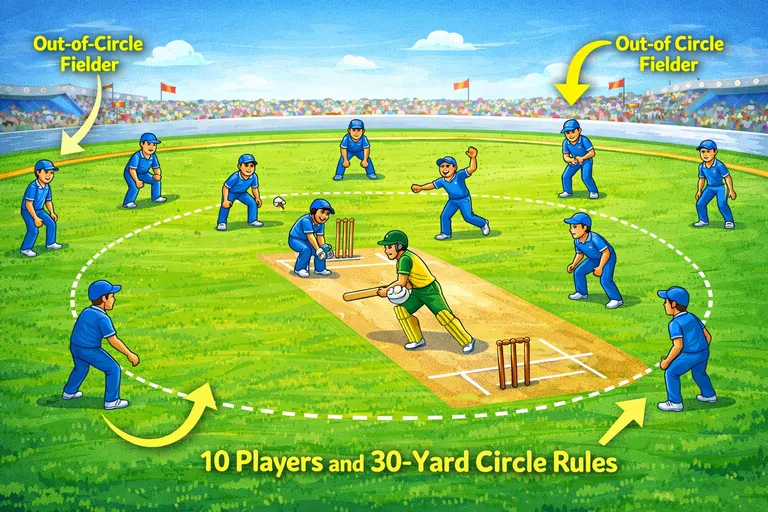
In international cricket, a match is normally played with 11 players on each side. If one player is off the field, the team can still field with fewer players, but T20 and ODI fielding limits must still be followed. Test cricket does not use the same circle rule as white-ball cricket.
You are watching a cricket match. One player gets hurt and goes off the field. Now a question comes into your mind: can the match still go on? If yes, how many players are needed? And if a team is fielding with only 10 players, where does the missing fielder count from? Is he counted from inside the circle or from the boundary side?
This question confuses many new fans because cricket has different rules for T20, ODI, and Test matches. The good news is that the rule becomes easy once you break it into small parts.
In this guide, you will learn:
- how many players are needed to start a match,
- how many fielders can be on the ground,
- what happens if one player is missing,
- how circle rules work in T20 and ODI,
- why Test cricket is different,
- and what penalties can happen to the player or the team. These points come from the current ICC playing conditions for international cricket and the MCC Laws of Cricket.
Quick Answer
At the international level, a cricket match is normally played between two teams of 11 players each. In ODI and T20I cricket, each captain also names up to 4 substitute fielders before the match. In Test cricket, each captain names up to 6 substitute fielders.
If one player goes off the field, the team can still keep fielding with fewer players for a time, because the laws define a fielder as one of the “11 or fewer” players on the field. So yes, a team can field with 10 players if needed.
But there is one big rule to remember:
The missing player does not automatically count as a circle fielder or a boundary fielder.
The captain places the remaining fielders where he wants, but the team must still follow the fielding limits of that format. In T20 and ODI, the number of fielders outside the circle has a maximum limit. In Test cricket, there is no same powerplay circle rule.
Also Read More About: Cricket Helmet Rules for Fielders and Wicketkeepers: Full Detailed Guide
Fast Rules Table
| Format | Normal team size | Substitute fielders named before match | Outside-circle rule | If one player is missing |
|---|---|---|---|---|
| T20I | 11 | Up to 4 | Powerplay: max 2 outside, later max 5 outside | Still legal to field with 10, but outside-circle limits stay the same |
| ODI | 11 | Up to 4 | Overs 1–10: 2 outside, 11–40: 4 outside, 41–50: 5 outside | Still legal to field with 10, but outside-circle limits stay the same |
| Test | 11 | Up to 6 | No ODI/T20-style circle limit | Still legal to field with 10, but on-side behind popping crease rule still applies |
These format rules come from the current ICC playing conditions.
How Many Players Are Needed to Start a Cricket Match?
International cricket
In international cricket, the standard rule is simple: a match is played between two sides, each of 11 players. That is the normal starting point for T20I, ODI, and Test cricket.
So, if you are asking:
“At international level, what is the minimum to start?”
The normal answer is:
11 players per side.
Domestic, club, and local cricket
Domestic cricket can be more flexible. The MCC Laws say a match may be played with fewer than 11 players if there is an agreement or if the competition rules allow it. The same law also says that not more than 11 players may field at one time, and if a side drops below its original number during the match, the game should continue if it still can.
That means in local or domestic cricket, the exact minimum can depend on league rules. One tournament may allow a reduced team. Another may not.
Easy example
Think of it like this:
- International cricket: fixed and strict, start with 11.
- Domestic cricket: can be flexible if that competition allows it.
Also Read More About: Five Penalty Runs in Cricket (2026): Full Rule Explained with Real Match Stories
How Many Fielders Must Be on the Ground?
This is where many people get confused.
The laws do not give one simple line like “you must always have at least 10 fielders on the field.” Instead, the laws define a fielder as one of the “11 or fewer” players representing the fielding side on the field of play.
That means if one player is off the field, the team may still field with 10 players for a while. If a legal substitute comes on, that substitute can fill the place. If not, the team may simply be short by one person.
So the easy answer is:
A team can field with 10 if one player is off.
But the team is then weaker, and it must still follow all format rules about where fielders may stand.
Also Read More About: Player Leaving the Field in Cricket: Full Rules for Injury, Substitutes, Return, and Penalty Time
If a Team Has Only 10 Fielders, Where Does the Missing Fielder Count From?
The answer is:
The missing player does not “count” from one fixed place.
He is not automatically treated as:
- an inside-circle fielder, or
- an outside-circle fielder.
Instead, the captain sets the remaining fielders wherever he wants, as long as the team does not break the format’s fielding limits.
Very simple way to understand it
The rule does not say:
“If one fielder is missing, remove one from the circle.”
And it also does not say:
“If one fielder is missing, remove one from the boundary.”
It only says how many fielders are allowed at most in certain places.
So the captain can choose where to feel the shortage.
T20 Rule in Simple English
In T20 cricket, the fielding side has outside-circle limits.
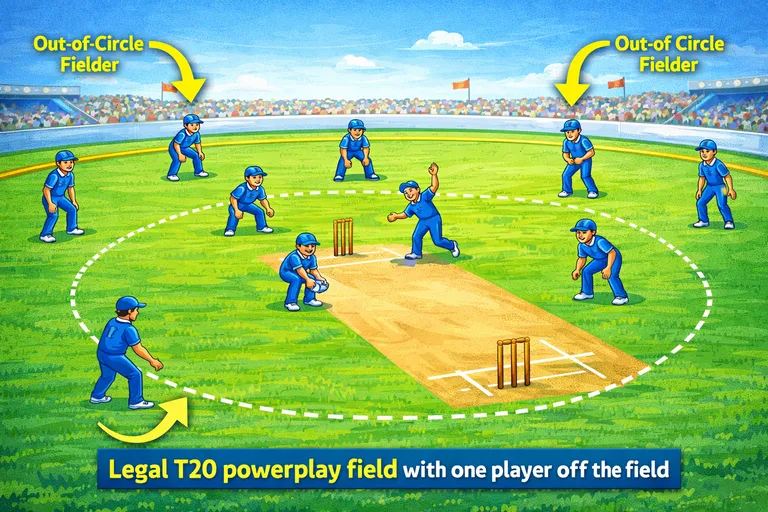
During the powerplay, only 2 fielders may stand outside the 30-yard circle. After the powerplay, no more than 5 fielders may stand outside the circle. T20 rules also say there cannot be more than 5 fielders on the leg side at the instant of delivery, and no more than 2 fielders other than the wicketkeeper may stand behind the popping crease on the on side.
If the team has only 10 players on the field in T20
The team still must obey the same limit.
That means:
- in the powerplay, max 2 can be outside the circle,
- after the powerplay, max 5 can be outside the circle.
The missing player does not change those limits.
Easy T20 example
Team A is fielding in over 3 of a T20 match. One player has gone off because he got hurt. Now Team A has only 10 players on the field.
The captain can do this:
- 2 fielders outside the circle,
- the rest inside.
That is legal.
But if the captain puts 3 fielders outside the circle in the powerplay, that is illegal.
Penalty in T20
If the fielding side breaks the T20 fielding restriction, the umpire calls No-ball. In T20, the ball after any No-ball is a free hit. The rules also say the field may then be changed if the No-ball happened because of a fielding restriction breach.
ODI Rule in Simple English
ODI cricket has three phases for outside-circle fielders:
- Overs 1 to 10: max 2 outside the circle
- Overs 11 to 40: max 4 outside the circle
- Overs 41 to 50: max 5 outside the circle
ODI rules also keep the same basic placement limits:
- not more than 5 fielders on the leg side,
- not more than 2 fielders other than the wicketkeeper behind the popping crease on the on side.
If the team has only 10 fielders in ODI
The same idea applies.
The team still follows the phase rules.
So:
- in over 8, max 2 outside
- in over 25, max 4 outside
- in over 47, max 5 outside
The missing player is not counted from one side. The captain chooses how to place the 10 fielders, but he must stay inside the legal limit.
Easy ODI examples
Example 1: Over 6
One fielder is off the ground. The team has 10 players on the field. The captain puts 2 men on the boundary and keeps the others inside. This is legal.
Example 2: Over 24
Again the team has 10 fielders. The captain puts 4 outside the circle and 4 inside, with the bowler and wicketkeeper in their normal places. This is legal.
Example 3: Over 48
The captain uses 5 boundary fielders. That is also legal in this phase.
Penalty in ODI
If the fielding side breaks ODI fielding restrictions, the square-leg umpire calls No-ball. In ODI cricket, the next ball after any No-ball is a free hit, and the field may be changed to fix the breach.
Test Match Rule
Test cricket is different from ODI and T20.
Test playing conditions do not use the same outside-circle powerplay system. Instead, one of the main fielding position limits is that at the instant of delivery, there cannot be more than two fielders, other than the wicketkeeper, behind the popping crease on the on side. If that rule is broken, the umpire calls No-ball.
What this means in simple words
In Test cricket:
- there is no ODI/T20-style “max 2 outside in powerplay” rule,
- there is no same outside-circle setup to worry about,
- but there are still some field placement limits.
So if one player is missing and the team is fielding with 10, there is no question of “should the missing fielder be counted inside the circle or outside the circle,” because that white-ball circle rule does not apply in the same way.
Easy Test example
A fast bowler gets a cut finger and leaves the field for treatment. His team now has 10 fielders.
The captain may still set:
- slips,
- gully,
- point,
- cover,
- mid-off,
- mid-on,
- square leg,
- fine leg.
That is fine if the on-side-behind-the-popping-crease rule is still respected. But if the captain places 3 fielders behind square on the on side in the wrong way and breaks that limit, the umpire can call No-ball.
Can a Substitute Fielder Come On?
Yes. The laws say the umpires shall allow a substitute fielder if a player has been injured, become ill during the match, or has another wholly acceptable reason. But a substitute may not bowl, may not act as captain, and may keep wicket only if the umpires allow it.
This is why many times a team does not stay at 10 for long. A substitute can come on and do the fielding work.
Simple example
A player runs into the boundary rope and hurts his ankle. He leaves the field. A substitute fielder comes in. The team is back to 11 bodies on the field, but the substitute still cannot bowl.
What Happens If a Player Stays Off the Field Too Long?
This is where penalty time comes in.
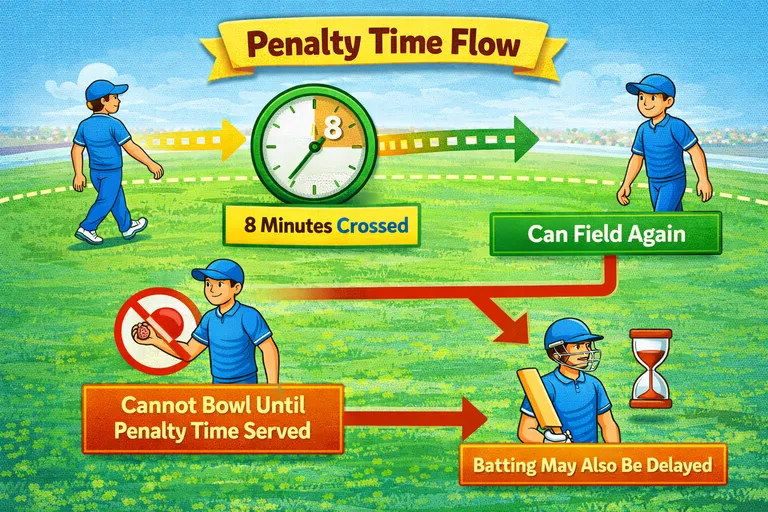
If a player is absent from the field for more than 8 minutes, future limits may apply to that player. In T20, the player may not bowl until he has served the same amount of playing time, and the maximum unserved penalty time is 40 minutes. The player also may not bat until the same amount of playing time has passed in his team’s innings, although he may bat immediately once 5 wickets are down.
In ODI and Test cricket, the same idea applies, but the maximum unserved penalty time is 120 minutes instead of 40. The player cannot bowl until that time is served, and cannot bat until the same time has passed in the innings, although he may bat once 5 wickets have fallen.
Easy example
A bowler leaves the field for 20 minutes in an ODI because of a problem that does not fall into the “no penalty” group. When he comes back, he may field, but he cannot bowl right away. He must first serve the needed penalty time.
When Is Penalty Time Not Given?
A player’s absence does not automatically bring penalty time in every case.
ODI and T20 playing conditions say penalty time is not incurred if:
- the player suffered an external blow during the match,
- the umpires think the reason was otherwise wholly acceptable,
- or the player was off for 8 minutes or less.
The rules also say that illness or internal injury is not automatically included in the “wholly acceptable reasons” group.
So in simple words:
- hit by ball and goes off: maybe no penalty time,
- short absence: maybe no penalty time,
- long absence for internal problem: penalty time may apply.
What If a Player Comes Back Without Umpire Permission?
This can become costly.
The rules say a player who has left the field may not return during a session of play without the umpire’s consent. If that player comes back without permission and touches the ball while it is in play:
- the ball becomes dead,
- No-ball or Wide is signaled if needed,
- the batting side gets 5 penalty runs,
- completed runs can still count,
- and the ball does not count in the over.
Easy example
A fielder runs back onto the ground too early, without the umpire saying yes, and stops the ball near the rope. That is a big mistake. The batting team can get 5 penalty runs.
Can a Team Be Forced to Field Short?
Yes, in some cases.
The MCC Laws say a player can be removed or suspended for serious misconduct, and in some serious conduct cases no substitute is allowed. That can leave a team short in the field. The laws also provide for 5 penalty runs in serious player conduct situations.
So a team may be short not only because of injury, but also because of discipline trouble.
International Rule vs Domestic Rule
Here is the easiest way to see the difference.
International cricket
- Standard start: 11 players each side
- ODI/T20I: up to 4 named substitute fielders
- Test: up to 6 named substitute fielders
- A side may temporarily field with fewer players if someone is off the field
- T20 and ODI outside-circle rules still stay in force
- Test uses different field placement rules
Domestic cricket
- Can be more flexible
- A match may be played with fewer than 11 if rules or agreement allow
- Still, no more than 11 may field at one time
- If a side is reduced during the match, play can continue if possible
The One-Line Rule New Fans Should Remember
If a team is fielding with 10 players, the missing player is not automatically taken from the circle or from the boundary.
The captain places the 10 players where he wants.
He just must stay inside the legal fielding limits of that format:
- T20: powerplay max 2 outside, later max 5
- ODI: 2 outside, then 4, then 5 by phase
- Test: no same white-ball circle rule, but other field placement rules still apply.
Conclusion
Cricket looks hard from the outside, but this rule is actually simple.
At the international level, matches start with 11 players per side. If one player goes off, the team can still field with fewer players for a time, or use a legal substitute. In T20 and ODI, the captain still has to obey the outside-circle limits. In Test cricket, the game does not use the same powerplay circle rule. And if a player stays off too long or comes back without permission, there can be real penalties.
So the simplest final answer is this:
A team can field with 10, but the rules of the format still control where those 10 can stand.
FAQ Section
1) Can an international cricket match start with 10 players?
Normally, no. International cricket is played with 11 players per side. Domestic cricket can be different if rules allow it.
2) Can a team field with 10 players?
Yes. A team can field with fewer than 11 if one player is off the field. The laws define a fielder as one of the 11 or fewer players on the field.
3) In T20, if one fielder is missing, does he count inside the circle?
No. The missing player does not count from one fixed place. The captain places the remaining fielders, but the team must still keep within the legal outside-circle limit.
4) In ODI, can a team keep 5 fielders on the boundary in the powerplay?
No. In overs 1 to 10 of an ODI, only 2 fielders may be outside the circle.
5) In ODI over 25, how many fielders can be outside the circle?
In overs 11 to 40, the fielding side may have up to 4 fielders outside the circle.
6) In ODI over 48, how many fielders can be outside the circle?
In overs 41 to 50, up to 5 fielders may be outside the circle.
7) Does Test cricket use the same circle rule as ODI and T20?
No. Test cricket does not use the same ODI/T20 outside-circle powerplay system.
8) Can a substitute fielder bowl?
No. A substitute fielder may not bowl and may not be captain. He may keep wicket only with the umpires’ consent.
9) What happens if a player stays off the field too long?
If the absence is more than 8 minutes, penalty time can apply. The player may not bowl right away, and batting can also be delayed.
10) What is the maximum penalty time in T20?
In T20, the maximum unserved penalty time is 40 minutes.
11) What is the maximum penalty time in ODI and Test?
In ODI and Test cricket, the maximum unserved penalty time is 120 minutes.
12) What happens if a player comes back without umpire permission and touches the ball?
The ball becomes dead, the batting side gets 5 penalty runs, and the ball does not count in the over.

Isabella Brooks is a sports content writer with a strong interest in cricket rules and match regulations. She simplifies technical laws, umpiring decisions, and gameplay conditions into engaging explanations. Her writing helps casual fans follow matches with confidence and clarity.