
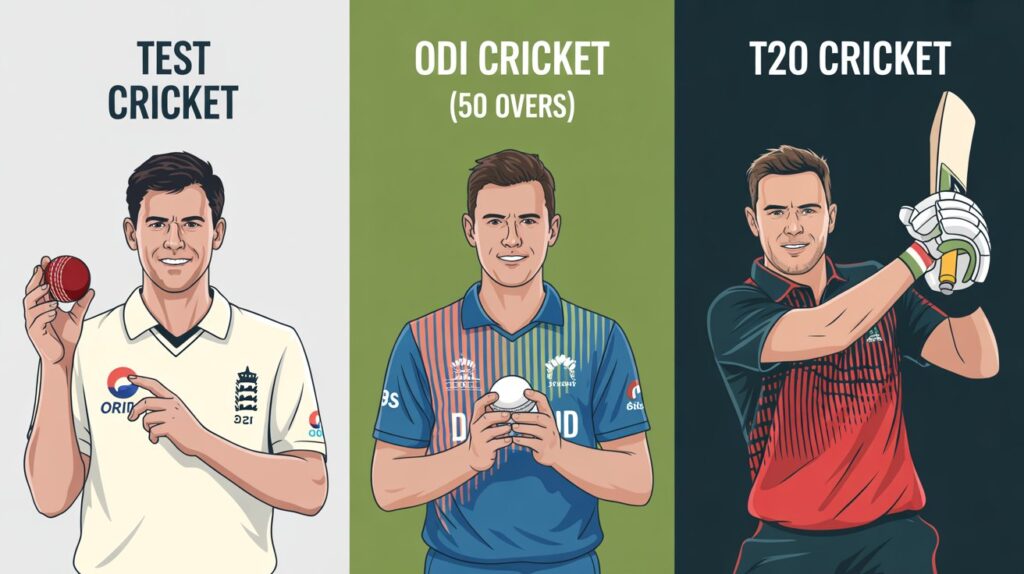
Cricket is more than just a sport—it’s a tradition, a passion, and a global phenomenon. Over the years, the game has evolved into three main formats: Test cricket, One Day Internationals (ODIs), and Twenty20 (T20s). Each format comes with unique rules, strategies, and excitement, catering to different audiences and playing conditions.
This guide gives you a complete overview of Test, ODI, and T20 formats, including their rules, structure, powerplays, overs, and playing conditions—so you can understand cricket like a pro.
🏏 Test Cricket – The Ultimate Test of Skill and Patience
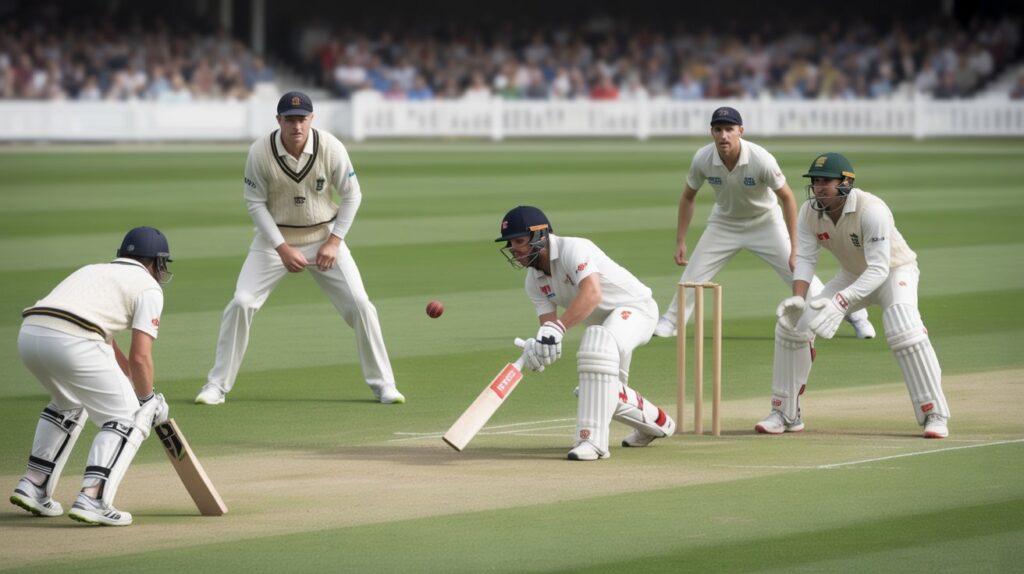
Test cricket is the oldest and most traditional form of the game. Known as the “purest format,” it tests players’ endurance, skill, and strategy over several days.
Key Features of Test Cricket Rules:
- Match Duration: Played over 5 days.
- Innings: Each team gets two innings (batting & bowling twice).
- Overs: No fixed limit—teams bat until they are all out or declare.
- Ball Used: A red ball is used, which behaves differently throughout the day.
- Session Structure: Three sessions per day (morning, afternoon, evening).
- Draws & Results: Matches can end in a win, loss, draw, or tie.
Test Match Rules in Detail:
- Follow-on Rule: If the team batting second is behind by 200+ runs, the other team may enforce a follow-on, making them bat again immediately.
- Bowler’s Limit: No restriction on the number of overs a bowler can bowl.
- Fielding Restrictions: Minimal compared to limited-overs formats.
- Review System (DRS): Teams can challenge umpire decisions using technology.
🏏 One Day Internationals (ODIs) – Balance Between Tradition and Speed
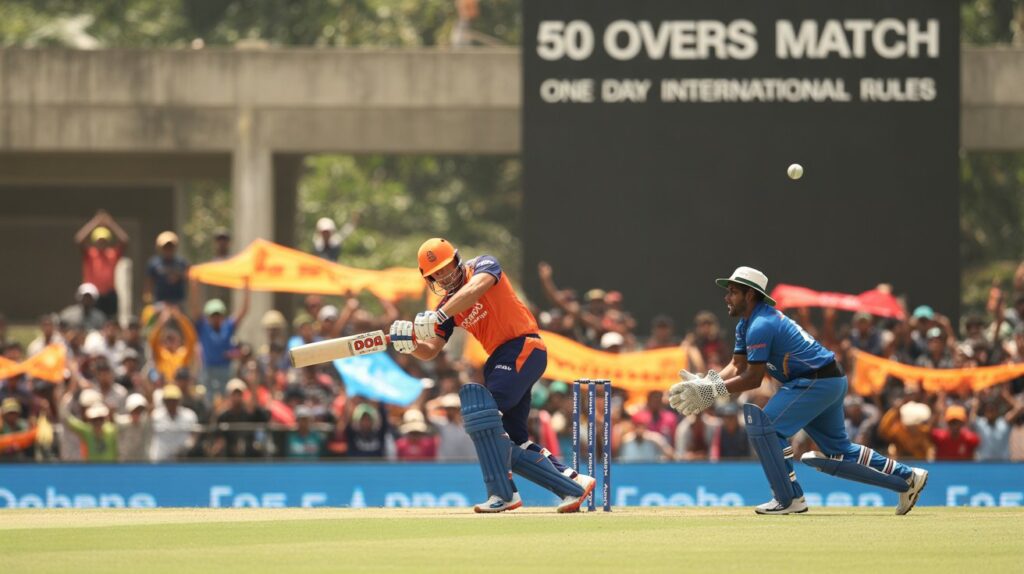
One Day Internationals (ODIs) offer a shorter, fast-paced version of cricket while keeping the strategic depth alive.
Key Features of ODI Rules:
- Match Duration: Each game lasts one day (~7–8 hours).
- Overs: Each team plays a maximum of 50 overs.
- Ball Used: White ball (two balls used, one from each end).
- Innings: Each team bats once.
- Result: The team with the higher score at the end of 50 overs wins.
ODI Match Rules in Detail:
- Bowler’s Limit: Each bowler can bowl a maximum of 10 overs.
- Fielding Restrictions (Powerplays):
- First 10 overs (Mandatory Powerplay): Only 2 fielders allowed outside the 30-yard circle.
- 11–40 overs (Middle Overs): Maximum 4 fielders outside the circle.
- 41–50 overs (Death Overs): Maximum 5 fielders outside the circle.
- Tied Matches: Some tournaments use Super Over to break ties.
🏏 Twenty20 (T20) – The Entertainment Format
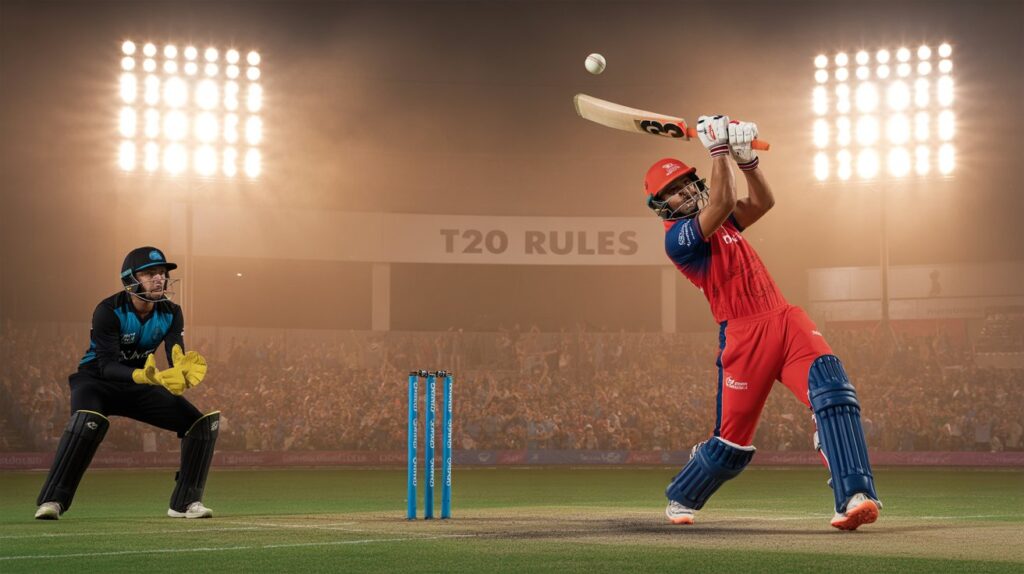
T20 cricket is the most fast-paced and entertainment-driven format, designed for fans who enjoy thrill and quick results.
Key Features of T20 Rules:
- Match Duration: Around 3–4 hours.
- Overs: Each team plays a maximum of 20 overs.
- Ball Used: White ball (one for the whole innings).
- Innings: Each team bats once.
- Result: The team with the higher score wins—no room for draws.
T20 Match Rules in Detail:
- Bowler’s Limit: Each bowler can bowl a maximum of 4 overs.
- Fielding Restrictions (Powerplays):
- First 6 overs (Powerplay): Only 2 fielders outside the 30-yard circle.
- 7–20 overs: Maximum 5 fielders outside the circle.
- Tiebreakers: Matches tied are decided by a Super Over.
- Time Restriction: Teams must complete their 20 overs within 90 minutes.
- Entertainment Factor: Known for big sixes, cheerleaders, music, and packed stadiums.
⚖️ Comparison Table – Test vs ODI vs T20
| Feature | Test Cricket | One Day Internationals (ODI) | Twenty20 (T20) |
|---|---|---|---|
| Match Duration | 5 days | 1 day (7–8 hours) | 3–4 hours |
| Overs | Unlimited | 50 per side | 20 per side |
| Innings | 2 per team | 1 per team | 1 per team |
| Ball Used | Red ball | White ball (2 balls) | White ball (1 ball) |
| Bowler’s Limit | No limit | 10 overs | 4 overs |
| Powerplays | None | 3 stages (10-30-10 overs) | First 6 overs only |
| Result Options | Win, loss, draw, tie | Win, loss, tie (Super Over) | Win, tie (Super Over) |
📸 Image Prompt for Ideogram:
A professional infographic comparing Test, ODI, and T20 formats with icons of a red ball, white ball, stopwatch, and cricket field diagrams.
What are the main differences between Test, ODI, and T20 cricket?
- Test Cricket: Played over 5 days, unlimited overs, red ball, traditional and strategic.
- ODI Cricket: Limited to 50 overs per side, 2 white balls, powerplays, balanced pace.
- T20 Cricket: Limited to 20 overs per side, fast-paced, entertainment-focused, tie resolved by Super Over.
FAQs About Cricket Formats
Q1. Which cricket format is the longest?
👉 Test cricket, lasting up to five days.
Q2. How many overs are there in ODI cricket?
👉 50 overs per side.
Q3. What is the powerplay rule in T20 cricket?
👉 First 6 overs allow only 2 fielders outside the 30-yard circle.
Q4. Why is the red ball used in Test matches?
👉 It maintains shine longer, helps with swing, and suits long-format play.
Q5. What happens if an ODI match is tied?
👉 Depending on the tournament, it can either stay tied or be decided by a Super Over.
Q6. Can a Test match end without a winner?
👉 Yes, if both teams don’t complete their innings within 5 days, it’s a draw.
Q7. Which format is most popular with younger fans?
👉 T20 cricket, because it’s short, exciting, and fast-paced.
Q8. How many balls are used in an ODI match?
👉 Two new white balls are used—one from each end of the pitch.
🎯 Conclusion
Cricket’s three main formats—Test, ODI, and T20—offer something for everyone.
- If you love tradition, patience, and deep strategy, Test cricket is for you.
- If you want a balanced format with excitement and endurance, ODIs are the perfect choice.
- If you’re after thrill, entertainment, and quick results, T20 cricket delivers unmatched action.
No matter the format, one thing remains constant: cricket unites millions of fans worldwide through passion, competition, and unforgettable moments.

Daniel Foster is a senior sports writer specializing in cricket laws and international playing conditions. With extensive experience covering ICC rules, domestic leagues, and tournament regulations, he delivers detailed yet easy-to-read explanations. His work is trusted by readers looking for accurate and up-to-date sports rules.