
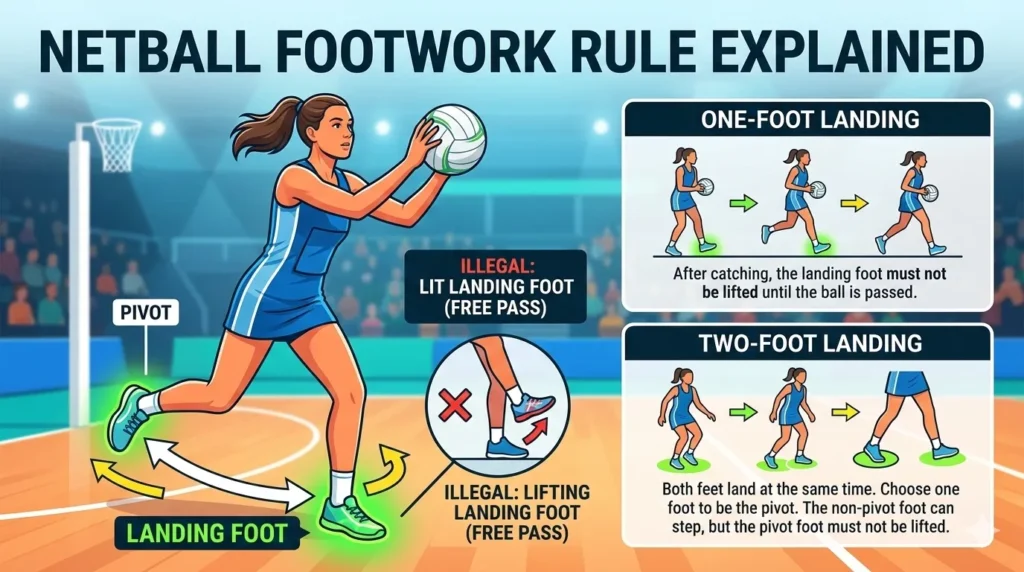
If you’ve ever played your first netball match, you know this moment: you catch a perfect pass, get excited… and the umpire blows the whistle for footwork (stepping). It feels unfair because you weren’t trying to cheat—you were just trying to balance, stop, and look for a pass.
That reaction is exactly why people search “Footwork rule in netball explained with examples.” The user intent is clear: you want to know what counts as stepping, how to use your landing foot, how to pivot legally, and how to avoid common mistakes—especially in real match pressure.
In simple words, the netball footwork rule exists to keep netball a passing sport, not a dribbling/running sport. It forces players to stop, control their body, pivot, and pass—fast and safely.
Official source used: World Netball Rules of Netball
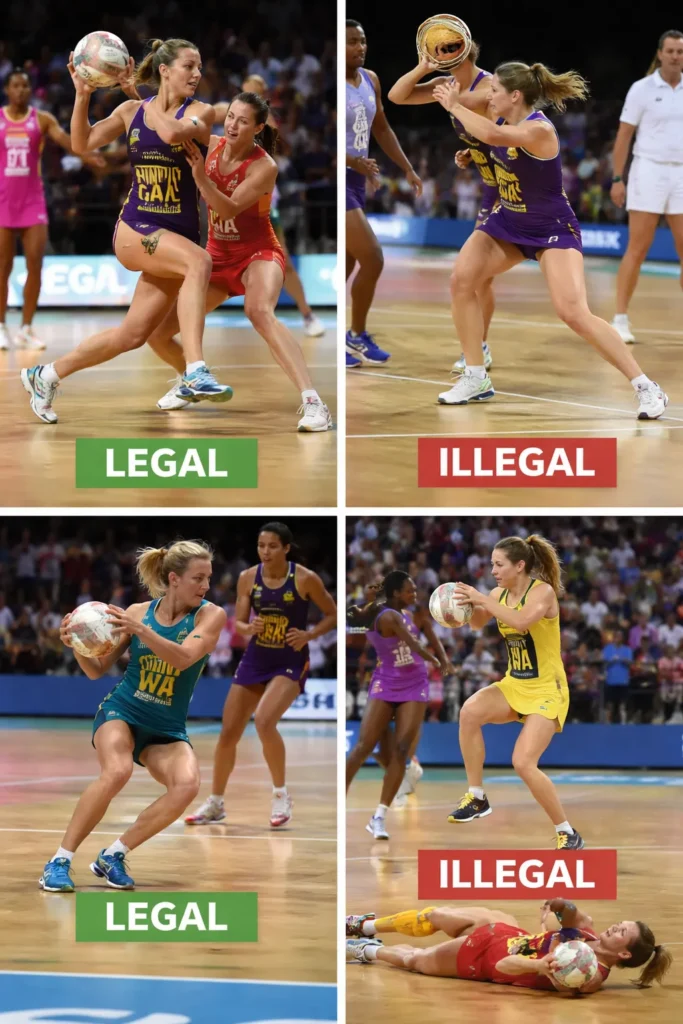
What Is the Footwork Rule in Netball?
The footwork rule controls what you can do with your feet after you catch the ball.
The main idea
When you catch the ball:
- You must stop and control your landing
- You may pivot and reposition
- But you cannot keep stepping or reground your landing foot after lifting it (depending on your landing type)
If you break footwork rules, the sanction is a free pass to the other team.
Why netball has this rule (history + purpose)
Netball was designed as a sport where you advance the ball mainly by passing (not dribbling like basketball). The footwork rule:
- stops players from “running with the ball”
- keeps the game fast and skill-based
- reduces heavy contact and collisions by forcing controlled stops
- supports fair play and clear umpiring decisions
This is why netball strategy often looks like:
catch → stop → pivot → pass (instead of dribble-drive).
Latest Netball Rules 2026 Explained in Simple English
Key Terms You Must Understand (Landing Foot, Pivot, Stepping)
Landing foot
Your landing foot is the foot that becomes your “control foot” when you receive the ball (especially in a one-foot landing).
Pivot
A pivot means turning your body by rotating on one foot to face a new direction. Pivoting is legal—stepping extra is not.
Stepping (footwork infringement)
Stepping is when you move your feet in a way that breaks the legal landing rules. Umpires usually call this footwork.
Rule 13.3 Footwork: The Official Structure (World Netball)
World Netball explains footwork in three main parts:
- One-foot landing
- Two-foot landing
- Other foot movements you may NOT do
All are under Rule 13.3 (Footwork) in the 2024 rules.
One-Foot Landing Rule (With Simple Examples)
What is a one-foot landing?
A one-foot landing happens when:
- you already have one foot on the ground when you catch, OR
- you catch the ball in the air and land on one foot first
World Netball then lists what you may do after a one-foot landing.
Netball Positions and Their Roles Explained (GS, GA, WA, C, WD, GD, GK)
What you ARE allowed to do (one-foot landing)
After landing on one foot, you may:
A) Step with the second foot, lift the landing foot, and pass/shoot before re-grounding it
Easy example:
- You catch the ball and land on your right foot (right = landing foot).
- You step forward with your left foot.
- You lift your right foot slightly to turn your hips.
- You pass before your right foot touches the floor again. ✅ Legal
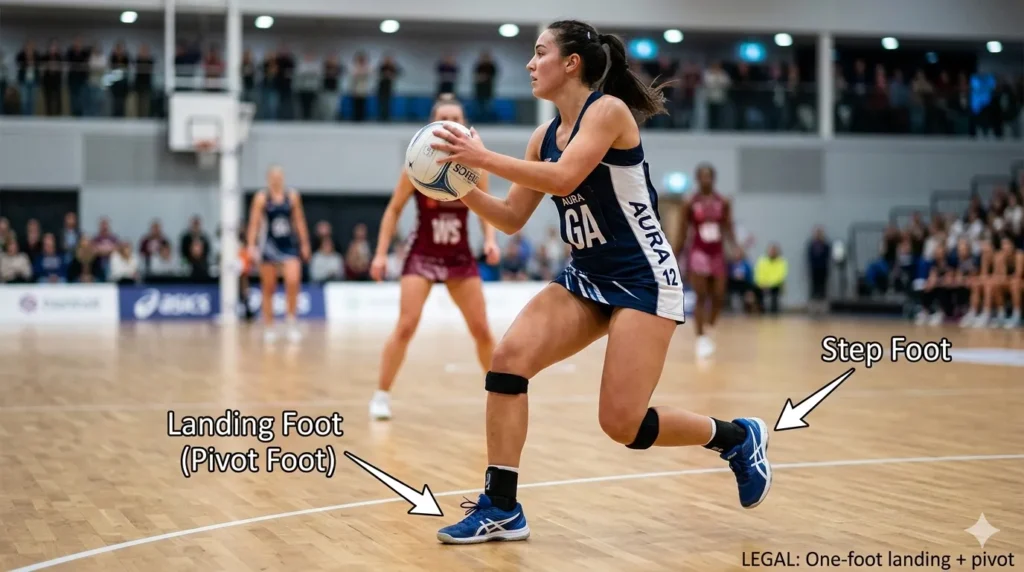
B) Pivot on the landing foot and step with the other foot one or more times
Easy example:
- Land on right foot.
- Keep right foot as your pivot.
- Step around with left foot to find space. ✅ Legal
C) Jump patterns are allowed—BUT you must release the ball before re-grounding in a way that breaks the rule
This part is why netball sometimes looks like “quick hop-turn-pass” under pressure.
Scoring System in Netball 2026: How Goals Are Awarded
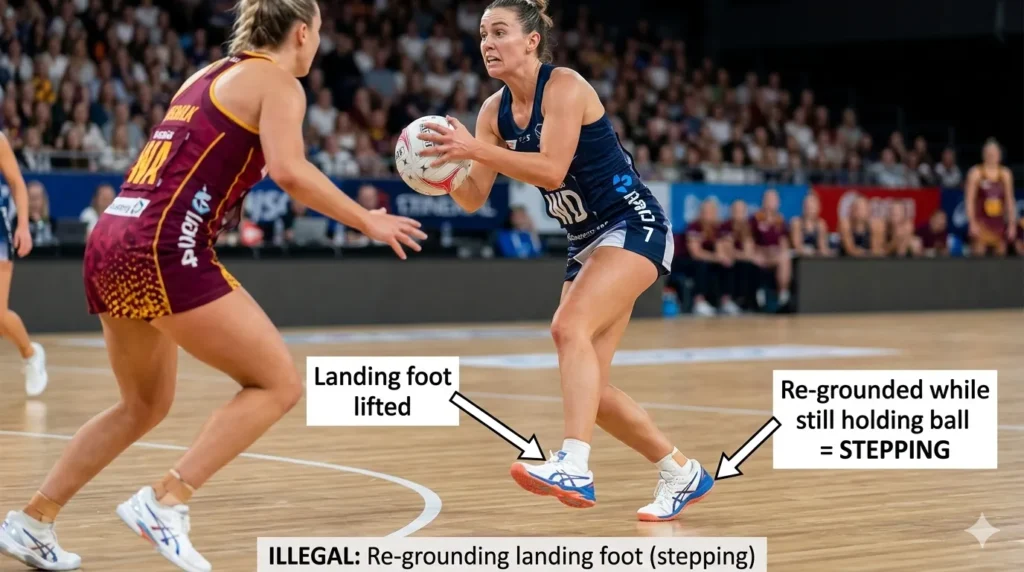
The most common one-foot landing mistake
Mistake: You lift the landing foot and put it down again while still holding the ball.
That is classic stepping → free pass.
Two-Foot Landing Rule (With Simple Examples)
What is a two-foot landing?
A two-foot landing happens when:
- you receive the ball with both feet on the ground, OR
- you catch the ball in the air and land on both feet at the same time
World Netball lists what you may do next.
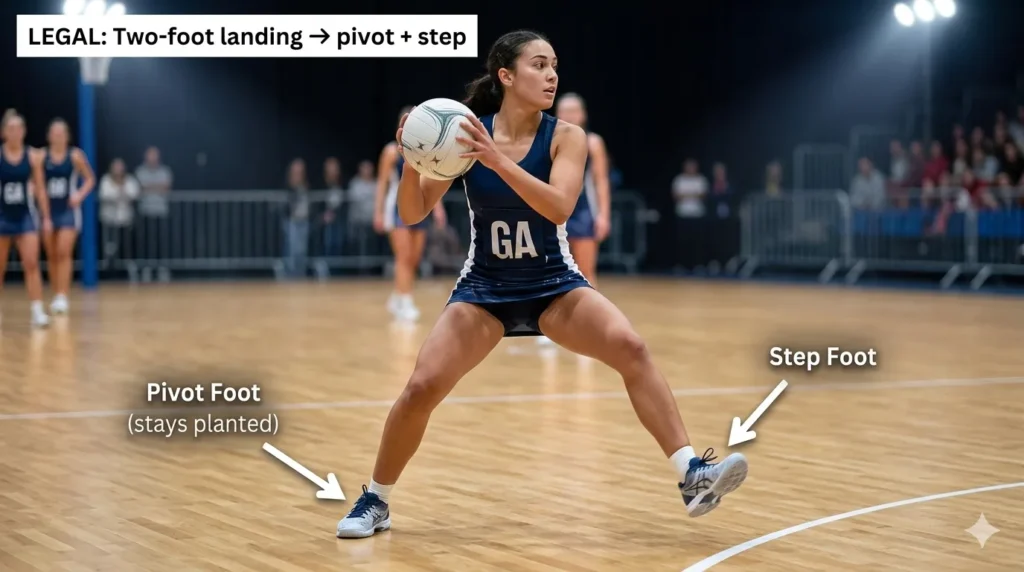
What you ARE allowed to do (two-foot landing)
After landing on both feet, you may:
A) Step with one foot, lift the other foot, and pass/shoot before the lifted foot is re-grounded
Easy example:
- Land on both feet.
- Step forward with right.
- Lift left.
- Pass before left touches down again. ✅ Legal
B) Step one or more times with one foot while pivoting on the other
Easy example:
- Land on both feet.
- Decide left is pivot.
- Step around with right multiple times to create angle. ✅ Legal
C/D) Some jump/step combinations are legal, but the ball must be released before you break the grounded-foot condition
The most common two-foot landing mistake
Mistake: You land on two feet and then shuffle both feet to balance while still holding the ball.
That becomes stepping (footwork).
Other Foot Movements That Are NOT Allowed (Big “NO” List)
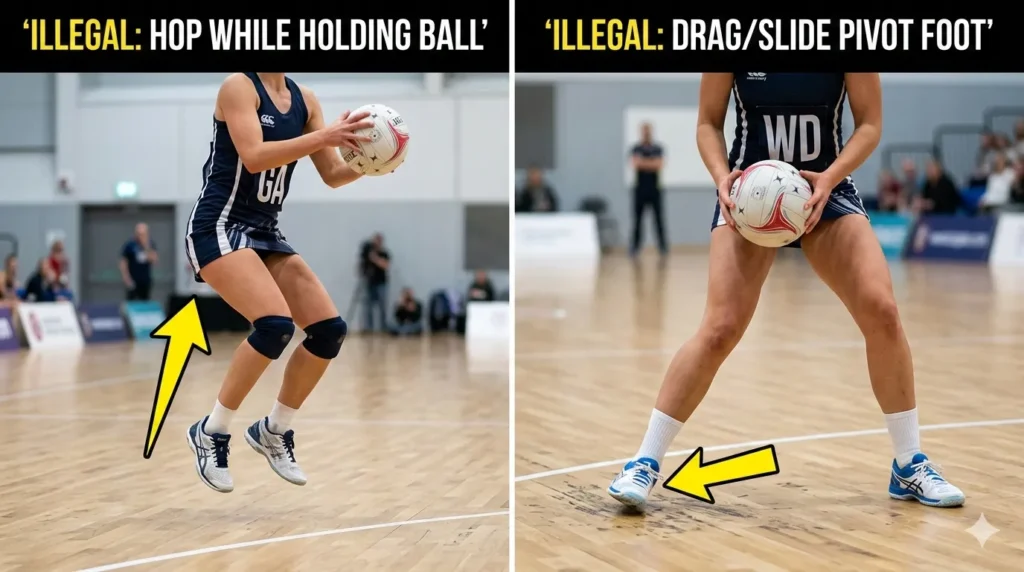
World Netball clearly states that a player in possession may not:
- drag or slide the landing foot
- hop on either foot
- jump from both feet and land on both feet while still holding the ball
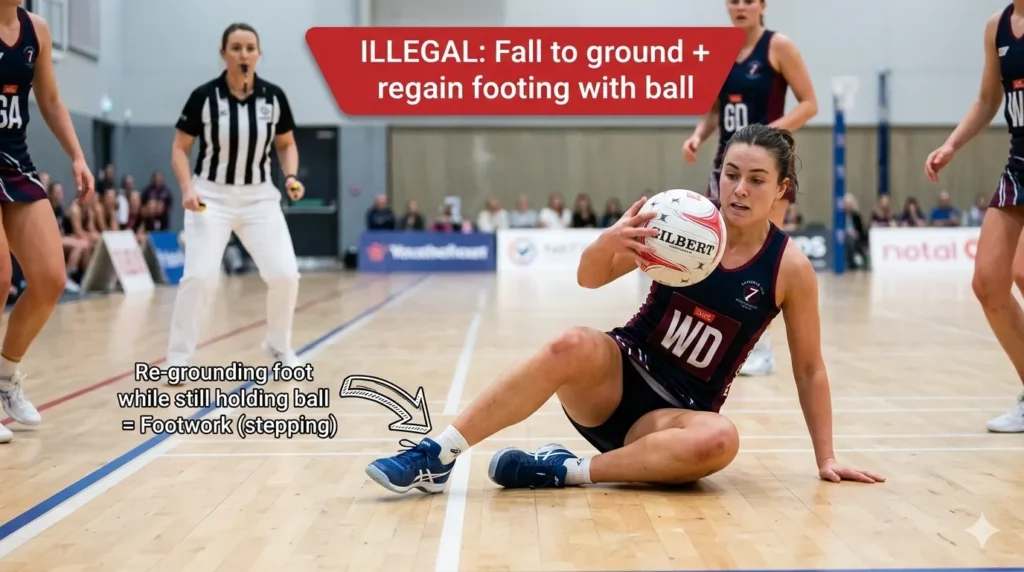
- fall to the ground and reground the landing foot
All of these are footwork infringements → free pass.
The “fall to ground” clarification (important 2024 update)
The 2024 rule updates clarified: if a player falls while holding the ball, and then regains footing, it is penalized for footwork unless the landed foot stays in contact with the ground the entire time.
This was clarified because the older wording caused confusion and inconsistent decisions.
Footwork vs Held Ball (3 Seconds): How They Work Together
Many players confuse footwork and held ball.
Held ball = time rule
You must pass or shoot within three seconds when in possession.
Footwork = movement rule
Even if you pass within 3 seconds, you can still be called for footwork if your feet move illegally.
Match scenario example:
- You catch the ball, quickly take extra steps, and pass in 2 seconds.
✅ Time is fine
❌ Footwork is not → free pass
Why the Footwork Rule Is Implemented (Real Game Reasons)
1) It protects the “netball identity”
Netball is meant to be:
- fast passing
- smart positioning
- clean movement
Footwork rules force the ball to move by passing, not by one player running through the court.
2) It improves safety
When players must stop and control their landing:
- there are fewer full-speed collisions
- less pushing and barging
- more space-based defending (with strict rules like obstruction distance)
3) It creates tactical teamwork
Footwork rules force teams to build:
- safe passing triangles
- switches to move defense
- circle entry timing (feed → shooter)
That’s why netball looks like set play more often than basketball.
“Switch → Feed → Pivot → Shoot” (How Footwork Creates Strategy)
This pattern is common because footwork rules encourage it:
Switch
You change the angle by moving the ball side-to-side.
Feed
You deliver the entry pass into the shooting circle.
Pivot
The feeder or shooter pivots on a legal foot to protect the ball and find a clear pass/shoot.
Shoot
Goal is taken inside the shooting circle.
Because footwork limits movement with the ball, teams must win with:
- timing
- angles
- clean pivots
- quick release
Match Scenarios: Footwork Calls You’ll See Every Weekend
Scenario 1: Catch near the sideline (out of bounds + footwork)
A player catches the ball at speed and lands too close to the side line. They try to save it by shuffling back in.
What happens:
- They often step out of bounds or shuffle illegally → turnover/free pass.
Coaching fix:
Practice: “catch one step inside the line” and “stop strong, pivot, pass.”
Scenario 2: Shooter catches under the post (circle pressure)
Goal Shooter catches and turns to shoot. Under pressure, they “hop” to re-balance.
What happens:
Hopping is not allowed as a foot movement while in possession.
Fix:
Train stable landing + controlled pivot, then shoot.
Scenario 3: Centre pass receive (fast restart mistakes)
During centre pass, players rush the first pass and forget to control landing.
What happens:
Footwork is common here because players are sprinting and receiving at pace.
Fix:
Use a strong “braking step” and choose a pivot foot instantly.
Mini Case Study: Court Layout + Footwork Under Pressure (2010 Commonwealth Final)
In the 2010 Commonwealth Games netball final, New Zealand beat Australia 66–64 after double extra time.
In matches like this, footwork becomes even more important because:
- pressure increases
- players receive the ball at speed
- defenders hunt intercepts
- one footwork turnover can decide the result
Tight finals often come down to which team:
- keeps clean possession
- avoids “cheap” turnovers (footwork, held ball)
- executes circle entries calmly under stress
(This is the exact reason coaches drill footwork more than almost any other skill.)
Easy “Do This / Don’t Do This” Footwork Cheat Sheet
✅ Do this
- Land strong and balanced
- Decide your pivot foot quickly
- Pivot to protect the ball
- Pass before you panic-step
- Keep eyes up for safe passing lanes
❌ Don’t do this
- Shuffle both feet after landing
- Hop to re-balance while holding the ball
- Drag/slide the landing foot
- Fall and then reground the landing foot (2024 clarified)
Training Tips: How to Stop Getting Called for Footwork
Drill 1: “Catch–Stop–Pivot–Pass” (30 seconds each side)
- Partner passes fast
- Receiver lands, freezes, pivots, and passes in 2 seconds
- Focus on quiet feet (no shuffle)
2) Drill : One-foot landing control
- Jump to catch
- Land on one foot
- Step with the second foot
- Pivot and pass before re-grounding the lifted landing foot (if you lift it)
Drill 3: Sideline survival
- Pass along the sideline
- Receiver must land clearly inside and pivot back to court
FAQs
Is footwork the same as travelling in basketball?
It’s similar in purpose (stopping illegal steps), but netball is stricter because you can’t dribble and travel.
What is the sanction for footwork?
A free pass to the opposing team.
Can I pivot in netball?
Yes. Pivoting is a key part of playing legally—just don’t step/hop/drag illegally.
What changed in 2024 about footwork?
A key clarification added that a player in possession may not fall to the ground and reground the landing foot, and Q&A guidance clarified how it should be penalized.

I am a netball writer and match analyst who creates easy, practical guides for beginners and club players. I focuses on netball rules, court markings, and position-based strategy—explaining the “why” behind each rule with real match scenarios and clear examples. When not writing, I follow international netball events and breaks down game patterns like circle entries, intercept setups, and centre-pass plays to help readers understand netball faster.