
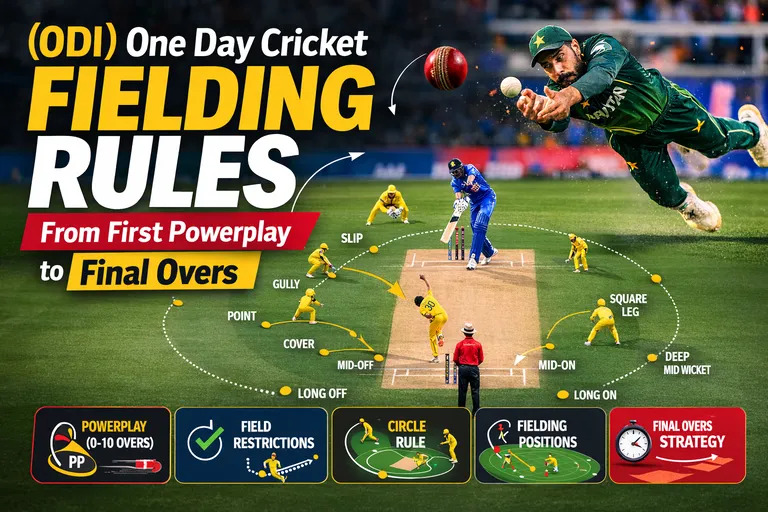
In One Day International (ODI) cricket, fielding plays a crucial role in controlling runs and taking wickets. Unlike Test cricket, ODI fielding is strictly regulated by the ICC under Law 28 (The Fielder) and playing conditions for limited-overs cricket.
Each phase of a 50-over match comes with specific fielding restrictions to ensure a fair balance between bat and ball.
This guide explains every fielding rule in ODI cricket—from powerplays to illegal positions—so even a newcomer can fully understand how the 11 fielders must position themselves. Here are some most important odi fielding rules.
1. Number of Fielders Allowed on the Field
Each team can have 11 players on the field, including one wicketkeeper and one bowler.
- Minimum fielders required: 10 (excluding the bowler).
- Maximum: 11 (entire playing team).
📘 ICC Law Reference: Law 2.1 (Substitutes and fielders)
📌 Note: Substitute fielders can replace an injured player but cannot bowl, bat, or act as captain or wicketkeeper. This is one of easiest fielding rules in odi cricket.
2. Fielding Circle and Powerplay Rules (Mandatory Restrictions) ⚡
In a 50-over ODI match, the fielding circle determines how many players can stand outside the 30-yard circle during different overs.
The 30-yard circle is marked on the field, and the restrictions are divided into three powerplay phases:
One Day Cricket Powerplay Rules:
In ODI cricket, the first powerplay lasts from overs 1–10, during which only 2 fielders are allowed outside the 30-yard circle, Overs 11–40 Up to 4 fielders allowed outside while in the remaining overs up to 5 fielders can stand outside the circle
| Phase | Overs | Fielding Restriction | Allowed Outside 30-Yard Circle |
|---|---|---|---|
| Powerplay 1 | Overs 1–10 | Only 2 fielders allowed outside | 2 |
| Powerplay 2 | Overs 11–40 | Up to 4 fielders allowed outside | 4 |
| Powerplay 3 | Overs 41–50 | Up to 5 fielders allowed outside | 5 |
📘 ICC Law Reference: ODI Playing Conditions – Fielding Restrictions 13.4
🧠 Example:
In the first 10 overs, you’ll often see only two fielders near the boundary—usually third man and fine leg—while all others stay inside to prevent singles and take early wickets.
Cricket Fielding Positions in Powerplay
In ODI cricket, powerplay fielding positions are the placements used when fielding restrictions are active. During the first powerplay (overs 1–10), only 2 fielders are allowed outside the 30-yard circle, so teams usually keep more fielders inside the ring to stop singles and create wicket-taking pressure. The ODI playing conditions also define the inner ring using 30-yard (27.43 m) semi-circles.
Common fielding positions in the first powerplay
Teams often use a mix like this:
- Slip
- Gully
- Point
- Cover
- Mid-off
- Mid-on
- Square leg
- Fine leg
- Third man
- Deep square leg or deep fine leg as one of the 2 outside fielders
These are not fixed by ICC as one compulsory setup; captains choose them based on the bowler, batter, and match situation. The rule mainly controls how many fielders can stand outside the circle, not the exact names of the positions.
Simple explanation
In the powerplay, captains usually put attacking fielders like slip, point, cover, and mid-off inside the circle, while only two fielders stay near the boundary. This helps the bowling side attack early wickets while still protecting a few scoring areas.
How many fielders are allowed outside the circle in ODI?
In ODI cricket, the number of fielders allowed outside the 30-yard circle depends on the phase of the innings. During the Powerplay overs, only 2 fielders are allowed outside the circle. During the non-Powerplay overs, up to 5 fielders are allowed outside the circle. These fielding restrictions are set out in the ICC ODI playing conditions.
🏏 Comparison Table: Fielding Restrictions in T20, ODI, and Test Matches
| Aspect | T20 Match (20 Overs) | One Day Match (50 Overs) | Test Match (Unlimited Overs) |
|---|---|---|---|
| Powerplays | 2 Powerplays | 3 Powerplays | ❌ No Powerplays |
| Powerplay 1 | Overs 1–6 → Only 2 fielders allowed outside 30-yard circle | Overs 1–10 → Only 2 fielders allowed outside 30-yard circle | ❌ Not applicable |
| Powerplay 2 | Overs 7–20 → 5 fielders allowed outside 30-yard circle | Overs 11–40 → 4 fielders allowed outside 30-yard circle | ❌ Not applicable |
| Powerplay 3 (Death Overs) | ❌ Not applicable (T20 has only 2 phases) | Overs 41–50 → 5 fielders allowed outside 30-yard circle | ❌ Not applicable |
| Maximum Fielders on Leg Side | 5 fielders maximum | 5 fielders maximum | 5 fielders maximum |
| Fielding Circle Size | 30-yard circle (mandatory) | 30-yard circle (mandatory) | No circle restriction (fielders can stand anywhere) |
| Minimum Fielders Inside Circle | During non-powerplay overs, at least 4 fielders inside the 30-yard circle | During non-powerplay overs, at least 4 fielders inside the 30-yard circle | No fixed requirement |
| Boundary Fielders Allowed (Max) | 5 fielders after powerplay | 4–5 fielders depending on powerplay phase | No limit |
| Slip Fielders (Close Catchers) | Usually 0–1 (depends on format strategy) | 0–2 early overs | 2–4 common in early overs |
| Substitute Fielders Rule | Allowed (field only, can’t bowl/keep/bat) | Allowed (same rule) | Allowed (same rule) |
| DRS Usage for Fielding | 2 unsuccessful reviews per innings | 2 unsuccessful reviews per innings | 3 unsuccessful reviews per innings |
| Field Changes for Free Hit | Allowed only if striker changes end | Allowed only if striker changes end | ❌ Not applicable |
| Overthrow Runs Count | Yes | Yes | Yes |
| Penalty for Illegal Fielding | 5 runs to batting team | 5 runs to batting team | 5 runs to batting team |
| Purpose of Restriction | Encourage aggressive batting, balance game | Maintain bat-ball balance in longer limited overs | No limit—focus on strategy and endurance |
🧠 Summary Explanation
- T20 Matches:
Focused on fast scoring and entertainment. Hence, only 6 overs of powerplay with tighter restrictions.
Fielders mostly play defensive positions after 6 overs. - ODI Matches (50 Overs):
Balanced between aggression and strategy.
Has three phases of restrictions to keep both batters and bowlers active throughout the game. - Test Matches:
Played without any fielding circle or powerplays. Captains have full freedom to place fielders anywhere.
Strategy and patience matter more than restrictions.
3. Fielding Positions and Their Roles
Each fielder has a role depending on the match situation.
Common fielding positions:
- Close-in: Slip, Gully, Silly Point, Short Leg
- Inner Circle: Point, Cover, Mid-off, Mid-on, Midwicket
- Boundary: Third Man, Deep Point, Deep Square Leg, Long-on, Long-off
📌 Tip for Beginners:
In powerplay overs, fielders usually stay in attacking positions (slips, short cover).
In death overs, they move to defensive boundary positions (deep midwicket, long-on).
4. Maximum Number of Fielders on Leg Side ⚖️
To prevent unfair leg-side fields, ICC has a rule:
“No more than five fielders are allowed on the leg side at any time.”
📘 Law Reference: ODI Playing Conditions 13.2
🧠 Example:
If a bowler places six fielders on the leg side, the umpire calls a No Ball under this law.
5. Fielding Restrictions for No-Ball and Free Hit
If a bowler bowls a front-foot no-ball, the next delivery becomes a Free Hit.
👉 The fielding team cannot change the field unless the striker changes his end.
📘 Law Reference: ICC ODI Playing Conditions 21.10
🧠 Example:
If Bumrah bowls a no-ball to Warner, and Warner remains the striker, the same field must remain for the free-hit delivery.
6. Fielding During Dead Balls and Overthrows
- Fielders cannot change position after the bowler starts his run-up.
- Any deliberate obstruction or distraction is penalized.
- If a fielder causes overthrows (throws that miss the wicketkeeper), the runs scored are added to the batter’s total.
📘 Law Reference: Law 41.5 (Deliberate distraction or obstruction by fielders)
🧠 Case Study:
In the 2019 World Cup Final, England gained an extra four runs after a deflection off Ben Stokes’ bat — one of the most famous overthrow incidents ever.
7. Substitute and 12th Man Rules 🧢
- A substitute fielder (12th man) can field for an injured player but cannot bowl or keep wickets.
- The umpire must approve the substitution.
- If a player leaves the field without permission, he must spend the same time off the field before resuming play.
📘 Law Reference: Law 24 (Fielder’s absence; substitute)
🧠 Example:
If Virat Kohli leaves the field for 20 minutes, he cannot bowl or bat until he has spent 20 minutes back on the field.
8. Illegal Fielding & Penalties 🚫
There are several acts considered illegal fielding, which can result in penalties:
| Illegal Act | Consequence |
|---|---|
| Fielder uses cap, helmet, or towel to stop the ball | 5 Penalty Runs |
| More than 5 fielders on leg side | No Ball |
| Fielder distracts batter (shouting, waving) | 5 Penalty Runs |
| Fielder changes position unfairly after bowler starts | Dead Ball + 5 Runs |
| Unauthorized substitute enters field | Warning or penalty by umpire |
📘 Law Reference: Law 28.2, Law 41.3–41.5
🧠 Case Study:
In 2001, India received 5 penalty runs when a fielder used a cap to stop the ball—clear violation of Law 28.2.
9. Specialist Fielding Rules for One-Day Internationals
- Fielding Captain must ensure all restrictions are followed.
- Third Umpire reviews possible boundary saves and clean catches.
- Powerplays can change momentum drastically, so captains plan their field accordingly.
- Wet Ball Rule: If the ball is wet, fielders can request the umpire for replacement to maintain fairness.
📘 Law Reference: ODI Playing Conditions 5.2 (Changing the Ball)
10. DRS and Fielding in ODIs
Fielding teams can use Decision Review System (DRS) to challenge umpire calls (e.g., catches or LBWs).
Each team gets 2 unsuccessful reviews per innings in ODIs.
📘 Law Reference: ICC DRS Protocol 3.1
🧠 Example:
If a fielder takes a doubtful catch near the boundary, the third umpire reviews it using slow-motion and UltraEdge technology.
FAQs – Fielding Rules in ODI (50 Overs)
Q1. How many powerplays are there in a 50-over match?
There are three powerplays – 1–10 overs (2 fielders out), 11–40 overs (4 out), and 41–50 overs (5 out).
Q2. Can a team change field during a free hit?
Only if the striker changes his end after a no-ball.
Q3. What happens if a fielder deliberately distracts the batter?
The batting side gets 5 penalty runs.
Q4. Can a substitute fielder bowl in ODI?
No, substitutes can only field. They cannot bat, bowl, or keep wickets.
Q5. How many fielders are allowed on leg side?
A maximum of five fielders are allowed on the leg side.
Conclusion
Fielding in One Day Internationals (50 overs) isn’t just about catching and stopping runs—it’s about following ICC laws that maintain balance and fairness. From powerplays to penalties, every rule ensures strategy and excitement remain central to the game.
Understanding these rules helps newcomers appreciate how teams control games using field placements and smart captaincy.

Daniel Foster is a senior sports writer specializing in cricket laws and international playing conditions. With extensive experience covering ICC rules, domestic leagues, and tournament regulations, he delivers detailed yet easy-to-read explanations. His work is trusted by readers looking for accurate and up-to-date sports rules.