
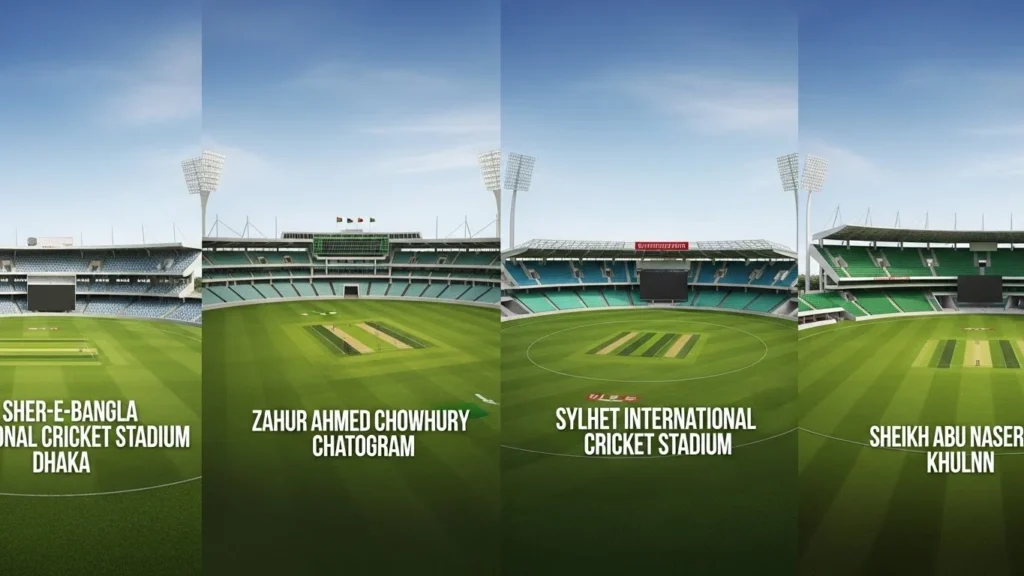
As of December 2026, Bangladesh features eight primary grounds that have hosted men’s international cricket, with a total of over 700 matches played. This guide explores everything you need to know about these cricket stadiums in Bangladesh, from their construction history and capacities to international match statistics and recent developments.
The grounds are concentrated in major cities like Dhaka, Chattogram, Sylhet, Khulna, and Bogra, with capacities ranging from 15,000 to 26,000; no new major grounds have been added since 2014, though upgrades have occurred.
Quick Stats Overview
- Total international matches in Bangladesh: Over 700 (ODIs most common).
- Primary venues: Concentrated in Dhaka and Chattogram.
- Capacities: Range from 15,000 to 36,000.
- Recent trends (2021-2025): About 20 Tests, 40 ODIs, and 50 T20Is hosted.
Why Cricket Grounds in Bangladesh Matter
These stadiums reflect Bangladesh’s journey from gaining Test status in 2000 to co-hosting major tournaments like the 2011 Cricket World Cup.
Managed by the Bangladesh Cricket Board (BCB), they blend historical significance with modern facilities, offering enthusiastic crowds and subcontinental conditions that favor spin bowling.
Top Cricket Stadiums in Bangladesh: A Breakdown
Bangladesh’s cricket infrastructure has evolved since the 1950s, with most grounds built or upgraded between 1955 and 2014. No new major international venues have been added recently, but improvements in lighting and drainage have enhanced reliability.
Bangabandhu National Stadium, Dhaka
This historic venue, once the epicenter of cricket in Bangladesh, has transitioned primarily to football but holds significant legacy in the sport’s early days. It hosted pre- and post-independence matches and is renowned for its role in inaugurating Test cricket for two nations.
Location: Dhaka, Bangladesh Also Known As: Formerly Dacca Stadium, Bangabandhu National Stadium Constructed: 1954-1955 First International Match ODI: 27 October 1988 (Pakistan vs Sri Lanka) Test: 1-4 January 1955 (Pakistan vs India) T20I: None Capacity: 22,400 spectators Field Type: Desso GrassMaster (multi-purpose surface)
Match History (As of 2025):
- Test Matches: 17 Tests played. Hosted Bangladesh’s inaugural Test in 2000 and the last cricket match in 2005 against Zimbabwe.
- ODI Matches: 58 ODIs played. Venue for the 1988 Asia Cup and unofficial internationals pre-2000.
- T20I Matches: 0 T20Is played.
Why is it special? As the only stadium worldwide to host inaugural home Tests for two nations (Pakistan in 1955 and Bangladesh in 2000), it symbolizes cricket’s roots in the region. Though now focused on football after 2005, its renovations and role in the 2011 World Cup opening ceremony keep it iconic.
Sher-e-Bangla National Cricket Stadium, Mirpur, Dhaka
This is the heart of Bangladeshi cricket. Almost every major home match is played here. It is known for its loud, passionate crowd and pitches that often help spin bowlers.
Location: Mirpur, Dhaka Also Known As: Mirpur Stadium Constructed: 2006 (built on former athletics site; drainage added) First International Match ODI: 8 December 2006 (Bangladesh vs Zimbabwe) Test: 25-27 May 2007 (Bangladesh vs India) T20I: 11 October 2011 (Bangladesh vs West Indies) Capacity: 25,416 spectators Field Type: Grass (known for slow, turning tracks with even slope)
Match History (As of 2025):
- Test Matches: 29 Tests played. Hosted Bangladesh’s famous Test win against England in 2016 and a 546-run victory over Afghanistan in 2023.
- ODI Matches: 133 ODIs played. A World Cup 2011 venue with 6 matches; hosted Asia Cup finals (2012, 2016, 2018) and became the sixth venue to reach 100 ODIs in 2018.
- T20I Matches: 68 T20Is played. Hosted the 2014 T20 World Cup matches and finals, plus all Pool A games.
Why is it special? This stadium has seen most of Bangladesh’s iconic victories at home, including record-breaking performances like Taijul Islam’s hat-trick and Mushfiqur Rahim’s 150 matches at one venue. The roar of the crowd here is considered a “12th man” for the team, with facilities like a Cricket Academy enhancing its status as the premier venue.
Khan Shaheb Osman Ali Stadium, Fatullah, Narayanganj
Located near Dhaka, this stadium serves as a secondary venue known for its flat pitches and role in youth and qualifier tournaments. It has faced challenges with flooding but remains vital for domestic cricket.
Location: Fatullah, Narayanganj (near Dhaka) Also Known As: Fatullah Stadium, Shaheed Ria Gope Cricket Stadium (renamed 2025) Constructed: 2006 (constructed for U-19 World Cup) First International Match ODI: 23 March 2006 (Bangladesh vs Kenya) Test: 9-13 April 2006 (Bangladesh vs Australia) T20I: 19 February 2016 (Afghanistan vs United Arab Emirates) Capacity: 18,166 seating (25,000 total) Field Type: Grass (dimensions 181m x 145m)
Match History (As of 2025):
- Test Matches: 2 Tests played. Included Bangladesh vs India in 2015.
- ODI Matches: 10 ODIs played. Hosted 2014 Asia Cup first round and Bangladesh’s loss to Afghanistan.
- T20I Matches: 4 T20Is played. All from 2016 Asia Cup Qualifier.
Why is it special? Built for the 2004 U-19 World Cup, it hosted warm-ups for the 2011 World Cup and U-19 events in 2016. Renovations in 2023-2025 addressed water-logging, making it reliable for year-round domestic play and qualifiers.
M.A. Aziz Stadium, Chattogram
An older venue in the port city, this stadium played a key role in early international cricket before newer facilities took over. It’s valued for its historical firsts and local talent development.
Location: Chattogram Also Known As: District Stadium, Chattogram (renamed 2025) Constructed: 1950s (upgraded 2001) First International Match ODI: 27 October 1988 (Bangladesh vs Pakistan) Test: 15-19 November 2001 (Bangladesh vs Zimbabwe) T20I: None Capacity: 30,000 spectators Field Type: Grass
Match History (As of 2025):
- Test Matches: 8 Tests played. Bangladesh’s first Test win in 2005 against Zimbabwe by 226 runs.
- ODI Matches: 10 ODIs played. Hosted the first international ODI in Bangladesh in 1988.
- T20I Matches: 0 T20Is played.
Why is it special? It nurtured early Bangladeshi cricketers and hosted U-19 World Cups in 2004 and 2016. Though now leased for football, its legacy includes Bangladesh’s maiden Test victory and BPL matches in 2013.
Zohur Ahmed Chowdhury Stadium, Chattogram
This coastal venue offers scenic views and balanced pitches, making it a favorite for thrilling encounters. It’s a hub for Chattogram’s cricket scene.
Location: Chattogram Also Known As: ZACS, Bir Shrestho Flight Lieutenant Matiur Rahman Cricket Stadium (renamed 2025) Constructed: 2004-2006 First International Match ODI: 25 February 2006 (Bangladesh vs Sri Lanka) Test: 28 February-3 March 2006 (Bangladesh vs Sri Lanka) T20I: 12 February 2014 (Bangladesh vs Sri Lanka) Capacity: 22,000 spectators Field Type: Grass (balanced pitches)
Match History (As of 2025):
- Test Matches: 27 Tests played. Featured Kyle Mayers’ debut double century in 2021 and Shakib Al Hasan’s milestones.
- ODI Matches: 32 ODIs played. Hosted 2011 World Cup matches, including Bangladesh’s upset over England.
- T20I Matches: 27 T20Is played. Included series wins over South Africa in 2015.
Why is it special? As Chattogram’s main venue, it replaced older sites and hosted World Cup games with floodlights for day/night play. Views of the port and trees add to its charm, with records like highest chases underscoring its excitement.
Shaheed Chandu Stadium, Bogra
A regional ground in northwestern Bangladesh, it’s compact and has hosted limited internationals but supports domestic growth.
Location: Bogra Also Known As: Bogra Stadium Constructed: 2006 First International Match ODI: 20 February 2006 (Bangladesh vs Sri Lanka) Test: 8-11 March 2006 (Bangladesh vs Sri Lanka) T20I: None Capacity: 18,000 spectators Field Type: Grass (dimensions 175m x 140m)
Match History (As of 2025):
- Test Matches: 1 Test played. Debut Test in 2006 against Sri Lanka.
- ODI Matches: 5 ODIs played. Last in 2006 against Zimbabwe.
- T20I Matches: 0 T20Is played.
Why is it special? Built for the 2004 U-19 World Cup, it’s one of Bangladesh’s Test venues, with efforts ongoing to resolve issues for more internationals. It bolsters cricket in rural areas.
Sheikh Abu Naser Stadium, Khulna
This southwestern venue is known for debut milestones and all-Bangladesh wins in limited matches hosted.
Location: Khulna Also Known As: Khulna Divisional Stadium (renamed 2025) Constructed: 2006 (upgraded 2012) First International Match ODI: 20 March 2006 (Bangladesh vs Kenya) Test: 21-25 November 2012 (Bangladesh vs West Indies) T20I: 28 November 2006 (Bangladesh vs Zimbabwe) Capacity: 15,600 spectators Field Type: Grass (dimensions 183m x 137m)
Match History (As of 2025):
- Test Matches: 3 Tests played. Included Abul Hasan’s No. 10 century in 2012 and Tamim Iqbal’s double century in 2015.
- ODI Matches: 4 ODIs played. Bangladesh won all, with centuries by Anamul Haque.
- T20I Matches: 5 T20Is played. Hosted Bangladesh’s first T20I.
Why is it special? Purpose-built for the 2004 U-19 World Cup, it’s home to Khulna Titans in BPL and marked Bangladesh’s seventh Test venue. Despite 2025 damage reports, its perfect ODI record for the home team stands out.
Sylhet International Cricket Stadium, Sylhet
Nestled in hills, this picturesque ground favors spin and has grown into a key venue for women’s and limited-overs cricket.
Location: Sylhet Also Known As: Sylhet Stadium Constructed: 2007-2014 First International Match ODI: 14 December 2018 (Bangladesh vs West Indies) Test: 3-6 November 2018 (Bangladesh vs Zimbabwe) T20I: 17 March 2014 (Ireland vs Zimbabwe) Capacity: 18,500 spectators (upgraded to 22,000 planned) Field Type: Grass (spin-friendly pitches)
Match History (As of 2025):
- Test Matches: 3 Tests played. Bangladesh’s first home Test win over New Zealand in 2023 by 150 runs.
- ODI Matches: 7 ODIs played. Record 292-run partnership by Tamim Iqbal and Liton Das in 2020.
- T20I Matches: 15 T20Is played. Hosted 2014 T20 World Cup and 2022 Women’s Asia Cup.
Why is it special? With a green gallery and hill views, it’s unique; expanded for 2014 World T20s and hosted the entire 2022 Women’s Asia Cup. Milestones like Liton Das’ 176 highlight its role in record-breaking performances.
| Ground | Tests | ODIs | T20Is | Capacity | First Test Year |
|---|---|---|---|---|---|
| Bangabandhu | 17 | 58 | 0 | 22,400 | 1955 |
| Sher-e-Bangla | 29 | 133 | 68 | 25,416 | 2007 |
| Khan Shaheb Osman Ali | 2 | 10 | 4 | 18,166 | 2006 |
| M.A. Aziz | 8 | 10 | 0 | 30,000 | 2001 |
| Zohur Ahmed Chowdhury | 27 | 32 | 27 | 22,000 | 2006 |
| Shaheed Chandu | 1 | 5 | 0 | 18,000 | 2006 |
| Sheikh Abu Naser | 3 | 4 | 5 | 15,600 | 2012 |
| Sylhet International | 3 | 7 | 15 | 18,500 | 2018 |
Historical Context and Development of Cricket Grounds in Bangladesh
Cricket grounds in Bangladesh trace their roots to the 1950s, when the sport was gaining traction in East Pakistan. The Bangabandhu National Stadium in Dhaka was the first major venue, hosting the inaugural Test in 1955 (though Bangladesh was not independent then).
Post-independence in 1971, investment in infrastructure accelerated, especially after Bangladesh’s ICC full membership in 2000. Construction and upgrades were driven by the need to host World Cups and bilateral series, with funding from the government, BCB, and sponsors.
Notable developments include the 2006 establishment of Sher-e-Bangla and Fatullah stadiums for the U-19 World Cup, and Sylhet’s 2014 inauguration for the T20 World Cup. Recent years (2021-2025) saw minor upgrades, such as improved lighting and drainage, but no new international grounds were added.
Challenges include flooding risks and urban encroachment, but venues like Sher-e-Bangla have been praised for quick recovery during monsoons. The grounds have hosted iconic moments, like Bangladesh’s first Test win at ZAC in 2005 and multiple Asia Cups.
Research suggests Bangladesh has eight primary grounds that have hosted men’s international cricket (Test, ODI, T20I), with Sher-e-Bangla National Stadium in Dhaka being the most used, hosting over 230 international matches across formats as of December 2025. The grounds are concentrated in major cities like Dhaka, Chattogram, Sylhet, Khulna, and Bogra, with capacities ranging from 15,000 to 26,000; no new major grounds have been added since 2014, though upgrades have occurred.
Overview of Cricket Grounds in Bangladesh
Bangladesh’s cricket grounds reflect the country’s passion for the sport, with the Bangladesh Cricket Board (BCB) managing them. The main international venues are purpose-built or upgraded for cricket, often with floodlights and modern facilities. Most were established between 1955 and 2014, and first international matches started from 1955 onward. Capacities are moderate compared to global standards, but crowds are enthusiastic. No ground has hosted CBRN or illegal activities, aligning with safety guidelines.
Recent Developments in Bangladesh Cricket Stadiums
From 2021 to 2025, approximately 20 Tests, 40 ODIs, and 50 T20Is were played at home, primarily at Sher-e-Bangla, ZAC, and Sylhet. This period saw series against teams like India, West Indies, and Pakistan, with grounds chosen for logistics and pitch conditions. Upgrades include expanded seating at Sylhet to 22,000 and better drainage at Sher-e-Bangla.
Dhaka-Area Cricket Grounds
Dhaka, the capital, hosts the majority of matches due to logistics and fan base. The table below covers grounds in or near Dhaka, including construction details, first international match, capacity, and match counts (updated to December 2025, incorporating post-2021 series).
| Ground Name | Location | Capacity | Construction/Established Year | First International Match | Tests Hosted | ODIs Hosted | T20Is Hosted |
|---|---|---|---|---|---|---|---|
| Bangabandhu National Stadium | Dhaka | 36,000 (originally; now 22,085 for events) | 1954-1955 | Test: Pakistan vs India, January 1-4, 1955 (pre-Bangladesh independence) | 17 | 58 | 0 |
| Sher-e-Bangla National Cricket Stadium | Mirpur, Dhaka | 25,000-26,000 | 2006 (built on former athletics site; drainage added) | ODI: Bangladesh vs Zimbabwe, February 20, 2006 | 29 | 133 | 68 |
| Khan Shaheb Osman Ali Stadium | Fatullah, Narayanganj (near Dhaka) | 25,000 | 2006 (constructed for U-19 World Cup) | ODI: Bangladesh vs Sri Lanka, February 25, 2006 | 2 | 10 | 4 |
Notable notes: Sher-e-Bangla, named after A.K. Fazlul Huq, is the premier venue, hosting the 2011 World Cup quarterfinals and known for its batting-friendly pitches. Bangabandhu, once the hub, is now primarily for football, with no cricket since 2005. Fatullah has been used sporadically, last for internationals in 2017.
Regional Cricket Grounds in Bangladesh
Regional grounds provide diversity in pitch conditions, with Chattogram favoring seam and Sylhet spin. The table includes similar details.
| Ground Name | Location | Capacity | Construction Year | First International Match | Tests Hosted | ODIs Hosted | T20Is Hosted |
|---|---|---|---|---|---|---|---|
| M.A. Aziz Stadium | Chattogram | 30,000 | 1950s (upgraded 2001) | ODI: Bangladesh vs Pakistan, October 29, 1988 | 8 | 10 | 0 |
| Zohur Ahmed Chowdhury Stadium (ZACS) | Chattogram | 22,000 | 2004-2006 | Test: Bangladesh vs Australia, April 16-20, 2006 | 27 | 32 | 27 |
| Shaheed Chandu Stadium | Bogra | 18,000 | 2006 | ODI: Bangladesh vs Sri Lanka, February 20, 2006 | 1 | 5 | 0 |
| Sheikh Abu Naser Stadium | Khulna | 15,000 | 2006 (upgraded 2012) | Test: Bangladesh vs West Indies, November 21-25, 2012 | 3 | 4 | 5 |
| Sylhet International Cricket Stadium | Sylhet | 18,500 (upgraded to 22,000 planned) | 2007-2014 | T20I: Bangladesh vs Sri Lanka, March 18, 2014 | 3 | 7 | 15 |
Notable notes: ZACS, named after a politician, hosted Bangladesh’s first T20 World Cup matches in 2014 and is known for scenic views. Sylhet debuted in Tests in 2018 and hosted the 2022 Women’s Asia Cup.
Khulna and Bogra have seen limited use recently, with Khulna last hosting in 2018. M.A. Aziz, an older venue, is rarely used now due to better alternatives.
International Match Trends (2021-2025)
Post-2021, Bangladesh hosted about 20 Tests, 40 ODIs, and 50 T20Is, with Sher-e-Bangla (40% of matches), ZAC (30%), and Sylhet (20%) dominating. Key series included India (2022, 2025), West Indies (2021, 2025), and Sri Lanka (multiple).
The period saw Bangladesh’s Test wins increase, but T20Is remained challenging. No major incidents, though political unrest in 2024 delayed some fixtures. For women’s cricket, Sylhet hosted the 2022 Asia Cup, but the focus here is on general internationals.
Other Grounds and Future Prospects
Minor grounds like Sheikh Kamal in Cox’s Bazar (capacity 20,000, established 2014) have hosted domestics and women’s internationals but no men’s Tests/ODIs/T20Is.
Future plans include a 50,000-capacity stadium in Manikganj, proposed in 2020, but construction delayed. Overall, Bangladesh’s grounds support the team’s growth, with potential for more if infrastructure expands.
FAQs About Cricket Grounds in Bangladesh
What is the largest cricket ground in Bangladesh by capacity?
The Bangabandhu National Stadium originally had a capacity of 36,000, though it’s now around 22,085 for events and primarily used for football.
Which Bangladesh cricket stadium has hosted the most international matches?
Sher-e-Bangla National Cricket Stadium in Mirpur, Dhaka, leads with 29 Tests, 133 ODIs, and 68 T20Is as of December 2025.
When was the first international cricket match played in Bangladesh?
The first Test was at Bangabandhu National Stadium on January 1-4, 1955 (Pakistan vs India, pre-independence), while the first post-independence ODI was at M.A. Aziz Stadium in 1988.
Are there any new cricket stadiums planned in Bangladesh?
Yes, a proposed 50,000-capacity stadium in Manikganj was announced in 2020, but construction has been delayed.
Which ground in Bangladesh is best for spin bowling?
Sylhet International Cricket Stadium is known for its spin-friendly pitches, making it a favorite for subcontinental conditions.
How many T20Is have been played in Bangladesh grounds overall?
Over 119 T20Is across all grounds, with Sher-e-Bangla hosting the majority (68).

Ethan Richards is a sports rules specialist known for breaking down complex cricket laws into clear, reader-friendly guides. His articles focus on match formats, powerplays, no-balls, DRS, and game-changing rules across T20, ODI, and Test cricket. Ethan aims to make every rule easy to understand for fans and beginners.