
If you’ve ever watched a netball game from the side line, you’ve seen this moment: a player catches the ball, pivots, and the defender closes in. Someone shouts “Contact!” Someone else shouts “Obstruction!” The umpire blows the whistle—and half the court looks confused.
That confusion is normal, because contact and obstruction often happen in the same tight spaces: the centre third, the circle edge, and inside the shooting circle where pressure is highest. But they are not the same rule.
Here’s the clearest way to separate them:
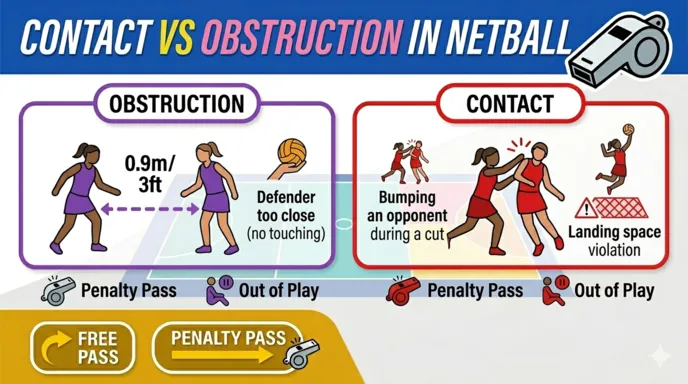
- Obstruction = illegal closeness (distance + active defending). You can get penalized even with zero touch.
- Contact = illegal physical touch that interferes or creates danger. Touch (and its effect) is the issue.
Netball is built to reward timing, positioning, intercepts, and clean contests instead of heavy physical pressure. That’s why these two rules exist and why they are applied so often. The official definitions and interpretations come from World Netball’s Rules of Netball, especially Rule 16 (Obstruction) and Rule 17 (Contact).
Topics to Cover in this Article
difference between contact and obstruction in netball, netball obstruction rule, netball contact rule, defending distance 0.9m, 3 feet rule netball, penalty pass contact, penalty pass obstruction, umpiring contact vs obstruction, causing contact player in the air, landing space netball.
What is obstruction in netball?
Obstruction happens when a defender is too close to a player with the ball (inside the required distance) while actively defending—for example, trying to block a pass, contest a shot, or intercept. The standard defending distance is 0.9 metres (3 feet).
What is contact in netball?
Contact happens when a player makes physical contact that unfairly interferes with an opponent’s movement or play, or creates a safety risk. World Netball also covers “causing contact,” including important situations like player in the air / landing space.
One-line difference:
- Obstruction = distance/space problem (no touch needed)
- Contact = physical interference problem (touch + effect/safety)
2) Why Netball Needs These Rules (The “Why” Behind the Whistle)
Netball is not basketball. It grew from early basketball ideas but developed a different identity—especially in how it handles physical pressure. World Netball’s history explains netball was first played in England in 1895 and spread through Commonwealth countries, evolving with different versions before rules became standardized.
Over time, netball’s rule structure aimed to protect three things:
- Fair contest for possession
Netball wants defenders to win ball through reading the pass, timing, and positioning—not by crowding or pushing. - Free movement and clean passing
Because netball is a passing sport (catch → stop → pivot → pass), players need space to pivot and release the ball safely. - Safety, especially when jumping and landing
Contact rules—especially “player in the air” / “landing space”—exist because collisions during landing create high injury risk. World Netball’s Rule 17 details this clearly.
These goals create a sport where space is protected (obstruction) and unfair physical interference is penalized (contact). That’s why both rules are strict and common.
Also Read More About: Common Fouls and Penalties in Netball, Umpire signals + exact call words
3) The Official Rule Families: Rule 16 vs Rule 17
World Netball organizes these rules into two main sections:
- Rule 16: Obstruction (defending distance and space)
- Rule 17: Contact (physical interference and “causing contact”)
You don’t need to memorize the full text to understand the difference. But you should understand the logic:
- Rule 16 asks: Are you defending too close and taking away the ball carrier’s space?
- Rule 17 asks: Did physical contact unfairly interfere or create danger?
4) Obstruction in Netball
4.1 What obstruction really means
Obstruction is a space and distance rule.
It protects the ball carrier’s ability to:
- pivot freely
- pass safely
- shoot without being crowded
Obstruction can be called even if:
- the defender never touches the attacker
- the defender “was just standing there”
- the defender thinks they were “going for the ball”
If the defender is inside the legal distance while actively defending, it can be obstruction. World Netball’s education explains that a defender may be within 0.9m in some situations, but cannot actively defend/intercept until the ball is released.
4.2 The famous defending distance: 0.9m (3 feet)
The defending distance is 0.9 metres, often taught as the 3-feet rule.
What umpires are judging (simple version)
Umpires are watching:
- the ball carrier’s landing foot (where they landed when catching)
- the defender’s nearest foot
- whether the defender is active (hands up, leaning in, blocking passing line, trying to intercept)
If the defender is too close and actively defending, it’s obstruction.
Important update/clarification (why people get confused)
World Netball has published clarifications explaining that a defender may be within 0.9m as long as they do not interfere with the passing/shooting action and do not attempt to defend/intercept while the opponent is in possession; once the ball is released, they may contest.
That means some moments that look “too close” are legal—until the defender starts actively defending before the release. That’s why players sometimes think the umpire is inconsistent.
Also Read More About: Offside Rule in Netball Explained Simply (2026)
4.3 What obstruction looks like in real matches (5 common patterns)
Pattern 1: The “creep”
Ball carrier catches → pivots → defender creeps closer with hands up.
No touch happens. The defender thinks it’s fine.
But if the defender breaks the distance while actively defending → obstruction.
Pattern 2: The “shadow block”
Defender stands inside the legal space and “shadows” the attacker’s passing arm, forcing awkward release angles.
Even without contact, this can be obstruction because it interferes with passing/shooting space.
Pattern 3: The “circle crowd”
Shooter receives in the circle and gathers to shoot. Defender closes too close with hands up.
If they are inside distance and actively contesting the shot → obstruction call is likely.
Pattern 4: The “step into the pivot”
Attacker pivots on landing foot. Defender steps into the pivot line to block movement too close.
This often triggers obstruction because it removes space to pivot and pass.
Pattern 5: The “fake intercept”
Defender stands close, pretending not to defend, then flicks hands as the ball carrier starts a pass.
If the defender was inside distance and actively defending before release, that’s obstruction. If they wait for release, it can be legal.
4.4 Why obstruction matters tactically
Obstruction is not just a “technical rule.” It shapes netball strategy:
- It creates clean passing lanes
- It encourages defenders to win ball through intercepts (timed, legal)
- It prevents basketball-style “in your face” defense that would stop the passing game
That’s why netball looks like switch → feed → pivot → shoot: attackers can pivot and pass because defenders must give space.
5) Contact in Netball
5.1 What contact really means
Contact is about physical touch that:
- unfairly interferes with movement or play
or - creates a safety issue
Contact can be:
- accidental
- “ball-first” attempt
- caused by the attacker or defender (World Netball includes “causing contact”)
This is why a player saying “I didn’t mean it” does not automatically remove the penalty. Umpiring focuses on effect + fairness + safety.
5.2 The most important contact concept: “Player in the air” / landing space
World Netball’s Rule 17 includes a major safety principle:
A player who jumps into the air must be allowed to land safely—either in the same place or in another place on court (within the rules). Opponents must not move into that landing space after the jump begins.
What this means in plain English
If an attacker jumps to catch or shoot:
- a defender cannot step underneath them late
- a defender cannot “take the landing space”
- if a collision happens because the defender moved into the landing path → causing contact
This is a big reason netball is safer than many contact-heavy sports: landing injuries are serious, so rules protect airborne players.
5.3 Common contact types (how it shows up in games)
Type 1: Bump/displacement contact
Defender bumps attacker off their line when cutting or driving into space.
If the attacker’s movement changes unfairly → contact.
Type 2: Arm across body / holding
Defender uses arms to restrict attacker’s run or passing action.
Even small holding can be contact if it affects movement.
Type 3: “Body first” contest
Defender crashes the body into the contest, not the ball.
If that contact stops a pass/shot or forces an error → contact.
Type 4: Landing collision (highest risk)
Shooter or jumper lands on defender’s foot or body because the defender moved into landing space.
This is usually treated firmly because of safety.
Type 5: Moving player contact (cutting off path)
World Netball also covers causing contact by moving into an opponent’s path too quickly/closely so they cannot stop or change direction in time.
5.4 Why contact rules are strict (the tactical reason)
If contact was tolerated, defenders could stop attackers by:
- bumping cutters
- pushing shooters off balance
- blocking runs with body checks
That would destroy netball’s core identity: skill + space + timing. So netball keeps contact penalties strict to protect:
- fair movement
- passing flow
- safety
6) The Clear Difference
6.1 The two-question test
When you’re unsure, ask:
Test A: Was there physical touch that unfairly affected play or safety?
If yes → Contact is likely.
Test B: Even without touch, was the defender too close while actively defending a player with the ball?
If yes → Obstruction is likely.
6.2 A simple memory phrase
- Obstruction = space problem
- Contact = touch problem
6.3 Why players confuse them
Because many moments include both:
- defender closes too close (obstruction risk)
- defender also clips an arm or body (contact risk)
Umpires choose the infringement that best fits what happened and what had the biggest effect.
7) Comparison Table (Contact vs Obstruction)
| Feature | Obstruction (Rule 16) | Contact (Rule 17) |
|---|---|---|
| Main idea | Too close while defending; denies space | Physical touch that interferes or risks safety |
| Touch required? | No | Yes (or “causing contact”) |
| Key measurement | 0.9m (3 feet) defending distance | Effect of contact + fairness + safety |
| Typical location | Circle edge, midcourt pivots | Cuts, contests, rebounds, circle landings |
| Classic example | Defender crowds ball carrier with hands up | Defender bumps attacker off line |
| “Player in the air” focus | Not the main rule | Major focus (landing space protected) |
| What the umpire is watching | Feet distance + active defense before release | Was contact avoidable? did it displace/interfere? |
| Most common result | Penalty pass (infringer out of play) | Penalty pass (infringer out of play) |
| Why it exists | Protect passing/pivot space | Protect movement + safety |
(World Netball rule structure supports Rule 16/17 separation and details “player in the air”.)
8) Penalties, Sanctions, and “Out of Play” (What Happens After the Whistle)
In netball, many infringements—including contact and obstruction—result in a penalty pass (and sometimes a penalty shot depending on where it occurs and competition rules). The infringing player must stand beside and away (commonly called “out of play”) until the ball is released. This is part of why netball penalties feel powerful: for a moment, the infringer is removed from the contest.
Advantage (why the whistle sometimes doesn’t stop play)
Netball also uses the advantage concept so the non-offending team is not harmed by the whistle. Rule updates and guidance documents often emphasize improved advantage application for game flow.
9) Match Scenarios (15 Realistic Situations With Clear Calls)
These scenarios are written so players can picture them instantly. Use them for coaching, blogging, or learning umpiring logic.
Scenario 1: “No touch, but too close”
GA catches at circle edge, pivots to pass. GD steps inside distance with hands up. No touch.
Call: Obstruction (too close while actively defending).
Scenario 2: “Correct distance, then a bump”
Defender starts 0.9m away, then lunges and bumps the attacker’s shoulder during the pass.
Call: Contact (physical interference).
Scenario 3: “Late step into landing space”
Shooter jumps to shoot. Defender steps under after takeoff. Shooter lands on defender.
Call: Contact / causing contact (player in the air).
Scenario 4: “Stationary defender already there”
Shooter jumps forward and lands into a defender who was already stationary in that space.
Call: This can be judged differently depending on timing and responsibility; World Netball explains attackers may not intentionally move into a stationary opponent when jumping and catching.
Scenario 5: “The pivot crowd”
Ball carrier pivots; defender steps closer with feet and blocks the pivot space. No contact.
Call: Obstruction.
Scenario 6: “Hand on the hip”
Defender places a hand on attacker’s hip to guide or slow a cut.
Call: Contact (physical restriction).
Scenario 7: “Arm across passing line + touch”
Defender swings arm across and hits the attacker’s forearm during release.
Call: Contact (caused error).
Scenario 8: “Close but passive”
Defender is inside 0.9m but does not attempt to defend or intercept while ball is held; they wait for release.
Call: Can be legal under certain interpretations (no interference + no active defense while possession held).
Scenario 9: “Active hands before release”
Same as Scenario 8, but defender waves hands and leans in to block the pass before release.
Call: Obstruction.
Scenario 10: “Two players jump, one wins possession”
Two opposing players jump to contest a pass. The player who gains possession has priority to land, and opponents must yield landing space.
Call if opponent doesn’t yield: Contact / causing contact.
Scenario 11: “Cutting off path too fast”
Defender moves into the path of a fast-moving attacker so close that attacker cannot stop in time. Collision happens.
Call: Contact / causing contact (moving player).
Scenario 12: “Circle rebound crash”
Shot misses. Players go for rebound. Defender crashes into shooter mid-air.
Call: Contact, likely serious if landing is affected.
Scenario 13: “Lean-in chest contest”
Defender doesn’t touch with hands but leans body into attacker’s space so the attacker can’t pass cleanly.
Call: Often obstruction if distance is the problem; contact if actual collision occurs and interferes.
Scenario 14: “Circle edge trap”
Two defenders create pressure: one legal distance, one creeping too close.
Call: Obstruction against the one who breaks distance while actively defending.
Scenario 15: “Ball carrier steps into opponent”
Attacker tries to pivot and steps into the defender’s body causing collision.
Call: Can be “causing contact” by the attacker depending on responsibility and timing (judged by umpire).
(These align with World Netball concepts of obstruction/active defense and contact/causing contact, especially “player in the air”.)
10) Why Umpires Look “Inconsistent” (But Usually Aren’t)
10.1 Obstruction depends on “active defending”
Two defenders can stand equally close, but only one is penalized—because only one is actively defending while the opponent has the ball. World Netball explains the difference between being within 0.9m and interfering/defending before release.
10.2 Contact depends on effect and safety
A tiny brush that does nothing may be play-on, but a similar brush that makes a player stumble, lose the ball, or land dangerously becomes contact.
10.3 Umpire angle changes what is visible
From one angle, distance looks fine; from another, the defender is clearly inside the space. From one angle, the collision looks attacker-caused; from another, defender stepped late into the path.
11) Coaching Guide: How to Avoid These Penalties (Attack + Defense)
11.1 How defenders avoid obstruction
- Set distance early—don’t creep during the pivot
- “Feet first” defense: keep legal space, then use hands
- If you’re too close, drop back fast and reset
- Time your contest for after release, not before
11.2 How defenders avoid contact
- Avoid body-first challenges
- Don’t step into landing spaces (especially in the circle)
- Approach at controlled speed; don’t cut off fast attackers too late
- Keep arms disciplined (no holds, pushes, or body blocks)
11.3 How attackers protect themselves and “read” the whistle
- Use strong landing and stable pivot (clear landing foot helps umpire judge distance)
- Keep the ball safe; don’t swing elbows into defenders
- If defender crowds your space, stay composed—your best option is often a quick pass (don’t panic)
12) History: How Netball Developed These Ideas (And Why They Stayed)
World Netball notes netball started in England in 1895 and grew across Commonwealth countries with non-standard rules early on.
Netball’s evolution into its own sport is often linked to variations from early basketball and adaptations for outdoor, school-based play. Broad historical references also note basketball’s invention (1891) and early variations that influenced netball’s development.
As netball standardized, it leaned into:
- controlled movement (stop + pivot)
- passing patterns and set play
- limited physical pressure
- strong safety protections in airborne contests
This is why today’s rules focus so hard on:
- defending distance (obstruction)
- physical interference and landing safety (contact)
These rules didn’t appear “to be strict.” They exist because without them, netball would drift toward a more physical, crowded, dribble-driven game—basically changing its identity.
13) Mini Case Study: 2010 Commonwealth Games Final (Why These Calls Matter Under Pressure)
The match fact (verified)
In the 2010 Commonwealth Games netball final, New Zealand beat Australia 66–64 after double extra time. It lasted 84 minutes, noted as the longest ever official game.
Why this match is the perfect example
High-pressure finals expose the importance of contact and obstruction rules because:
13.1 Possession becomes priceless
In tight finals, teams don’t give away possession easily. One penalty pass from obstruction/contact gives the opponent a huge attacking chance near goal.
13.2 Intercepts are match-changing
In netball, defenders win ball mainly through intercepts and forced errors—not heavy contact. Under pressure, circle-entry passes become riskier. One clean intercept can swing the result.
13.3 Circle contests become intense
The circle is where shots happen, so pressure is highest there. Umpires must manage:
- defenders staying legal distance (obstruction control)
- safe landing spaces (contact control)
What the scoreline tells you without even seeing a replay
A 66–64 double extra time final signals:
- both teams defended strongly
- each penalty and turnover mattered
- structure and discipline likely beat chaos
That’s netball at its highest level: space + timing + control under pressure, guided by strict obstruction/contact principles.
14) Common Myths (Fix These Fast)
Myth 1: “If I didn’t touch them, it can’t be a penalty.”
False. Obstruction doesn’t require touch. It’s about distance and active defending.
Myth 2: “If it was accidental, it’s not contact.”
False. Contact can be accidental but still illegal if it interferes or risks safety.
Myth 3: “If I touched the ball first, contact doesn’t count.”
Not always. Ball-first intent doesn’t erase contact if the effect is unfair or dangerous.
Myth 4: “Obstruction is always 0.9m no matter what.”
0.9m is the core distance concept, but interpretations explain situations where a defender may be within 0.9m if they are not interfering or defending while the opponent holds the ball.
FAQs
1) What is the difference between contact and obstruction in netball?
Obstruction is about illegal defending distance and denying space; contact is physical touch that interferes or risks safety.
2) Is obstruction a type of contact?
No. Obstruction is a separate rule family (Rule 16) focused on distance and space.
3) What is the 0.9m (3 feet) rule in netball?
It is the standard defending distance used for obstruction decisions—defenders must not actively defend inside this space while the opponent has the ball.
4) Can you be called for obstruction without touching?
Yes. Obstruction does not require contact.
5) Can you be called for contact even if it was accidental?
Yes. Contact can be accidental and still illegal if it interferes or causes danger.
6) What is “causing contact” in netball?
It refers to situations where a player’s movement creates the collision unfairly, including moving into an opponent’s path or failing to yield landing space.
7) What does “player in the air” mean in netball contact rules?
A player who jumps must be allowed to land safely, and opponents must not move into the landing space after takeoff.
8) Is stepping into someone’s landing space always contact?
Often yes if the opponent moved into the landing place after the jump began, because it’s a safety issue under Rule 17.
9) What penalty do you get for obstruction?
Typically a penalty pass (and the infringer stands out of play until the ball is released).
10) What penalty do you get for contact?
Typically a penalty pass (and possibly stronger management if repeated or dangerous).
11) Why do umpires call obstruction so often near the circle edge?
Because circle edge contests involve tight marking, pivots, and passing lanes—exactly where distance and active defense are tested.
12) Why does netball restrict close defending more than basketball?
Netball evolved as a passing-and-space sport and uses obstruction rules to prevent crowding that would stop the pivot-and-pass style.
13) Can a defender be within 0.9m and still be legal?
World Netball clarifications explain this can occur if the defender is not interfering/actively defending while the opponent holds the ball—contest begins after release.
14) What’s the most dangerous contact situation in netball?
Landing collisions (“player in the air”) are among the most dangerous because they can cause ankle/knee injuries. World Netball’s Rule 17 addresses this strongly.
15) What’s the best way to stop giving away contact and obstruction penalties?
For defenders: keep legal distance first, time contests for after release, and never step into landing space. For attackers: strong pivots and clean movement make infringements easier to judge.
Conclusion
Contact and obstruction are different rules with different goals.
Obstruction protects space: defenders must not crowd a ball carrier and must respect legal defending distance while the opponent is in possession. Contact protects fair movement and safety: physical touch that interferes—or actions that cause unsafe collisions, especially with a player in the air—must be penalized.
If you want to understand netball at a higher level, stop thinking only “touch or no touch.” Start thinking:
- Is the defender too close and actively defending? (obstruction)
- Did physical interference or unsafe movement occur? (contact)
That mindset makes the whistle feel logical. It also makes you a smarter player: you’ll protect possession better in attack, and defend with cleaner timing—winning more intercepts without giving away easy penalty passes.

I am a netball writer and match analyst who creates easy, practical guides for beginners and club players. I focuses on netball rules, court markings, and position-based strategy—explaining the “why” behind each rule with real match scenarios and clear examples. When not writing, I follow international netball events and breaks down game patterns like circle entries, intercept setups, and centre-pass plays to help readers understand netball faster.