
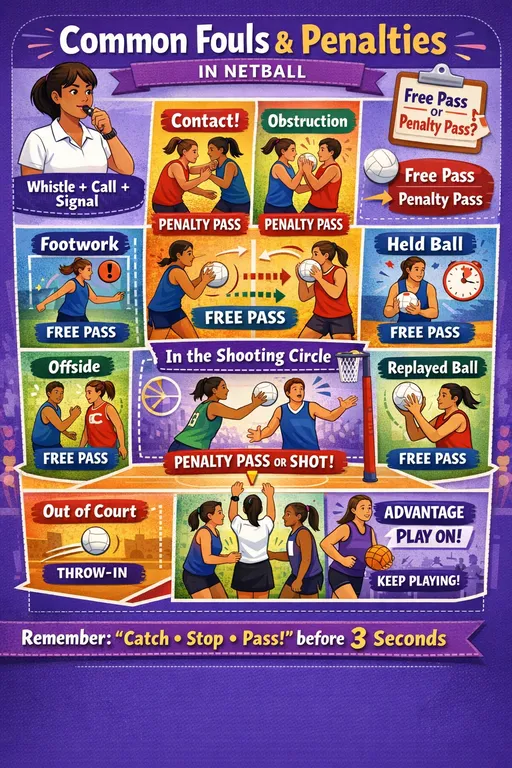
If you’ve ever watched netball and thought, “Why did the umpire stop play there?” you’re not alone. Netball is fast, but it’s also a rule-and-space sport. The court is divided into thirds, players have restricted areas, and the ball must move quickly by passing. That’s why fouls like footwork, obstruction, contact, held ball, offside, replayed ball, and over a third show up again and again.
This guide explains the most common netball fouls, what penalties are given (free pass vs penalty pass), why the rules exist, and what these calls look like in real match moments—so you can play smarter, coach better, or understand the game instantly.
Topics to be Explained
World Netball, netball rules, free pass, penalty pass, penalty pass or shot, obstruction (0.9m/3ft), contact, footwork, held ball (3 seconds), offside, replayed ball, over a third, short pass, toss up.
How penalties work in netball (Free Pass vs Penalty Pass)
Before you learn fouls, you must understand the two big penalties:
1) Free pass (usually for “general play” errors)
A free pass is commonly used for technical or general infringements (example: stepping/footwork, held ball, offside, replayed ball). The ball is given to the other team to restart play.
2) Penalty pass (usually for “major” infringements)
A penalty pass is a stronger sanction, used for major infringements like obstruction and contact. The key idea is: the infringing player must stand out of play, giving the attacking team an advantage.
Penalty pass or shot (inside the goal circle)
If a Goal Shooter (GS) or Goal Attack (GA) is awarded a penalty pass in the goal circle, they may choose to pass or shoot.
Why this exists: It stops defenders from “fouling on purpose” near the goal to break an easy scoring chance.
Also Read More About: Netball Positions and Their Roles Explained (GS, GA, WA, C, WD, GD, GK)
The most common netball fouls (with penalties + match scenarios)
Footwork (Landing / Stepping)
What it means ?
Footwork is called when a player moves illegally after catching the ball—like stepping, dragging, or re-grounding the wrong foot.
Why the rule exists (history + purpose)
Netball came from early women’s basketball-style rules that reduced continuous running with the ball and encouraged quick passing and controlled movement. The strict footwork rule supports netball’s identity: catch → stop → pivot → pass/shoot.
Common footwork situations (what umpires see)
- Catching while running and taking extra steps
- Jumping/landing poorly and then moving again
- Losing balance and “walking” with the ball
- Pivoting but lifting/re-grounding the landing foot incorrectly
Clarification you should know
World Netball clarified that a player in possession may not fall to the ground and re-ground the landing foot.
Penalty
Usually a free pass to the other team at the place of the infringement.
Match scenario
A Wing Attack (WA) receives a fast pass near the side line, catches while moving, then steps out trying to save the ball—footwork + turnover, and the other team gains possession near attack.
How to avoid it (quick coaching tips)
- Practice “catch, stop, balance” drills
- Land on one foot, keep it planted, and pivot cleanly
- Don’t panic near boundaries—set your feet first
Held Ball (3-second rule)
What it means
A player holding the ball must pass or shoot within 3 seconds. If not, the umpire calls held ball (a turnover).
Why this rule exists
It stops time-wasting and keeps netball fast and skill-based. Because netball does not use basketball-style dribbling to travel, the game must stay quick through passing and movement.
Match scenario
A Center (C) catches the ball, looks for options, but defenders block passing lanes. If the C hesitates too long—held ball—and the other team gets the free pass.
How to avoid it
- Decide your next pass before you catch
- Use quick pivots and “give-and-go” movement
- Keep passing options close (triangles)
Also Read More About: Scoring System in Netball 2026: How Goals Are Awarded
Offside (Entering a forbidden area)
What it means
In netball, each position has restricted areas. If a player enters an area they are not allowed to enter, it’s offside.
Why it exists (history + purpose)
Restricted zones were part of netball’s early development from women’s basketball-style rules, designed to create structure and reduce chaos. They also create clearer roles and tactical set play patterns.
Match scenario
A Goal Defense (GD) chases a pass too far and steps into the centre third when they’re not allowed—offside—free pass to the attack.
How to avoid it
- Learn your position areas like a map
- Train “stop at the transverse line” awareness
- Call teammates back if they drift
Obstruction (Defense distance / 0.9m rule)
What it means (easy)
Obstruction is when a defender is too close to the player with the ball and stops them from passing or shooting freely.
A common teaching point is 0.9m (3 feet) distance from the ball carrier’s landing foot when defending.
Why this rule exists
Netball is intended to be controlled and skillful, not a physical wrestling match. Obstruction protects:
- safe passing and shooting
- player safety (less collision)
- fairness (space to play)
What obstruction looks like in matches
- Defender jumps right in front of the thrower with arms up from too close
- Defender crowds a shooter inside the circle, preventing a clean shot
Penalty
Obstruction typically results in a penalty pass (major infringement), with the infringing player required to stand out of play.
How to avoid it
- Defend “from distance” and time your contest
- Keep your feet set and arms up without stepping into the space
- Work on reading passes for intercepts instead of crowding
Also Read More About: Footwork Rule in Netball Explained with Examples
Contact (Illegal physical contact)
What it means
Contact is called when a player makes illegal physical contact that affects an opponent—pushing, holding, bumping, or landing in their space.
Why it exists
Netball grew as a sport designed to limit heavy contact and keep play based on movement, timing, and passing. This rule supports safety and fair contesting.
Common contact situations
- Running into a player’s landing space
- Using body force to move an opponent out of the way
- Holding arms/jersey during a contest
Penalty
Usually a penalty pass for contact (major infringement).
Match scenario
A defender tries to block a circle feed, but crashes into the shooter’s landing space. Umpire calls contact, awards penalty pass close to goal—huge scoring chance.
How to avoid it
- Learn “shadow defense”: stay close but don’t collide
- Focus on footwork and angle, not body force
- Give the opponent space to land safely
Also Read More About: Netball Match Duration, Quarters & Timing Rules
Replay (Replayed Ball)
What it means
A player cannot regain the ball after they have already controlled it, except in specific legal situations (for example, if the ball is touched by another player). Replayed ball is a common cause of turnovers.
Why it exists
This rule prevents players from repeatedly dropping and regathering to waste time and protects clean play.
Match scenario
A player catches, bobbles, and catches again without another player touching it—replayed ball, free pass to the other team.
How to avoid it
- Catch strong: soft hands, elbows slightly bent
- Don’t “double catch” after full control
- Keep balance on the catch (footwork helps)
Over a Third (Skipping a third)
What it means
The ball must be touched or caught in each third. It cannot be thrown directly from the defensive third to the attacking third without being touched in the centre third.
Why it exists
This rule enforces the court structure (thirds) and keeps netball a passing-and-build sport instead of a long-bomb game.
Match scenario
A Goal Keeper (GK) intercepts and launches a long pass straight to the GS in the far circle. If nobody touches it in the centre third first—over a third—turnover.
How to avoid it
- Always find a centre-third link player (C/WA/WD) first
- Use one safe pass into centre third before switching long
Short Pass
What it means (simple)
A short pass is called when the pass is so close that there is no space for a third player to move between the thrower and receiver (often explained as “too close”).
Why it exists
It encourages proper passing technique and reduces collision risk.
Match scenario
Two players stand shoulder-to-shoulder and “hand” the ball in a tiny gap—umpire calls short pass—free pass to defense.
How to avoid it
- Step away to create a passing lane
- Use clean throwing form (not “hand-offs”)
Breaking (Centre pass infringement)
What it means
Breaking happens when a player enters a restricted area too early during a centre pass setup or violates centre pass procedures.
Why it exists
Centre passes restart play fairly and stop teams from gaining a head start.
Match scenario
As the whistle goes, a player runs into the centre circle early to grab the pass—breaking—free pass the other way.
How to avoid it
- Hold your position until the whistle and correct moment
- Practice centre pass timing patterns
Out of Bounds (Out of Court)
What it means
If the ball goes outside the side line/goal line, it is out of bounds, and play restarts with a throw-in.
Why it exists
Simple boundary rule—keeps play fair and controlled.
Match scenario (high pressure)
Late in a close game, a rushed pass near the side line can fly out. That becomes a turnover and can decide the match.
Simultaneous possession (Toss Up)
What it means
If two opponents gain equal possession at the same time, the umpire may call a toss up to restart fairly.
Why it exists
It’s the cleanest solution when neither team clearly controls the ball.
Mini Case Study: Pressure, penalties, and court structure (2010 Commonwealth Games Final)
In the 2010 Commonwealth Games netball final, New Zealand beat Australia 66–64 after double extra time—the match lasted 84 minutes.
Why this match is a perfect example for fouls/penalties under pressure:
- In long, tight matches, possession becomes priceless—one held ball, footwork, or offside call can swing momentum.
- Defenders hunt for intercepts, but must avoid contact and obstruction or they hand away penalty passes near the circle.
- RNZ’s recap highlights a late, high-pressure moment involving the ball going out and a desperate long pass strategy—exactly the kind of situation where turnovers/out-of-court decisions and clean third-by-third movement matter.
The lesson: at elite level, teams don’t just “play hard”—they play disciplined. Most match-winning moments come from forcing errors while staying legal.
Common “penalty moments” inside the shooting circle
Inside the circle, penalties are even more costly:
- A contact or obstruction call can become a penalty pass very close to goal.
- If GS/GA receives a penalty pass in the circle, they may shoot—so defenders must be extra careful.
Quick cheat sheet: foul → what you lose
- Footwork / Held ball / Offside / Over a third / Replayed / Short pass / Breaking → usually free pass (turnover)
- Obstruction / Contact (major) → usually penalty pass (bigger advantage for attack)
How umpires communicate (the simple system)
In netball, umpires usually do 3 things together:
- Whistle (to stop play)
- Call the infringement name (the “call words”)
- Show the hand signal (so everyone understands)
World Netball includes a full section called Umpire Hand Signals inside the official Rules Book.
The most common call words + what the umpire usually says
1) “Contact!”
When you hear it: illegal physical contact affects an opponent.
Umpire may also say:
- “Contact — (team color/name) ball”
- “Penalty pass” (if it’s a penalty)
What you’ll see: a contact hand signal (plus direction).
2) “Obstruction!”
When you hear it: defender is too close / blocks the ball carrier unfairly (often taught as the 0.9m / 3ft concept).
Umpire may also say:
- “Obstruction — penalty pass”
- “Stand out” (telling the infringing player to move out of play)
What you’ll see: the obstruction signal + direction.
3) “Footwork!” (also called stepping by many players)
When you hear it: illegal stepping / landing / pivot movement after a catch.
Umpire may also say:
- “Footwork — (team color) ball”
What you’ll see: footwork signal + direction.
4) “Held ball!” (or “3 seconds!” in some local games)
When you hear it: player holds the ball too long and doesn’t pass/shoot in time.
Umpire may also say:
- “Held ball — turnover”
- “(Team color) ball”
What you’ll see: held ball signal (often shown clearly for players).
5) “Offside!”
When you hear it: player enters an area of the court they are not allowed to enter.
Umpire may also say:
- “Offside — (team color) ball”
What you’ll see: World Netball groups offside under “incorrect position / incorrect use of court areas” in hand signals guidance.
6) “Over a third!”
When you hear it: ball is thrown from one third to the next without being touched/caught in the middle third.
Umpire may also say:
- “Over a third — free pass”
What you’ll see: also grouped under “incorrect position / incorrect use of court areas” signals.
7) “Replayed ball!”
When you hear it: player controls the ball and then regathers it illegally (common bobble mistake).
Umpire may also say:
- “Replayed ball — (team color) ball”
What you’ll see: replayed/incorrect playing of the ball signals are commonly trained together in umpire resources.
8) “Short pass!”
When you hear it: pass is too close (no room for a third player to move between).
Umpire may also say:
- “Short pass — free pass”
What you’ll see: short pass signal (trained as a common infringement).
9) “Out of court!” / “Out!”
When you hear it: ball goes out of bounds (side line / goal line).
Umpire may also say:
- “Out of court — throw in”
- then point direction for which team has the throw-in
What you’ll see: clear direction signal + out-of-court management.
10) “Throw-in!” / “Incorrect throw-in!”
When you hear it: restart from the side line, or throw-in rules were broken.
Umpire may also say:
- “Incorrect throw-in — (other team) throw in”
World Netball rule updates also mention throw-in clarifications and sanctions.
11) “Toss up!”
When you hear it: two opponents take equal possession at the same time, or another situation requires a fair restart.
Umpire may also say:
- “Toss up here” (while showing the mark)
What you’ll see: toss up signal + where it will be taken.
12) “Advantage!” / “Play on!”
When you hear it: an infringement happened, but the non-offending team is better off if play continues.
Umpire resources explain that advantage is part of good game management (not stopping play unnecessarily).
Extra “match management” call words you’ll hear
“Penalty pass!” / “Free pass!”
Umpires sometimes say this clearly so players know the type of restart (especially for newer teams).
“Stand out!”
Used after a penalty (like contact/obstruction) to tell the infringing player to move out of play and not interfere.
“Time!” / “Time on!”
Used to stop/restart the clock for injuries, blood, equipment, serious stoppages, etc. (Exact timing management differs by competition, but “time” calls are standard officiating language).
Quick memory trick (for players)
If you only remember one thing:
- Contact + Obstruction = usually Penalty pass (bigger punishment)
- Footwork + Held ball + Offside + Replayed + Short pass + Over a third = usually Free pass / turnover
Umpire Calls Cheat Sheet (Copy-Paste Friendly)
Use this during practice or while watching matches. It covers: call words, what it means, usual penalty, and quick fix. (Based on World Netball Rules + common umpire training wording.)
Quick rule to remember
- Contact + Obstruction → usually Penalty pass (bigger punishment)
- Most others → Free pass / Turnover
Cheat Sheet Table
| Umpire call words | What it means (simple) | Usual restart | Quick fix (1 line) |
|---|---|---|---|
| “Contact!” | Illegal body contact that affects opponent | Penalty pass | Defend with feet + angle, not bumping |
| “Obstruction!” | Too close / blocks throw or shot (defense distance issue) | Penalty pass | Step back, contest from legal distance |
| “Footwork!” | Illegal steps / landing / pivot after catching | Free pass | Catch → stop → balance → pivot cleanly |
| “Held ball!” (or “3 seconds!”) | Holding ball too long | Free pass | Decide pass early; move the ball fast |
| “Offside!” | Player enters a forbidden area/third | Free pass | Learn your zones; stop at transverse line |
| “Over a third!” | Ball skips the centre third (not touched there) | Free pass | Link through centre third before long pass |
| “Replayed ball!” | You controlled ball then regathered illegally | Free pass | Secure the catch—no double-catch after control |
| “Short pass!” | Pass too close (no space between players) | Free pass | Step away; create a clear passing lane |
| “Out of court!” / “Out!” | Ball went out of bounds | Throw-in | Use safer passes near the line |
| “Throw-in!” | Restart from sideline after out of bounds | Throw-in continues | Wait for whistle; keep foot correct/controlled |
| “Incorrect throw-in!” | Throw-in rules broken | Throw-in to other team | Check foot placement + release correctly |
| “Toss up!” | Equal possession / stuck ball situation | Toss-up restart | Avoid wrestling—release when tied |
| “Advantage!” / “Play on!” | Infringement happened but play continues | No stop | Keep playing—don’t freeze after whistle-less moment |
| “Penalty pass!” | Major infringement restart | Penalty pass | Offender must stand out |
| “Free pass!” | General infringement restart | Free pass | Reset quickly; defend the next pass |
Circle Cheat Add-On (Super Important)
Inside the shooting circle, penalties hurt more:
- Contact/Obstruction near a shot often gives a penalty pass close to goal (big scoring chance).
- If GS/GA gets a penalty in the circle, they can choose penalty pass or shot.
One-Line “Player Mindset” (Stops most turnovers)
Catch → Stop → Scan → Pivot → Pass (before 3 seconds
FAQs
1) What is the most common foul in netball?
For beginners, the most common are footwork and held ball (3 seconds) because players are still learning to stop, pivot, and pass quickly.
2) What is a penalty pass in netball?
A penalty pass is a major sanction (often for contact or obstruction) where the infringer stands out of play while the other team takes the pass.
3) Can you shoot from a penalty pass in the goal circle?
Yes—if GS or GA is awarded a penalty pass inside the goal circle, they may pass or shoot.
4) What is obstruction in netball?
Obstruction is when a defender is too close and prevents free play; a common teaching distance is 0.9m (3ft) from the landing foot.
5) What counts as contact in netball?
Illegal physical interference like pushing, holding, or landing in an opponent’s space can be called contact.
6) What is the 3-second rule?
A player in possession must pass or shoot within 3 seconds, or it becomes held ball and a turnover.
7) What is “over a third”?
The ball must be touched or caught in each third; you can’t throw directly from defensive to attacking third without a touch in centre third.
8) What is replayed ball?
Replayed ball happens when a player regains the ball after controlling it, without another player touching it (common bobble mistake).
9) What is a short pass?
A short pass is when the pass is too close—no space for a third player to move between thrower and receiver (often like a hand-off).
10) What is offside?
Offside is entering an area of the court your position is not allowed to enter (position restrictions).
11) What happens when the ball goes out of court?
Play restarts with a throw-in, and possession changes based on who last touched it.
12) Why are netball penalties so strict?
Because netball is designed to reward skill, space, and safe contesting—penalties protect fairness and player safety.
Conclusion
Netball fouls are not random—they are tied directly to the sport’s identity: fast passing, structured thirds, controlled movement, and legal defending distance. If you learn the core infringements (footwork, held ball, offside, replayed, over a third, obstruction, and contact), you’ll understand 90% of whistle calls and immediately cut your turnovers. The best teams win by protecting possession, creating clean circle entries, and forcing mistakes—without giving away easy penalty passes near goal.

I am a netball writer and match analyst who creates easy, practical guides for beginners and club players. I focuses on netball rules, court markings, and position-based strategy—explaining the “why” behind each rule with real match scenarios and clear examples. When not writing, I follow international netball events and breaks down game patterns like circle entries, intercept setups, and centre-pass plays to help readers understand netball faster.