
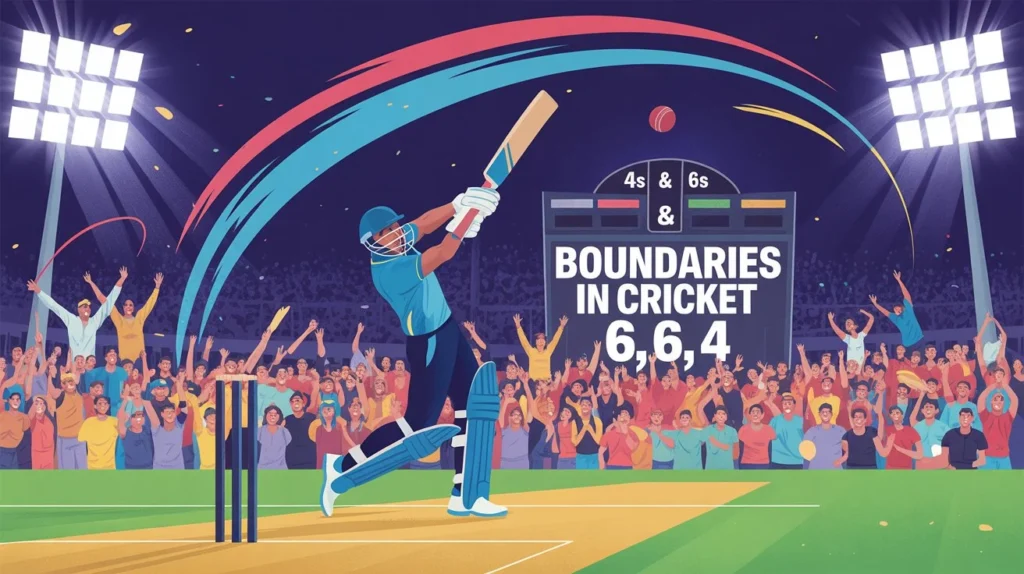
In cricket, the term boundaries plays a crucial role in scoring runs and shaping matches. Boundaries in cricket mean when the ball crosses the edge of the field after being hit by the batter, resulting in either four runs or six runs.
Fans love boundaries because they add excitement, turn games around, and showcase batting power and timing. Whether it’s the longest boundaries in cricket seen in international stadiums, or the shortest boundaries in cricket that allow quick scoring, boundaries remain one of the most thrilling elements of the game.
In this article, we’ll break down everything about what boundaries in cricket mean, their rules, differences between fours and sixes, records of the most boundaries in cricket history, and even modern concepts like digital boundaries in cricket. This guide is designed for cricket fans, learners, and players who want to understand the finer details of this exciting aspect of the sport.
What Are Boundaries in Cricket?
In simple terms, boundaries in cricket refer to the edge of the playing field. When a batter strikes the ball and it reaches or crosses this edge, it is called a boundary.
- 4 Runs (Four): When the ball touches or bounces before crossing the rope.
- 6 Runs (Six): When the ball clears the boundary rope in the air without touching the ground.
So, boundaries in cricket mean 4 or 6 runs depending on how the ball crosses the line. For example, 3 boundaries in cricket means the batter has hit either three fours, three sixes, or a mix of both.
Boundaries in Cricket Rules
The rules of boundaries in cricket are standardized by the ICC:
- If the ball hits the rope, it is considered a boundary.
- If the ball goes over the rope in the air → six runs.
- If the ball touches the ground before crossing → four runs.
- Fielders must stay inside the boundary rope while making a catch.
There’s often a question: What is the difference between fours and boundaries in cricket?
- A boundary is the general term for scoring runs by hitting the ball past the field line.
- A four is a specific type of boundary (ball bounces before crossing).
- A six is another type of boundary (ball clears without touching the ground).
🏏 Difference Between Boundaries and Fours
1. What is a Boundary?
In cricket, a boundary refers to any shot that reaches or crosses the edge of the playing field (the boundary rope or fence).
It’s a general term that covers both fours and sixes.
So, whenever the ball crosses the boundary line (whether it bounces or not), it’s called a boundary — but the number of runs depends on how it crossed.
2. What is a Four?
A four is a type of boundary.
If the batter hits the ball and it touches the ground before crossing the boundary line, it’s called a four.
✅ Example:
If a batsman drives the ball along the ground, and it rolls or bounces across the rope — that’s 4 runs automatically.
3. What About a Six?
A six is another type of boundary — but this time, the ball crosses the boundary without touching the ground.
✅ Example:
If a batter hits the ball high and it flies over the boundary rope directly, that’s 6 runs.
4. Summary Table
| Term | Description | Runs Awarded |
|---|---|---|
| Boundary | Any shot where the ball reaches or crosses the boundary line | 4 or 6 |
| Four | Ball touches the ground before crossing the boundary | 4 runs |
| Six | Ball crosses the boundary without touching the ground | 6 runs |
5. Easy Way to Remember
👉 All fours are boundaries,
but not all boundaries are fours — some are sixes!
Does the Distance From the Cricket Wicket to the Boundary Change Over Time?
Yes, the distance from the cricket wicket to the boundary has changed over time, and it can also vary from one ground to another. Cricket does not require a fixed boundary size for every stadium. Instead, the boundary distance depends on the shape, size, and design of the ground.
In the early days of cricket, many grounds were larger, and boundaries were usually farther from the pitch. This made scoring runs, especially sixes, more difficult. As the game evolved and shorter formats like One Day Internationals (ODIs) and T20 cricket became popular, many stadiums introduced shorter boundaries to make the game more exciting for players and spectators.
According to official cricket rules, there is a minimum and maximum allowed boundary distance. As long as a ground follows these limits, the boundary size is considered legal. This means the distance can change between different eras, countries, and even different stadiums within the same country.
Even today, boundary distances are not the same everywhere. Some grounds have longer straight boundaries and shorter square boundaries, while others are more evenly shaped. Weather conditions, pitch placement, and temporary boundary ropes can also affect the exact distance during a match.
Overall, changes in boundary distance are a normal part of cricket and are allowed within the rules. These variations add strategic depth to the game, influencing batting styles, bowling plans, and field placements.
How to Hit Boundaries in Cricket
Hitting boundaries requires a mix of power, timing, and technique. Here are some key tips for players:
- Footwork: Good balance and positioning help create clean shots.
- Shot selection: Play along the ground for safer fours; go aerial for sixes.
- Timing: A well-timed shot often travels faster than a hard swing.
- Power hitting: Use core strength and bat swing for maximum distance.
Professional batters practice hitting boundaries in both shorter and longer grounds, learning how to adapt based on pitch and field conditions.
Shortest and Longest Boundaries in Cricket
Boundaries aren’t the same in every stadium. Some grounds have short boundaries, making it easier to score sixes, while others are known for their longest boundaries, testing even the strongest hitters.
- Shortest Boundaries in Cricket: Eden Park in New Zealand has some of the smallest boundaries, often under 60 meters.
- Longest Boundaries in Cricket: The Melbourne Cricket Ground (MCG) in Australia is famous for its massive boundary size, often stretching beyond 85 meters.
This difference makes boundary-hitting strategies unique across countries and tournaments.
Records: Most Boundaries in Cricket History
Fans often ask, “Who has the most boundaries in cricket?” Let’s look at some highlights:
| Player | Format | Most Boundaries (4s + 6s) |
|---|---|---|
| Sachin Tendulkar | ODIs | 2,016 fours (record) |
| Rohit Sharma | ODIs + T20s | Sixes ODIs (344), T20s (205) Fours ODIs(383) T20s (1,045) |
| Chris Gayle | T20 | Most sixes in history (1056) |
| Virat Kohli | All formats | Consistent boundary scorer |
- Highest Boundaries in Cricket (Match): Martin Guptill, Rohit Sharma, and Chris Gayle have hit record numbers of boundaries in single innings.
- Most Boundaries in Cricket World Cups: Rohit Sharma holds the record for most fours and sixes combined in a single World Cup edition.
Digital Boundaries in Cricket
With technology entering sports, digital boundaries in cricket are becoming popular. These are LED-lit boundary ropes that glow when the ball touches them, making it easier for umpires and viewers to confirm fours and sixes.
So, if you’re wondering “What are digital boundaries in cricket?” — they’re simply high-tech versions of ropes used to ensure accurate decision-making.
Biggest Boundaries in Cricket
Some grounds are famous for their biggest boundaries, making six-hitting extremely challenging. Examples include:
- Melbourne Cricket Ground (MCG) – Over 85 meters.
- The Wanderers, South Africa – Known for its high-scoring games yet wide boundaries.
- Dubai International Stadium – Big boundaries balanced by flat pitches.
These large boundaries test a batter’s skill, strength, and patience.
Difference Between Four and Boundaries in Cricket
Many people confuse boundaries with fours. Let’s clear it:
- A four is always a boundary.
- A six is also a boundary.
- But boundaries is the umbrella term that includes both.
So, when someone says, “most boundaries in cricket history”, it includes both fours and sixes combined.
FAQs on Boundaries in Cricket
Q1. What is boundaries in cricket?
It refers to when the ball crosses the edge of the field, giving either four or six runs.
Q2. Boundaries in cricket means 4 or 6?
Yes, boundaries can mean either four or six depending on how the ball crosses the line.
Q3. What is the meaning of boundaries in cricket?
It’s the scoring rule where runs are awarded when the ball reaches or crosses the rope.
Q4. Who has hit the most boundaries in cricket history?
Sachin Tendulkar holds the record for the most fours, while Chris Gayle leads in sixes.
Q5. What is the difference between four and boundaries in cricket?
A four is a type of boundary; boundaries include both fours and sixes.
Conclusion
Boundaries in cricket are more than just scoring shots; they’re the heartbeat of the game. From the shortest boundaries that allow quick fireworks to the biggest boundaries that test raw hitting power, they define the thrill of batting. Records of the most boundaries in cricket history, modern innovations like digital boundaries, and legendary players who mastered the art all highlight why fans love them so much.
Whether you’re a beginner asking “What are boundaries in cricket?” or a fan tracking the highest boundaries in cricket, the concept remains one of the most exciting parts of the sport.

Isabella Brooks is a sports content writer with a strong interest in cricket rules and match regulations. She simplifies technical laws, umpiring decisions, and gameplay conditions into engaging explanations. Her writing helps casual fans follow matches with confidence and clarity.