
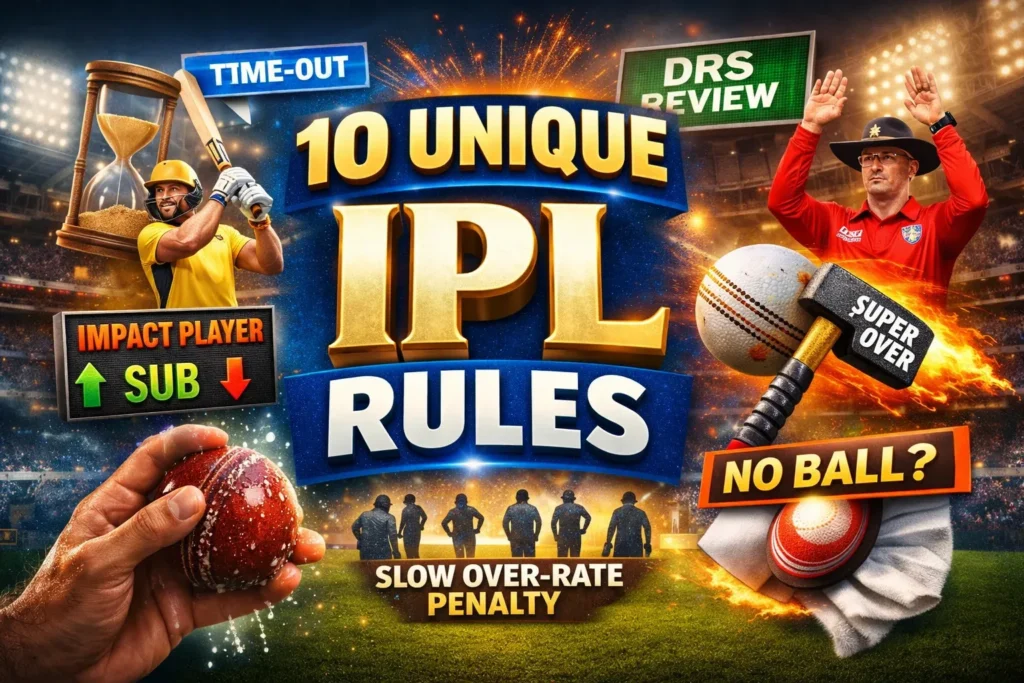
IPL feels different because it uses some special rules and rule tweaks that stand out from many other matches and leagues. These include the Impact Player rule, Strategic Time-Outs, a wet-ball replacement option after the 10th over in the second innings, wider DRS use for some wides and no-balls, and live slow over-rate fielding penalties.
The IPL is not just another T20 tournament. It follows the basic laws of cricket, but it also uses some special rules that make the game feel faster, smarter, and more dramatic. Some of these rules change tactics on the field. Others shape team selection, substitutes, or even how players enter the auction. Not every rule below belongs only to the IPL, but together they make the league feel very different from standard international T20 cricket.
That is why IPL matches often feel more like a mix of cricket, strategy, and entertainment. A captain is not only thinking about bowling changes and field settings. He is also thinking about time-outs, substitutions, dew, reviews, overseas-player limits, and over-rate penalties. These rules can change the flow of a match in a very big way.
Fast Facts Table
| Rule | What it means in simple words | Why it feels unique |
|---|---|---|
| Impact Player | A team can use one tactical substitute during the match | It lets teams change balance after the game starts |
| Strategic Time-Outs | Each innings has two short tactical breaks | Captains and coaches get time to reset plans |
| Wet-ball replacement | Bowling side in the second innings can ask for one ball change after the 10th over | It helps deal with dew in night matches |
| Saliva allowed again | Bowlers can use saliva to shine the ball in IPL | This moved away from the COVID-era ban |
| Wider DRS scope | Teams can review some wide-ball and height no-ball calls | It gives more technology-based checking |
| Slow over-rate field penalty | If a team is late, it can lose one outside-circle fielder at the end | The punishment affects live play, not just fines |
| 11 players + 5 substitutes named after toss | Captains submit XI and up to 5 substitute fielders after the toss | This gives more tactical planning room |
| Max 4 overseas on field | A team cannot have more than 4 overseas players on the field at one time | Team balance becomes a big puzzle |
| Repeat Super Overs | If one Super Over is tied, another is played until there is a winner | It creates high drama and a clear result |
| Match fee for each playing member | Every playing member, including the Impact Player, gets a match fee | It is a notable IPL player-regulation feature |
The table above is based on the official IPL 2026 Match Playing Conditions, the IPL 2025 captains’ meeting update, and the IPL Player Regulations 2025–27 announcement.
Royal Challengers Bengaluru IPL 2026 Full Schedule, Squad ,Ownership, Equity, Rivalries &History
1) The Impact Player rule
The most famous IPL rule is the Impact Player rule. The IPL Governing Council officially said that the Impact Player regulation would continue for the 2025 to 2027 cycle. This means the rule is not a short trial anymore. It is now a real part of how the IPL works.
In simple words, the Impact Player rule gives a team one extra tactical move during the match. A side can bring in a player to improve batting or bowling strength at the right time. That makes the game feel very different from normal T20 cricket, where teams usually begin with their best eleven and must live with that choice for the whole match except for regular substitutes or concussion replacements. The current ICC Men’s T20 World Cup 2026 playing conditions still use the standard model of 11 players plus up to 4 substitute fielders, not an IPL-style Impact Player system.
This is one reason the IPL feels more tactical than many other cricket matches. A team can bat first with extra batting depth and later bring in a specialist bowler. Or it can bowl first and then add a batter for the chase. That one move can completely change the shape of the match.
Also Read More About: Cricket Helmet Rules for Fielders and Wicketkeepers: Full Detailed Guide
2) Strategic Time-Outs
Here is everything about IPL Timeout Rules explained in simple, easy English! 🏏
⏱️ IPL Strategic Timeout Rules — Super Simple Guide
🔵 What is a Strategic Timeout?
A Strategic Timeout is basically a short break in the middle of the game. Players stop playing for a few minutes. The captain and coach talk about their plan. Then the game starts again!
Think of it like a “half-time talk” — but shorter and in the middle of an over break.
⏰ How Long is the Timeout?
Each timeout lasts 2 minutes and 30 seconds (2.5 minutes).
🔢 How Many Timeouts Does Each Team Get?
Each team gets 2 timeouts per innings — one for the bowling team and one for the batting team.
📍 When Can Each Team Take Their Timeout?
This is the most important part! Each team has a specific window:
| Team | When They Can Take Timeout |
|---|---|
| 🎳 Bowling Team | Between Overs 6 to 9 |
| 🏏 Batting Team | Between Overs 13 to 16 |
One timeout must be taken by the bowling team between the conclusion of the 6th and 9th overs, and the other by the batting team between the end of the 13th and 16th overs.
⚠️ What are the ipl time out rules? If a Team Forgets to Take Their Timeout?
If a team doesn’t take its timeout before the 16th over, it is automatically called by the umpire after that over.
So even if you forget — the umpire will force a timeout anyway!
🧠 What Happens During the Timeout?
During the timeout, coaches and analysts rush onto the field with tablets, sharing crucial data and strategic adjustments with the players.
Simple breakdown of what teams do:
- Captain talks to all players
- Coach gives new plan
- Data analysts show stats on tablets
- Team decides — bowl short? bowl full? attack? defend?
📺 Why Does IPL Even Have Timeouts?
Two reasons:
1. Cricket reason — Teams can regroup under pressure and discuss bowling or batting plans, breaking the opponent’s momentum.
2. Money reason — Franchise officials say the timeout is necessary from both the cricketing and financial perspective, because it provides a window to generate broadcast revenues that help the IPL survive.
😂 Funny Controversy About Timeouts!
In IPL 2025, Punjab Kings needed just 1 run to win from 4 overs — and the umpires still called a Strategic Timeout! Fans were shocked and confused. Former England captain Michael Vaughan also made fun of the IPL after a similar situation where a team needed only 2 runs from 24 balls and a timeout was still called.
This happens because the rules say the timeout MUST happen — even if it makes no sense at that moment! 😄
📝 Quick Summary Table
| Rule | Detail |
|---|---|
| Duration | 2.5 minutes each |
| Timeouts per innings | 2 (one per team) |
| Bowling team window | Overs 6 to 9 |
| Batting team window | Overs 13 to 16 |
| If team forgets | Umpire calls it automatically at over 9 or 16 |
| Who takes it | Captain decides (or umpire forces it) |
Also Read More About: Player Leaving the Field in Cricket: Full Rules for Injury, Substitutes, Return, and Penalty Time
3) The wet-ball replacement rule after the 10th over
One of the most practical IPL rules is the wet-ball replacement rule for evening games. The IPL 2026 Match Playing Conditions say that the team bowling second can request one ball change after the 10th over, and this applies only once in the second innings of evening games. The request must come after the end of an over, not during one, and the replacement ball must have similar wear and tear.
This rule matters because dew can make the ball wet and hard to control. A wet white ball can slip out of a bowler’s hand. Yorkers become harder to land. Spinners may lose grip. Slower balls may not come out right. In a night game, that can make life much easier for the batting side. The IPL rule tries to reduce that problem and make the contest fairer.
It is a very “IPL-style” rule because it is built around Indian evening conditions and the reality of high-scoring T20 cricket. The law does not remove dew from the game, but it gives the bowling side one official chance to fight back. In close matches, that one ball change can be very important.
Also Read More About: Minimum Players Needed to Start a Cricket Match: T20, ODI, and Test Rules in Simple English
4) Saliva is allowed again in the IPL
In March 2025, after the IPL captains’ meeting, the league officially announced that bowlers would once again be allowed to use saliva to shine the ball. The IPL said this followed consultation with all 10 teams and marked a return to traditional ball maintenance after the COVID-era ban was lifted.
This becomes even more interesting when you compare it with current international cricket. The ICC Men’s T20 World Cup 2026 playing conditions say that if umpires believe saliva has been applied to the ball, they must award 5 penalty runs to the opposing side and replace the ball, unless they believe the fielding side did it on purpose to get a replacement unfairly.
So the IPL has taken a different path from current ICC T20 rules. That makes this one of the clearest examples of the league doing something its own way. Fans may not notice it on every ball, but for bowlers this can matter a lot. In T20 cricket, even a little extra help with shine, control, or movement can change an over.
Also Read More About: What Is Impact Player in IPL? Rule and Role?(2026)
5) The IPL’s DRS is wider than standard T20 DRS
The IPL also uses a bigger version of the Decision Review System. The IPL 2026 Match Playing Conditions say that a player may review not only dismissal decisions, but also an on-field umpire decision about wide or no-ball. The same section also says that no other umpire decisions are eligible for a player review.
That is a major point because the current ICC Men’s T20 World Cup 2026 playing conditions do not give players that same wide-ball review option. ICC rules allow player reviews for dismissal decisions and related no-ball checks, but not for every kind of wide-ball call in the same way the IPL now does.
This matters because wide calls are very important in T20 cricket. A wide yorker that just misses the guideline can decide a game. A batter moving across the stumps can also confuse the decision. In the IPL, teams now have a better chance to challenge those moments. That makes the league more technology-heavy and more exact than many other T20 setups.
6) Slow over-rate brings a live fielding penalty
Most cricket fans know that slow over-rates can lead to fines. But in the IPL, the punishment can also hit the team during the match itself. The IPL 2026 Match Playing Conditions say that if the fielding side does not finish its overs by the scheduled or rescheduled end time, then from the start of the next over, and for the rest of the innings, no more than 4 fielders may stand outside the fielding restriction area. The same section notes that if the last over has already started, this in-game fielding penalty does not apply, although financial penalties still can.
This is a very big deal because in normal non-powerplay overs a fielding side may have up to 5 fielders outside the circle. In the IPL, if you are too slow, that number can drop from five to four at the worst possible time.
Think about the death overs. That is the time when captains most want boundary riders. If a team loses one of those deep fielders because of a slow over-rate, the batting side gets more open space and more scoring chances. So this is not just a discipline rule. It is a rule that can directly change the result of the match.
7) Team sheets are submitted after the toss, with 11 players plus 5 substitute fielders
The IPL 2026 Match Playing Conditions say that each captain shall nominate 11 players plus a maximum of 5 substitute fielders after the toss. The rules also say that, except in limited situations, no player in the playing eleven may be changed after nomination and before the start of play without the consent of the opposing captain.
This may sound small, but it makes the IPL more tactical. Teams can wait for the toss result, look at the surface, think about dew, and then lock in their plans. They also have a bigger bench of named substitutes ready for the match. That works especially well in a tournament where tactics, match-ups, and role changes matter so much.
Compared with standard ICC T20 conditions, this also looks different in detail. The ICC Men’s T20 World Cup 2026 rules say each captain nominates 11 players plus a maximum of 4 substitute fielders, and the team sheet is checked immediately prior to the toss. The IPL’s after-toss naming process, along with five substitutes, gives teams a little more flexibility.
8) A team can never have more than four overseas players on the field
The IPL’s overseas-player rule is one of the most important squad-balance rules in the league. The IPL 2026 Match Playing Conditions say that a team may not name more than 4 overseas players in its starting eleven, and it may not have more than 4 overseas players on the field of play at any time during a match. The same clause explains that if a team starts with four overseas players, an overseas substitute fielder can only replace another overseas player. If the team starts with fewer than four overseas players, an overseas substitute may come on only if the total still stays at four or fewer.
This rule shapes the IPL more than many casual fans realize. It affects auction planning, team balance, impact-player thinking, and even last-minute substitute decisions. A franchise may have five or six excellent foreign players in its squad, but only four can be on the field at once. That means teams are always chasing the best combination, not just the biggest names.
This is one of the reasons the IPL feels different from ordinary cricket conversations. In many matches outside franchise cricket, the question is simply, “Who are the best eleven?” In the IPL, a better question is often, “Which four overseas players fit this match best, and how do they fit with the Indian core?” That team-building puzzle is a huge part of the league’s identity.
9) If the Super Over is tied, the IPL keeps going until there is a winner
The IPL’s Super Over rules are very dramatic. The IPL 2026 Match Playing Conditions say that if a Super Over is tied, then subsequent Super Overs will be played until there is a winner. They also say that, in normal circumstances, the next Super Over begins 5 minutes after the previous one ends, the team batting second in the previous Super Over will bat first in the next one, and the same selected balls are reused by the same teams.
This means a tied match does not end with one extra over if the tie remains. The league keeps pushing until one side finally wins. That makes ties in the IPL feel bigger and more dramatic than in many ordinary cricket matches. The game becomes a series of mini-fights under extreme pressure.
There is also another tactical twist. The fielding side must bowl the next Super Over from the opposite end to the previous one. So even after a tie, teams cannot simply repeat everything exactly the same way. Pressure, angle, match-up, and player choice all change again. That is one reason IPL ties are so memorable.
10) A capped Indian player can become uncapped again
This is one of the strangest off-field IPL rules. In the IPL Governing Council’s 2025–27 player regulations announcement, the league said that a capped Indian player will become uncapped if, in the previous five calendar years, he has not played in the starting XI in international cricket or does not have a BCCI central contract. The same update says this applies only to Indian players.
That sounds unusual because in normal cricket talk, once a player becomes capped, he stays capped forever in people’s minds. But the IPL uses a more practical rule for auction and squad purposes. It looks at recent international status, not just old history. This affects how teams classify players and can change retention plans and squad value.
The same IPL regulations update also shows how different the league’s off-field system can be. It introduced a match fee of INR 7.5 lakhs per match for each playing member, including the Impact Player. It also said overseas players must register for the Big Auction or become ineligible for the following year’s auction, and a player who pulls out after being picked can be banned from the tournament and player auction for 2 seasons. These rules go beyond what happens on the pitch and show how tightly the IPL manages its player system.
Why these rules make the IPL feel different
The IPL feels different because it is built not only as a cricket tournament, but also as a high-speed franchise competition. That means the rules are designed to increase strategy, improve fairness in Indian conditions, sharpen television timing, and keep the match exciting from start to finish. Strategic Time-Outs help coaches and captains reset. The wet-ball rule responds to dew. The bigger DRS handles more tight calls. The over-rate rule punishes delay inside the game itself.
At the same time, the IPL still sits inside the wider world of T20 cricket, so the differences stand out more clearly when you compare them with current ICC men’s T20 rules. The ICC still uses the standard eleven-player system with up to four substitutes, does not allow saliva in the same way, and does not give the same player-review scope for wides that the IPL now uses. That contrast is one reason fans often say the IPL feels like its own cricket universe.
Final thoughts
If you want one simple answer, here it is: the IPL is different because it mixes cricket with tactics, technology, squad science, and event-style planning. That is why an IPL match is not just about bat versus ball. It is also about substitutions, time-outs, dew, reviews, overseas balance, over-rate pressure, and special player regulations.
That is what makes the league feel so fresh, and sometimes so strange. A normal T20 match may be decided by one over. An IPL match may be shaped by one review, one time-out, one overseas-player call, one Impact Player decision, or one slow over-rate mistake. That is why IPL rules themselves have become a big part of the show.
FAQs
1) What is the most unique rule in IPL?
The most talked-about unique IPL rule is the Impact Player rule, and the IPL Governing Council said it will continue through the 2025–2027 cycle.
2) What is the Impact Player rule in IPL?
It allows a team to use one tactical substitute during the match to improve batting or bowling balance.
3) How many substitute fielders can an IPL team name?
An IPL captain names 11 players plus a maximum of 5 substitute fielders after the toss.
4) Does IPL have Strategic Time-Outs?
Yes. Each innings has two Strategic Time-Outs, and each one lasts 2 minutes and 30 seconds.
5) What is the wet-ball rule in IPL?
In evening matches, the team bowling second can request one ball change after the 10th over, and the umpires must replace it with another ball of similar wear and tear.
6) Can bowlers use saliva in IPL?
Yes. From IPL 2025, bowlers were allowed again to use saliva to shine the ball.
7) Can teams review wides in IPL?
Yes. IPL expanded DRS to include wide-ball reviews outside the off stump and height-based no-ball reviews.
8) What happens if an IPL team bowls its overs too slowly?
A slow over-rate can lead to an in-match fielding penalty, where the team is limited to only 4 fielders outside the 30-yard circle for the rest of the innings after the penalty starts.
9) How many overseas players can be on the field in IPL?
A team may not have more than 4 overseas players on the field at any time during a match.
10) What happens if an IPL match is tied?
If the match is tied, a Super Over is played. If that Super Over is also tied, more Super Overs are played until there is a winner.
11) Does IPL give a match fee to players?
Yes. The IPL Player Regulations 2025–27 announcement said a match fee was introduced, and each playing member, including the Impact Player, gets INR 7.5 lakh per match in addition to the contracted amount.
12) Why does IPL feel different from other leagues?
IPL feels different because it mixes cricket rules with tactical breaks, squad-balance rules, technology-heavy reviews, and special match-condition tweaks like the wet-ball replacement and Impact Player system.

Liam Thompson is a cricket regulations analyst who covers international and league-level rules in depth. He focuses on fielding laws, over-rate penalties, powerplay strategies, and updated ICC guidelines. Liam’s goal is to educate readers while keeping the excitement of the game alive.